A landmark creative collaboration between Ryan Gosling and visionary directors Phil Lord and Chris Miller has successfully rewritten the rules of modern cinematic storytelling.
By fusing rigorous scientific inquiry with profound human vulnerability, the creative team proved that high-concept science fiction can achieve monumental narrative scale without diluting emotional warmth or intellectual integrity.
Through fearless narrative craft, technical discipline, and an unwavering respect for audience intelligence, this ambitious production established an enduring blueprint for high-budget filmmaking in an era dominated by superficial spectacles.
The production of ‘Project Hail Mary’ marked a definitive turning point for high-stakes Hollywood cinema.
When visionary filmmakers Phil Lord and Chris Miller joined forces with actor Ryan Gosling, the industry anticipated a distinctive collision of cinematic styles.
Lord and Miller had spent decades subverting Hollywood expectations with an unmatched blend of comedic pacing, visual boundary-pushing, and subversive storytelling.
Ryan Gosling had long earned his status as one of the finest dramatic actors of his generation, celebrated for introspective performances, charismatic restraint, and meticulous preparation.
Their partnership on Andy Weir’s celebrated space survival odyssey transformed an intricate scientific premise into an exhilarating cinematic triumph.
Instead of softening hard scientific principles for casual viewing, the filmmaking team chose to lean directly into scientific complexity.
Every narrative calculation, orbital trajectory, and biological problem was elevated into an engine of dramatic tension.
The resulting adaptation stands as an uncompromising testament to the power of intelligent blockbuster filmmaking.
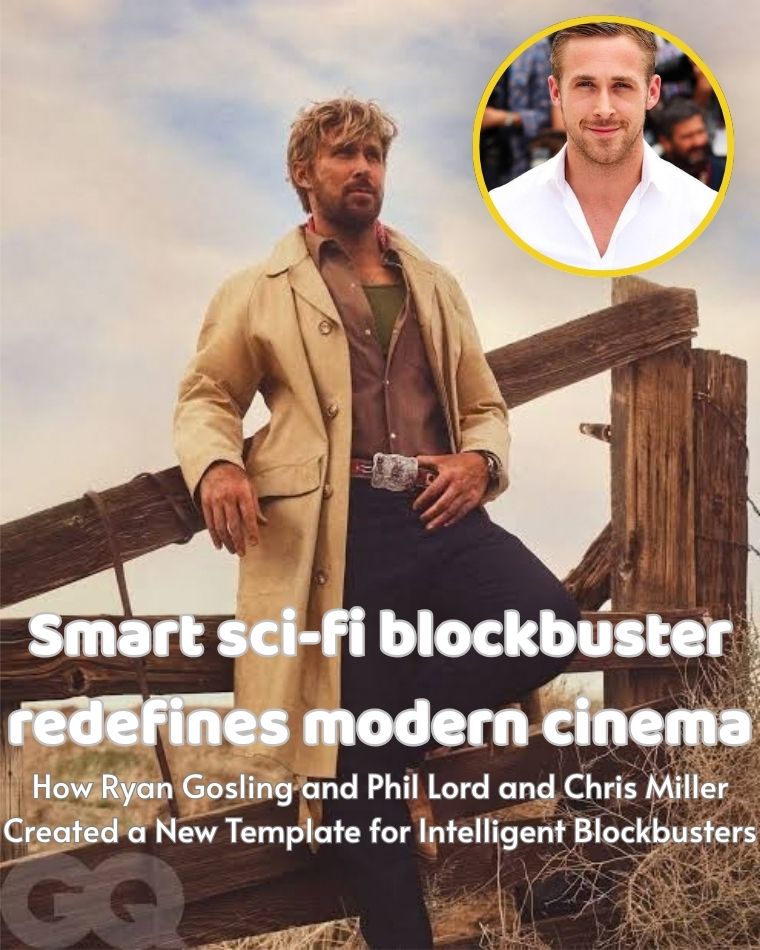
Cre: Wikimedia Commons — Gage Skidmore (CC BY-SA 2.0)
The Evolution of Phil Lord and Chris Miller’s Creative Philosophy
Throughout their celebrated careers, Phil Lord and Chris Miller have consistently championed narrative audacity.
The directing duo first rose to industry prominence by taking ideas that seemed unworkable on paper and transforming them into critical and creative masterpieces.
Whether translating an animated culinary catastrophe or revitalizing an iconic toy brand in ‘The Lego Movie’, their work proved that self-awareness and emotional sincerity can thrive within the same frame.
Their groundbreaking work behind ‘Spider-Man: Into the Spider-Verse’ pushed animation past traditional aesthetic boundaries and redefined visual syntax across global cinema.
What distinguishes Lord and Miller from their contemporaries is an abiding refusal to talk down to audiences of any age.
Their directorial philosophy insists that viewers possess the cultural literacy and emotional maturity to handle dense, rapidly evolving narratives.
They embrace kinetic pacing while leaving ample breathing room for poignant character development and genuine vulnerability.
When they set their sights on adapting ‘Project Hail Mary’, they recognized an opportunity to apply this philosophy to live-action science fiction on an unprecedented scale.
The material demanded an absolute mastery of visual rhythm, technical precision, and situational humor.
Rather than relying on familiar genre tropes, the filmmakers approached the adaptation with the curiosity of experimental craftspeople.
They dismantled the conventions of deep-space isolation films, replacing despair with proactive discovery and kinetic problem-solving.
Their creative vision required an anchor who could shoulder the weight of an intricate scientific mystery while keeping audiences emotionally invested.
In Ryan Gosling, Lord and Miller found a creative collaborator who shared their obsession with authenticity and craft.
Ryan Gosling as the Emotional and Scientific Anchor
Casting the central figure in an adaptation centered around severe isolation and complex scientific deduction presents enormous artistic risks.
The entire dramatic architecture rests squarely on a single performer’s ability to communicate complex internal deductions without losing cinematic magnetism.
Ryan Gosling brought a rare combination of grounded vulnerability and natural charisma to the role of Ryland Grace.
Gosling approached the character not as an invincible action hero, but as a relatable educator forced into terrifying cosmic circumstances.
His performance relied on an instinctive understanding of how real human beings react to existential dread and relentless cognitive pressure.
He meticulously balanced the quiet terror of deep space with the dry, observational humor necessary to maintain psychological equilibrium.
Rather than relying purely on external technical cues, Gosling internalized the mechanics of scientific methodology to make each breakthrough feel earned.
His acting technique transformed dry equations into thrilling physical discoveries.
He infused his character’s desperate problem-solving process with authentic physical exhaustion and intellectual delight.
Through subtle adjustments in posture, vocal cadences, and expressive micro-movements, Gosling rendered the immense stakes painfully tangible.
The directors placed immense faith in Gosling’s ability to guide the audience through difficult narrative terrain without relying on heavy-handed exposition.
In turn, Gosling placed complete trust in Lord and Miller’s visual architecture, knowing they would frame his performance within a dynamic, visually captivating world.
Balancing Hard Science and Unapologetic Emotional Depth
Science fiction films often struggle to maintain an effective equilibrium between technical veracity and narrative warmth.
Productions that lean excessively into dense calculations frequently risk alienating viewers with mechanical dialogue and sterile environments.
Conversely, films that prioritize emotional sentimentality at the expense of internal scientific consistency often lose dramatic credibility.
‘Project Hail Mary’ obliterated this conventional dilemma through rigorous storytelling discipline.
Lord, Miller, and Gosling established a storytelling environment where the scientific challenge and the emotional journey were indistinguishable.
Every physics problem encountered in the vacuum of space served as a direct manifestation of the protagonist’s fight for survival.
The process of scientific inquiry became the film’s emotional backbone, illustrating the resilience of the human mind under extreme duress.
The scientific accuracy of the production was not treated as background dressing or superficial prestige packaging.
Scientific rigor was woven directly into the structural DNA of every sequence.
When the narrative explored chemical anomalies, energy crises, and interstellar logistics, the filmmakers allowed the tension to emerge naturally from real-world physical laws.
The laws of thermodynamics, orbital mechanics, and cellular biology were treated as uncompromising antagonists and life-saving allies.
This fidelity to scientific principles granted every scene an intense, palpable weight.
Audiences were invited to think alongside the protagonist rather than passively observing spectacle.
This collective problem-solving dynamic created an electrifying bond between the screen and the viewer.
Visual Invention and the Deconstruction of Cinematic Isolation
Space travel narratives have historically leaned into oppressive shadows, stark monochromatic palettes, and crushing silence to convey cosmic dread.
While Lord and Miller honored the terrifying scale of the void, their visual style injected unprecedented vitality into the environment.
They designed the interior spaces of the mission to feel tactile, practical, and dynamically responsive to the protagonist’s evolving needs.
Every instrument panel, containment seal, and scientific workstation was crafted with tangible industrial authenticity.
The camera movements reflected the directors’ signature kinetic energy while maintaining strict spatial coherence.
Instead of static, detached wide shots, the visual language remained fluid, observant, and intimately connected to the character’s immediate tactile reality.
The lighting schemes actively mirrored the cognitive state of the protagonist, transitioning from sterile disorientation to purposeful focus.
The visual effects team avoided glossy, weightless digital illusions in favor of grounded, physical textures.
Microscopic biological phenomena were magnified into sweeping visual landscapes that felt alien yet biologically plausible.
The vastness of interstellar transit was visualized not merely as empty darkness, but as an active physical environment filled with lethal radiation and unmapped gravitational anomalies.
By reimagining the aesthetic of deep space, the production avoided the derivative visual language that has saturated modern science fiction.
The visual style honored the gravity of the subject matter while infusing it with exhilarating creative ambition.
The Intelligent Blockbuster: Defying Hollywood’s False Dichotomies
For decades, an unspoken consensus within major studio corridors suggested that blockbuster entertainment must sacrifice intellectual complexity to appeal to broad global demographics.
Conventional commercial wisdom often equated large production budgets with simplified narratives, accessible archetypes, and predictable plot formulas.
‘Project Hail Mary’ directly assaulted this prevailing assumption.
The creative coalition between Lord, Miller, and Gosling proved that audiences do not require condescension to remain thoroughly captivated.
Viewers across cultural demographics respond enthusiastically to narratives that challenge their deductive capabilities and demand attentive engagement.
An intelligent blockbuster does not mean an arid, academic lecture masquerading as a motion picture.
True cinematic intelligence resides in the elegance of dramatic exposition, the depth of character relationships, and the structural honesty of the storytelling.
By refusing to truncate scientific problem-solving into quick montage shortcuts, the filmmakers honored the audience’s capacity for sustained focus.
They demonstrated that the journey of deduction can generate just as much visceral excitement as an explosive kinetic sequence.
The film’s triumph challenged the risk-averse tendencies that have driven modern studio decision-making toward repetitive franchises and intellectual stagnation.
It demonstrated that investing in bold, complex original concepts remains a viable, highly sustainable artistic model.
When studios empower elite filmmakers to maintain creative integrity at a large scale, the entire cinematic medium benefits.
This production demonstrated that the intelligent blockbuster is not an anomaly, but a vital commercial format waiting to be reclaimed.
Sloan Science in Cinema Recognition and Academic Resonance
The artistic achievements of ‘Project Hail Mary’ were formally validated by prestigious institutions that champion the authentic intersection of art and science.
The film’s recognition through the prestigious Sloan Science in Cinema Prize reaffirmed its extraordinary success in bringing legitimate scientific thinking to the screen.
The Sloan Foundation has long maintained rigorous criteria for honoring cinematic works, demanding that honored films present science not merely as decorative set dressing, but as an indispensable narrative engine.
‘Project Hail Mary’ met and exceeded this high bar by demonstrating how scientific curiosity serves as an expression of humanity’s highest survival instincts.
Educators, scientific researchers, and cinema scholars praised the production for its refusal to invent convenient pseudoscientific solutions to genuine narrative crises.
The film meticulously portrayed the frustrations of failed experiments, the necessity of rigorous testing, and the patience required to verify empirical data.
It presented the scientific method as a thrilling act of creative deduction rather than an emotionless mechanical process.
By celebrating intellectual perseverance and scientific collaboration, the film resonated far beyond entertainment industry circles.
The collaboration became a point of reference for how cinema can inspire popular fascination with astronomy, biochemistry, and physics without sacrificing dramatic momentum.
It highlighted how cinematic art can ignite genuine public curiosity about the universe and humanity’s place within it.
The award affirmed that when filmmakers take science seriously, scientific authenticity returns the favor by elevating the dramatic stakes to unprecedented heights.
Redefining Industry Leadership and Curatorial Influence
The expanding impact of Phil Lord and Chris Miller’s creative vision has garnered widespread institutional reverence throughout the global cinematic landscape.
Their selection as AFI Fest guest directors served as definitive confirmation of their stature as central architects of contemporary filmmaking.
The American Film Institute’s recognition is reserved for creators whose work alters the cultural conversation and redefines the possibilities of cinematic expression.
As guest directors, Lord and Miller were given a major platform to articulate their expansive view of cinema’s evolving future.
Their curatorial choices reflected an enduring commitment to inventive storytelling, cross-genre experimentation, and bold authorial voices.
They used their cultural authority to champion films that bridge the divide between artistic ambition and mainstream accessibility.
Their career trajectory demonstrates that commercial success and artistic daring do not have to exist in perpetual conflict.
They have established a collaborative production culture where technical animators, screenwriters, actors, and digital artists work in reciprocal harmony.
Their leadership style emphasizes creative freedom, intense revision, and a willingness to dismantle working concepts until the best narrative solution emerges.
In Ryan Gosling, they found an actor whose own creative values matched this relentless quest for excellence.
Together, their collaborative dialogue influenced industry perceptions regarding how major productions should be developed and executed.
They established that the strongest directors are those who cultivate genuine partnerships with their cast and crew, treating every contributor as an essential partner in artistic discovery.
The Long-Term Impact on Future Ambitious Storytelling
The creative and critical footprints left by ‘Project Hail Mary’ will influence major cinematic development for years to come.
As the industry navigates profound technological transformations and shifting distribution channels, the demand for distinctive, singular storytelling has never been more urgent.
This collaboration established a compelling counter-narrative to algorithmic content production.
It proved that audiences hunger for cinematic experiences that feel authored, ambitious, and deeply human.
Future creators looking to adapt intricate literary works will point to Lord, Miller, and Gosling’s work as a foundational model.
They proved that faithful adaptation does not require timid literalism; it demands capturing the emotional spirit and intellectual courage of the source material.
They showed that character-driven narratives can command massive scales without collapsing under the weight of digital visual effects.
Moreover, the collaboration demonstrated that genuine humor and intellectual curiosity are essential ingredients in high-stakes dramatic narratives.
Human beings use humor, irony, and camaraderie to survive extreme trauma, and portraying those emotional realities on screen creates immediate viewer empathy.
The film’s legacy lies in its refusal to embrace creative cynicism.
It stands as an unapologetic celebration of human intelligence, mutual survival, and the endless pursuit of knowledge.
In an era often dominated by dystopian dread and formulaic entertainment, this partnership delivered a beacon of narrative optimism and artistic discipline.
The enduring success of the project reinforces the timeless truth that filmmaking at its finest is an act of courageous collaboration between visionary artists and an engaged, thoughtful audience.
Để lại một phản hồi