In Netflix’s 2023 animated musical comedy Leo, Adam Sandler delivers a voice performance that uncovers an unexpected reservoir of warmth, emotional vulnerability, and world-weary wisdom.
Playing a 74-year-old classroom tuatara confronting his own mortality, the actor navigates delicate themes of aging and mentorship with remarkable poise.
The film stands as a refreshing milestone in Sandler’s modern career, proving that thoughtful family storytelling can resonate just as deeply as his celebrated dramatic work.
A Classroom Reptile Facing the Final Stretch of Life
The story centers on Leo, a decades-long class pet dwelling inside a Florida elementary school terrarium.
For seventy-four years, Leo has observed generations of students pass through the fifth grade.
Alongside his terrarium companion, a cynical box turtle named Squirtle, Leo watches human childhood unfold from behind glass.
His comfortable routine shatters when he overhears a parent explain that tuataras live roughly seventy-five years.
Convinced he has only one year remaining before his journey ends, Leo experiences a sudden existential crisis.
He realizes that a lifetime confined to a small glass box has denied him a chance to experience the natural wilderness.
He develops an urgent desire to visit the Florida Everglades before his time expires.
Opportunity arrives when the school assigns a strict substitute teacher who insists that students take class pets home on weekends.
Leo plans to use these home visits as a gateway to make his grand escape.
Yet every escape attempt unravels when a student accidentally discovers his hidden ability to speak.
Instead of fleeing into the wild, the ancient reptile finds himself pulled into the complicated emotional lives of vulnerable children.
📸 [ẢNH: Loài bò sát tuatara ngoài đời thực tại New Zealand với vảy xám và đôi mắt cổ đại đặc trưng]
Link: https://upload.wikimedia.org/wikipedia/commons/5/52/Tuatara_Sphenodon_punctatus_standing_proud.jpg
Nguồn: Wikimedia Commons — Digitaltrails (Giấy phép CC BY-SA 3.0)
Stripping Away Physical Slapstick for Vocal Sincerity
Throughout his long comedy career, Adam Sandler has often depended on kinetic physical humor and oversized mannerisms.
In Leo, the computer-animated medium strips away physical comedy entirely.
Sandler is forced to rely solely on vocal delivery to establish emotional depth and believable connection.
Rather than adopting a jarring caricature, Sandler introduces a raspy, tender grandfatherly cadence.
The vocal texture sounds tired and raspy, yet it remains consistently approachable and empathetic.
Every sentence carries the slow, measured pace of an individual who has watched seven decades of schoolroom drama unfold.
Sandler captures the heaviness of old age without draining the character of vibrant humor.
When Leo speaks to a distressed child, his tone softens into intimate, genuine understanding.
The vocal modulation shows an actor fully aware of how small inflections can convey safety to a terrified youth.
Leo does not patronize the children, nor does he address them as miniature adults.
He communicates with an unvarnished honesty that cuts straight through childhood confusion.
Critics quickly noted that this performance ranks among Sandler’s most controlled vocal efforts.
The dry delivery grounds an absurd premise in tangible human tenderness.
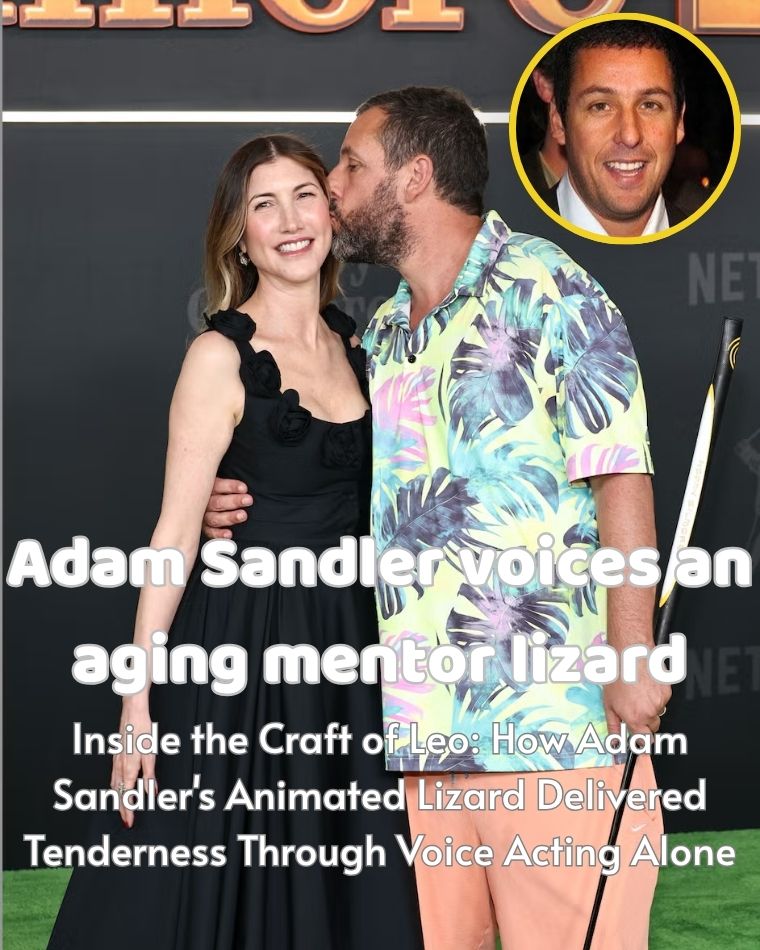
Cre: Wikimedia Commons — David Shankbone
The Deep Human Need for Listening and Mentorship
At the emotional core of Leo sits a timely examination of childhood vulnerability in an anxious modern society.
Each fifth-grader who brings Leo home wrestles with an unspoken personal insecurity.
One talkative girl speaks incessantly because she fears that pauses in speech make her unworthy of attention.
Another boy lives under the constant surveillance of an overprotective drone dispatched by anxious parents.
Other classmates suffer from social alienation, pressure to conform, or the pain of unresolved family loss.
The children’s parents frequently love them deeply but fail to grasp their genuine emotional needs.
Adults talk at the children or overcorrect them, leaving the young students feeling fundamentally unheard.
Leo steps into this communication vacuum with a radical yet simple posture: he listens patiently.
He lets the children speak until their frantic anxiety subsides.
Only after understanding their worries does Leo provide gentle, direct reality checks.
He explains to the talkative student that asking questions of others is the foundational secret to building true friendship.
He assures the sheltered boy that taking small risks is a natural part of growing up.
These small acts of kindness produce transformative breakthroughs for every single fifth-grader.
The reptilian hero proves that meaningful mentorship requires neither formal credentials nor complicated theories.
True mentorship demands sincere presence, active listening, and unconditional patience.
Echoes of Click and the Reckoning with Mortality
The existential foundation of Leo recalls one of Sandler’s most memorable thematic explorations: Frank Coraci’s 2006 fantasy comedy-drama Click.
In Click, Sandler played an overworked architect who used a magical remote control to fast-forward past the unpleasant moments of life.
That narrative concluded with a gut-wrenching awakening about missed family milestones, lost youth, and the terrible finality of passing time.
Where Click delivered its mortality lesson through frantic regret and high-stakes cinematic tears, Leo approaches similar territory with calm contemplation.
Leo does not possess an instrument to rewind time or alter his history.
He must accept that seventy-four years have quietly slipped past while he rested on a synthetic plastic rock.
His panic about a looming deadline mirrors the universal anxiety humans face when realizing their remaining days are finite.
However, Leo pivots away from despair and toward immediate purpose.
Instead of dwelling on lost decades, the aging tuatara discovers that even a single remaining season can hold profound purpose.
The film suggests that the value of an existence is not measured by geographical mileage or unchecked bucket lists.
Value resides in the positive impact left behind in the minds and hearts of other people.
By trading his dream of fleeing to the swamp for an opportunity to uplift struggling children, Leo discovers true freedom inside empathy.
A Tight Scripting Collaboration with Robert Smigel and Paul Sado
The narrative strength of Leo stems directly from the sharp script penned by Adam Sandler, Robert Smigel, and Paul Sado.
Smigel has served as Sandler’s key comedic collaborator since their legendary formative days on Saturday Night Live.
Their creative partnership produced satirical benchmarks such as You Don’t Mess with the Zohan and Hotel Transylvania.
Paul Sado has similarly worked alongside Sandler on numerous film productions, bringing a grounded storytelling rhythm.
In Leo, the writing trio crafts a distinct tonal harmony that refuses to treat younger audiences as intellectually fragile.
The humor features witty observational satire directed toward modern helicopter parenting and contemporary educational anxieties.
Yet the satire never descends into cynicism or bitterness.
The dialogue remains snappy, intelligent, and rich with multi-layered comedic beats.
Children enjoy the physical sight gags, while parents recognize acute observations about family dynamics.
The script balances the odd-couple comedic dynamic between Leo and Squirtle with genuine psychological clarity.
Squirtle represents the defensive, self-serving impulse that fears change.
Leo represents the compassionate impulse that risks discomfort to heal another being.
Smigel and Sado anchor this philosophical struggle in dialogue that feels crisp, truthful, and delightfully hilarious.
The Power of Melodic Storytelling in Animated Form
Adding to the film’s artistic charm are several original musical numbers woven seamlessly into the narrative progression.
Animated musicals often risk feeling calculated or intrusive when show tunes stop story momentum.
In Leo, however, the songs operate as functional comedic dialogues and emotional confessions.
Adam Sandler sings in character, embracing vocal imperfections rather than chasing technical bravura.
His raw vocal performance highlights vulnerability, making the character feel deeply authentic.
When Leo sings to a crying child about managing sorrow, the sequence provides both humor and practical comfort.
The songs do not attempt to mimic Broadway standards.
Instead, they sound like heartfelt pieces of improvised advice hummed by an affectionate relative.
The fifth-graders also contribute their own musical moments with unpolished, charming delivery.
This musical sincerity disarms audience cynicism.
The compositions reinforce the narrative’s recurring motif: honesty is far more precious than polished perfection.
Critical Acclaim and the Introspective Sandler Era
Upon its November 2023 debut on Netflix, Leo garnered enthusiastic praise from film critics and global viewers alike.
Reviews commended the production for balancing satirical comedy with emotional earnestness.
Many publications emphasized that Sandler’s ability to connect emotionally with audiences extends far beyond live-action drama.
The film performed exceptionally well on streaming metrics, proving that families were hungry for heartfelt character-driven storytelling.
This positive response reflects the wider evolution of Adam Sandler’s cinematic output over the past decade.
While the entertainer remains beloved for uninhibited comedies, his contemporary choices reflect a mature creative curiosity.
Works like The Meyerowitz Stories, Uncut Gems, and Hustle revealed an actor willing to explore complex psychological dimensions.
Leo functions as the family-friendly sibling to that dramatic evolution.
It provides an artistic space where Sandler can examine fatherhood, the inevitability of aging, and personal legacy.
He does not lecture his audience from an ivory tower.
Instead, he dons the scales of an old lizard to share hard-won wisdom about life’s essential virtues.
Why Leo Will Resonate for Generations of Viewers
Great family cinema rarely relies on complicated plots or relentless spectacle alone.
It endures because it touches upon fundamental truths that resonate across multiple age groups.
Children who watch Leo discover that they are not alone in facing anxiety, fear of failure, or social hesitation.
Adults who watch the movie receive a poignant reminder to slow down, put away distractions, and genuinely listen to their families.
Through seventy-four years of observing classrooms, Leo recognizes that childhood is brief and delicate.
He reminds us that human connection is built through small gestures rather than grand declarations.
Sandler’s soulful voice anchors that message with complete commitment.
The green tuatara never managed to reach his tranquil swamp paradise in the manner he initially envisioned.
Yet he secured something far more durable: a permanent home in the grateful hearts of students he guided toward maturity.
In portraying that transformation, Adam Sandler delivered one of the warmest animated performances of his entire career.
Để lại một phản hồi