Google has recruited Hollywood star and hardcore gaming icon Henry Cavill to champion its brand-new Googlebook laptop ecosystem.
Rather than fronting a generic promotional campaign, the British actor is actively developing a video game directly on the hardware to demonstrate its creative and gaming capabilities.
The high-profile initiative combines Cavill’s authentic gaming reputation with a cheeky nod to his iconic mustache, signaling Google’s determination to challenge premium Windows PCs and MacBooks.
Google has officially introduced a bold new chapter for its personal computing ambitions.
The tech giant unveiled its next-generation Googlebook laptop series with high-performance hardware and deep Gemini intelligence integration.
To lead the public introduction of this critical platform, the company turned to one of the most recognizable and respected figures in modern nerd culture: Henry Cavill.
The partnership represents a calculated pivot from standard celebrity brand endorsements.
Google is not merely putting the actor on billboards holding a lightweight notebook.
Instead, the company announced that Cavill will actively design and build a playable video game using the Googlebook itself.
Reports published by tech outlets 9to5Google and TweakTown confirm that this unconventional collaborative project is scheduled for a full public reveal in November 2026.
The campaign kicked off in late September 2026, coinciding with the opening of retail preorders for the initial Googlebook lineup.
Preorders for the fleet began on September 21, with five launch models starting at a baseline price of $899.
Google aims to capture a major share of both mainstream productivity users and performance-focused gaming enthusiasts with this rollout.
By tying the laptop’s debut to an authentic gaming icon, Google hopes to overcome historical skepticism surrounding non-traditional computing platforms.
The company is positioning Googlebook as a versatile workstation capable of managing intensive creative tasks, game development workflows, and high-end entertainment.
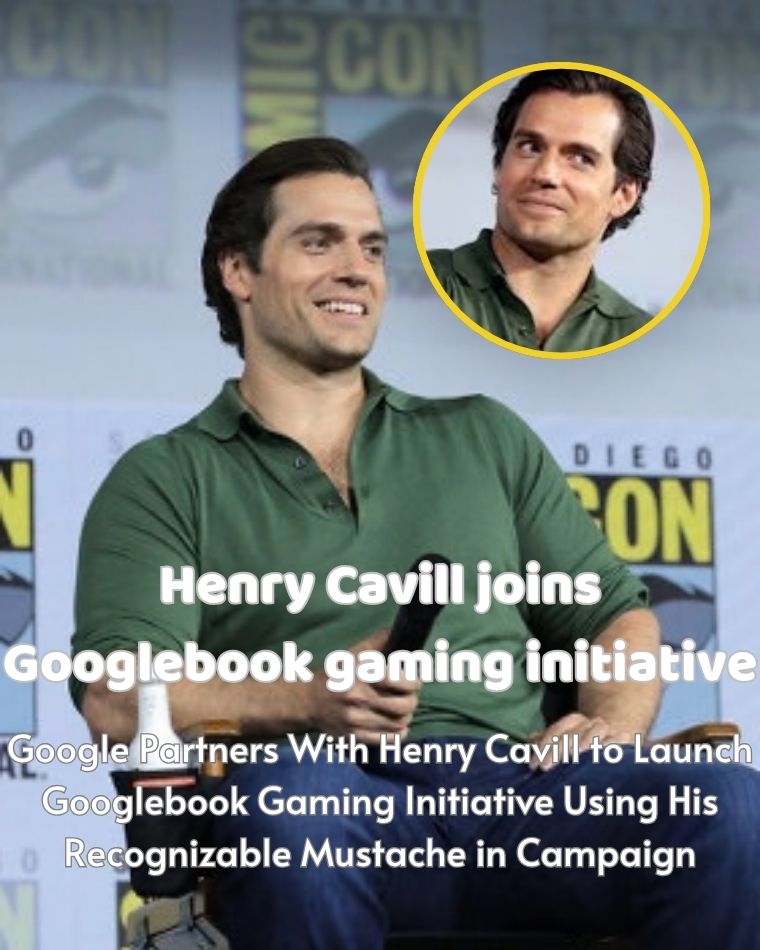
Cre: Wikimedia Commons — Gage Skidmore / CC BY-SA 2.0
The Mustache Callback and a Cheeky Marketing Angle
Central to Google’s initial teaser campaign is a playful visual focal point that pop culture followers know all too well: Henry Cavill’s facial hair.
The promotional video and associated marketing visuals spotlight Cavill sporting a distinguished mustache.
For millions of filmgoers and gamers worldwide, the actor’s mustache is an unforgettable cultural touchstone.
The visual recalls Cavill’s rugged styling during his tenure as Geralt of Rivia in Netflix’s fantasy adaptation The Witcher.
It also directly evokes the infamous pop-culture saga surrounding his appearance in Paramount’s Mission: Impossible – Fallout.
During that 2018 action production, Cavill grew a prominent mustache that contractually could not be shaved during concurrent reshoots for Warner Bros.’ Justice League.
The resulting digital removal of his mustache in post-production became one of the most widely discussed visual-effects memes of the modern cinematic era.
Google’s marketing team deliberately leaned into this piece of internet history rather than avoiding it.
By highlighting Cavill’s mustache with self-aware humor, Google immediately struck a playful chord across social channels.
Tech commentators noted that the decision made the initial teaser feel human, self-deprecating, and tailored for online audiences.
Traditional corporate computer advertisements often rely on sterile boardroom settings or glossy lifestyle montages.
Google, however, elected to engage tech enthusiasts through visual callbacks and internet literacy.
The tactic succeeded in generating immediate conversational momentum across platforms like Reddit and X.
Tech watchers quickly observed that Google was deliberately speaking the native language of the gaming community.
The mustache served as an irresistible visual hook that pulled attention directly toward the hardware underneath.
Authentic Gaming Credibility: Beyond Traditional Endorsements
The decision to enlist Cavill is rooted primarily in his hard-earned credibility within the global gaming community.
In an industry where celebrity endorsements often provoke eye-rolls, Cavill stands out as a genuine, hardcore enthusiast.
Gamers routinely view corporate tech sponsorships with intense skepticism when the hired spokesperson has no real connection to the product category.
Cavill represents the exact opposite of that tired marketing trope.
His dedication to video games and tabletop hobbies is documented extensively through years of candid interviews and viral social media posts.
One of the most famous anecdotes in modern gaming lore involves Cavill missing a phone call from director Zack Snyder.
That call was intended to offer Cavill the career-defining role of Clark Kent in Man of Steel.
Cavill famously admitted that he let the phone ring because he was in the middle of a high-stakes dungeon raid in Blizzard’s MMORPG World of Warcraft.
The actor has frequently recounted how he looked down, saw Snyder’s name on caller ID, and still finished his raid before returning the call.
That singular story cemented Cavill’s legendary status among PC gamers worldwide.
Furthermore, Cavill broke the internet during the 2020 lockdowns when he shared a self-recorded video assembling a custom gaming PC entirely from scratch.
Set to romantic mood music, the video showed Cavill meticulously installing the motherboard, routing cooling tubes, and testing GPU components.
Hardware enthusiasts celebrated the clip for showing genuine technical competency rather than a staged photo opportunity.
Beyond digital video games, Cavill is also world-renowned for his passion for Games Workshop’s dark tabletop universe, Warhammer 40,000.
He is known to spend hours personally painting miniature Adeptus Custodes figurines with obsessive attention to detail.
Cavill has frequently corrected interviewers on intricate tabletop lore and imperial hierarchy during mainstream press junkets.
He is currently executive producing and starring in an upcoming cinematic universe based on the Warhammer 40,000 franchise with Amazon Studios.
This uncompromising enthusiasm has earned him an unprecedented level of respect among gamers, tech geeks, and digital creators.
Google recognized that Cavill’s authentic voice could carry far more weight than any conventional advertising pitch.
When Cavill discusses computing performance, frame rates, and processing loads, his audience knows he is speaking from practical experience.
Google’s choice of spokesperson is thus built on trust, credibility, and cultural resonance.
Google’s Ambitious Strategy for Personal Computing Hardware
The partnership with Cavill arrives at a pivotal moment in Google’s long-term hardware evolution.
For more than a decade, Google addressed the laptop market primarily through ChromeOS and Chromebook hardware.
While Chromebooks captured enormous market share within educational sectors and light consumer browsing, they often struggled against heavy-duty competitors.
Power users, professional digital artists, and competitive gamers consistently bypassed the platform in favor of macOS or Windows.
With the launch of the Googlebook family, Google is executing an aggressive push upmarket into premium computing territory.
The new laptops are engineered with high-tier build materials, premium chassis designs, and enhanced processing capabilities.
The Googlebook lineup begins at an entry price of $899 across five distinct launch models, placing it squarely in competition with premium ultraportables.
Rather than relying purely on cloud compute, the Googlebook line is built around native performance, Android app continuity, and on-device Gemini intelligence.
Google’s broader goal is to convince consumers that a Googlebook can serve as a primary daily computer for demanding workloads.
Gaming is a cornerstone of this repositioning effort.
Modern consumers expect a premium laptop priced near $1,000 to handle entertainment and casual gaming alongside office tasks.
By demonstrating that a Googlebook can power game development and digital rendering, Google aims to dispel legacy perceptions of lightweight capability.
The hardware push also represents Google’s renewed dedication to the gaming sector after previous shifts in corporate focus.
Following the retirement of its Stadia cloud gaming service, industry analysts questioned whether Google remained committed to the gaming audience.
The Googlebook campaign answers that question with a resounding affirmative.
Instead of streaming games from remote servers, Google is showing that its new local hardware ecosystem has the muscle to handle intensive software creation.
Google’s hardware teams are determined to establish a credible foothold among mainstream PC consumers.
Partnering with an elite celebrity who happens to be a passionate PC builder sends an unmistakable signal to the market.
Hands-On Video Game Development: Beyond Passive Celebrity Promotion
The defining element of this campaign is Cavill’s active participation in building an actual video game on the Googlebook.
In typical celebrity marketing contracts, an actor appears in a short commercial, poses with the device, and posts a pre-approved message on social media.
Google and Cavill took a fundamentally different operational approach.
According to Google’s official announcements, the company sought someone capable of pushing the laptop’s creative boundaries to the limit.
Menaka Shroff, Vice President of Marketing for Google’s Global Android Ecosystem, emphasized the collaborative nature of the initiative.
Shroff noted that Google wanted to tap directly into Cavill’s “inner maker” by challenging him to create something concrete on the hardware.
Cavill himself indicated that he insisted on testing the device personally before agreeing to spearhead the campaign.
“Having worked with the device and spoken with the team, I can say that this has the potential to be the beginning of something special,” Cavill stated.
He remarked that modern computing and AI tools are evolving at dizzying speeds.
“Time and technology are racing forward at a breakneck pace, and in this, as well as in everything Google is trying to do with it, there is a sense of the next generation,” Cavill added.
The video game project will see Cavill collaborate with Google developers to conceptualize, design, and assemble a digital interactive title.
The actor is utilizing the Googlebook platform throughout the entire production pipeline.
The hardware is being put through its paces across demanding digital illustration, asset management, and code execution.
Google is also demonstrating how Gemini’s deep intelligence tools can streamline creative production for solo creators.
The platform provides intelligent context handling, advanced speech-to-text dictation, and seamless mobile integration with Android phones.
By applying these features to the grueling process of game creation, Google hopes to showcase real-world utility rather than theoretical benchmarks.
Specific details regarding the game’s exact genre, narrative theme, and gameplay mechanics remain tightly guarded secrets.
Neither Google nor Cavill has announced whether the project is an atmospheric role-playing game, an action title, or a puzzle adventure.
Gaming communities have naturally speculated whether Cavill’s love for dark sci-fi, fantasy, and tabletop lore might influence the game’s setting.
Tech outlet TweakTown reported that Google has not yet confirmed whether the final product will be fully playable by everyday users or presented as an interactive showcase.
Regardless of distribution specifics, the campaign provides an uncommonly rigorous proof of concept.
If a Googlebook can reliably support game creation workflows, it immediately validates the hardware for other digital creators.
Google has established a dedicated web portal to track behind-the-scenes milestones from the development journey.
Behind-the-scenes development logs and workflow previews are rolling out across official channels ahead of the November unveiling.
Launch Timeline and Community Reactions Across Tech and Gaming
The strategic rollout of the Cavill campaign was timed precisely to support the commercial introduction of the Googlebook hardware.
Google opened initial preorders for the five debut Googlebook models on September 21, 2026.
Retail availability across major electronics stores and carrier partners commenced shortly thereafter on October 4, 2026.
The Henry Cavill promotional phase was launched in the closing days of September to sustain public excitement through the opening sales window.
The culmination of the campaign will occur during November 2026, when Google and Cavill formally unveil the finished video game project.
The initial reception from technology and gaming communities has been notably upbeat.
Hardware forums and social media communities responded with immediate amusement and respect for the partnership.
Commentators on Reddit highlighted the rare authenticity of seeing Cavill attached to a technology device.
Many users pointed out that while most celebrity ambassadors clearly do not use the electronics they advertise, Cavill’s tech fluency is indisputable.
Tech journalists from 9to5Google, TweakTown, and Chrome Unboxed commended Google for understanding its target audience.
Writers noted that Google successfully transformed what could have been a dry enterprise laptop debut into an engaging cultural event.
Some industry analysts, however, maintain a cautious perspective regarding the hardware’s long-term competitive path.
Veteran PC reviewers emphasize that the $899-plus laptop bracket is one of the most fiercely contested segments in consumer electronics.
Competitors such as Apple’s MacBook Air and high-performance Windows ultraportables boast established software ecosystems and immense brand loyalty.
For Googlebook to succeed permanently, it must prove that its Android-based architecture can handle daily computing as smoothly as established desktop operating systems.
Reviewers are eager to analyze hands-on benchmarks to see how Googlebook’s cooling, battery endurance, and graphics processing hold up under sustained gaming workloads.
Nevertheless, marketing experts agree that Google’s opening gambit has accomplished its primary objective.
The campaign has successfully forced the gaming and tech communities to take Googlebook seriously from day one.
Instead of slipping unnoticed onto retail shelves, the new laptop lineup has captured worldwide headlines.
A Decisive Test for Google’s Computing Ecosystem
The coming weeks leading into November will prove decisive for Google’s new computing initiative.
As consumer units land in the hands of everyday buyers, real-world evaluations of the hardware will begin to pour in.
Meanwhile, the tech community will be watching closely to see what Cavill and Google deliver when the curtain rises on their collaborative video game.
If the project yields a compelling, functional experience, it will stand as one of the most innovative marketing demonstrations of recent memory.
Google will have proved that its laptops can serve as genuine engines of digital creativity.
Cavill, in turn, will add game developer to his already versatile résumé as actor, producer, and pop-culture maven.
Most importantly, the partnership demonstrates that tech giants must earn the trust of passionate user communities through authenticity rather than superficial glamour.
By respecting Henry Cavill’s genuine gaming roots—and having a little fun with his famous mustache along the way—Google has launched its Googlebook family with undeniable style.
Whether the Googlebook can establish itself as a permanent rival to established gaming laptops remains to be seen.
One thing, however, is already beyond doubt.
Google has made its opening move in the laptop gaming arena, and it has done so with the ultimate gamer at its side.
Để lại một phản hồi