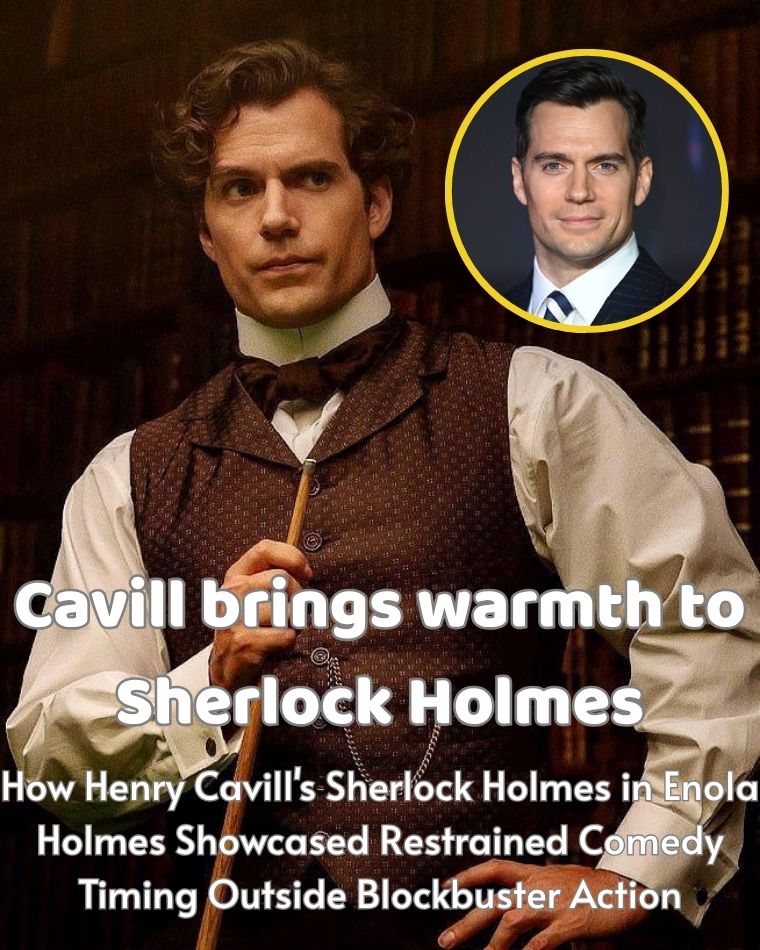
Henry Cavill delivered an unexpectedly tender and nuanced portrayal of Sherlock Holmes across two Netflix franchise installments. By setting aside conventional blockbuster dominance in favor of understated comedic timing, the actor revealed fresh artistic range. His protective sibling dynamic alongside Millie Bobby Brown effectively anchored the franchise in genuine emotional warmth.
Across literary and cinematic history, Sir Arthur Conan Doyle’s legendary consulting detective has frequently been depicted through eccentric brilliance, cold calculation, and hyperactive deduction.
From early cinematic interpretations to contemporary television adaptations, the iconic sleuth has rarely prioritized emotional openness.
When Henry Cavill stepped into the character for the Netflix feature adaptations, he initiated a deliberate shift away from established genre conventions.
The British actor approached the Victorian detective from an angle focused largely on domestic warmth, patience, and subdued comedic restraint.
Instead of dominating the screen through sheer eccentric energy or aggressive physical bravado, Cavill built an emotionally accessible older brother.
His performance established a grounded figure whose legendary intellect never completely overshadowed his familial loyalty.
Cre: Wikimedia Commons — Gage Skidmore, CC BY-SA 3.0 lmes from past historical iterations.
The Baker Street detective is often recognized as a detached intellect who treats interpersonal relationships with analytical indifference.
Earlier cinematic and television incarnations leaned heavily into manic deductive energy and rapid-fire dialogue.
Cavill took a distinctly alternative route by allowing silence, measured reactions, and quiet affection to lead the character.
Rather than portraying Sherlock as an isolated and antisocial thinker, Cavill presented an investigator who possesses genuine empathy.
He did not abandon the sharp intellectual awareness that defines the detective.
Instead, he recalibrated how that intelligence interacted with people he actually cared about.
The result was an older sibling who felt surprisingly approachable, thoughtful, and emotionally present.
The emotional core of both films ultimately relied on the natural dynamic between Cavill and Millie Bobby Brown.
Brown’s title heroine, Enola, brought relentless energy, fourth-wall breaks, and spirited rebellion to Victorian London.
Cavill’s supporting role required him to deliberately yield narrative space while maintaining a commanding presence.
Rather than competing with the protagonist’s vibrant delivery, he acted as a firm and reliable anchor.
Their interactions felt grounded because his Sherlock listened with genuine curiosity rather than condescension.
Even when offering critical deductive advice, his tone remained protective rather than dismissive.
This sibling balance gave the young detective an equal who treated her development with respect.
Over the course of two films, their relationship progressed from awkward distance to collaborative mutual respect.
In the first installment, Sherlock entered the story as an accomplished yet distant brother trying to navigate family responsibilities.
By the second film, he evolved into an appreciative partner who openly acknowledged his sister’s unique investigative talents.
Cavill conveyed this internal character growth with subtlety rather than sweeping dramatic declarations.
He let quiet looks of pride communicate the detective’s shifting perspective.
This evolution offered audiences a rare glimpse into a Holmes who was capable of learning from family.
Much of Cavill’s success in the role stemmed from his deliberate use of physical comedy and precise timing.
Having built a massive international reputation as a leading action hero, the actor is widely known for imposing physical presence.
Yet in these period adaptations, he directed that physical presence toward quiet, understated humor.
Many of his most memorable moments relied on nothing more than a raised eyebrow or a slight pause.
He often allowed Victorian propriety to constrain his movements, generating humor out of polite awkwardness.
When placed in disorderly environments, his character’s formal demeanor created natural, unforced comedic contrast.
One notable sequence in the second film found an intoxicated Sherlock leaning heavily on his sister as she guided him home through rainy London streets.
The scene inverted traditional action dynamics entirely by turning the towering detective into an unwieldy, vulnerable companion.
Cavill leaned into the awkward physical reality of the situation without sacrificing the character’s fundamental charm.
His slightly slurred cadence and relaxed posture offered a sharp departure from his usual disciplined hero roles.
Moments like this allowed the audience to see the human flaws behind the legendary intellect.
He never relied on exaggerated slapstick or loud punchlines to draw laughs.
Instead, the comedy arose from the stark gap between Victorian decorum and domestic chaos.
His detective frequently found himself slightly baffled by the untraditional manners of his rebellious sister.
Rather than responding with outrage, Cavill played those instances with deadpan confusion.
That restrained comedic timing elevated the source material and kept the tone charming throughout.
The Victorian setting played a crucial role in shaping Cavill’s artistic choices.
Victorian society was famously bound by rigorous social etiquette, emotional reserve, and formal expectations.
Cavill used those historical social boundaries to inform every gesture and vocal inflection.
His Sherlock stood upright with classical refinement, reflecting the rigid social environment of late nineteenth-century Britain.
Yet the performance subtly exposed how those societal standards could feel suffocating to a curious mind.
Cavill’s restraint felt completely authentic to the period while still speaking to contemporary viewers.
He wore tailored three-piece suits and long overcoats with natural, aristocratic ease.
His carriage conveyed an investigator who understood the rules of high society but chose to operate on its fringes.
This historical accuracy grounded the narrative whenever the storytelling drifted into lighter adventure.
By playing the period details straight, Cavill provided the film with an essential sense of reality.
The balance between historical stiffness and heartfelt warmth made his Sherlock feel three-dimensional.
He did not treat the Victorian aesthetic as mere costume, but as an essential element of his character’s psychological framework.
This specific project also served as a compelling demonstration of Cavill’s broad acting range.
Prior to these films, mainstream audiences recognized him primarily for intensely physical, heroic roles.
From comic-book icons to rugged fantasy warriors and stylish cinematic spies, his resume was defined by high-octane spectacle.
Those blockbuster productions rarely afforded him the space to explore delicate emotional nuance.
The role of Sherlock Holmes proved that his screen magnetism did not depend on choreographed action sequences.
He carried entire dialogues purely through verbal rhythm and thoughtful eye contact.
His work showed that an actor known for physical dominance could thrive in a conversational, character-driven period ensemble.
Industry observers frequently noted how his imposing physical stature actually heightened the gentleness of the performance.
A physically formidable actor playing an emotionally sensitive intellectual created an engaging subversion of expectations.
When a character with such commanding presence speaks with soft-spoken care, the gentleness resonates even more deeply.
Cavill embraced that dynamic, allowing his stature to reinforce the detective’s protective nature rather than his aggressiveness.
His Holmes was formidable not because he raised his voice, but because he observed every detail with quiet clarity.
This creative decision allowed him to fit seamlessly into an ensemble where another actor was the primary lead.
Stepping back into a supporting function requires significant discipline from a recognized Hollywood leading man.
Cavill handled that transition with total artistic commitment.
He never attempted to seize the central spotlight away from the title character.
Instead, he focused on providing the narrative support needed to make her journey shine.
Critical reaction to his non-traditional interpretation was widely positive across industry reviews.
Commentators consistently praised the refreshing nature of a warmer, less cynical Sherlock Holmes.
Audiences responded warmly to seeing literature’s most famous analytical mind display genuine family loyalty.
While traditional literary purists sometimes debate changes to the classic canon, many appreciated the creative freshness of the approach.
Cavill proved that beloved classic figures can be successfully reimagined without losing their essential identity.
His interpretation showed that empathy and intellect do not need to be mutually exclusive traits.
By finding humor in propriety and strength in emotional connection, he gave the iconic detective an enduring, contemporary resonance.
Ultimately, Henry Cavill’s contribution to the franchise remains a showcase of thoughtful artistic restraint.
He resisted the temptation to rely on familiar action tropes, delivering an authentic character study instead.
His collaborative partnership with Millie Bobby Brown elevated both installments into heartwarming, memorable cinematic adventures.
As the franchise continues to attract broad international streaming audiences, Cavill’s Sherlock stands out as a unique entry in the detective’s storied history.
It stands as clear evidence that disciplined restraint can create just as lasting an impression as cinematic spectacle.
Để lại một phản hồi