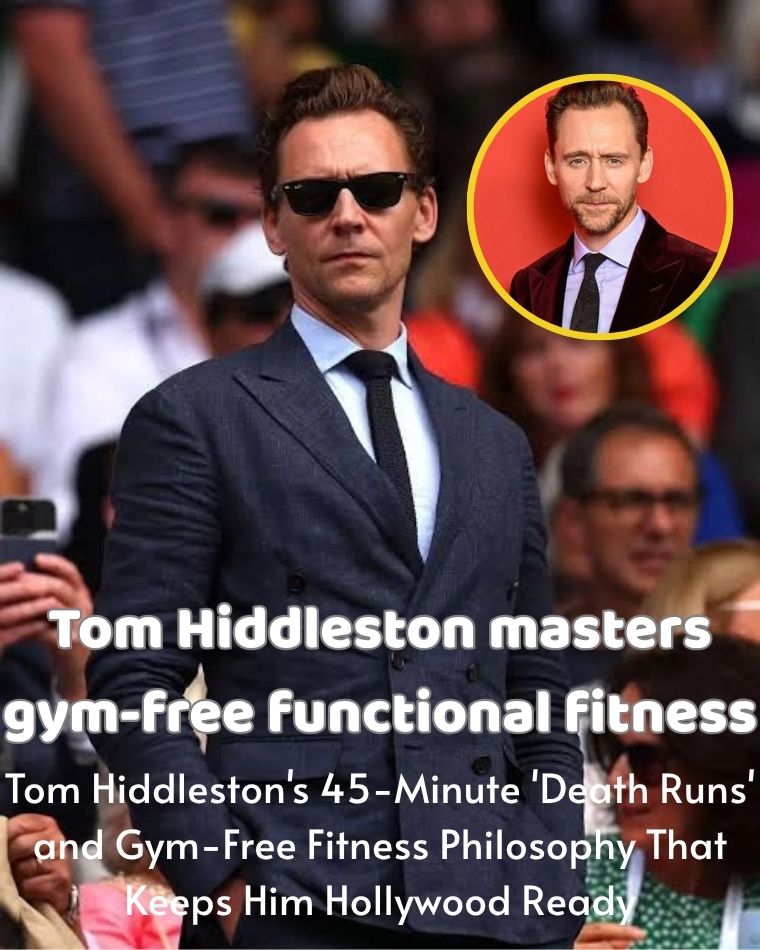
British actor Tom Hiddleston has forged one of Hollywood’s most durable physical transformations across two decades of high-intensity action cinema without relying on traditional weight rooms or complicated machinery. In a detailed interview with Men’s Health, the 45-year-old star revealed his remarkably stripped-back fitness doctrine, anchored by punishing 45-minute “death runs” and bodyweight calisthenics. From executing agile combat choreography as Loki to enduring the harsh mountain environment of Everest Base Camp for Tenzing, his athletic career proves that functional physical excellence requires little more than human willpower.
Cre: Wikimedia Commons — Gage Skidmore / CC BY-SA 2.0
Hollywood training culture has long been dominated by warehouse gyms, heavy barbell lifting, and grueling bodybuilding splits designed to maximize cosmetic muscle bulk.
Yet at 45 years of age, Tom Hiddleston stands as a prominent counter-example to modern exercise trends by deliberately choosing to bypass the conventional gym altogether.
Instead of lifting heavy iron plates or relying on specialized resistance equipment, the British screen star adheres to an intensely practical physical routine built around natural movement patterns.
His approach to longevity, mobility, and cardiovascular power has captured global interest among fitness enthusiasts seeking straightforward conditioning without the burden of equipment.
At the very core of this philosophy is an uncompromising training session that Hiddleston personally refers to as his “death runs.”
The Brutal Architecture of Tom Hiddleston’s 45-Minute “Death Runs”
The cornerstone of Hiddleston’s aerobic endurance is an unforgiving 45-minute training format designed to push the human cardiovascular engine to its absolute limits.
While conventional steady-state jogging focuses on maintaining a comfortable heart rate over extended distances, his signature session incorporates a brutal 5-kilometer shuttle sprint test paired with minimal recovery intervals.
The name “death run” was coined by Hiddleston himself to capture the sheer psychological and physical toll required to finish the high-intensity routine.
During these sessions, the runner repeatedly alternates between rapid accelerations and short recovery phases, never allowing the heart rate to drop back to baseline.
By stripping away lengthy pauses between sprints, the body is forced to operate under sustained oxygen debt.
This relentless conditioning sharpens the aerobic threshold while simultaneously developing explosive lower-body power and mental grit.
Hiddleston relies on these sessions not merely to burn calories, but to forge functional athletic conditioning capable of handling sustained physical stress.
The sustained pace replicates the stop-and-go demands of long filming days, where action sequences must be executed with full intensity across multiple takes.
For Hiddleston, the open pavement or trail serves as the ultimate laboratory for raw cardiovascular conditioning.
He treats each 45-minute workout as an exercise in mental resilience, training his mind to remain completely composed under intense physical fatigue.
The “You Just Need Your Body” Philosophy and Rejection of Gym Culture
In an industry where high-profile trainers often advocate complex machine setups and isolated weight lifting, Hiddleston’s philosophy stands out for its directness: “You just need your body.”
This perspective rejects the commercialized fitness belief that meaningful strength requires an active gym membership or heavy metal weights.
The actor contends that the human frame is an inherently complete training system capable of building exceptional functional capacity on its own.
Hiddleston argues that relying on fitness machines often restricts the body into rigid, unnatural planes of motion.
In contrast, bodyweight calisthenics requires the coordinated recruitment of multiple muscle groups alongside deep stabilizer activation.
By utilizing his own mass as resistance, he develops a type of physical balance and spatial awareness that static gym machines cannot easily replicate.
This minimalist framework allows him to maintain peak physical readiness regardless of where his filming commitments take him around the world.
Whether stationed inside a hotel room, a remote soundstage, or a foreign filming location, his entire training environment travels with him.
He eliminates the friction of scheduling gym sessions by transforming any available open space into an immediate training venue.
This liberating mindset removes excuses, ensuring consistent physical maintenance throughout unpredictable production schedules.
Over the years, Hiddleston has discovered that stripping away equipment also deepens bodily awareness and prevents common overuse injuries caused by heavy external loading.
His minimalist stance has proven to be an effective antidote to the burnout frequently experienced by individuals following rigid gym regimens.
Navigating Demanding Roles: From Marvel Stunts to Sir Edmund Hillary
Hiddleston’s athletic versatility has been tested across an extensive variety of screen roles spanning two decades.
Early in his career, preparing to enter the Marvel Cinematic Universe required a sudden and dramatic shift in physical scale.
When preparing for his initial screen work surrounding Thor, Hiddleston famously had to put on 9 kilograms of mass in just 6 weeks, an intense experience that fundamentally reshaped his relationship with physical discipline.
Yet as he settled into the long-term role of Loki, his physical focus shifted from heavy bulk to fluid athleticism, speed, and sustained stamina.
Playing the God of Mischief demanded acrobatic combat skills, rapid evasive maneuvers, and extended wire-work sequences.
Excessive bulk proved counterproductive for the lightning-quick stunt choreography required under heavy layers of leather and armor.
His transition back to functional running and bodyweight movement allowed him to perform intricate fight choreography take after take without joint pain.
The durability forged through running enabled him to withstand hours of physical performance without experiencing systemic exhaustion.
When cast as Sir Edmund Hillary in the Apple Original feature Tenzing, his athletic focus had to pivot toward mountain resilience and total systemic stamina.
Portraying the mountaineer who conquered the world’s highest peak alongside Tenzing Norgay required more than cinematic muscularity.
It demanded an authentic foundation of cardiovascular endurance, core balance, and relentless functional fitness.
Hiddleston’s background in endurance running provided the physiological framework required to step convincingly into Hillary’s historic boots.
The Specific Bodyweight Exercises Powering Hiddleston’s Total Fitness
Without barbells or plate-loaded systems, Hiddleston relies on a structured rotation of functional bodyweight exercises to build full-body resilience.
His routine focuses primarily on multi-joint compound movements that train the body to work as a unified unit.
Push-up variations form the core of his upper-body pressing strength, targeting the chest, shoulders, and triceps while maintaining core tension.
By varying hand placement from wide grips to diamond variations, he stimulates different muscular angles without changing equipment.
Pull-ups and chin-ups using available bars or outdoor beams provide the pulling power needed for stunt work and climbing preparation.
These vertical pulling movements develop latissimus dorsi strength, grip endurance, and scapular control crucial for acrobatic coordination.
For lower-body development, Hiddleston emphasizes bodyweight squats, walking lunges, and plyometric jump squats.
High-repetition bodyweight lunges mimic natural human locomotion while building stabilizing strength through the hips, knees, and ankles.
Core strength is developed through dynamic isometric holds, including extended forearm planks, side planks, and hollow-body holds.
Rather than performing standard crunches, he prioritizes exercises that train the abdominal wall to resist rotation and support spinal alignment under fatigue.
These bodyweight movements are frequently linked together into continuous circuit rounds with minimal pause.
By minimizing rest between exercises, Hiddleston transforms a bodyweight workout into an intense conditioning session that taxes both muscular endurance and aerobic capacity.
This approach preserves joint health while promoting functional mobility and lean athletic conditioning.
Real-World High-Altitude Preparation for Everest Base Camp
To accurately portray legendary mountaineer Sir Edmund Hillary in Tenzing, Hiddleston committed to real-world physical conditioning well beyond artificial sets.
Before filming began, he completed the grueling trek to Everest Base Camp in the Nepalese Himalayas.
Trekking to Base Camp exposed his body directly to high-altitude environments, steep technical ascents, and thin air.
This real-world experience demonstrated the distinction between aesthetic gym muscle and true functional endurance.
Hiddleston dedicated months to building “total fitness” through sustained long-distance trail running and intense outdoor conditioning sessions.
The steep ascents and rugged mountain trails demanded persistent calf stamina, ankle stability, and mental focus.
Every hour spent navigating high-altitude terrain reinforced the importance of sustained cardiovascular efficiency over short bursts of heavy power.
The high-altitude trek validated his philosophy of training for real-world utility rather than mirrored gym aesthetics.
By experiencing the physiological realities of the Himalayas, he internalized the grit that defined Hillary’s historic 1953 expedition.
The expedition cemented Hiddleston’s belief that real physical mastery is tested in nature rather than indoors.
The Evolution of Physical Resilience Across Two Decades of Screen Performance
Sustaining peak athletic conditioning at 45 years of age demands a mature understanding of physical recovery and training longevity.
Over a screen career spanning more than twenty years, Hiddleston has adjusted his approach to keep pace with changing physical realities.
In his earlier career, aggressive timelines and sudden body transformations placed substantial stress on his musculoskeletal system.
The 6-week rapid mass gain for Thor taught him that forced muscle gain can be mentally taxing and physically uncomfortable over long durations.
As he moved through his thirties and into his mid-forties, sustainable health replaced short-term bulk as his primary training priority.
He learned to listen closely to physiological biofeedback, recognizing when to push through a “death run” and when to allow the body to recover.
Endurance running became a regular mental release, offering clarity amidst chaotic international filming schedules.
The consistency of running alongside bodyweight calisthenics has kept his joints supple and free from chronic inflammation.
Rather than measuring fitness by the weight on a barbell, he measures success by mobility, energy levels, and athletic longevity.
His career demonstrates that intense physical roles can be sustained well into mid-life without relying on complex gym facilities.
By committing to functional movement, high-intensity running intervals, and bodyweight fundamentals, Tom Hiddleston offers a proven blueprint for lifelong fitness.
His journey confirms that with mental discipline and natural movement, the human body remains the ultimate training tool.
Để lại một phản hồi