Released in 2002, Punch-Drunk Love remains the definitive artistic turning point of Adam Sandler’s cinematic career. Directed by auteur filmmaker Paul Thomas Anderson, the indie masterpiece deconstructed the actor’s commercially dominant comedy persona to reveal unprecedented dramatic vulnerability and intense emotional turmoil. By introducing audiences to the fragile Barry Egan, Sandler demonstrated extraordinary dramatic range that forever transformed critical perceptions of his acting talent.
At the turn of the millennium, Adam Sandler stood unchallenged as the reigning king of mainstream American slapstick comedy.
His signature man-child rage and loud comedic set pieces had conquered multiplexes across the globe.
Yet underneath those broad comedic formulas lingered a persistent question about his true depth as an actor.
Audiences had grown intimately familiar with the explosive outbursts that fueled his blockbuster comedy hits.
Paul Thomas Anderson recognized something profoundly human and melancholic simmering behind those familiar explosive comic routines.
When the two men decided to collaborate, it caught the global film industry completely by surprise.
The resulting production dared to strip away every comfortable commercial crutch Sandler had relied upon for years.
In doing so, it exposed a fragile, raw, and deeply moving performance that remains a cinematic marvel.
An Unexpected Creative Union at the Height of Slapstick Dominance
By 2002, Adam Sandler was arguably the most bankable comedy star working in contemporary Hollywood cinema.
His box-office record commanded immense influence within major studios, yet he willingly risked that security.
Stepping into an independent production helmed by an art-house auteur seemed like a bewildering career move.
Anderson, meanwhile, had earned widespread critical acclaim for sprawling, ambitious ensemble dramas.
The director had long admired Sandler’s screen presence and openly admitted writing a screenplay specifically around him.
Sandler possessed an intrinsic vulnerability that Anderson felt had been consistently overshadowed by high-concept comedy gags.
Choosing to accept Anderson’s invitation meant venturing far outside the comforting confines of mainstream commercial comedy.
It required Sandler to abandon the safe formulas that had consistently guaranteed him immense international popularity.
Taking such a calculated creative gamble demonstrated an authentic hunger for artistic growth and reinvention.
The creative partnership was forged out of genuine mutual respect and a shared artistic curiosity.
Anderson sought to preserve the chaotic energy of Sandler’s persona while transmuting it into psychological realism.
The project promised to challenge audiences who had pigeonholed Sandler into one single comic archetype.
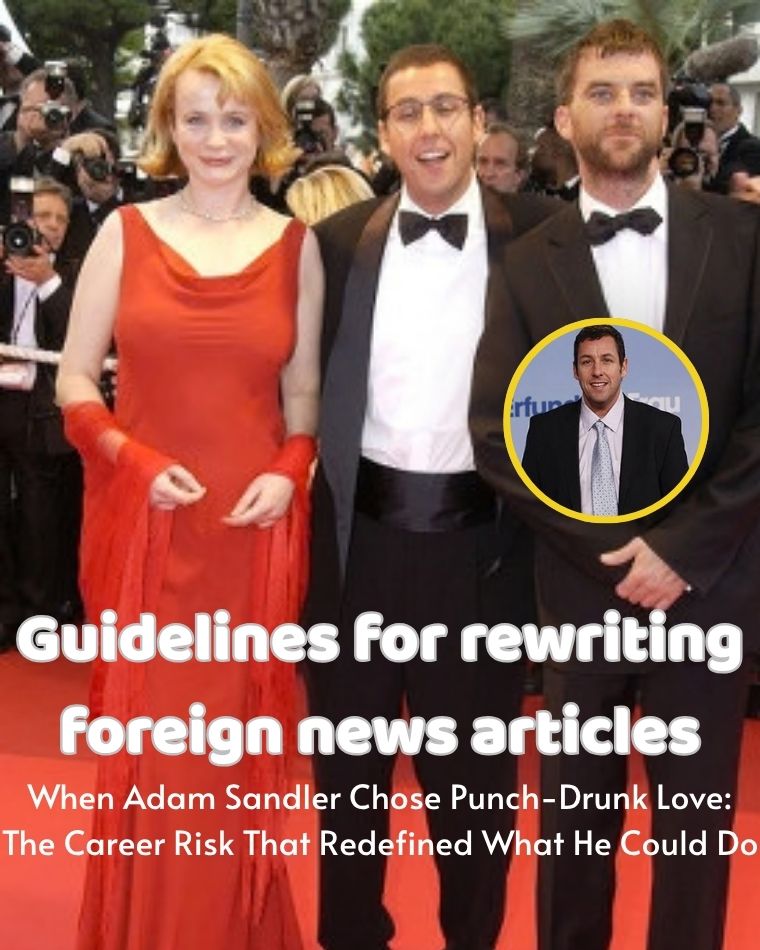
Cre: Wikimedia Commons — Rita Molnár, giấy phép Creative Commons Attribution-Share Alike (CC-BY-SA)
Understanding Barry Egan: An Anatomy of Social Alienation and Volatility
At the center of Punch-Drunk Love is Barry Egan, a deeply lonely and repressed novelty businessman.
Barry lives an agonizingly solitary existence, running an enterprise out of a stark, echoing warehouse.
He is smothered, mocked, and emotionally badgered by a relentlessly overwhelming gauntlet of seven overbearing sisters.
Their casual domestic cruelties have left Barry trapped in an excruciating cycle of extreme insecurity.
He struggles with paralyzing social awkwardness, finding even basic human conversations fraught with intense anxiety.
Beneath his timid, unassuming exterior lies an explosive volatility that bursts forth without warning.
When Barry becomes overwhelmed by emotional stress, he destroys walls, smashing fixtures in blind fury.
Unlike the comedic temper tantrums of Sandler’s earlier films, these outbursts are horrifyingly tragic and painful.
Sandler deliberately plays Barry’s inner life with remarkable physical economy and haunting emotional restraint.
His hunched posture and hesitant vocal cadences emphasize Barry’s perpetual feeling of physical unworthiness.
He wanders through life wearing an unmistakable electric-blue suit that visually amplifies his utter alienation.
The blue suit acts as both an armor against the external world and a glaring marker of otherness.
Barry yearns desperately for meaningful human warmth while terrified of the exposure intimacy demands.
His quiet desperation reaches a heartbreaking peak when he dials a phone-sex line simply to talk.
That impulsive search for simple companionship ultimately embroils him in a dangerous extortion nightmare.
Yet Barry’s persistent search for connection reveals a deeply empathetic soul searching for genuine redemption.
Paul Thomas Anderson’s Distinctive Directing Approach
Paul Thomas Anderson approached the production with an exacting, sensory-driven directorial philosophy.
Rather than treating the movie as a traditional romantic comedy, Anderson orchestrated a psychological symphony.
He used disorienting soundscapes and abrupt tonal shifts to place viewers directly inside Barry’s turbulent mind.
Composer Jon Brion supplied a percussive, anxiety-inducing musical score that mirrored Barry’s internal panic.
Anderson frequently trapped Sandler in long, uninterrupted tracking shots that left no room for performance tricks.
These prolonged visual takes forced Sandler to exist fully in the terrifying silence of his character.
The camera tracked Barry’s anxious pacing with an intimate, unblinking cinematic scrutiny.
Anderson utilized vibrant, saturated colors and surreal visual interludes created with artist Jeremy Blake.
Sudden lens flares and bursts of abstract light repeatedly pierce the melancholy aesthetic of Barry’s world.
An inexplicable harmonium mysteriously abandoned on a curb becomes an evocative symbol of Barry’s longing.
Anderson encouraged Sandler to dial back his broad theatricality in favor of micro-expressions and silence.
Whenever Barry smiles, it feels like a monumental personal triumph carved out of persistent agony.
The director understood that Sandler’s greatest dramatic asset was his innate, wounded sincerity.
By stripping away the laugh tracks and comedic beats, Anderson uncovered pure emotional resonance.
The filmmaking refused to sentimentalize Barry’s mental distress, treating his loneliness with absolute gravity.
This immersive directorial style provided the safe artistic scaffold Sandler required to perform without fear.
Performance Nuance: Breaking Away from the Conventional Comedy Blueprint
What makes Sandler’s work in Punch-Drunk Love extraordinary is its calculated subversion of his persona.
In standard comedy vehicles, anger served as the hilarious punchline to every escalating conflict.
Here, that exact same fury is diagnosed as the debilitating symptom of acute emotional trauma.
Sandler does not play Barry Egan for cheap laughs, nor does he beg the audience for pity.
He inhabits the role with an unflinching honesty that makes Barry’s distress palpably uncomfortable.
His eyes dart around rooms with agonizing vigilance, expecting ridicule or emotional violence at every turn.
Watch how Barry interacts with his warehouse employee Lance, played with deadpan perfection by Luis Guzmán.
Barry tries desperately to project commercial authority while visibly trembling under everyday pressure.
Even Barry’s ingenious exploitation of a grocery pudding promotion to accumulate frequent flyer miles feels poignant.
The scheme is not presented as a madcap comedic scam, but as a hyper-focused emotional coping mechanism.
Sandler conveys the meticulous determination of a desperate man trying to bring order to chaos.
His confrontational sequences showcase a terrifying transformation from passive victim to fierce defender.
When Barry faces off against predatory criminals, Sandler unleashes a frighteningly raw primal energy.
Yet that aggression is never celebrated as cartoon machismo; it is the desperate survival response of a broken man.
The physical nuances of his performance proved that Sandler could hold a dramatic frame with immense power.
He demonstrated an astonishing ability to evoke intense empathy through quiet, understated character beats.
The Chemistry with Emily Watson: An Anchor of Unconditional Grace
The emotional core that anchors Punch-Drunk Love is the transcendent relationship between Barry and Lena.
British actress Emily Watson portrays Lena Leonard with radiant gentleness, patience, and resolute grace.
Lena enters Barry’s discombobulated existence like an unexpected ray of pure, unconditional light.
She sees past Barry’s social awkwardness, recognizing the innate goodness buried underneath his armor.
Watson’s tender, grounded performance provides the perfect emotional ballast to Sandler’s nervous volatility.
She does not recoil when Barry displays odd behavior or reveals glimpses of his overwhelming anxiety.
Instead, Lena meets Barry’s chaotic emotional turbulence with steady, luminous affection.
Their romantic courtship defies every clichéd convention of standard Hollywood romantic comedies.
Their conversations unfold with idiosyncratic rhythms, filled with nervous pauses and unexpected confessions.
A memorable intimate exchange where they express affection through playful, aggressive dialogue captures their unique bond.
Sandler allows Barry to soften in Lena’s presence, creating moments of quiet emotional beauty.
When Barry journeys all the way to Hawaii to surprise her, the film transforms into pure lyrical romance.
Framed in silhouette against soft pastel backgrounds, their embrace represents Barry’s hard-won salvation.
Watson’s presence challenged Sandler to elevate his emotional authenticity to match her world-class standard.
Their chemistry proves that Barry’s emotional redemption is earned through genuine reciprocal connection.
Love becomes the stabilizing force that finally allows Barry to channel his chaotic energy constructively.
The Philip Seymour Hoffman Clash and High-Stakes Dramatic Confrontation
A crucial test of Sandler’s dramatic credibility comes during his intense collision with Dean Trumbell.
Played with blistering ferocity by the late Philip Seymour Hoffman, Dean is a ruthless mattress store owner.
Dean operates the fraudulent phone-sex racket that attempts to extort money from Barry.
The escalating telephone screaming matches between Sandler and Hoffman are masterclasses in comedic-dramatic tension.
Hoffman delivers blistering intimidation, yet Sandler refuses to shrink into comedic subservience.
Barry’s righteous fury rises to match Dean’s threats, generating unforgettable dramatic electricity.
Their eventual face-to-face confrontation in Utah cements Barry’s profound psychological transformation.
Barry walks directly into Dean’s furniture store, refusing to remain a frightened, submissive target.
In an iconic declaration, Barry announces that the love he has found makes him invincibly strong.
Sandler delivers this climactic confrontation with absolute moral clarity, intense gravitas, and quiet force.
Going toe-to-toe with one of the greatest character actors in cinema history was a daunting challenge.
Yet Sandler more than matched Hoffman’s fierce intensity, anchoring the scene with commanding conviction.
The confrontation proves that Barry has finally reclaimed his personal agency and self-respect.
It provides a visceral dramatic catharsis that elevates the film beyond a simple romance.
Sandler proved conclusively that he possessed the dramatic weight necessary to command serious cinematic narratives.
Critical Acclaim at Cannes and Shifting Industry Perceptions
When Punch-Drunk Love debuted in competition at the 2002 Cannes Film Festival, it stunned critics.
The international festival circuit was an unfamiliar arena for an actor associated with gross-out comedy.
Paul Thomas Anderson earned the prestigious Best Director prize at Cannes for his visionary execution.
More importantly, international film critics showered Adam Sandler with widespread, enthusiastic praise.
Reviewers marveled at how effectively Anderson had unlocked the pathos latent in Sandler’s screen persona.
Many critics hailed the performance as a revelation, noting its delicate balance of tragedy and sweet innocence.
The performance earned Sandler a Golden Globe nomination for Best Actor in a Motion Picture – Musical or Comedy.
While some diehard comedy fans were perplexed by the film’s unconventional rhythms, cinephiles embraced it deeply.
The critical response fundamentally altered the entertainment industry’s evaluation of Sandler’s capabilities.
He was no longer regarded solely as a commercial box-office brand churning out seasonal comedies.
Instead, Punch-Drunk Love permanently cemented Sandler’s status as a formidable dramatic talent.
The film validated that mainstream comedy stars often possess untapped reservoirs of profound dramatic depth.
It proved that under the guidance of uncompromising visionary directors, popular entertainers can create true cinematic art.
The Enduring Legacy: Paving the Way for Uncut Gems and Beyond
The artistic triumph of Punch-Drunk Love created a profound blueprint for the rest of Sandler’s career.
Without Barry Egan, it is impossible to imagine Sandler taking on the challenging dramatic roles that followed.
The film unlocked creative courage that later bore fruit in Noah Baumbach’s acclaimed The Meyerowitz Stories.
Years later, that same volatile, hyper-pressurized screen presence reached a fever pitch in the Safdie brothers’ Uncut Gems.
In Uncut Gems, Sandler played Howard Ratner, channeling a darker, relentless strain of chaotic desperation.
Critics and scholars frequently traced a direct lineage from Barry Egan to Howard Ratner’s tragic descent.
Both characters share an intoxicating blend of frantic kinetic energy, profound vulnerability, and fatal optimism.
Anderson demonstrated how Sandler’s natural charisma could be weaponized to generate unbearable cinematic tension.
The 2002 indie release showed that Sandler did not need to alter his fundamental essence to succeed dramatically.
Rather, he needed filmmakers brave enough to interpret his signature manic traits through a serious lens.
Decades after its original release, Punch-Drunk Love remains universally cherished as a singular artistic milestone.
It stands as a testament to the transformative power of genuine artistic risk-taking.
By stepping out of his commercial comfort zone, Sandler crafted an indelible, timeless piece of modern cinema.
Barry Egan’s journey from agonizing loneliness to love remains one of cinema’s most rewarding character arcs.
Ultimately, Punch-Drunk Love proved that Adam Sandler’s artistic genius was never confined to laughter alone.
Để lại một phản hồi