Eight years after its release, Mission: Impossible – Fallout remains a gold standard for modern Hollywood action filmmaking.
Henry Cavill’s imposing physical performance as CIA assassin August Walker fundamentally elevated the production alongside co-star Tom Cruise.
Through rigorous stunt work, devastating close-quarters choreography, and undeniable screen presence, Cavill delivered an antagonist whose impact still resonates across the action genre.
The Legendary Bathroom Fight Scene and Its Lasting Impact
Few action sequences in contemporary cinema have achieved the immediate critical acclaim of the Grand Palais bathroom brawl.
The sequence drops Ethan Hunt and August Walker into a confined, sterile white tile restroom against a singular, hyper-lethal operative.
Director Christopher McQuarrie chose to shoot the altercation without musical score, relying purely on bone-crunching ambient audio.
Every impact against ceramic sinks, mirrors, and plaster walls echoes with genuine, concussive force.
The absence of non-diegetic music forces viewers to process the raw exhaustion and escalating desperation of the combatants.
Stunt coordinator Wade Eastwood designed the choreography around tight, restricted spaces where wide haymakers are practically impossible.
Henry Cavill brought a sheer, boulder-like weight to every offensive maneuver during this prolonged struggle.
While Tom Cruise’s Ethan Hunt relies on agility and frantic improvisation, Cavill’s August Walker attacks with direct, blunt-force demolition.
The contrast between both performers elevates the sequence far beyond standard franchise hand-to-hand combat.
Liang Yang, who performed as the decoy John Lark, pushed both lead actors to their absolute physical limits on set.
The three men spent weeks rehearsing every specific grapple, throw, and counter-strike to ensure complete spatial precision.
The white tile setting offered zero visual clutter, meaning every punch and block had to land convincingly without trick editing.
Cinematographer Rob Hardy utilized wide and medium lenses to preserve full-body kinetic clarity throughout the sequence.
Hollywood action had long suffered from hyper-edited close-ups that obscured the physical craft of stunt performers.
The bathroom fight served as a direct rejection of disorienting, rapid-cut camera techniques.
Industry observers frequently place the brawl alongside legendary close-quarters milestones found in classic martial arts cinema.
Audiences witnessed real bodies hitting genuine surfaces with minimal digital intervention or stunt-double cutaways.
That unfiltered physical honesty transformed an early-second-act brawl into an enduring cinematic benchmark.
Even years later, action filmmakers still dissect the bathroom sequence to understand how spatial discipline generates tension.
It demonstrated that great fight design requires spatial continuity, audible weight, and visible human strain.
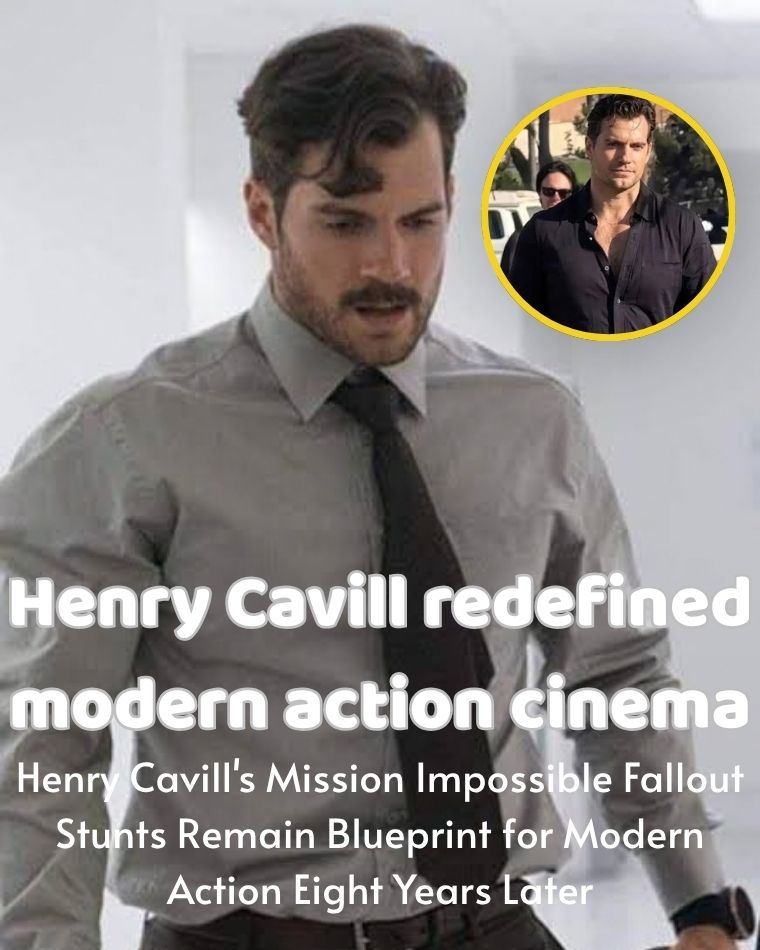
Cre: Wikimedia Commons
Brutal Physical Preparation and Practical Stunt Commitment
Embodying a lethal operative capable of challenging Tom Cruise demanded an extraordinary level of conditioning from Cavill.
The British actor committed entirely to developing functional, athletic power rather than purely aesthetic musculature.
His training regime focused heavily on core strength, rotational velocity, and heavy cardiovascular endurance.
Executing complex fight choreography for multiple takes across continuous twelve-hour shoot days requires exceptional stamina.
Cavill worked alongside veteran stunt trainers to master practical combat disciplines, including judo, boxing, and tactical grappling.
Every punch thrown on camera required controlled deceleration to protect scene partners while retaining convincing ferocity.
Beyond studio soundstages, Mission: Impossible – Fallout placed its cast into demanding practical environments across international locations.
Cavill participated directly in high-altitude helicopter pursuit sequences filmed across the treacherous Southern Alps of New Zealand.
Hanging out of open helicopter doors in freezing conditions tested the actor’s physical resilience and mental focus.
Operating in exposed cockpits amidst severe downdrafts requires rigorous safety protocol and steady physical control.
Tom Cruise’s legendary commitment to practical filmmaking famously inspires everyone working on his productions.
Cavill met that formidable challenge head-on, refusing to delegate demanding physical beats to stunt doubles.
He endured bruised knuckles, muscle strains, and continuous physical fatigue across months of demanding principal photography.
The actor’s background in physically demanding roles provided a solid base, but Fallout required a far grittier edge.
Every grapple in the mud, snow, and shattered glass carried visible physical wear and tear on the actor’s body.
Directors frequently note that genuine physical strain cannot be fully replicated through visual effects or digital stunt work.
When an actor is genuinely out of breath, the camera captures authentic physiological reactions that ground the storytelling.
Cavill’s sweat, heavy respiration, and rigid posture throughout Fallout were direct results of authentic physical exertion.
That relentless dedication earned deep respect from the seasoned stunt crew responsible for coordinating the blockbuster.
His willingness to take hard falls on unforgiving surfaces anchored August Walker firmly into the real world.
The resulting footage possesses a tactile weight that CGI-heavy contemporary blockbusters simply cannot manufacture.
Audiences instinctively recognize when physical mass and gravity are genuinely present in a frame.
Cavill’s preparation ensured that Walker felt like a living, breathing wrecking ball in every single scene.
Raising the Bar for the Action Movie Antagonist
Creating a villain who presents a credible physical threat to Ethan Hunt has historically proven challenging for the franchise.
Ethan Hunt regularly cheats death, scales skyscrapers, and survives impossible odds through sheer determination.
August Walker succeeded as an antagonist because his raw presence immediately signaled severe danger to the audience.
Cavill portrayed Walker not as an eccentric mastermind, but as an institutional hammer deployed with lethal precision.
From his initial introduction, Walker carries an air of cold, quiet calculation backed by immense muscularity.
He operates with absolute economy of movement, contrasting sharply with Hunt’s kinetic, often frantic energy.
When Walker throws a punch, the narrative makes it abundantly clear that a single clean strike could end the hero.
This dynamic created genuine dramatic tension in a franchise where Ethan Hunt often feels virtually invincible.
The mustache debate that briefly circulated in the entertainment press quickly dissolved once audiences saw the final performance.
What remained was an indelible screen villain characterized by cold eyes, unwavering posture, and clinical ruthlessness.
Walker’s internal code of brutal efficiency made him the perfect dark mirror to Ethan Hunt’s improvisational heroism.
He does not engage in long monologues or theatrical displays of cruelty during critical operational moments.
Instead, Walker executes tasks with chilling, pragmatic focus, treating violence merely as an occupational necessity.
When the narrative reveals Walker’s true allegiance as John Lark, the reveal lands with devastating physical weight.
The character does not change his demeanor upon unmasking; he merely drops the bureaucratic pretense entirely.
His climactic confrontation with Hunt on the rocky cliffs of Kashmir strips away all remaining tactical refinement.
The battle degrades into an animalistic struggle for survival utilizing steel hooks, rock faces, and bare fists.
Cavill sells the character’s unyielding malice through furious, bloodied glares and relentlessly aggressive forward momentum.
Walker refuses to stop advancing even when severely injured, embodying the relentless force of an oncoming locomotive.
This relentless drive forced Tom Cruise’s protagonist to dig deeper physically than in almost any previous installment.
By pushing the franchise’s legendary hero to the absolute brink, Cavill cemented Walker as a premier modern villain.
Great action cinema requires antagonists whose presence raises the stakes exponentially for the hero.
Walker remains a high-water mark for how physical presence, economy of dialogue, and combat mastery define an action antagonist.
The Viral Reload-Arm-Cocking Moment as a Cultural Signature
During the frantic climax of the bathroom fight, Cavill delivers an instinctive physical gesture that captured global imagination.
Backing up against a shattered partition, Cavill rolls his shoulders forward and forcefully thrusts his fists downward.
The motion visually mirrored the mechanical action of cocking a shotgun or reloading heavy ballistic weaponry.
Instantly, that micro-moment exploded across social media platforms, transforming into one of the most recognizable memes of modern cinema.
Audiences around the world replayed the brief clip millions of times, marveling at its spontaneous, unvarnished swagger.
What made the moment so universally celebrated was its absolute authenticity within the context of the brawl.
Cavill later explained that the motion was a natural reaction to loosen strained arm tendons and reset his posture between takes.
Rather than looking like an artificial theatrical flourish, it looked like an elite brawler resetting his body to inflict maximum violence.
The gesture communicated complete psychological recalibration in the middle of a fight Walker was surprisingly losing.
It showed an operative casting aside technical caution to unleash unrestrained, bare-knuckle aggression.
Moments like this demonstrate how subtle physical instincts can define an action character’s lasting legacy.
Memorable screen combat often hinges on distinct personal mannerisms rather than merely the complexity of the moves.
Action fans remember Bruce Lee rubbing his nose, or Arnold Schwarzenegger cocking a lever-action shotgun one-handed on a motorcycle.
Cavill’s arm-reload joined that elite pantheon of non-verbal, purely physical character signatures.
It captured the specific essence of August Walker: heavy, mechanical, unstoppable, and built like an artillery piece.
Even during the film’s promotional press junkets, interviewers and fellow actors routinely referenced the iconic gesture.
The viral spread of the clip introduced the sequence to millions of viewers who had not yet purchased a cinema ticket.
It functioned as organic, peer-to-peer marketing that highlighted the film’s distinctive, grounded tone.
In an era dominated by interchangeable digital battles, a two-second practical gesture stood out prominently.
It proved that audiences crave visceral, human-driven physical performance above artificial spectacle.
Years after the film’s debut, pop culture still celebrates the arm-reload as an iconic cinematic flourish.
The gesture remains permanently associated with Cavill’s commanding transition into elite, real-world action cinema.
Bridging Superhero Spectacle and Grounded Spy-Thriller Action
Before stepping into the espionage world of Fallout, Cavill was internationally recognized as the cinematic face of Superman.
Portraying an invincible superhero requires an entirely different physical vocabulary than playing a grounded covert operative.
Superhero performances often rely heavily on wire rigs, visual effects compositing, and pristine, statuesque postures.
Transitioning from an airborne comic-book savior to a dirt-splattered, brutal CIA assassin represented a significant artistic pivot.
Fallout provided Cavill with the ideal vehicle to demonstrate his vast range within the wider action landscape.
He stripped away the majestic grace of superhero flight in favor of heavy, earthbound, punishing kinetic combat.
Instead of catching falling buildings, he was throwing desperate forearm strikes and grappling on wet linoleum floors.
The film proved that Cavill’s commanding physical frame was not merely an aesthetic asset for fantasy adaptations.
He demonstrated complete mastery over practical tactical maneuvers, firearm handling, and tactical movement.
His performance showcased an innate understanding of weight distribution, balance, and spatial awareness during high-velocity sequences.
Many actors who excel in green-screen environments struggle when thrust into the unforgiving reality of practical stunt filmmaking.
Cavill, conversely, seemed entirely energized by the dirt, bruises, and physical demands of Christopher McQuarrie’s set.
His work in Fallout convinced filmmakers and studio executives of his credibility in hard-edged, grounded thriller narratives.
He successfully bridged two divergent subgenres: epic high-budget fantasy and visceral, tactile practical espionage.
This versatility expanded the trajectory of his career, establishing him as an authentic modern action star.
Critics noted that Cavill brought unexpected layers of bureaucratic menace and grim humor to the character of Walker.
His interactions with Cruise crackled with competitive friction, establishing a memorable on-screen dynamic.
He never allowed himself to be dwarfed by Cruise’s titanic star power or legendary on-set energy.
Instead, Cavill planted his feet firmly and delivered a counterweight that anchored the entire midsection of the narrative.
Audiences walked away recognizing an actor capable of carrying diverse, demanding roles without relying on digital doubles.
The transition established a blueprint for how modern performers can successfully traverse disparate cinematic traditions.
August Walker proved that physical commitment and classical acting presence can combine into something truly unforgettable.
Why Fight Coordinators Still Study Fallout’s Combat Choreography
The tactical combat designed for Mission: Impossible – Fallout continues to exert a profound influence on contemporary stunt teams.
Industry choreographers routinely analyze the film’s pacing, camera placements, and execution of kinetic impact.
Modern fight design frequently suffers from visual over-saturation, where complex moves lose dramatic meaning in a flurry of cuts.
Fallout demonstrated the supreme value of compositional restraint, allowing choreography to unfold in unbroken rhythm.
Fight coordinators observe how the production utilized environmental architecture to restrict and dictate combat movement.
The bathroom sequence, in particular, treats every architectural element as an active participant in the violence.
Sinks shatter, mirrors explode into dust, and structural pillars provide temporary tactical cover.
The choreography emphasizes exhaustion, depicting combatants whose precision visibly degrades as stamina wanes.
Most cinematic fights depict combatants executing flawless martial arts techniques from opening bell to final knockout.
Fallout reversed this convention by showing elite professionals devolving into wild, desperate survival brawling.
Cavill’s August Walker absorbs punishment that would incapacitate lesser men, yet his strikes become heavier and less guarded.
This emphasis on realistic physiological degradation creates extraordinary narrative stakes for the viewing audience.
Stunt coordinators frequently point to Cavill’s clean execution of basic strikes as an example of effective screen fighting.
He does not rely on overly flamboyant spin-kicks or acrobatic flips that clash with his bulky character design.
Instead, his offense consists of punishing straight rights, clubbing forearms, brutal takedowns, and relentless forward drives.
The choreography matches the character’s physical profile perfectly, creating absolute narrative and visual cohesion.
When action design aligns seamlessly with character psychology, the resulting sequence transcends mere spectacle.
Furthermore, the seamless integration of lead actors with world-class stunt doubles sets an operational industry standard.
Eastwood’s stunt team mapped out the choreography so that Cruise, Cavill, and Liang Yang could execute primary beats safely.
The camera never turns away out of embarrassment or technical limitation; it stays locked onto the actors’ faces.
Seeing the recognizable stars absorbing genuine physical contact deepens the audience’s emotional investment.
Contemporary action productions across streaming and theatrical landscapes frequently borrow visual motifs from the sequence.
From corridor brawls to enclosed elevator struggles, echoes of the Fallout bathroom fight appear constantly in new releases.
The sequence proved that audiences respond enthusiastically to disciplined, practical combat filmed with absolute clarity.
As digital production tools continue to proliferate, Fallout stands as a triumphant testament to practical stunt mastery.
Henry Cavill’s contribution to that achievement remains one of the defining highlights of modern action history.
His performance affirmed that genuine physical presence, rigorous rehearsal, and fearless execution will always captivate the world.
The Architectural Precision of Close-Quarters Stunt Design
Examining the technical anatomy of the film’s action reveals an obsession with spatial geography and sound engineering.
Every action sequence begins with clear spatial establishment, ensuring the audience understands the boundaries of the room.
In the Grand Palais bathroom, the camera maps out the entrance, stall partitions, washbasins, and blind spots immediately.
When the violence erupts, viewers maintain an intuitive mental map of where each combatant stands in relation to danger.
Disorienting edits that violate the 180-degree axis are strictly avoided throughout the encounter.
This discipline allows viewers to appreciate the sheer tactical ingenuity displayed by the stunt coordinators.
Cavill’s sheer physical mass becomes an obstacle within the confined geography of the set.
His movements feel hazardous not only to his opponents, but to the very architectural integrity of the location.
Plaster crumbles under his shoulders, plumbing pipes burst upon impact, and ceramic fixtures shatter into lethal shards.
The sound design team amplified this tactile realism by recording distinct, heavy impacts for different materials.
The dull thud of flesh striking drywall sounds profoundly different from the sharp crack of bone hitting ceramic.
These nuanced acoustic textures register subconsciously with the audience, reinforcing the illusion of authentic violence.
Cavill’s vocalizations during the brawl—grunts of effort, sharp intakes of breath, and deep exhalations—were captured with crisp fidelity.
The sonic landscape strips away cinematic glamour, leaving behind the ugly, exhausting reality of life-or-death combat.
By rejecting sweeping orchestral accompaniment, the sound designers allowed the rhythmic cadence of the fight to drive the scene.
Every footstep squeaking on wet floor tiles builds tension prior to the next explosive collision.
This meticulous attention to sensory detail distinguishes Fallout from ordinary genre competitors.
The sequence functions as a masterclass in how visual clarity and acoustic design amplify practical stunt performance.
Choreographers continue to instruct young stunt performers using these precise parameters of spatial awareness and impact realism.
The film demonstrated that modern audiences possess a refined literacy for physical action and reject hollow visual shortcuts.
Cavill’s dedication to mastering these complex parameters allowed the production team to execute their ambitious vision flawlessly.
His willingness to repeatedly crash through breakaway partitions without hesitation granted the director total creative freedom.
The resulting scene remains a triumph of collaborative filmmaking, uniting performer, stunt coordinator, and director into one seamless unit.
The Enduring Legacy of August Walker
Eight years after the film’s theatrical run, the cultural footprint of August Walker remains remarkably vibrant.
Action cinema has evolved through numerous trends, yet audiences continuously return to Fallout as a high-water mark.
Henry Cavill’s performance demonstrated how an established dramatic actor could conquer the physical demands of high-tier stunt work.
He crafted an antagonist who was simultaneously terrifying, physically imposing, and endlessly charismatic.
Walker never felt like a disposable plot device designed solely to be overcome by the heroic protagonist.
He was a formidable force of nature whose presence permanently altered the trajectory of the Mission: Impossible franchise.
The film redefined expectations for how antagonists should be integrated into practical action set pieces.
Rather than watching from command bunkers, modern action villains are now increasingly expected to engage directly in combat.
Cavill set a standard of physical excellence that subsequent action releases have actively strived to emulate.
His work proved that practical commitment yields artistic dividends that digital shortcuts can never replicate.
The bruising authenticity of the bathroom brawl and the helicopter pursuit continue to inspire new generations of filmmakers.
Fans and critics alike celebrate the performance as a masterclass in physical storytelling and screen presence.
August Walker stands alongside cinema’s most iconic action adversaries, defined by unwavering menace and ferocious power.
As the action genre continues to navigate the balance between practical stunts and digital technology, Fallout remains a north star.
Henry Cavill’s commanding contribution to that cinematic triumph guarantees his place in the annals of modern action excellence.
Để lại một phản hồi