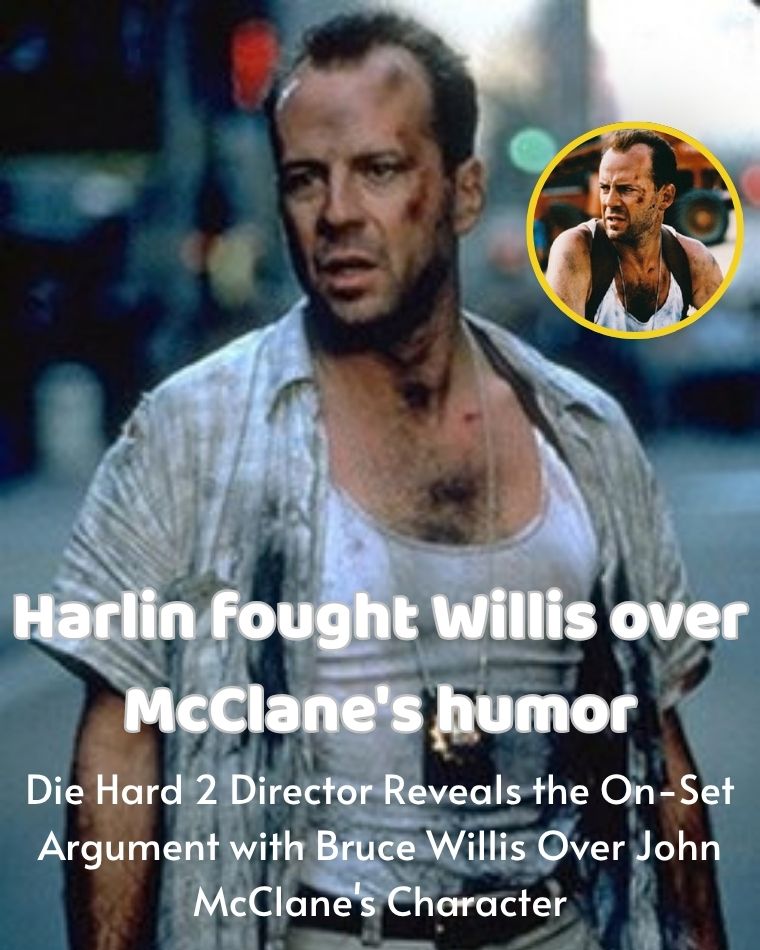
The director of the explosive 1990 action sequel Die Hard 2 has revisited the intense creative battle he fought with lead star Bruce Willis over the core identity of John McClane.
While audiences remember the holiday airport thriller for its relentless pacing and sardonic wit, that exact comedic edge was nearly erased from the production entirely.
The resolution of that clash not only salvaged the franchise’s signature tone but also proved how collaborative tension can define an iconic cinematic character.
The massive blockbuster sequel faced extraordinary expectations from the very first day of principal photography.
Director Renny Harlin stepped into the high-stakes production aiming to replicate and elevate the magic of John McTiernan’s 1988 original film.
Bruce Willis returned to his career-defining role as the tough New York City police officer navigating another nightmare scenario.
However, Willis arrived on set with an entirely unexpected perspective regarding how McClane should behave under fire.
The actor firmly believed that the character needed a fundamental tonal overhaul for the second installment.
Harlin, conversely, remained convinced that stripping away McClane’s humanity and humor would alienate millions of devoted moviegoers.
Their diametrically opposed interpretations sparked an immediate creative impasse between the director and his leading man.
Understanding this conflict requires examining how John McClane originally subverted traditional Hollywood action conventions.
During the late 1980s, the action landscape was dominated by indestructible, muscular powerhouses like Arnold Schwarzenegger and Sylvester Stallone.
Those cinematic heroes rarely exhibited genuine fear, physical vulnerability, or relatable anxiety.
John McClane broke that rigid mold by bleeding, complaining, suffering severe injuries, and using dark sarcasm as an emotional defense mechanism.
Audiences connected deeply with his blue-collar sensibility and self-deprecating commentary throughout the hostage siege at Nakatomi Plaza.
When production commenced on Die Hard 2, Willis felt that the harrowing events of the original movie should have hardened the character dramatically.
He believed that an officer facing another terrorist takeover would not realistically crack jokes or mutter dry one-liners.
Cre: Wikimedia Commons — Creative Commons Attribution 2.0 Generic
Harlin recalled that Willis flatly refused to deliver McClane’s trademark banter during early rehearsals and takes.
The star was determined to portray McClane strictly as a grim, deadly serious lawman operating under extreme pressure.
“You know, those quips, and funny lines, and smirks that I did in Die Hard. That’s bullshit. I’m just going to play it straight,” Willis explicitly told the young director.
Willis argued that when innocent human lives are actively in jeopardy, cracking jokes feels artificial and irresponsible for an authentic cop.
From Willis’s vantage point, dramatic integrity demanded that McClane take every threat with unflinching gravity.
The actor wanted to strip away the smirks and theatrical levity to ground the performance in stark realism.
Harlin immediately recognized the existential danger this tonal shift posed to the sequel’s commercial and narrative appeal.
The director countered passionately, reminding Willis why the original movie had resonated so strongly across the globe.
“But Bruce, why do you think there is Die Hard 2? It’s because people loved your character, John McClane,” Harlin argued back.
Harlin emphasized that audiences did not view McClane as a sterile military commando or a grim procedural operative.
He reminded the actor that McClane was fundamentally a blue-collar cop armed with an everyday worker’s cynical sense of humor.
“Who is he? He is a blue-collar cop with a sarcastic sense of humor, and that’s the character,” Harlin insisted during their heated discussion.
Harlin argued that whether the action erupted in a towering skyscraper or a crowded international airport, the character’s internal essence had to remain constant.
The director maintained that movies operate on emotional contracts with the audience rather than strict adherence to grim real-world behavior.
“Yeah, not in real life, but this is a movie. This is Die Hard,” Harlin told Willis during their debate.
He warned Willis that viewers felt an intimate personal friendship with McClane and expected that companionable bond to continue.
Nguồn: Wikimedia Commons — Creative Commons Attribution-ShareAlike 3.0 Unported
Despite Harlin’s persistent efforts, Willis remained steadfast in his refusal to lean into the sarcastic humor.
The creative stalemate quickly threatened the day-to-day rhythm and overall schedule of the high-budget sequel.
Realizing that the production had arrived at a critical crossroads, Harlin knew he needed external support to break the deadlock.
He escalated the issue directly to legendary mega-producer Joel Silver.
“It came to a point where I had to go to Joel and say, ‘We have a real problem,'” Harlin recalled of the boiling crisis.
Joel Silver was an industry titan renowned for orchestrating landmark action masterworks and managing massive star egos.
Silver immediately convened a high-stakes, closed-door conference with Harlin and Willis to establish a working resolution.
The meeting was charged with creative tension as all three men debated the future trajectory of the character.
Silver understood the commercial necessity of preserving the charm that turned the original into a cultural sensation.
At the same time, the production could not afford to antagonize its marquee star, whose commitment was vital to every scene.
Together, the trio hammered out an unusual on-set compromise that required tremendous discipline from both director and actor.
The terms of the truce gave Willis the complete freedom he desired while safeguarding Harlin’s directorial vision.
Under the agreement, Willis was granted permission to perform as many takes as he wanted in his preferred serious, dramatic style.
Every sequence would allow the actor to explore the gritty, straight-laced intensity he believed in so firmly.
However, the binding condition was that after completing those takes, Willis had to deliver one final take specifically for Harlin.
In that dedicated take, Willis agreed to incorporate the signature humor, dry quips, and smirks that Harlin requested.
“The outcome was that Bruce agreed to do as many takes as he wanted of the way he wanted to do it, and then we’d do one take the way I wanted to do it, with humor,” Harlin explained.
The arrangement was executed on set every single day, although Willis complied with evident reluctance.
“He did it reluctantly, and not so happily, but he did it,” Harlin noted when recounting their daily shooting routine.
This meticulous approach resulted in double the footage for almost every dialogue exchange throughout the airport complex.
Harlin maintained strict discipline, ensuring that every comedic variant was safely recorded and archived on film.
The director knew that the true battlefield of the movie would ultimately lie inside the post-production editing room.
Once principal photography concluded, Harlin assembled the rough cut using the lighter, more sarcastic takes whenever possible.
He carefully balanced the life-or-death airport siege against McClane’s exasperated, incredulous commentary.
Memorable lines such as McClane groaning about how the same catastrophe could happen to the same guy twice were preserved.
The ultimate validation of Harlin’s artistic instincts arrived when studio executives at 20th Century Fox viewed the early assembly.
The studio brass were immediately thrilled by the action but zeroed in on the exact element Willis had tried to suppress.
According to Harlin, the very first question the executives asked after the screening was whether there were any additional humorous moments available.
“The first question the executives asked, when they saw it, was, ‘Do you have any more moments with humor?'” Harlin recalled.
Harlin had to deliver a candid response to the enthusiastic studio leadership.
“I said, ‘Unfortunately, I used everything I had,'” the director revealed.
Every single scrap of witty footage captured during those hard-fought compromise takes had already been spliced into the movie.
There was no hidden surplus of banter left sitting on the cutting room floor.
When Die Hard 2 premiered in theaters in the summer of 1990, it achieved massive critical and commercial success.
Moviegoers embraced John McClane’s second trial with immense enthusiasm, cementing the brand as an elite action franchise.
Audiences once again rooted for the exhausted, quipping hero as he fought mercenaries across frozen runways.
Reviewers specifically highlighted McClane’s sarcastic charisma as the anchor that prevented the film from devolving into mechanical carnage.
The box office returns confirmed that Harlin’s creative gamble had paid off handsomely for the studio and the star alike.
Had Willis succeeded in enforcing his humorless interpretation, the entire franchise trajectory could have stalled prematurely.
The subsequent installments in the franchise reaffirmed the essential wisdom of preserving McClane’s comic sensibilities.
In later entries, filmmakers leaned even further into the character’s world-weary banter and mismatched comedic chemistry.
The creative dispute on the set of Die Hard 2 remains a textbook study in Hollywood collaboration and tension.
Film production is rarely a seamless process where all creative partners share identical visions from beginning to end.
Actors often develop deep protective instincts over the characters they inhabit, seeking deeper realism or dramatic evolution.
Directors, by contrast, must maintain an objective panoramic view of the broader cinematic ecosystem and audience expectations.
Harlin never viewed Willis’s resistance as malicious, recognizing it instead as an artist passionately wrestling with character authenticity.
The director’s retrospective reflections underscore how vital respectful pushback can be when crafting enduring entertainment.
Without Harlin’s firm stance and Joel Silver’s pragmatic mediation, John McClane might have lost the relatable spirit that made him legendary.
Instead, the creative friction forged a balanced performance that satisfied both the actor’s grit and the audience’s appetite for fun.
Decades after the film’s theatrical debut, Harlin looks back on the conflict with pride and fond professional appreciation.
He recognizes that navigating high-stakes disputes with major Hollywood stars is an inescapable part of directing large-scale tentpoles.
The anecdote illustrates how close great movies often come to missing the mark due to well-intentioned creative disagreements.
It also demonstrates the indispensable craft of behind-the-scenes negotiation in commercial filmmaking.
By agreeing to shoot alternative versions of key sequences, the filmmakers preserved options that ultimately saved the final cut.
The studio executives’ immediate craving for more laughs proved that Harlin had diagnosed the audience’s emotional pulse with absolute accuracy.
John McClane endured as an icon precisely because he laughed in the face of impossible danger.
His sarcastic wit served as an indispensable lifeline for viewers trapped alongside him in claustrophobic air ducts and snowbound runways.
The legacy of Die Hard 2 stands as a testament to the power of holding the line on tone.
Renny Harlin’s determination ensured that McClane remained the relatable, fast-talking hero fans fell in love with in the first place.
Through a delicate mixture of compromise, mediation, and directorial conviction, a potential artistic disaster was transformed into an enduring action classic.
Để lại một phản hồi