Thirty years after Quentin Tarantino transformed modern cinema with Pulp Fiction, the 1994 masterpiece remains one of the greatest movies ever made. Bruce Willis delivered an understated, career-redefining performance as prizefighter Butch Coolidge that grounded the wild narrative and broke him out of the standard action hero box. Here is an in-depth retrospective on how their collaboration took shape, why Butch’s storyline remains unforgettable, and where the performance stands three decades later.
Three full decades have officially passed since Pulp Fiction took the international film world by storm in 1994.
The film did not merely entertain audiences when it first arrived in theaters across the world.
It fundamentally reorganized how filmmakers structured crime fiction, dialogue, and non-linear narrative pacing for generations to follow.
Today, Pulp Fiction holds a stellar 92% critics score alongside a 96% audience rating on Rotten Tomatoes.
Those outstanding critical metrics reflect an enduring truth recognized by scholars and audiences alike across the entire globe.
Publications such as Collider have championed the work as the greatest crime movie ever made.
Similarly, Entertainment Weekly famously selected the production as the greatest American movie released since 1983.
The feature earned the prestigious Palme d’Or at the 1994 Cannes Film Festival against extraordinary global competition.
It subsequently captured seven Academy Award nominations and secured the Oscar for Best Original Screenplay.
Yet among the film’s dazzling ensemble cast, Bruce Willis’s portrayal of boxer Butch Coolidge provided an emotional anchor that kept the picture rooted in genuine human vulnerability.
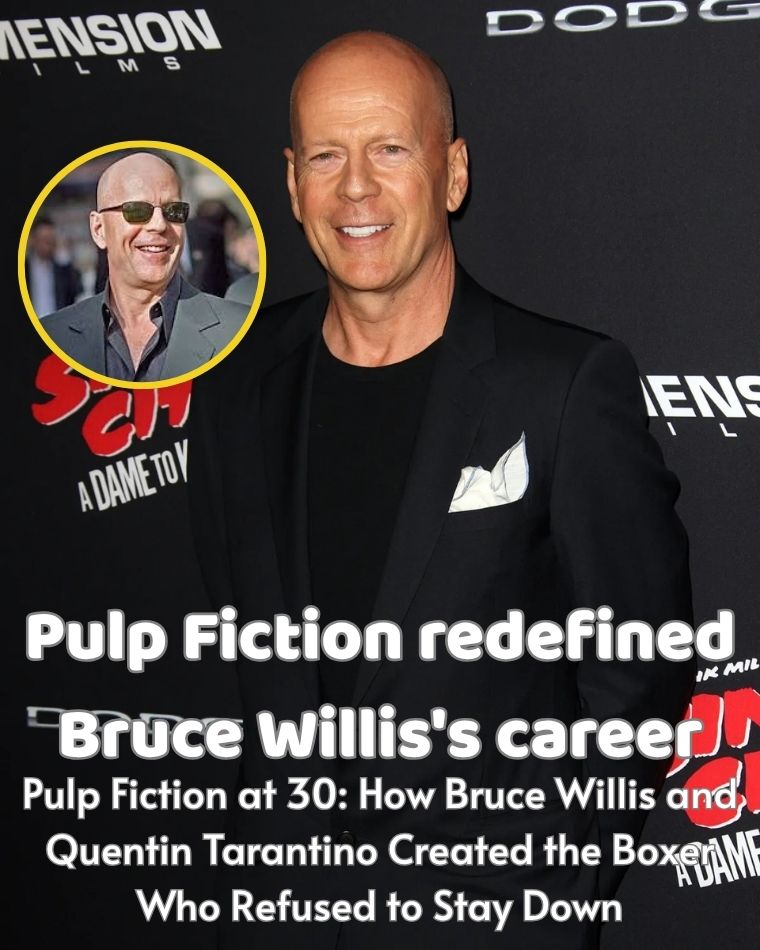
Cre: Wikimedia Commons
Before joining the production of Pulp Fiction, Bruce Willis found himself standing at an unexpected career crossroads.
During the late 1980s, Willis had skyrocketed into superstar status through the breakthrough success of Moonlighting and Die Hard.
John McClane had cemented Willis as the definitive everyman action protagonist of modern American Hollywood blockbusters.
However, the early 1990s brought significant professional turbulence and critical skepticism toward his dramatic viability.
High-profile studio projects like Hudson Hawk and The Bonfire of the Vanities had suffered severe box office setbacks.
Industry observers began questioning whether Willis possessed dramatic range beyond quip-heavy shootouts and explosions.
Enter Quentin Tarantino, a fearless young director who had recently shaken Hollywood with his electrifying debut feature Reservoir Dogs.
The part of Butch Coolidge was not originally drafted with Bruce Willis in mind.
Quentin Tarantino had initially offered the role of Butch to Mickey Rourke.
Actor Matt Dillon was also considered and approached for the part before ultimately declining to join the cast.
Fate intervened when producer Lawrence Bender and veteran actor Harvey Keitel arranged a personal introduction between Tarantino and Willis.
Harvey Keitel had served as an indispensable champion for Tarantino on Reservoir Dogs and understood cinema instincts intimately.
When Willis met Tarantino, both men recognized an uncommon opportunity to take a genuine creative gamble.
Tarantino restructured aspects of the Butch Coolidge character to fit Willis’s distinctive presence, physical build, and vintage demeanor.
Accepting a substantial pay cut compared to his customary studio salaries, Willis signed on to participate in the independent indie film.
His formal attachment gave the Miramax production massive commercial legitimacy and secured essential international distribution agreements.
It signaled to all of Hollywood that Quentin Tarantino was an auteur capable of attracting the biggest stars on the planet.
Within Pulp Fiction’s ambitious anthology structure, Butch Coolidge carries the vital second major chapter titled “The Gold Watch.”
Tarantino crafted an unconventional cinematic structure that boldly defied standard chronological storytelling conventions.
The film jumps back and forth across interconnected vignettes tracking hitmen Vincent Vega and Jules Winnfield alongside Mia Wallace and Marsellus Wallace.
While other characters revel in hyper-stylized criminal philosophizing, Butch operates as an old-school professional caught in a lethal trap.
Butch is an aging prizefighter nearing the twilight of his difficult, bruising career in the ring.
Crime kingpin Marsellus Wallace pays Butch a considerable sum of cash to take a dive in his upcoming boxing bout.
Marsellus delivers a brutally honest lecture reminding Butch that pride only hurts and never helps an aging athlete.
Instead of complying with the criminal contract, Butch bets his own purse on himself and knocks his opponent out cold.
In fact, his opponent tragically dies in the ring during the ferocious exchange of blows.
Butch is forced to execute an immediate escape plan across town before Marsellus’s ruthless syndicate can retaliate.
What distinguishes Butch from typical action figures is his constant awareness of his own mortality and vulnerability.
He is not an invincible hero capable of brushing off danger with witty one-liners like John McClane.
He is an exhausted survivor who simply wants to gather his earnings, protect his lover Fabienne, and escape the country forever.
Willis plays these scenes with a measured, restrained gravity that surprised critics who knew him only from summer blockbusters.
His performance is quiet, introspective, and heavily anchored in physical realism and nervous tension.
The emotional foundation of Butch’s narrative centers around an heirloom watch handed down through multiple generations of combat veterans.
In a now-famous prologue to the sequence, Captain Koons explains the harrowing history behind the gold timepiece.
The watch represents dignity, familial sacrifice, and honor amidst unimaginable degradation during overseas warfare.
When Butch arrives safely at his motel hideout, he discovers that Fabienne inadvertently forgot to pack the watch from their apartment.
The sudden realization transforms Butch from a cautious fugitive into an incandescent force of desperate fury.
He understands that returning to his apartment means walking directly into an ambush set by Wallace’s hitmen.
Yet living his remaining days without the heirloom is an outcome his conscience refuses to accept.
Willis portrays this difficult choice without theatrical melodrama or excessive dialogue.
His body language conveys pure anxiety as he slips quietly back into his apartment to recover the item.
Inside the quiet apartment, Butch encounters Vincent Vega emerging unexpectedly from the bathroom.
In a split-second confrontation, Butch reacts instinctively and guns Vincent down before fleeing onto the street.
The entire sequence relies heavily on Willis’s ability to communicate internal panic beneath a steely exterior.
His facial expressions reveal a man who hates what he has been forced to become in order to survive.
Every step of his journey is weighed down by the heavy emotional burden of his family legacy.
The climactic turning point of Butch’s storyline occurs inside a nightmarish pawnshop on the outskirts of town.
After colliding in a violent automobile accident, Butch and Marsellus engage in a brutal street brawl that spills into the store.
They are immediately captured by the depraved shop owner and bound in a secluded basement room.
Butch manages to free himself from his bonds and prepares to slip silently out the front door to safety.
Freedom is completely within his grasp, and escaping would eliminate his deadliest criminal enemy permanently.
Yet hearing Marsellus Wallace being brutalized in the adjoining basement forces Butch to halt his departure.
He stands before a wall of weapons, deliberating between a hammer, a baseball bat, a chainsaw, and a samurai sword.
Willis’s subtle performance during this silent selection process is widely considered one of the finest beats in his entire filmography.
There are no speeches delivered to the audience about morality or justice.
His eyes shift deliberately between the choices until he settles firmly upon the katana blade.
Choosing to descend back into that basement to save his bitter enemy represents the defining moral decision of the story.
It is an act of pure chivalric honor born out of an old-fashioned personal code.
After slaying their captor and freeing Marsellus, the two men forge an uneasy truce of mutual silence and respect.
Marsellus agrees that their blood feud is over forever, on the condition that Butch leaves Los Angeles immediately and never returns.
Butch climbs onto Zed’s parked chopper motorcycle, returns to Fabienne, and rides off toward a clean horizon.
The immediate critical and commercial triumph of Pulp Fiction fundamentally revitalized Bruce Willis’s Hollywood career.
By committing to Quentin Tarantino’s vision, Willis proved to critics and studio executives that he possessed formidable dramatic credentials.
He demonstrated that an established mega-budget star could seamlessly thrive within raw, uncompromised independent filmmaking.
The success of Pulp Fiction paved the way for Willis to take daring artistic risks throughout the remainder of the 1990s.
It directly led to compelling auteur collaborations like Terry Gilliam’s 12 Monkeys, Luc Besson’s The Fifth Element, and M. Night Shyamalan’s The Sixth Sense.
Furthermore, Willis’s participation helped spark the broader indie cinema revolution that defined 1990s American cinema.
It encouraged other top-tier Hollywood stars to seek out unorthodox scripts from daring emerging directors.
Thirty years later, the film’s 92% Rotten Tomatoes score stands as a testament to its timeless craftsmanship and enduring originality.
While John Travolta and Samuel L. Jackson received Oscar nominations for their dialogue-heavy roles, Willis delivered the story’s true heart.
Butch Coolidge represents the moral spine of Pulp Fiction—a bruised prizefighter fighting desperately to preserve his dignity.
As modern movie lovers look back on three decades of cinematic history, Pulp Fiction continues to shine brightly.
And Bruce Willis’s remarkable performance remains one of the greatest accomplishments in modern motion picture history.
Để lại một phản hồi