Director David Ayer and Hollywood star Brad Pitt deliberately abandoned conventional studio comforts while filming their survival thriller Heart of the Beast to capture authentic human vulnerability against brutal natural elements. By placing cast and crew directly into harsh, unpredictable backcountry environments, the production turned physical exhaustion and isolation into raw on-screen drama.
Filming major Hollywood productions usually involves climate-controlled trailers, elaborate craft catering, and an army of dedicated assistants catering to every personal whim.
On the set of Heart of the Beast, however, leading man Brad Pitt and director David Ayer chose an entirely different path.
The creative team voluntarily stripped away the traditional support network of modern filmmaking to immerse themselves completely in authentic wilderness conditions.
According to reporting from IndieWire, the production deliberately operated without typical movie set luxuries to forge a genuine atmosphere of survival.
This decision was not merely an eccentric aesthetic experiment, but a deliberate creative strategy designed to strip away Hollywood artifice.
Both the filmmakers and their star believed that a gritty survival story could not be convincingly executed while surrounded by everyday modern comforts.
The finished movie places viewers alongside a broken character battling extreme elements, where every shiver, stumble, and gasp for air feels grounded in reality.
Cre: Unsplash
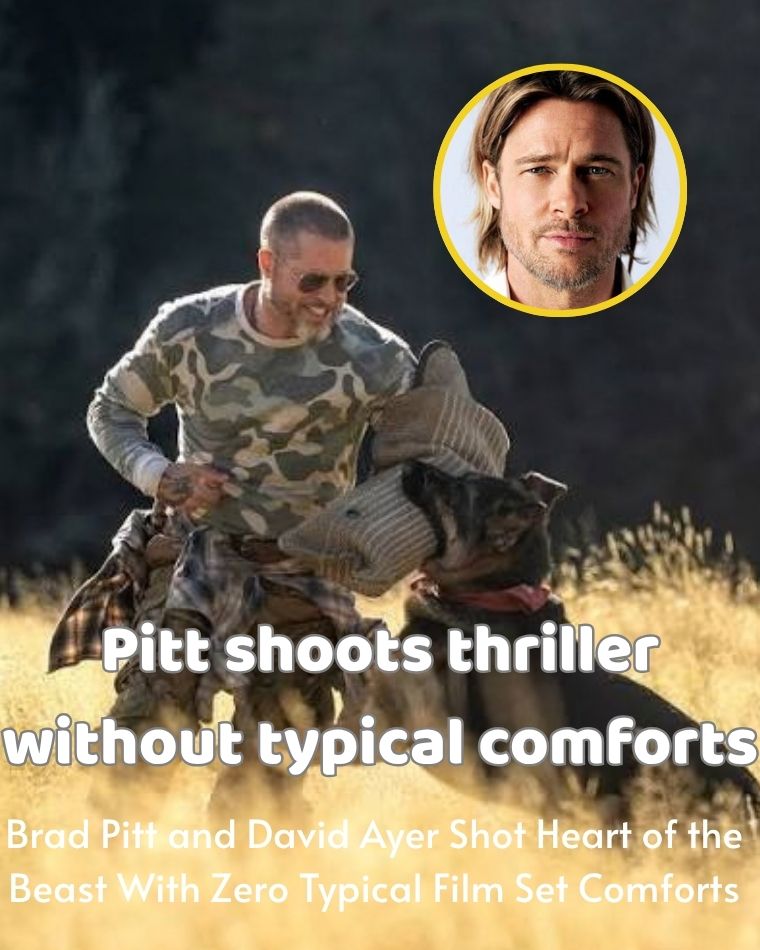
The film follows retired Special Forces veteran James Belmont, played by Pitt, who finds himself stranded deep in untamed wilderness after a catastrophic plane crash.
Accompanied only by his retired military combat dog, Belmont must navigate dozens of miles of punishing backcountry terrain to reach safety.
The narrative demands total physical and emotional exhaustion from its solitary protagonist.
Recognizing the intensity of Cameron Alexander’s script, David Ayer realized that standard soundstages and controlled outdoor studio backlots would ring hollow on screen.
Ayer had previously collaborated with Pitt on the acclaimed 2014 World War II tank drama Fury, a project renowned for its punishing authenticity and demanding methodology.
On Fury, Ayer famously placed his ensemble cast into confined quarters and rigorous boot camps to break down standard acting habits.
With Heart of the Beast, the director sought an even more uncompromising level of creative exposure.
Ayer noted on IndieWire’s Filmmaker Toolkit podcast that the stripped-down shoot presented a far greater trial than he had initially anticipated.
He remarked that the utter simplicity of the production exposed every creative choice in ways he had never experienced before.
In a setting where an actor is surrounded only by raw trees, cold rock, and biting wind, there is nowhere for a filmmaker or a performer to hide.
Every nuance of tone, camera angle, and performance carries an immense burden when decorative studio tricks are systematically removed.
During the location shoot, the crew had to transport heavy camera packages and technical gear through remote terrain without established roadway infrastructure.
Inclement weather patterns, plunging temperatures, and steep mountain slopes became daily working realities rather than problems solved by digital post-production.
The lack of standard heated staging areas meant that Pitt spent long stretches waiting between camera setups exposed to the same elements his character was fighting.
Crew members likewise worked under strenuous physical demands, navigating slick riverbeds, dense timber, and unpredictable shifts in natural lighting.
This shared physical exertion quickly dismantled the traditional social hierarchy typically observed on big-budget studio projects.
Everyone on location had to adapt on the fly, mirroring the resourceful mindset required of Belmont in the narrative.
By forcing cast and crew to face the physical toll of the terrain, Ayer generated an underlying tension that permeates every scene.
Working alongside animals in real wilderness settings added another layer of unpredictability to the rigorous shooting schedule.
Pitt shares the vast majority of his screen time with a scarred military German Shepherd named Odin, portrayed on set by canine actor Uber and backup doubles.
Canine performers do not respond to traditional vanity or Hollywood celebrity status.
They react strictly to genuine presence, authentic emotional energy, and environmental stimuli.
Navigating rugged river crossings and rough terrain with a live animal required Pitt to be hyper-present in every single take.
Ayer observed that Pitt received none of the typical actor support systems normally present during dialogue-driven dramatic scenes.
Instead of playing off human co-stars in a controlled space, Pitt had to command the screen in almost solitary fashion.
Ayer likened Pitt’s solitary acting task to a fighter jet pilot flying an isolated combat mission without a wingman.
The physical demands placed upon Pitt were extensive throughout the grueling production timeline.
His character suffers from severe prior medical complications, battle injuries, and lingering trauma while hiking across brutal terrain.
Faking that depth of strain while retiring to a warm luxury motorhome every twenty minutes would have broken the performer’s psychological focus.
By enduring the biting chill, mud, and uneven footing throughout entire working days, Pitt allowed the physical environment to inform his physical movement.
His gait slows naturally as the movie progresses, weighed down by genuine physical fatigue rather than calculated theatrical pantomime.
The actor embraced the vulnerability demanded by the environment, leaning into his decades of screen experience to deliver an understated, world-weary performance.
Ayer remarked that Pitt was at a stage in his distinguished career where he actively sought out roles that allowed him to explore uncommon emotional vulnerability.
The rugged outdoors became a mirror for the character’s battered internal psyche.
The decision to discard typical comforts was deeply rooted in David Ayer’s philosophical approach to modern filmmaking.
Throughout his career, Ayer has consistently favored visceral, tactile realism over glossy cinematic polish.
In an era increasingly dominated by massive green screens, virtual production volumes, and extensive digital character replacements, true wilderness filmmaking is becoming a rarity.
Ayer understood that modern audiences possess an instinctive ability to detect synthetic environments and artificial lighting.
When an actor is filmed against blue screens or on temperature-controlled soundstages, their body language subtly reflects that safety and comfort.
Their breath does not mist genuinely in the frosty air, their skin does not flush with real cold, and their muscles do not tense against authentic physical exhaustion.
By staging the survival story in genuine wilderness conditions, Ayer captured visual details that money cannot easily buy in post-production.
The camera documents real precipitation clinging to clothing, natural frost dusting facial hair, and the authentic weight of wet boots dragging through soggy soil.
Cinematographer Mauro Fiore utilized available natural light whenever possible, capturing the stark transitions from pale dawn to deep mountain dusk.
The shifting wilderness weather dictated the shooting schedule rather than a rigid studio call sheet.
When dense clouds rolled across the tree canopy, the production embraced the resulting gloom rather than pausing to set up artificial light banks.
When winds whipped through the mountain valleys, the audio gear captured the genuine roar of the gusts rattling the pine needles.
This documentary-like discipline forced the camera department to stay mobile, responsive, and stripped of cumbersome, heavy studio rigs.
The camera frequently moves at eye level with Pitt and his canine partner, tracking through brush and across boulder-strewn shorelines.
The result is a distinct visual texture characterized by grain, immediacy, and an palpable lack of studio polish.
Viewers are drawn into the sensory reality of the hike, feeling the claustrophobia of thick timber and the terrifying vulnerability of wide-open mountain ridges.
For Brad Pitt, stepping into such an unforgiving production environment offered a welcome creative challenge.
Having spent decades working at the highest tier of global cinema, Pitt has experienced every luxury that major studio budgets can provide.
Yet his most memorable performances often arise when he is pushed outside conventional Hollywood safety zones.
In Heart of the Beast, Pitt strips away the breezy charm and polished swagger that defined many of his blockbuster roles.
His performance is anchored in quiet observation, heavy silences, and the unglamorous mechanics of basic human survival.
There are long stretches of the film where no words are spoken at all, placing the narrative entirely on Pitt’s physical presence and facial micro-expressions.
Because the production stripped away extraneous luxuries, Pitt was able to maintain uninterrupted continuity of mood throughout long shooting days.
He stayed in his weathered survival gear, enduring the elements alongside his canine co-star without retreating into detached comfort.
This immersive discipline allowed the bond between man and dog to develop naturally in front of the lens.
The canine actors grew accustomed to Pitt as a true trail companion rather than a performer who merely appeared when the director called action.
The mutual trust forged between them in difficult terrain translates into subtle interactions on screen that cannot be faked through animal training alone.
When Belmont reaches out to steady his limping companion on a rocky slope, the touch carries the weight of authentic shared hardship.
The harsh conditions also heightened the underlying themes of masculinity and veteran trauma that lie at the center of the story.
Belmont is a man who has spent decades operating inside rigid military structures, only to find himself completely unmoored in civilian life.
The wilderness strips away all societal ranks, accolades, and artificial shields, leaving only the primal question of endurance.
Ayer pointed out that there is a deep kinship between the character’s internal struggle and the reality of traditional masculine identity.
Men are often conditioned to wear stoic, impenetrable masks, hiding the fragile beating heart beneath years of emotional suppression.
By stripping away the insulating layers of modern life on set, the film allowed Pitt to reach beneath that stoic facade and reveal genuine vulnerability.
The legacy of authentic, location-based wilderness shoots has deep historical roots in American cinema.
Classic survival films like Jeremiah Johnson, Deliverance, and The Revenant earned their enduring status precisely because their creators embraced the elements rather than retreating into soundstages.
In each of those landmark projects, the sheer difficulty of the shoot became woven into the fabric of the finished artwork.
Heart of the Beast follows firmly in that ambitious cinematic tradition, proving that modern filmmaking still has room for raw physical endurance.
When audiences watch Belmont drag himself across a frigid riverbed or shiver against the nocturnal mountain cold, they are witnessing a production that refused to cut corners.
The finished movie stands as a testament to what occurs when an A-list movie star and an uncompromising director prioritize craft over convenience.
By trading heated trailers for frozen timberlines and comfortable catering for Spartan trail conditions, the team achieved an unmistakable aura of truth.
David Ayer’s vision demonstrates that genuine suspense cannot be manufactured entirely on a computer hard drive.
True tension requires risk, unpredictability, and an honest reckoning between the human body and the natural world.
Through its relentless commitment to real wilderness filmmaking, Heart of the Beast delivers a harrowing portrait of endurance that resonates long after the screen fades to black.
The film serves as a compelling reminder that the most powerful cinematic experiences often require leaving the comforts of Hollywood behind.
Để lại một phản hồi