Brad Pitt has opened up about the emotional gravity behind his wilderness survival drama Heart of the Beast, revealing that the screenplay brought him to tears upon his very first reading.
The Academy Award winner explained how the intimate tale of a man navigating isolation with his canine companion mirrored his evolving perspective on empathy, emotional resilience, and mutual support.
At this stage in his life, the veteran actor emphasizes that acknowledging adversity is essential because nobody can truly survive life’s struggles alone.
Brad Pitt has spent decades navigating the glare of Hollywood stardom while portraying characters that defined cinematic masculinity.
Yet, when reading the screenplay for Heart of the Beast, the actor found himself stripped of emotional defenses.
The script struck a chord that was both unexpected and deeply grounding for the Hollywood heavyweight.
Pitt openly admitted to getting choked up as the narrative unfolded before him.
The raw depiction of love, wilderness survival, and endurance bypassed intellectual critique and struck straight at the heart.
For an actor who has seen countless scripts over forty years, experiencing an immediate physical and emotional reaction remains a rare occurrence.
He knew immediately that this specific story was one he could not simply pass by.
The drama focuses on former combat officer James Belmont and his loyal German Shepherd, Odin.
Stranded amidst unforgiving mountain terrain following an airborne emergency, Belmont is forced to confront harsh natural elements.
More significantly, he is forced to confront his inner isolation.
The screenplay captured Pitt’s imagination precisely because it stripped away the noisy spectacle of modern blockbuster filmmaking.
It replaced frantic dialogue with quiet resilience and non-verbal connection.
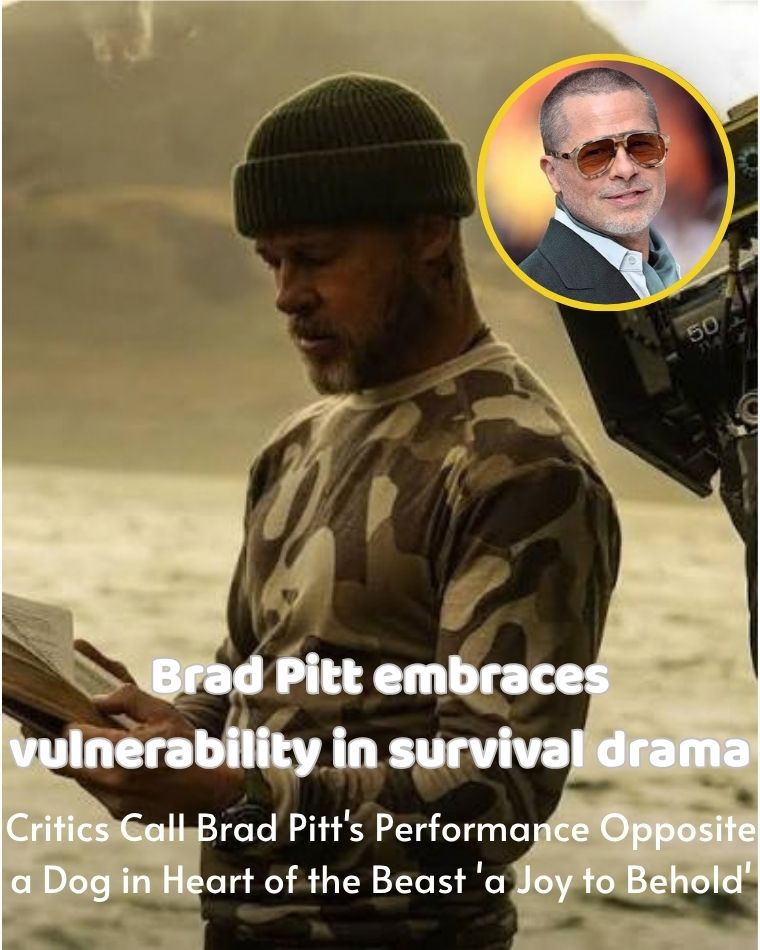
Cre: Wikimedia Commons
Director David Ayer experienced a nearly identical emotional reaction when he first evaluated the script.
Ayer described the text as a gentle yet fierce character portrait that read almost like a tone poem.
Like Pitt, Ayer confessed that reading the manuscript caused him to weep repeatedly, forcing him to pause before turning pages.
The mutual emotional response solidified an immediate creative pact between director and lead actor.
The duo had previously collaborated on the World War II tank thriller Fury, which was defined by claustrophobia and relentless violence.
By contrast, Heart of the Beast offered wide-open expanses where personal trauma had nowhere to hide.
Both filmmakers recognized that the project demanded absolute authenticity from everyone involved.
Pitt saw the narrative as a direct mirror to real emotional journeys that people experience far from cameras.
The character Belmont possesses elite tactical training, yet technical competence cannot shield him from profound vulnerabilities.
When his physical body experiences severe setbacks in the wild, Belmont’s self-reliance is completely shattered.
He must rely instead on the quiet fidelity of an animal partner to stay grounded.
This dynamic resonated profoundly with Pitt’s current personal outlook on navigating difficulty.
Rather than adopting an impenetrable exterior, Pitt has intentionally chosen to discuss human frailty openly with the public.
Speaking candidly during promotional appearances, Pitt reflected on why sharing the “human struggle” has become central to his perspective.
He pointed out that pretending life is effortless accomplishes nothing of genuine value.
“The human struggle is real, you know?” Pitt explained while discussing the philosophy behind the production.
“It’s a challenge and it’s an obstacle course and we need each other”.
His ultimate conclusion was as concise as it was impactful: “We can’t do it alone”.
For Pitt, recognizing that fundamental truth is liberating rather than weakening.
In modern society, solitary endurance is frequently glorified as the ultimate virtue.
Pitt views that mindset as an illusion that often leads to isolation.
He noted that people are inherently wired to form communities, provide care, and uplift those around them.
“What else are we here for?” Pitt mused during conversations surrounding the film’s premiere.
“Other than to connect and take care of each other and make each other better, why else are we here?”
That worldview directly informed how he portrayed Belmont’s psychological unraveling and subsequent renewal.
In the wilderness, when social hierarchies evaporate, the only currency that matters is genuine connection.
Belmont begins as a hardened recluse who avoids human contact and refuses even simple handshakes.
His solitary existence feels safe because it shields him from further heartache.
Yet isolation slowly becomes a cage that dulls his humanity.
Only through severe physical peril and unconditional animal companionship does he begin to soften.
Pitt explained that telling such stories is the primary reason he continues acting.
Unless a script contains authentic emotional truths, the actor admitted he would prefer to remain comfortably at home on his couch.
Elevating human experiences through cinema requires diving into spaces of uncertainty.
The demanding production environment of Heart of the Beast reflected those thematic challenges on a daily basis.
Filming in rugged outdoor locations meant there were virtually no comfortable breaks.
Cast and crew contended with biting cold, persistent moisture, and unpredictable terrain throughout the shoot.
Pitt stood in the elements during early sunrises and late evening wraps alongside his canine companion.
The four-legged lead, named Odin on screen, was primarily portrayed by a talented former rescue German Shepherd named Uber.
Uber was discovered in New Zealand by world-renowned animal trainer Andrew Simpson after extensive auditions across the country.
To handle diverse stunt sequences involving swimming, running, and heights, Uber was supported by his three sons as stunt doubles.
However, the expressive close-up work and core emotional heart of the character belonged strictly to Uber.
Working with a canine co-star brought an entirely distinct set of rules to the film set.
Animals cannot fake emotion, nor do they care about Hollywood status or past accolades.
To create genuine chemistry on screen, Pitt had to earn the animal’s trust completely.
The actor spent extensive time off-camera at the kennels observing Uber’s daily rhythms, energy levels, and behavioral cues.
He carried dog biscuits and cooked chicken everywhere he went to ensure a dependable rapport.
Ayer observed that Pitt learned to flow alongside the dog rather than trying to force scripted behaviors.
Whenever unexpected moments occurred during a take, Pitt adapted seamlessly to match the animal’s instincts.
The resulting performance feels remarkably unvarnished and raw.
Audiences witness an unscripted dialogue of gestures, eye contact, and shared fatigue.
The bond between Belmont and Odin serves as the beating pulse of the entire cinematic journey.
It demonstrates how devotion transcends spoken language when survival hangs in the balance.
David Ayer’s direction embraces visual restraint, allowing nature and human expression to tell the story.
Rather than relying on rapid dialogue or melodrama, extended stretches of the movie unfold in near silence.
Viewers observe Belmont setting up remote shelter, checking supplies, and navigating terrain alongside Odin.
Every action speaks to a man accustomed to self-sufficiency yet burdened by heavy internal scars.
A brief wilderness encounter with a passerby named Watkins, played by J.K. Simmons, highlights Belmont’s profound social detachment.
Belmont avoids conversation and keeps his distance, wary of opening himself up to human interaction.
Yet when catastrophic circumstances strip away his mobility, isolation becomes a lethal hazard rather than a refuge.
The narrative deliberately dismantles traditional masculine invulnerability.
Instead of an unstoppable action hero, the protagonist is an aging, wounded veteran facing physical limitations.
Pitt lean into those physical frailties with remarkable honesty.
He portrays the fear and exhaustion of a man who realizes his own body cannot conquer every obstacle alone.
The narrative proves that asking for help or depending on another soul is an act of courage.
In discussions of his broader career evolution, Pitt has consistently reflected on the importance of community and inner truth.
He views personal history not as something to bury, but as an opportunity for continuous learning.
Experiencing hardship has taught him that holding everything inside causes needless suffering.
By contrast, extending honesty toward others invites genuine empathy and shared healing.
Fans observing Pitt’s contemporary public appearances have noticed a distinct sense of peace and warmth.
He speaks with quiet humor, readily laughs at himself, and refuses to cultivate an aloof celebrity persona.
That personal groundedness directly mirrors the gentle core nestled inside Heart of the Beast.
The film stands apart from conventional survival spectacles that prioritize violence or high-octane stunts.
Instead, it functions as a tender exploration of mutual dependence and emotional rebirth.
Ayer noted that the project became a deeply personal mirror for his own past grief as well.
Having lost his father at an early age, Ayer recognized in Belmont’s journey a longing for healing and enduring loyalty.
Directing Pitt in this context allowed both artists to bring their mature reflections into every camera setup.
Every scene in the wilderness reinforces that strength is not found in emotional isolation.
Real resilience emerges from the humility to accept our shared human fragility.
As Pitt eloquently summarized, navigating life’s obstacle course requires companionship, trust, and openness.
Whether surviving the unforgiving mountains or navigating personal trials, no one is equipped to stand entirely alone.
With Heart of the Beast, Pitt and Ayer deliver a memorable tribute to the bonds that sustain the human spirit through every storm.
Slug: brad-pitt-heart-of-the-beast-emotional-interview
SEO Title: Brad Pitt on Heart of the Beast Script and Vulnerability
SEO Description: Brad Pitt opens up about tearing up over Heart of the Beast script, filming with his dog co-star, and why we cannot face human struggles alone.
SEO Keywords: Brad Pitt Heart of the Beast, Brad Pitt emotional interview, Brad Pitt dog movie, Brad Pitt vulnerability, David Ayer Brad Pitt, Heart of the Beast script
Brad Pitt has opened up about the emotional gravity behind his wilderness survival drama Heart of the Beast, revealing that the screenplay brought him to tears upon his very first reading.
The Academy Award winner explained how the intimate tale of a man navigating isolation with his canine companion mirrored his evolving perspective on empathy, emotional resilience, and mutual support.
At this stage in his life, the veteran actor emphasizes that acknowledging adversity is essential because nobody can truly survive life’s struggles alone.
Brad Pitt has spent decades navigating the glare of Hollywood stardom while portraying characters that defined cinematic masculinity.
Yet, when reading the screenplay for Heart of the Beast, the actor found himself stripped of emotional defenses.
The script struck a chord that was both unexpected and deeply grounding for the Hollywood heavyweight.
Pitt openly admitted to getting choked up as the narrative unfolded before him.
The raw depiction of love, wilderness survival, and endurance bypassed intellectual critique and struck straight at the heart.
For an actor who has seen countless scripts over forty years, experiencing an immediate physical and emotional reaction remains a rare occurrence.
He knew immediately that this specific story was one he could not simply pass by.
The drama focuses on former combat officer James Belmont and his loyal German Shepherd, Odin.
Stranded amidst unforgiving mountain terrain following an airborne emergency, Belmont is forced to confront harsh natural elements.
More significantly, he is forced to confront his inner isolation.
The screenplay captured Pitt’s imagination precisely because it stripped away the noisy spectacle of modern blockbuster filmmaking.
It replaced frantic dialogue with quiet resilience and non-verbal connection.
Director David Ayer experienced a nearly identical emotional reaction when he first evaluated the script.
Ayer described the text as a gentle yet fierce character portrait that read almost like a tone poem.
Like Pitt, Ayer confessed that reading the manuscript caused him to weep repeatedly, forcing him to pause before turning pages.
The mutual emotional response solidified an immediate creative pact between director and lead actor.
The duo had previously collaborated on the World War II tank thriller Fury, which was defined by claustrophobia and relentless violence.
By contrast, Heart of the Beast offered wide-open expanses where personal trauma had nowhere to hide.
Both filmmakers recognized that the project demanded absolute authenticity from everyone involved.
Pitt saw the narrative as a direct mirror to real emotional journeys that people experience far from cameras.
The character Belmont possesses elite tactical training, yet technical competence cannot shield him from profound vulnerabilities.
When his physical body experiences severe setbacks in the wild, Belmont’s self-reliance is completely shattered.
He must rely instead on the quiet fidelity of an animal partner to stay grounded.
This dynamic resonated profoundly with Pitt’s current personal outlook on navigating difficulty.
Rather than adopting an impenetrable exterior, Pitt has intentionally chosen to discuss human frailty openly with the public.
Speaking candidly during promotional appearances, Pitt reflected on why sharing the “human struggle” has become central to his perspective.
He pointed out that pretending life is effortless accomplishes nothing of genuine value.
“The human struggle is real, you know?” Pitt explained while discussing the philosophy behind the production.
“It’s a challenge and it’s an obstacle course and we need each other”.
His ultimate conclusion was as concise as it was impactful: “We can’t do it alone”.
For Pitt, recognizing that fundamental truth is liberating rather than weakening.
In modern society, solitary endurance is frequently glorified as the ultimate virtue.
Pitt views that mindset as an illusion that often leads to isolation.
He noted that people are inherently wired to form communities, provide care, and uplift those around them.
“What else are we here for?” Pitt mused during conversations surrounding the film’s premiere.
“Other than to connect and take care of each other and make each other better, why else are we here?”
That worldview directly informed how he portrayed Belmont’s psychological unraveling and subsequent renewal.
In the wilderness, when social hierarchies evaporate, the only currency that matters is genuine connection.
Belmont begins as a hardened recluse who avoids human contact and refuses even simple handshakes.
His solitary existence feels safe because it shields him from further heartache.
Yet isolation slowly becomes a cage that dulls his humanity.
Only through severe physical peril and unconditional animal companionship does he begin to soften.
Pitt explained that telling such stories is the primary reason he continues acting.
Unless a script contains authentic emotional truths, the actor admitted he would prefer to remain comfortably at home on his couch.
Elevating human experiences through cinema requires diving into spaces of uncertainty.
The demanding production environment of Heart of the Beast reflected those thematic challenges on a daily basis.
Filming in rugged outdoor locations meant there were virtually no comfortable breaks.
Cast and crew contended with biting cold, persistent moisture, and unpredictable terrain throughout the shoot.
Pitt stood in the elements during early sunrises and late evening wraps alongside his canine companion.
The four-legged lead, named Odin on screen, was primarily portrayed by a talented former rescue German Shepherd named Uber.
Uber was discovered in New Zealand by world-renowned animal trainer Andrew Simpson after extensive auditions across the country.
To handle diverse stunt sequences involving swimming, running, and heights, Uber was supported by his three sons as stunt doubles.
However, the expressive close-up work and core emotional heart of the character belonged strictly to Uber.
Working with a canine co-star brought an entirely distinct set of rules to the film set.
Animals cannot fake emotion, nor do they care about Hollywood status or past accolades.
To create genuine chemistry on screen, Pitt had to earn the animal’s trust completely.
The actor spent extensive time off-camera at the kennels observing Uber’s daily rhythms, energy levels, and behavioral cues.
He carried dog biscuits and cooked chicken everywhere he went to ensure a dependable rapport.
Ayer observed that Pitt learned to flow alongside the dog rather than trying to force scripted behaviors.
Whenever unexpected moments occurred during a take, Pitt adapted seamlessly to match the animal’s instincts.
The resulting performance feels remarkably unvarnished and raw.
Audiences witness an unscripted dialogue of gestures, eye contact, and shared fatigue.
The bond between Belmont and Odin serves as the beating pulse of the entire cinematic journey.
It demonstrates how devotion transcends spoken language when survival hangs in the balance.
David Ayer’s direction embraces visual restraint, allowing nature and human expression to tell the story.
Rather than relying on rapid dialogue or melodrama, extended stretches of the movie unfold in near silence.
Viewers observe Belmont setting up remote shelter, checking supplies, and navigating terrain alongside Odin.
Every action speaks to a man accustomed to self-sufficiency yet burdened by heavy internal scars.
A brief wilderness encounter with a passerby named Watkins, played by J.K. Simmons, highlights Belmont’s profound social detachment.
Belmont avoids conversation and keeps his distance, wary of opening himself up to human interaction.
Yet when catastrophic circumstances strip away his mobility, isolation becomes a lethal hazard rather than a refuge.
The narrative deliberately dismantles traditional masculine invulnerability.
Instead of an unstoppable action hero, the protagonist is an aging, wounded veteran facing physical limitations.
Pitt lean into those physical frailties with remarkable honesty.
He portrays the fear and exhaustion of a man who realizes his own body cannot conquer every obstacle alone.
The narrative proves that asking for help or depending on another soul is an act of courage.
In discussions of his broader career evolution, Pitt has consistently reflected on the importance of community and inner truth.
He views personal history not as something to bury, but as an opportunity for continuous learning.
Experiencing hardship has taught him that holding everything inside causes needless suffering.
By contrast, extending honesty toward others invites genuine empathy and shared healing.
Fans observing Pitt’s contemporary public appearances have noticed a distinct sense of peace and warmth.
He speaks with quiet humor, readily laughs at himself, and refuses to cultivate an aloof celebrity persona.
That personal groundedness directly mirrors the gentle core nestled inside Heart of the Beast.
The film stands apart from conventional survival spectacles that prioritize violence or high-octane stunts.
Instead, it functions as a tender exploration of mutual dependence and emotional rebirth.
Ayer noted that the project became a deeply personal mirror for his own past grief as well.
Having lost his father at an early age, Ayer recognized in Belmont’s journey a longing for healing and enduring loyalty.
Directing Pitt in this context allowed both artists to bring their mature reflections into every camera setup.
Every scene in the wilderness reinforces that strength is not found in emotional isolation.
Real resilience emerges from the humility to accept our shared human fragility.
As Pitt eloquently summarized, navigating life’s obstacle course requires companionship, trust, and openness.
Whether surviving the unforgiving mountains or navigating personal trials, no one is equipped to stand entirely alone.
With Heart of the Beast, Pitt and Ayer deliver a memorable tribute to the bonds that sustain the human spirit through every storm.
Để lại một phản hồi