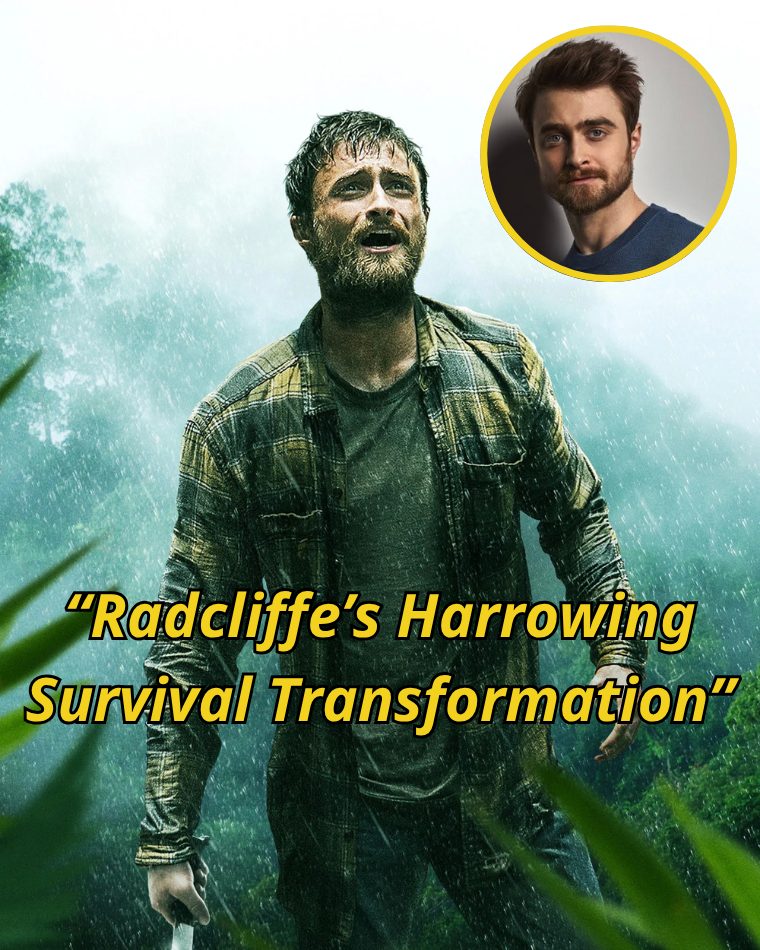
The gripping wilderness thriller Jungle is currently captivating streaming audiences worldwide, offering cinema fans a striking encounter with one of Daniel Radcliffe’s most relentless performances.
Adapted directly from Yossi Ghinsberg’s harrowing autobiographical survival chronicle, the feature film re-examines the young Israeli adventurer’s near-fatal three-week disappearance deep within the uncharted Bolivian Amazon in 1981.
Viewers seeking authentic tension, high-stakes human endurance, and visceral psychological realism will find the motion picture an uncompromising exploration of life against unforgiving wilderness.
For lead actor Daniel Radcliffe, portraying Ghinsberg meant shedding significant body weight and confronting hostile real-world filming environments that pushed his physical and emotional stamina beyond all previous boundaries.
Unlike standard Hollywood blockbusters shot on safe soundstages, the production immersed its cast in authentic jungle settings that echo the peril faced by real backpackers decades ago.
The result stands out as a defining chapter in the actor’s career, demonstrating his steadfast dedication to gritty storytelling, complex character vulnerabilities, and daring cinematic risks.
Cre: Umbrella Entertainment / Wikimedia Commons
The Chilling True Encounter in the Bolivian Amazon
The terrifying events captured in the feature film originated in late 1981, when 22-year-old Israeli traveller Yossi Ghinsberg completed his military naval service and set out for South America.
Long drawn to exploration after reading survival literature such as Henri Charrière’s Papillon, Ghinsberg harboured dreams of encountering undiscovered indigenous communities deep inside untouched rainforests.
While hitchhiking through South America, Ghinsberg befriended Marcus Stamm, a gentle Swiss primary school teacher.
The two companions eventually arrived in La Paz, Bolivia, where their fateful path crossed with Kevin Gale, an enthusiastic American photographer.
In the high-altitude capital, the trio met Karl Ruprechter, an Austrian expatriate who boldly presented himself as a knowledgeable geologist and seasoned jungle explorer.
Ruprechter captivated the young men with stories of hidden gold deposits and isolated Tacana villages situated deep along the uncharted Amazonian river systems.
Enticed by promises of rare adventure, the four men flew by charter to Apolo before plunging down into the dense rainforest trails alongside the Tuichi River.
However, the expedition quickly unravelled as supplies dwindled, basic provisions failed, and severe physical exhaustion began to torment the group.
Deep tensions emerged within the party when Marcus developed severe foot infections, causing him excruciating pain with every step.
The group decided to construct a wooden raft to navigate downstream, hoping the river currents would ease their arduous journey.
Their fragile unity fractured entirely when Ruprechter admitted he could not swim and refused to navigate the dangerous San Pedro Canyon rapids.
The party made the irreversible choice to split into two separate pairs.
Ruprechter and Stamm opted to trek back overland through the jungle toward civilisation.
Tragically, neither Ruprechter nor Stamm was ever seen again, vanishing without a trace into the unforgiving wilderness.
Meanwhile, Ghinsberg and Gale continued navigating the volatile river atop their precarious raft.
Within moments of approaching a treacherous waterfall canyon, monstrous rapids seized their vessel.
Gale managed to scramble to the safety of the rocky riverbank.
Ghinsberg, however, was swept uncontrollably over the falls, hurled downstream, and separated from all supplies, navigation tools, and companionship.
Three Weeks Trapped in an Unforgiving Green Abyss
Following the disastrous plunge over the falls, Ghinsberg spent four frantic days marching upstream along the riverbanks in an attempt to locate Gale.
Reality settled into cold dread when the young Israeli realized he was completely stranded alone in an uninhabited, uncharted wilderness.
What ensued was a three-week struggle against sheer starvation, predatory wildlife, relentless moisture, and psychological decay.
Without a rifle, compass, matches, or proper wilderness gear, Ghinsberg had to rely entirely on raw instinct to survive.
He foraged desperately for wild fruits and bird eggs to stay alive, but nourishment remained scarce and erratic.
The elements proved equally punishing, as severe rainfall caused flash floods that swept through the forest floor and nearly drowned him in muddy bogs on multiple occasions.
His physical body began deteriorating under the constant humidity and rampant parasite activity.
At one point, aggressive flesh-burrowing botfly larvae nested inside his forehead tissue, forcing him to painfully squeeze out dozens of worms using makeshift tools.
Colonies of vicious red biting ants and nocturnal termites swarmed over his exposed skin at night, feeding on his raw flesh while he lacked the strength to fight them off.
To evade a predatory jaguar tracking him closely through dense underbrush, Ghinsberg recalled an improvised weapon idea and turned an insect repellant can and a lighter into a crude flamethrower.
Fungal rot ate relentlessly into his wet feet, stripping away outer layers of skin and making every forward step an agony.
As starvation pushed his mental sanity to the edge, Ghinsberg experienced profound hallucinations to cope with the crushing isolation.
He imagined the persistent company of a young woman whom he protected and slept beside each night, using the vision to summon inner resilience when despair tempted him toward suicide.
Against overwhelming mathematical odds, Gale had survived his own ordeal, reached local indigenous villages downstream, and refused to abandon hope for his lost companion.
Teaming up with local indigenous searchers aboard a small motor canoe, Gale navigated the waterways for days searching for any sign of life.
Just as search teams were preparing to declare the mission hopeless after three exhausting weeks, Ghinsberg heard the faint, distant hum of an engine breaking the jungle silence.
Gale and the local rescue party found Ghinsberg collapsed on the muddy riverbank, emaciated by 35 pounds of severe weight loss and barely clinging to life.
Daniel Radcliffe’s Radical Transformation and Preparation
Translating this visceral historical journey into a cinematic narrative demanded an actor capable of shedding all vanity and pushing physical endurance to the limit.
Director Greg McLean, widely recognized for his unflinching Australian survival films, sought complete authenticity rather than reliance on digital illusions.
Daniel Radcliffe committed himself wholeheartedly to the lead role, viewing Ghinsberg’s story as a profound exploration of human endurance and existential discovery.
To accurately depict the physical ravages of prolonged starvation, Radcliffe undertook an extreme dietary regimen under strict supervision.
The actor starved himself down to an emaciated frame, shedding considerable weight over the course of the production to mirror the 35 pounds Ghinsberg lost during his three weeks stranded alone.
Radcliffe spent weeks consuming minimal caloric intake, living primarily on a restricted diet consisting of small fish portions, protein powders, and raw vegetables.
Beyond dietary deprivation, Radcliffe insisted on experiencing the harsh tactile realities of the wilderness during principal photography.
Rather than relying heavily on soundstages in London or Los Angeles, the crew shot extensively on practical river and rainforest locations across Colombia and Australia.
Radcliffe plunged into freezing rapids, dragged himself through real mud bogs, and endured swarms of real tropical insects to maintain the scene’s raw intensity.
The production spent weeks filming in rural Colombian environments such as Tobia, Guaduas, and Honda, confronting extreme natural humidity and difficult terrain.
Additional jungle sequences were completed amidst the dense rainforests of Mount Tamborine in Queensland, Australia.
Radcliffe worked intensively with dialect instructors to master Ghinsberg’s distinctive Israeli speech rhythm and inflection.
The actor also spent meaningful time conversing directly with the real Yossi Ghinsberg, absorbing the mental, emotional, and spiritual lessons learned during the ordeal.
Ghinsberg later noted with deep admiration that Radcliffe had achieved something remarkable on camera, capturing the essence of the experience without theatrical excess.
The real-life survivor praised Radcliffe for carrying the immense weight of the role with humility, sincerity, and total physical surrender.
Gritty Realism and Key Survival Depictions on Screen
Jungle distinguishes itself from typical Hollywood survival cinema by refusing to romanticise the perils of nature.
The movie does not portray the Amazon rainforest as a picturesque, exotic backdrop, but rather as an indifferent, relentless ecological machine.
One of the production’s greatest technical achievements lies in its portrayal of river rapids and whitewater navigation.
The sequence depicting Ghinsberg and Gale losing control of their makeshift log raft conveys genuine, chaotic velocity.
Practical stunts, in-river camera rigs, and authentic river environments give the crash an immediate sense of mortal danger.
When Ghinsberg plunges over the cataract, the audience feels the disorienting, claustrophobic fury of water pinning a man down against jagged river stones.
The film also captures the quiet, insidious biological threats that define true jungle survival.
Viewers are subjected to wince-inducing scenes of parasitic infection, including the infamous removal of a botfly larva embedded beneath Radcliffe’s forehead skin.
The progressive decay of Ghinsberg’s feet, ruined by fungal rot and incessant moisture, is rendered with meticulous practical makeup effects that convey agonizing reality.
Furthermore, the script delves deep into the psychological fracturing that accompanied Ghinsberg’s isolation.
As the days blur into weeks, the film transitions from an external action survival scenario into a psychological chamber piece.
Hallucinatory dreamscapes, sudden flashes of family memory, and phantom interactions seamlessly weave into the swamp landscape.
The camera lingers closely on Radcliffe’s sunken facial features, wild eyes, and frantic breathing, capturing a mind wrestling with madness.
Despite the agonizing bodily degradation, the film highlights an essential theme from Ghinsberg’s memoirs: the triumph of the human spirit over passive despair.
Surviving was not merely about avoiding physical predators, but about making the disciplined conscious choice to live each passing hour.
The rescue sequence near the climax avoids melodramatic fanfare, presenting Gale’s arrival as a fragile, emotional miracle forged through unwavering loyalty.
Critical Legacy, Streaming Availability, and Why Jungle Stands Out
Since its initial festival circuit rollout and home media run, Jungle has steadily grown into a celebrated modern survival classic.
Film critics widely praised Radcliffe’s performance, recognizing it as one of the boldest, most demanding turns in his post-franchise career.
Rather than relying on safe, familiar roles, Radcliffe has consistently chosen eccentric, challenging projects that showcase genuine artistic courage.
His portrayal of Yossi Ghinsberg required a degree of vulnerability, stamina, and psychological honesty that few contemporary leading actors are willing to risk.
Reviewers frequently drew favourable comparisons to harrowing survival milestones like Alejandro González Iñárritu’s The Revenant, noting that Jungle achieves equivalent tension on a far more intimate budget.
The film also honors the complex human history surrounding the tragic 1981 expedition.
The mysterious, permanent disappearance of Marcus Stamm and Karl Ruprechter remains an open, haunting wound in the narrative.
Decades after the event, search parties and regional authorities have never uncovered any trace of the missing men or their equipment.
In the aftermath of his rescue, Ghinsberg spent months recovering in medical care before dedicating years of his life back to the Amazon.
He returned to the Tuichi River region in Bolivia, partnering with the indigenous Tacana-Quechua people of San José de Uchupiamonas to establish Chalalan, an internationally acclaimed solar-powered eco-lodge.
His transformative experiences became best-selling books that inspired global audiences, motivational speaking tours, and international wilderness conservation initiatives.
For audiences seeking an adrenaline-charged wilderness drama, Jungle is currently available on major digital streaming platforms, including Amazon Prime Video and select regional services like Netflix.
Viewers tuning into the film should prepare for a breathless, visceral, and emotionally resonant cinematic journey.
It remains a testament to the miraculous capacity of human beings to endure unimaginable hardship against nature’s fiercest elements.
Through Daniel Radcliffe’s career-defining commitment, the harrowing survival tale of Yossi Ghinsberg continues to inspire and shock viewers across the world.
Để lại một phản hồi