How Daniel Radcliffe Escaped the Boy Wizard Curse to Build Cinema’s Most Fearless Career
Daniel Radcliffe’s post-Potter filmography represents one of the most deliberate, audacious franchise escapes in contemporary cinema history.
Rather than chasing lucrative studio blockbusters that would trap him in familiar archetypes, the British actor methodically broke his adolescent screen identity through audacious indie projects, physically grueling stage roles, and radical character transformations.
By weaponizing the immense financial security earned from the wizarding franchise, Radcliffe built an eclectic career defined by artistic bravery, proving that taking immense creative risks remains the ultimate antidote to Hollywood typecasting.
Breaking Free from the Shadow of a Global Phenomenon
Stepping away from a character that defined an entire generation of moviegoers is widely regarded as one of the most perilous hurdles in modern entertainment.
Child stars who lead massive commercial sagas routinely find themselves constrained by narrow industry perceptions and audience expectations that freeze them in adolescence.
For Daniel Radcliffe, playing the iconic boy wizard across eight blockbuster films brought worldwide fame, unprecedented financial security, and an urgent artistic challenge.
Casting directors and mainstream moviegoers spent an entire decade identifying him solely as the chosen wizard of cinema.
To ensure long-term artistic relevance, Radcliffe recognized that conventional Hollywood pathways would only reinforce that static perception.
Instead of seeking comparable big-budget studio leads, he adopted a counterintuitive strategy built around disruption and creative friction.
His post-Potter approach focused on challenging the audience’s comfort zone while deliberately disassembling his squeaky-clean cinematic image.
Every career decision became an opportunity to showcase range, emotional vulnerability, and an appetite for unorthodox narrative concepts.
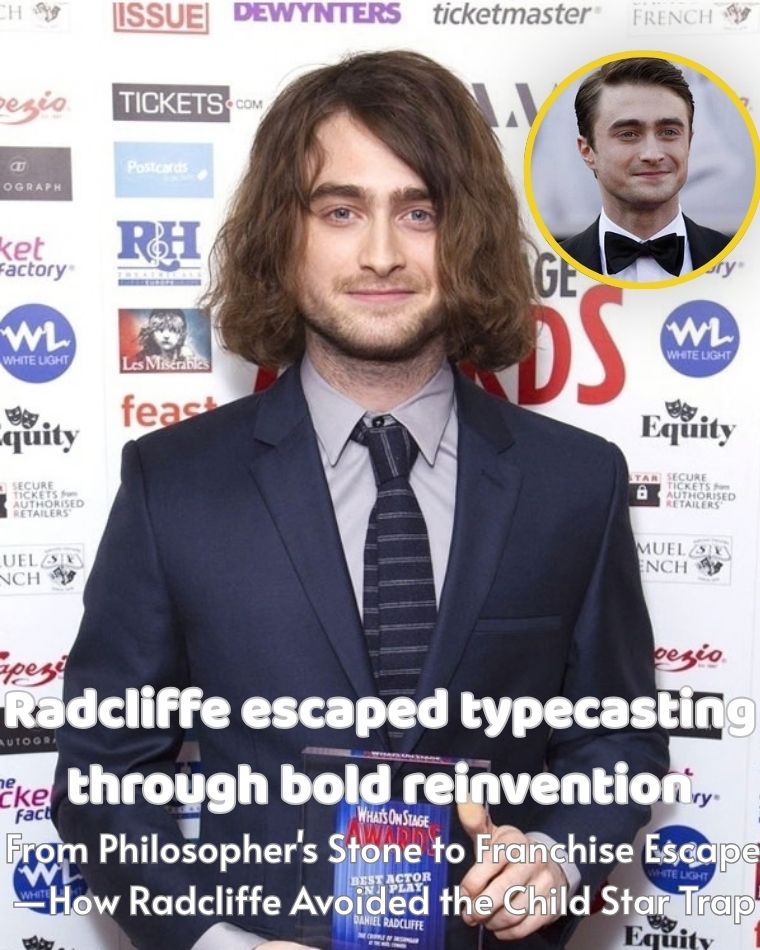
Cre: Wikimedia Commons — Gage Skidmore (CC BY-SA 2.0)
The Legitimizing Crucible of Live Theater
Radcliffe’s reinvention did not begin after the cinematic franchise wrapped; it started right in the middle of it.
In 2007, while still filming the magical series, the teenage actor took on Peter Shaffer’s dark psychological play, Equus.
Staged in London’s West End and subsequently on Broadway, the production demanded raw psychological intensity and a fully nude performance.
The artistic choice sent shockwaves through the entertainment industry and dominated international headlines.
Critics quickly realized that Radcliffe was deeply serious about honing the technical mechanics of acting.
The stage offered immediate feedback, disciplined vocal control, and a physical vulnerability that cameras could never replicate.
He reinforced this theatrical credibility by tackling the demanding musical How to Succeed in Business Without Really Trying on Broadway in 2011.
Taking on complex vocal arrangements and extensive dance choreography proved his willingness to master demanding stage disciplines.
Theater served as a rigorous training ground where franchise stardom held zero currency under the scrutiny of live audiences.
These theatrical runs successfully laid the groundwork for an adult career rooted in genuine craft rather than celebrity momentum.
Radical Shifts into the Absurd and the Uncomfortable
Following the completion of the final film in the wizard saga, Radcliffe deliberately avoided safe, predictable leading-man roles.
He actively sought out odd, provocative scripts that established filmmakers and conventional leading men frequently avoided.
Perhaps no film epitomized this creative philosophy better than the 2016 surreal comedy-drama Swiss Army Man.
Directed by Daniel Kwan and Daniel Scheinert, the narrative required Radcliffe to portray a flatulent, talking corpse named Manny.
Playing a multipurpose corpse stranded on an island demonstrated an absolute lack of vanity.
Radcliffe committed fully to the absurd physical comedy and existential pathos demanded by the offbeat premise.
Critics praised the performance for its bizarre sweetness, physical precision, and sheer narrative bravery.
The role sent a definitive signal across the film industry: Radcliffe was entirely unconcerned with safeguarding a polished superstar veneer.
Willingness to look ridiculous in service of original storytelling quickly emerged as his definitive artistic calling card.
Each bizarre creative swing expanded the boundaries of what filmmakers could envision him doing on screen.
Physical Metamorphosis as an Acting Tool
Beyond conceptual weirdness, Radcliffe committed to rigorous physical transformations that erased his familiar youthful silhouette.
In the 2017 biographical survival drama Jungle, directed by Greg McLean, he portrayed real-life adventurer Yossi Ghinsberg.
To authentically portray a man lost in an uncharted section of the Amazon rainforest, Radcliffe underwent extreme weight loss.
The resulting gaunt frame, hollow eyes, and visceral desperation effectively shocked viewers who remembered him as a schoolboy hero.
His harrowing physical and mental descent conveyed real isolation, starvation, and sheer survival instinct.
Radcliffe spent weeks filming in punishing environments, enduring torrential conditions and treacherous river terrain.
This intense physical dedication reaffirmed that he was eager to put his body through arduous challenges to achieve authentic realism.
Another striking transformation came with the 2016 dramatic thriller Imperium, directed by Daniel Ragussis.
Radcliffe played Nate Foster, an introverted, nebbish FBI analyst who shaves his head to infiltrate a violent white supremacist gang.
The role required him to navigate claustrophobic psychological tension and unsettling ideological spaces without relying on conventional heroism.
His portrayal of an anxious, terrified operative relying solely on intellect highlighted an impressive dramatic range.
By oscillating between extreme physical degradation and high-stakes psychological paranoia, Radcliffe continued dismantling his former screen persona.
The Freedom of Financial Independence
Radcliffe’s radical artistic trajectory cannot be separated from the immense financial fortune he secured before his twenty-first birthday.
Accumulating generational wealth during his youth granted him a rare, privileged position within the entertainment industry.
Radcliffe has consistently acknowledged this financial cushion with remarkable candor and humility in interviews.
Unlike most working actors, he was never forced to accept uninspiring commercial studio projects merely to maintain an income.
He utilized his financial freedom precisely as an artistic buffer, funding his appetite for uncompromised creative exploration.
Radcliffe weaponized his box-office earnings to underwrite projects directed by daring indie storytellers.
His presence often helped bizarre, lower-budget scripts secure international distribution and financing.
Rather than buying luxury brands or fading into comfortable early retirement, he treated independent filmmaking as an ongoing creative laboratory.
This financial security allowed him to prioritize personal curiosity over commercial safety nets at every single juncture.
He transformed the potentially suffocating legacy of childhood fame into an engine for relentless artistic experimentation.
The Power of Counter-Intuitive Casting
Radcliffe’s career choices also revealed a keen instinct for subverting audience expectations through deliberate genre-hopping.
He tackled Gothic horror in The Woman in Black, supernatural body horror in Horns, and dark comedy in Guns Akimbo.
In Guns Akimbo, he played an ordinary nerd with handguns surgically bolted to his hands, sprinting through a deadly live-streamed contest.
The film embraced over-the-top, hyper-violent satire that contrasted sharply with traditional Hollywood sensibilities.
Radcliffe simultaneously embraced television comedy, starring in the surreal anthology series Miracle Workers.
Across multiple seasons of the show, he portrayed an insecure angel, a dim-witted feudal prince, and a frontier reverend performing flamboyant musical numbers.
His willingness to lampoon his own public stature showcased comedic timing that few mainstream blockbusters allow.
In 2022, Radcliffe took on another delightfully offbeat assignment: portraying musical parodist “Weird Al” Yankovic.
His committed performance in Weird: The Al Yankovic Story earned him critical acclaim and major awards nominations.
Playing an exaggerated, hyper-masculine, fictionalized version of a comedy legend demonstrated how thoroughly he had redefined his public brand.
He turned an inherent professional disadvantage—being recognized instantly everywhere—into an unpredictable asset by consistently subverting what audiences expected to see next.
Refusing to Protect an Inflexible Screen Image
One of the most persistent traps awaiting child actors is the protective instinct to project maturity through stern, overly serious roles.
Many young stars overcompensate by pursuing gritty, brooding studio action roles designed to announce their adult masculinity.
Radcliffe consciously rejected that hollow cinematic posturing from day one.
He was never afraid to look foolish, pathetic, physically clumsy, or emotionally unhinged on camera.
By stripping away the self-consciousness that plagues so many former child performers, he unlocked exceptional creative flexibility.
Audiences began watching his projects not to see what the former boy wizard looked like now, but to see what insane premise he had chosen to champion.
His filmography developed an unpredictable, boutique reputation among contemporary cinephiles.
Filmgoers understood that a project featuring Daniel Radcliffe was almost guaranteed to offer an unusual, highly distinctive point of view.
He shifted the public discourse away from nostalgia and squarely toward admiration for his daring choices.
His ongoing career evolution proved that sustained longevity in entertainment is constructed through authentic curiosity rather than rigid brand preservation.
A Blueprint for Modern Franchise Performers
Daniel Radcliffe’s journey provides a masterclass for contemporary actors emerging from sprawling, multi-year franchises.
In an era dominated by superhero universes and streaming monopolies, young performers are frequently trapped within corporate franchise ecosystems.
Breaking out of those corporate ecosystems requires genuine discipline, strategic vision, and an appetite for professional discomfort.
Radcliffe showed that the most effective way to escape a defining persona is not to fight it aggressively, but to outwork it across diverse mediums.
He established that theatrical credibility cannot be manufactured by publicists; it must be earned on stage night after night.
He demonstrated that indie weirdness provides far superior creative insulation than middling studio action movies.
Above all, his creative path proves that specificity and unique perspective carry far greater enduring value than broad, watered-down commercial appeal.
Radcliffe never attempted to make audiences forget the boy wizard who launched his life.
Instead, he expanded his body of work so thoroughly that the wizarding franchise became merely the introductory chapter of an extraordinary creative odyssey.
Today, casting directors no longer view Daniel Radcliffe through the prism of youthful nostalgia.
They recognize a versatile, fearless character actor who approaches cinema with genuine reverence, endless humor, and tireless artistic dedication.
His triumphant post-franchise reinvention stands as an undeniable benchmark for the entire film industry.
Để lại một phản hồi