Chris Hemsworth undertook a striking physical and vocal transformation to portray the tyrannical warlord Dementus in George Miller’s post-apocalyptic spectacle Furiosa: A Mad Max Saga. Rather than relying on his familiar contemporary Australian speech or heroic cadence, the actor studied vintage broadcast recordings and drew deeply upon memories of his own grandfather to construct an unforgettable wasteland voice. This detailed exploration uncovers how historical research, family memory, and directorial freedom aligned to produce one of the actor’s most daring screen performances.
When audiences first witnessed Chris Hemsworth charging across the desert wasteland in Furiosa: A Mad Max Saga, many were immediately struck by the strange cadence and high-pitched, theatrical cadence of his delivery.
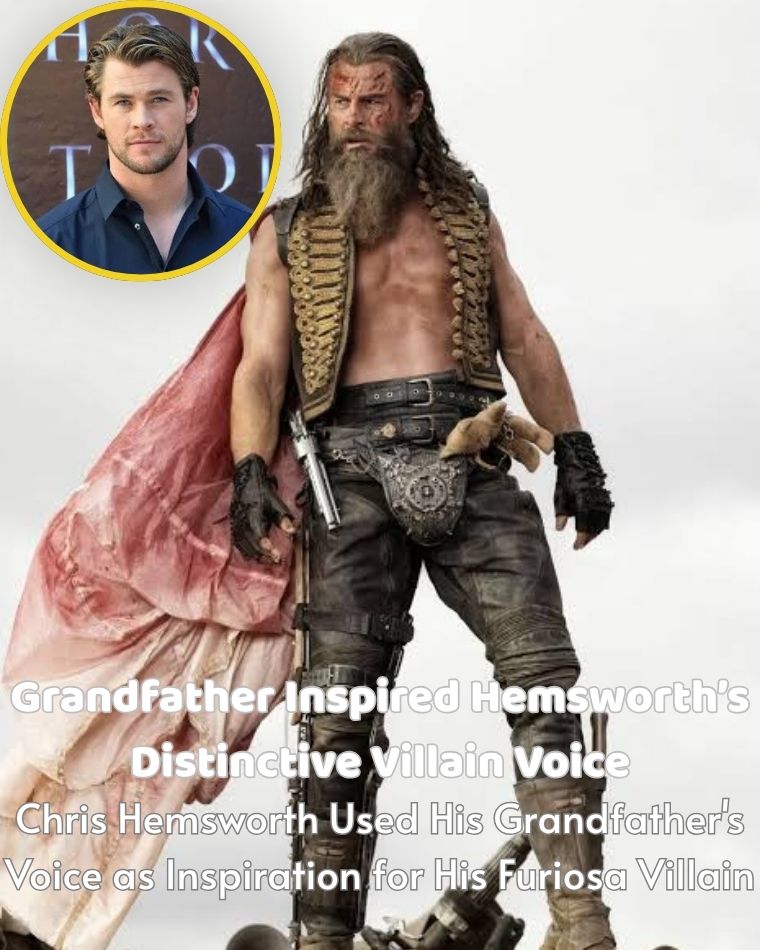
Behind the prosthetic nose, the flowing beard, and the eccentric chariot pulled by motorcycles stood an actor determined to strip away every shred of his recognizable heroic screen persona.
For over a decade, millions of cinema patrons around the globe had grown accustomed to hearing Hemsworth speak with deep, booming authority as Marvel’s god of thunder, Thor.
Yet inside the violent, mythic universe established by visionary Australian director George Miller, heroic familiarity had no place.
From the moment Hemsworth secured the role of the despotic warlord Dementus, he recognized that an unusual physical presence demanded an equally unexpected vocal architecture.
To build that unique sonic identity, Hemsworth looked far into the past rather than relying on standard movie villain accents.
He found his central artistic inspiration in archival Australian broadcasts from the 1970s and 1980s, alongside cherished childhood memories of how his own grandfather used to speak.
Cre: Gage Skidmore / Wikimedia Commons
The creative journey that led to this bold stylistic experiment began with Hemsworth’s lifelong admiration for George Miller’s legendary cinematic career.
Miller had permanently transformed modern action cinema decades earlier with the original Mad Max trilogy, before returning to shock the medium anew with Mad Max: Fury Road in 2015.
Hemsworth was among the millions who watched Fury Road with absolute awe when it arrived in theaters.
He later recounted that the relentless pacing, visual precision, and narrative density of Fury Road cemented his dream of one day collaborating with Miller on a cinematic project.
When Miller began developing Furiosa as a sprawling prequel detailing the origin of Charlize Theron’s iconic character, Hemsworth actively pursued the opportunity to join the production.
Landing the role of Dementus placed the actor in a position unlike any he had occupied in blockbuster Hollywood films up to that point.
Dementus was not merely another one-dimensional villain designed solely to clash with the protagonist and provide explosive action set pieces.
Instead, Miller’s script presented Dementus as a tragic, charismatic, yet deeply monstrous tyrant forged entirely by the unforgiving brutality of the Wasteland.
To inhabit such a complicated figure, Hemsworth realized that physical prosthetics and colorful cloaks alone would not suffice.
The character required a distinctive voice that immediately communicated history, eccentricity, and dangerous volatility.
In a comprehensive interview broadcast in May 2024 on ABC Australia’s flagship current affairs program 7.30, Hemsworth broke down his methodical approach to the role.
He explained to interviewer Sarah Ferguson that he consciously rejected the idea of letting Dementus sound like a modern, everyday Australian.
A contemporary suburban Australian accent would feel instantly jarring and out of place in a mythical, degraded post-apocalyptic future.
At the same time, giving the character a standard theatrical British accent or generic American speech would erase the distinct Australian heritage inherent to the entire Mad Max franchise.
To resolve this creative dilemma, Hemsworth embarked on an auditory investigation into how Australian speech patterns had evolved across recent generations.
He began sourcing and listening attentively to vintage television and radio interviews broadcast throughout Australia during the 1970s and 1980s.
These historical recordings revealed vocal qualities, cadence choices, and distinct rhythmic traits that have largely faded from modern urban discourse.
The older speakers in those broadcast archives often spoke with a theatrical precision combined with a raw, distinctively dry rural drawl.
As Hemsworth immersed himself in these historical recordings, an intimate and deeply personal reference point surfaced in his mind.
He was reminded of his own grandfather’s voice and the peculiar, memorable way the older man communicated stories and life experiences.
His grandfather possessed a particular cadence—a mix of theatrical storytelling, rhythmic pauses, and an elevated tonal register that stayed etched in Hemsworth’s memory.
It is important to emphasize that Hemsworth’s grandfather did not serve as a direct dialogue coach or formal vocal trainer for the Hollywood production.
Rather, the actor retrieved personal sensory memories of his grandfather’s speech habits to inform the emotional heart and vocal mannerisms of Dementus.
Hemsworth blended those fond familial recollections with the cadences he isolated from the vintage 1970s and 1980s broadcast archives.
The resulting dialect featured an unexpected pitch that oscillated between pompous public oratory and unhinged, gravelly desperation.
It produced a figure who spoke through a megaphone to legions of desert scavengers not as a cold calculating general, but as an eccentric carnival barker leading a mobile circus of terror.
When Hemsworth first presented these vocal ideas and character sketches to George Miller, he did so with natural nervousness.
Taking an established Hollywood superstar and radically modifying his vocal signature carries significant commercial and creative risks for a massive studio tentpole.
Yet Miller responded to Hemsworth’s vocal experiment with enthusiastic and unwavering support.
Miller had always viewed the Mad Max universe not merely as an action landscape, but as a heightened mythic realm populated by larger-than-life figures.
The director understood immediately that this older, idiosyncratic vocal cadence gave Dementus an authentic sense of individuality and generational age inside the Wasteland.
Miller actively encouraged Hemsworth to lean deeper into these historical vocal quirks, allowing the actor to improvise and play with vocal pitch across different scenes.
This directorial freedom allowed Hemsworth to explore nuances in Dementus that transcended simple cinematic cruelty.
Dementus speaks with an odd, grandfatherly familiarity even while inflicting unspeakable violence upon his victims and rivals.
That disturbing contrast between eccentric charm and sudden brutality became the signature trait of Hemsworth’s performance.
During public discussions and a special retrospective Q&A hosted by the National Board of Review in May 2024, both Hemsworth and Miller elaborated on this unique collaborative journey.
Miller pointed out that compelling storytelling often emerges when an actor draws genuine elements from real-world observation and personal heritage.
For Hemsworth, Furiosa provided a long-awaited artistic departure from the familiar confines of playing righteous champions.
Throughout his career, leading roles often required him to project straightforward strength, stoicism, and unwavering moral resolve.
Playing Dementus allowed him to dismantle those familiar expectations entirely.
He was able to dive headfirst into ugly vanity, chaotic vulnerability, philosophical rambling, and visceral cruelty.
The harsh environment of the Wasteland demands brutal adaptation, and Dementus was shaped entirely by the grief and survival instincts that that ruined world forged.
Hemsworth wanted the audience to hear the psychological scars of that wasteland existence directly within the character’s erratic vocal deliveries.
When Dementus delivers speeches to his biker horde, the cadence mimics an eccentric town hall orator clinging desperately to fragments of an extinct pre-collapse civilization.
When Dementus whispers in moments of impending defeat, the voice breaks into the thin, reedy rasp of an old wanderer worn down by endless violence.
The vocal design seamlessly complemented the meticulous external characterization crafted by the film’s costume and makeup departments.
Dementus carried an eccentric array of relics, from a teddy bear strapped to his chest to a cape that shifted color from white to dirty red as the story advanced.
Without the specific voice derived from older Australian accents and his grandfather’s rhythm, those physical props might have felt like empty eccentricities.
Instead, the vocal quality unified every bizarre visual choice into a cohesive, believable personality living on the fringes of sanity.
Reflecting on the critical reception following the global premiere of Furiosa: A Mad Max Saga, many film analysts singled out Hemsworth’s vocal choices as the film’s most pleasant surprise.
Critics noted that rather than coasting on charismatic celebrity, Hemsworth completely dissolved into the strange texture of Miller’s world.
The choice to avoid contemporary Australian slang and modern flat vowels allowed the fictional lore of the franchise to maintain its timeless, fable-like atmosphere.
Cinema history is filled with memorable antagonists whose identities were defined almost entirely through calculated vocal decisions.
From the chilling theatricality of classic Shakespearean performances to the stylized mannerisms of iconic cinema villains, voice remains an actor’s most immediate tool.
In Hemsworth’s case, anchoring a high-concept sci-fi villain in authentic domestic history proved remarkably effective.
By listening to recordings from decades prior, the actor tapped into real cultural rhythms that modern media consumers rarely encounter today.
By filtering those historical recordings through personal memories of his grandfather, he gave those abstract acoustic patterns real human warmth and emotional credibility.
The success of Dementus highlights how creative risk-taking can revitalize an established screen career.
After playing one of the most recognizable superhero figures on Earth for over a decade, Hemsworth demonstrated that he possesses the range and courage of a true character actor.
He showed an eagerness to look strange, sound weird, and challenge the expectations of audience members worldwide.
His work with George Miller proves that even within the gigantic scale of summer blockbuster cinema, intimate personal memories can drive major creative decisions.
As audiences and film students continue to analyze Furiosa: A Mad Max Saga in the years to come, Hemsworth’s Dementus will stand as an inspiring case study in character construction.
It reveals how an actor can synthesize historical investigation, deep cinematic collaboration, and private family history to birth something entirely original on screen.
Miller’s post-apocalyptic saga has always been renowned for spectacular practical stunts and visionary world-building.
Yet in the end, it is human choices—like an actor deciding to honor the voice of an older generation amid the roaring engines—that give those desolate sands their enduring power.
Để lại một phản hồi