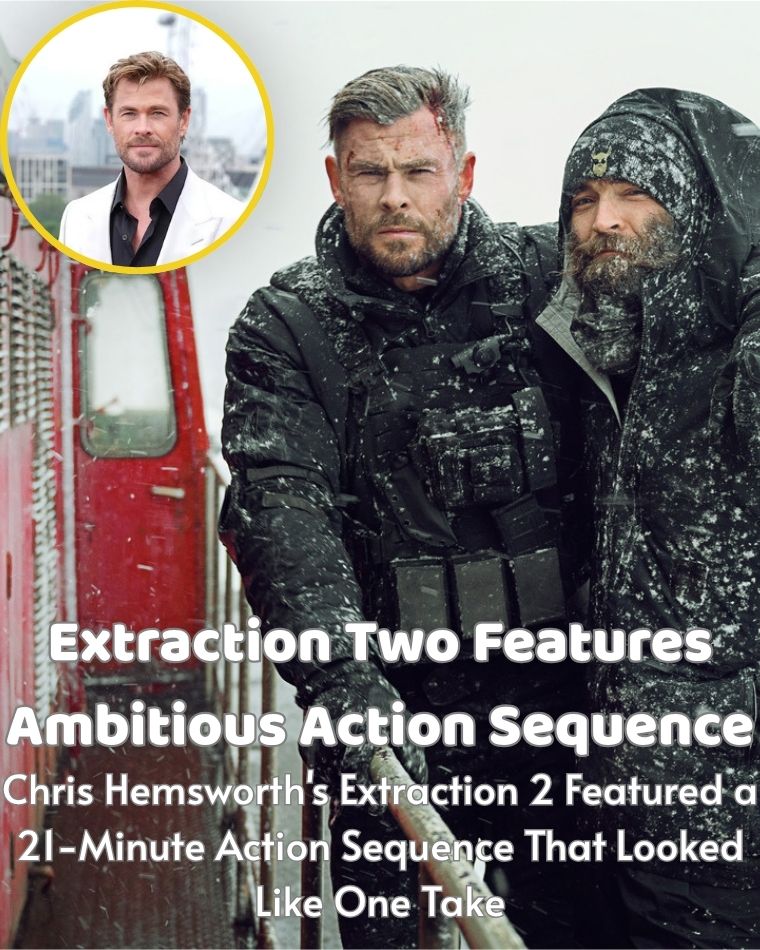
Chris Hemsworth returned to Netflix in 2023 to reprise his role as black-ops mercenary Tyler Rake in the high-octane sequel Extraction 2. Director Sam Hargrave set out to surpass the first film’s groundbreaking stunts by engineering an apparent continuous action sequence spanning over 21 minutes. Through intricate choreography, complex camera handoffs, and precisely concealed edits, the production delivered an illusion of non-stop momentum across prisons, vehicle chases, and moving trains.
The 2020 debut of Extraction established a new benchmark for modern streaming action films.
Audiences were captivated by the original twelve-minute single-take sequence through the streets of Dhaka.
When Netflix greenlit the follow-up project, the creative team faced the daunting task of raising their own high standard.
Leading man Chris Hemsworth signed on to explore deeper physical and emotional dimensions of his battle-hardened protagonist.
Director Sam Hargrave stepped behind the lens once more, determined to prove that contemporary action filmmaking could push boundaries even further.
Their central ambition evolved into an extended set piece lasting over 21 continuous minutes on screen.
The sequence unfolds as an apparently uninterrupted progression without visible cuts.
It thrusts viewers into a relentless survival scenario that shifts across radically contrasting environments.
The narrative momentum begins within the claustrophobic corridors of a high-security Georgian prison.
From there, the chaos spills outward into a freezing, snow-covered yard filled with hundreds of combative inmates.
The pacing accelerates into a multi-vehicle pursuit through rugged terrain.
Finally, the conflict transitions onto a speeding locomotive under heavy aerial bombardment.
Every stage of this transition required extraordinary coordination among stunt performers, camera crews, and visual effects specialists.
Cre: Wikimedia Commons
Director Sam Hargrave and the Ambition to Surpass the Original
Sam Hargrave brought a rare combination of physical acumen and cinematic vision to the director’s chair.
Before directing, Hargrave built an illustrious career as a veteran stunt coordinator and performer in major Hollywood productions.
His extensive background provided him with an instinctive grasp of spatial geography, kinetic timing, and actor safety.
Hargrave recognized that today’s audiences are remarkably perceptive when analyzing practical action versus digital deception.
Computer-generated visual effects often diminish the palpable tension of hand-to-hand combat.
To counter this detachment, the director insisted on grounding the action in authentic physical reality wherever possible.
Screenwriter Joe Russo famously issued a creative challenge in the original script draft.
Russo described the extraction set piece as an aspiration to craft the greatest continuous sequence in cinema history.
Hargrave accepted that challenge as an invitation to innovate practical techniques.
He collaborated closely with the stunt department to map out every punch, fall, and firearm exchange.
Pre-visualization sequences were developed with rigorous discipline to ensure camera operators could follow complex choreography without hesitation.
The goal was not merely to stage impressive acrobatics, but to tether the camera directly to Tyler Rake’s immediate survival instincts.
Hemsworth threw himself into months of demanding strength and tactical training to meet the director’s exacting demands.
The actor’s physical endurance allowed the production to design extended routines without relying on traditional wide shots to conceal doubles.
This close artistic partnership between director and star established the foundation for the ambitious project ahead.
Together, they formulated a multi-stage production strategy to capture the expansive 21-minute illusion.
Breaking Down the 21-Minute Journey Across Three Brutal Environments
The sequence commences inside the gloomy interior of Tkachiri Prison in Georgia.
Tyler Rake infiltrates the facility to liberate a mother and her two children trapped under brutal surveillance.
The camera navigates narrow concrete hallways, pressing tight against characters to generate immediate claustrophobia.
Fistfights erupt in cramped cells where weapons are improvised from everyday objects.
As Rake guides the family toward the outside world, a full-scale riot engulfs the courtyard.
Production recruited hundreds of stunt extras to stage an enormous melee amid falling snow and heavy smoke.
In one widely discussed moment, Rake defends himself with a riot shield while his arm is ignited in real flames.
Hargrave and his team chose to set Hemsworth’s protective jacket on fire practically rather than generating digital flames in post-production.
The actor executed complex martial arts combinations while crew members stood by with fire extinguishers just beyond camera range.
This willingness to embrace physical danger lent the courtyard brawl an undeniable sense of raw urgency.
Once clear of the prison gates, the characters scramble into getaway vehicles.
The action immediately shifts into a high-speed automotive convoy across frozen terrain.
Enemy pursuers flank the convoy, engaging in automatic weapon exchanges while maneuvering around natural obstacles.
The camera fluidly swoops between the interior cabin of Rake’s vehicle and the exterior roadside chaos.
Vehicles collide, flip, and explode around the protagonists in real time.
Eventually, the survivors abandon their compromised transport and board an active cargo train cutting through the wilderness.
The train chapter introduces verticality and extreme exposure to the sequence.
Attack helicopters swoop low over the moving carriages, unleashing heavy machine-gun fire.
Hargrave placed real helicopters mere feet above the train while camera operators tracked the action along the narrow roof.
Rake battles hostile operatives inside tight freight cars and out on open observation platforms.
The relentless environmental shifts ensure that the viewer never feels visual fatigue during the extended narrative ordeal.
The Reality Behind the Camera: Concealed Edits and Seamless Illusion
Despite the continuous visual flow presented on screen, the sequence was not captured in a single uninterrupted take.
Filming a continuous 21-minute scene across multiple geographic locations is a physical impossibility for any feature production.
Safety regulations, actor stamina, pyrotechnic resets, and lighting continuity demand structured pauses.
Instead, Hargrave and his editorial team employed the sophisticated art of concealed stitching.
This cinematic technique relies on strategically planned transitional moments to mask cuts between distinct takes.
A whip pan across a dark wall, a rapid pass behind a pillar, or a sudden burst of smoke provides an organic seam.
During vehicle transitions, the camera might sweep behind an opening door or duck through a window frame.
Each individual segment required dozens of takes to ensure that the end of one take perfectly matched the velocity of the next.
If a camera operator moved an inch too far to the left, the visual alignment would shatter the illusion.
Hargrave personally operated the camera for significant portions of the sequence.
He strapped himself to moving platforms, ran alongside actors in the freezing snow, and ducked beneath low obstacles.
However, the sheer physical demands required trusted collaborators to step in for specific specialized segments.
Camera operators like Nathaniel Perry took over the rig during segments where specialized balance was paramount.
Physical handoffs of the camera rig occurred live during takes while actors continued delivering their dialogue.
Digital effects artists at Digital Domain subsequently polished the seam lines to eliminate microscopic frame discrepancies.
Visual effects were also utilized to enhance background continuity and integrate subtle atmospheric details.
Only one specific vehicle shot relied on a blue screen setup, demonstrating the production’s overwhelming preference for location shooting.
The result is a masterclass in hybrid filmmaking where practical craft and digital refinement work in complete harmony.
Why Extraction 2 Reinvigorated Discussions on Action Craft
When Extraction 2 arrived on Netflix in June 2023, the 21-minute sequence immediately became the primary talking point among critics and industry peers.
Action cinema enthusiasts dissected the mechanics behind each camera movement on social platforms and film forums.
The sequence demonstrated that modern streaming productions can match or exceed the technical complexity of traditional theatrical blockbusters.
In detailed interviews with outlets like RogerEbert.com and Netflix Tudum, Hargrave candidly discussed the extensive labor required to execute the sequence.
He refused to hide behind false marketing claims that the footage was achieved without cuts.
By openly explaining the mechanics of hidden edits, Hargrave elevated respect for the entire crew.
Audiences gained a deeper appreciation for the weeks of preparation, safety protocols, and rehearsal required for every few seconds of screen time.
The achievement also highlighted the evolving role of stunt professionals transitioning into feature directors.
Directors like Chad Stahelski with John Wick and Sam Hargrave with Extraction have redefined cinematic action through practical literacy.
Their background ensures that action serves character dynamics rather than serving as empty visual filler.
In Extraction 2, Rake’s physical exhaustion mirrors his internal psychological battle to redeem his past failures.
The uninterrupted camera movement traps the viewer inside Rake’s mental state, forcing them to experience every bone-crunching blow.
Cinematic history has witnessed legendary long takes, from Alfred Hitchcock’s Rope to Alfonso Cuarón’s Children of Men.
Extraction 2 took that aesthetic tradition and fused it with full-contact tactical warfare.
It proved that camera choreography can function as an expressive narrative instrument just as potent as dialogue.
The sequence stands as a benchmark for what can be achieved when a dedicated cast and fearless crew refuse to take shortcuts.
As future action films seek new ways to engage viewers, the cold prison yard and high-speed train of Extraction 2 will remain a gold standard of practical dedication.
Để lại một phản hồi