Emilia Clarke brought quiet ferocity to the Star Wars galaxy in Solo: A Star Wars Story by turning childhood survivor Qi’ra into a deeply layered player in galactic crime. Rather than serving as a conventional love interest, her character established a morally grey presence that reshaped Han Solo’s formative journey forever.
When Lucasfilm unveiled Solo: A Star Wars Story in May 2018, audiences were invited to witness the turbulent youth of the galaxy’s most iconic smuggler.
The narrative brought forth familiar iconography alongside unexpected revelations about how the cynical pilot developed his legendary worldview.
Yet among the blasters, fast ships, and daring escapes, it was the arrival of Emilia Clarke as Qi’ra that introduced an entirely fresh psychological dynamic to the saga.
Having already captured international attention for her celebrated performance as Daenerys Targaryen in Game of Thrones, Clarke faced the formidable task of establishing herself in another storied cinematic universe.
Instead of portraying a wide-eyed rebel or a pure archetype of galactic nobility, she embraced a shadowy figure defined primarily by grit and pragmatism.
Qi’ra represented someone who could not afford ideological purity when every sunrise was a direct negotiation for basic survival.
Her presence immediately disrupted conventional storytelling formulas by confronting the legendary hero with an equal who lived by different rules.
Throughout the production, Clarke approached the character as an individual whose life had been shaped by unforgiving environments.
Her history with Han Solo, portrayed by Alden Ehrenreich, anchored the narrative in gritty emotional reality rather than simple romantic nostalgia.
The resulting character became one of the most enigmatic additions to modern franchise cinema.
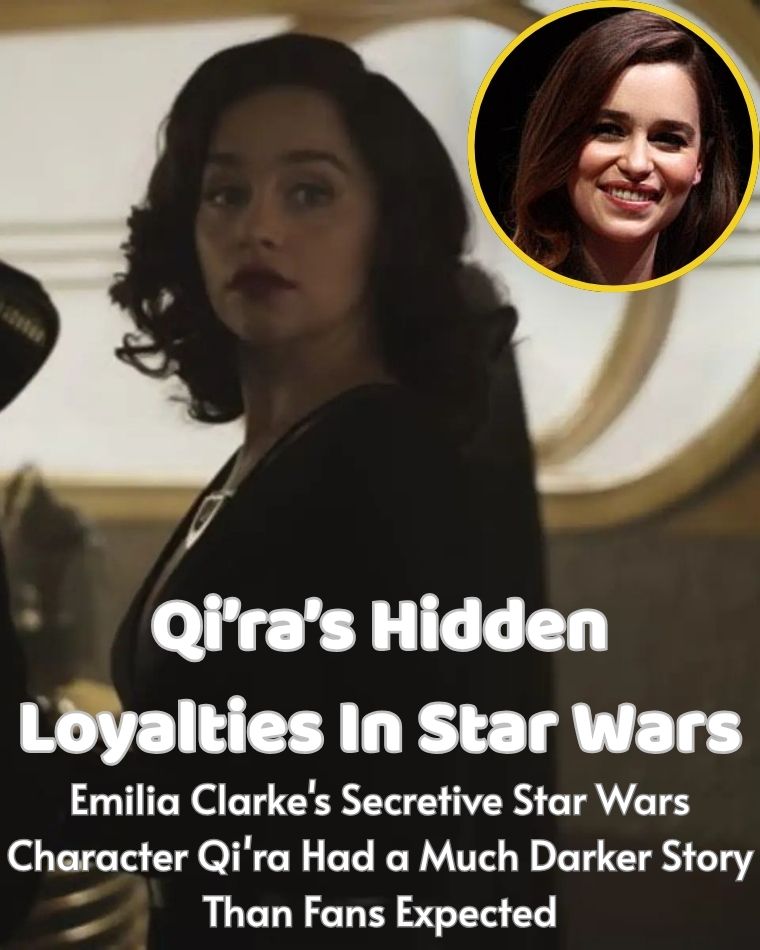
Cre: Wikimedia Commons — Georges Biard / CC BY-SA 4.0
The journey of Qi’ra began deep within the industrial underbelly of the planet Corellia.
Corellia was depicted not as a glorious starport of grand adventure, but as a grinding machine run on exploitation and forced street labor.
Both Qi’ra and Han grew up as street scrumrats trapped under the tyrannical control of Lady Proxima and the White Worms gang.
Every waking moment on the polluted streets involved dodging violent enforcers and stealing whatever scrap of value could be found.
Clarke pointed out during promotional discussions that this joint upbringing forged an undeniable bond between the two characters.
They were partners in crime who learned how to read danger together in the dark corridors of Coronet City.
Han was driven by an irrepressible dream of owning his own ship and escaping the clutches of servitude.
Qi’ra shared that desperate desire for freedom, yet her practical instincts recognized that dreams without caution could prove fatal.
Their daring bid to escape Corellia required bribing Imperial security with a stolen vial of hyperfuel coaxium.
The desperate chase through the security gates marked the definitive fracture in their shared timeline.
While Han managed to slip through the security barrier just in time, the gate slammed down between them.
Imperial guards seized Qi’ra, dragging her back into captivity while Han was forced onto an Imperial transport after swearing an oath to return.
That traumatic separation became the defining moment that sent the two Corellian runaways down wildly divergent paths.
For Han, the incident cemented a heroic drive to return and rescue the person he loved.
For Qi’ra, the aftermath was a harrowing descent into the darkest corners of the galactic underworld.
She learned quickly that promises and hopes offered no tangible protection against cold reality.
Survival demanded that she adapt to any master, master any weapon, and bury her vulnerabilities under armor of absolute poise.
When Qi’ra re-entered Han Solo’s life years later, the reunion took place in an environment entirely foreign to their humble street beginnings.
Han encountered her aboard the lavish luxury yacht of Dryden Vos, the ruthless public figurehead of the Crimson Dawn crime syndicate.
Played with chilling charm by Paul Bettany, Dryden Vos represented the gilded brutality of high-stakes galactic crime.
Qi’ra was no longer a trembling runaway wearing grime-stained rags.
She stood clad in elegant silk and geometric metal necklaces, moving effortlessly through a room filled with opulent predators.
Her official role was Dryden’s trusted lieutenant, a position won through sheer endurance and calculating intelligence.
The contrast between her refined exterior and the violent syndicate she served created immediate dramatic tension.
Han viewed her through the rose-tinted lens of their shared youth, assuming she was a captive who needed saving.
Qi’ra, however, made it clear that her survival had required choices that Han could scarcely imagine.
She understood the lethal nature of Dryden Vos far better than anyone else in the room.
Vos was volatile, capable of smooth pleasantries one second and catastrophic violence the next.
Navigating his volatile moods required an immense amount of emotional control and tactical foresight.
Clarke captured this internal tightrope walk with exceptional subtlety throughout the film’s central heist.
When tasked by Vos to accompany Tobias Beckett’s crew to Kessel, Qi’ra served as the syndicate’s watchful eye.
She was both a valued team member and an implicit reminder of what would happen if the mission failed.
Her knowledge of underworld protocol and negotiation helped secure the Millennium Falcon through Lando Calrissian.
During the daring raid on the coaxium mines of Kessel, she showcased fierce martial prowess alongside her intellectual composure.
The international premiere of the movie at the Cannes Film Festival in May 2018 offered Clarke an opportunity to reflect publicly on the role.
Speaking to journalists on the French Riviera, Clarke described the meticulous creative research that went into defining Qi’ra.
She explained that she spent extensive time discussing the character’s psychological background with the screenwriting team and director Ron Howard.
Her goal was to construct a woman whose complexity felt earned rather than superficial.
Clarke pointed out that Qi’ra had multiple guises that she wore depending on who was in the room.
In the presence of Dryden Vos, she adopted the role of an obedient, sophisticated, and indispensable subordinate.
In the presence of Han, glimpses of the spirited girl from Corellia emerged, though always tempered by defensive caution.
Clarke noted that when someone has survived severe hardship, glamor is often just a mask worn over rough roads.
She rejected the idea that Qi’ra had to fit into neat categories of good or evil.
Every action the character took was rooted in a rational assessment of what would keep her alive for another day.
The actress worked deliberately to ensure that Qi’ra’s affection for Han felt genuine even while her loyalties remained ambiguous.
That ambiguity was essential because it forced Han to confront the messy reality of the galaxy outside his idealized daydreams.
Alden Ehrenreich’s Han was fundamentally an idealist searching for a way to rewrite his fortunes.
Qi’ra was the realist who knew that debts in the underworld were never truly erased.
This philosophical contrast provided the emotional heartbeat of the entire production.
Clarke’s nuanced interpretation prevented the film from devolving into a simplistic space rescue fantasy.
Instead, the audience was given an authentic portrait of two survivors coping with the trauma of their shared past in radically different ways.
The climax of the story on the planet Savareen brought all of Qi’ra’s conflicting loyalties to an explosive reckoning.
As Tobias Beckett betrayed the crew and Han confronted Dryden Vos in the yacht’s private suite, Qi’ra made her decisive move.
Initially holding Han at blade-point under Vos’s command, she swiftly turned her weapon on the crime lord himself.
In a fierce hand-to-hand duel, Qi’ra struck down Dryden Vos, neutralizing the immediate threat to Han’s life.
To an outside observer, this act seemed to signal a triumphant romantic resolution where the two runaways could finally escape together.
Qi’ra urged Han to hurry outside to save Chewbacca and secure the coaxium from Beckett.
She promised to follow right behind him as soon as she gathered supplies from the yacht.
Yet the moment the blast doors closed, Qi’ra revealed her true understanding of galactic power structures.
She knew that simply killing Dryden Vos did not make them free.
Crimson Dawn was an expansive network with tentacles reaching into every corner of the known galaxy.
Walking away into the sunset would merely ensure that bounty hunters hunted them down until both were dead.
Stepping forward to Dryden’s desk, Qi’ra activated the syndicate’s encrypted transmission terminal.
The holoprojector flickered to life, revealing the true mastermind behind Crimson Dawn: the former Sith Lord Maul.
Without a tremor in her voice, Qi’ra reported Dryden’s death, strategically placing the blame entirely on Tobias Beckett.
Maul accepted her report, recognizing her competence and ambition, and summoned her to meet him on his homeworld of Dathomir.
By accepting this summon, Qi’ra chose power and self-preservation over romantic escape.
From the cockpit of his shuttle, Han watched in disbelief as Dryden Vos’s yacht ascended into orbit, leaving him standing alone on the dunes.
Qi’ra’s fateful departure served as the definitive emotional forge for Han Solo’s iconic persona.
The youthful idealist who believed that love and good luck could conquer any obstacle was permanently dismantled.
In his place stood the hardened, self-reliant cynic whom audiences first met decades earlier in a Mos Eisley cantina.
Han learned firsthand that in an unforgiving galaxy, trust was a luxury that few could afford.
Qi’ra did not betray Han out of malice or greed; she chose the only path that ensured her survival and shielded him from the wrath of Crimson Dawn.
Her departure was an act of tragic pragmatism that carried far more emotional weight than a traditional sacrifice.
Clarke’s performance ensured that Qi’ra was never reduced to a cold-hearted villain or a passive victim.
She played her as an active architect of her own destiny, willing to pay whatever spiritual price was required to stay alive.
While Solo: A Star Wars Story encountered a divided commercial landscape upon release, the legacy of Qi’ra only expanded over time.
Fans and critics consistently highlighted Clarke’s sophisticated interpretation as one of the film’s strongest creative achievements.
Her complex loyalties and enigmatic final scene created an enduring curiosity that inspired subsequent storytellers.
Qi’ra went on to play pivotal roles in expanded canonical literature, including prominent comic book crossovers and gaming narratives.
Through it all, the foundation laid by Emilia Clarke in 2018 remained the anchor for the character’s identity.
She gave Star Wars an anti-heroine of remarkable intelligence, sharp poise, and unbreakable will.
Qi’ra proved that within a galaxy of grand battles between light and dark, the most compelling stories often belong to those surviving in the shadows between.
Để lại một phản hồi