Emilia Clarke arrived in Midtown Manhattan in early 2013 with the eyes of the entertainment industry firmly fixed upon her every move.
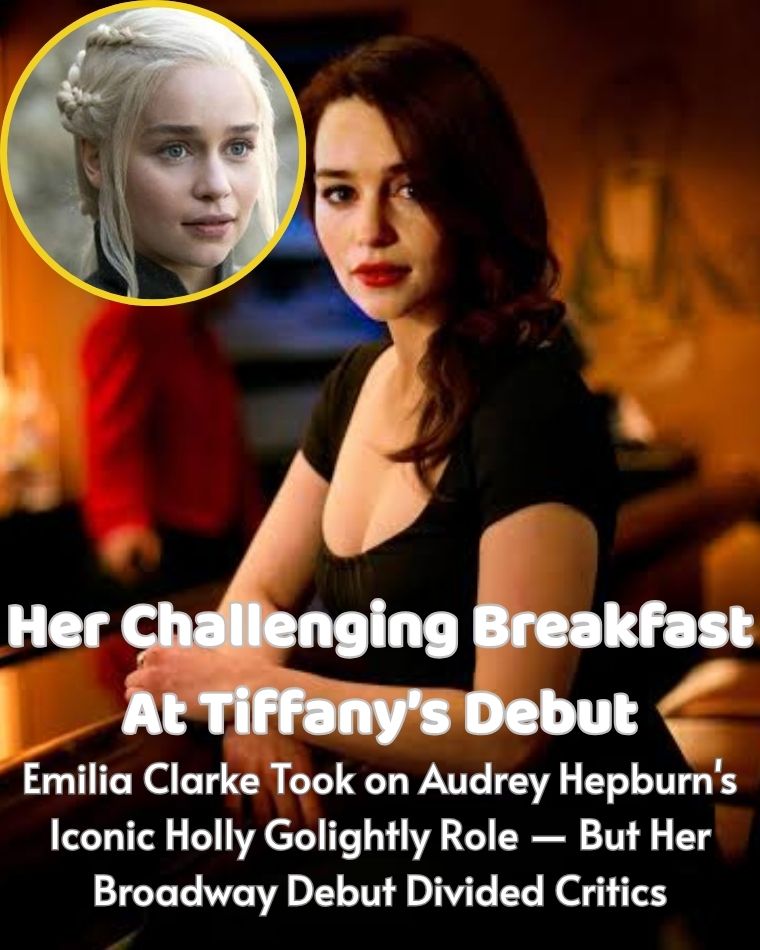
Her high-profile debut as Holly Golightly in Richard Greenberg’s stage adaptation of Breakfast at Tiffany’s represented a bold detour from the global television phenomenon that had redefined her career.
The ambitious production opened at the Cort Theatre on March 20, 2013, testing whether the British actress could conquer the legendary demands of Broadway while navigating the long cultural shadow cast by Audrey Hepburn and Truman Capote.
The Leap From Television Royalty to the New York Stage
By early 2013, Emilia Clarke had achieved international renown for her magnetic portrayal of Daenerys Targaryen on HBO’s blockbuster series Game of Thrones.
The fantasy epic had rapidly elevated the young English actress from recent drama school graduate to an unmistakable face of global pop culture.
Yet the nature of television stardom often confines performers to the very aesthetics that made them famous.
On the screen, Clarke was framed by grand cinematic landscapes, expansive visual effects, and intense digital spectacle.
Her character commanded dragons, mobilized armies, and inhabited a sweeping narrative of royal lineage and violent political intrigue.
Stepping onto the Broadway stage represented the exact opposite of that mediated environment.
In live theater, an actor cannot rely on close-ups, favorable editing cuts, or post-production sound design to convey emotional weight.
Every gesture, inflection, and pause must register immediately with hundreds of patrons seated across multiple tiers of an auditorium.
Clarke recognized that testing herself in front of a live audience was essential for her artistic growth.
She chose not to retreat into safe choices or replicate her existing television persona in another fantasy project.
Instead, she signed on to headline a major commercial play in the most demanding theater district in the world.
The decision required immense discipline and an appetite for creative vulnerability.
Taking on a Broadway lead would challenge her vocal stamina, physical presence, and psychological endurance eight times a week.
Cre: Wikimedia Commons
Reclaiming Truman Capote’s Original Vision
When director Sean Mathias began mounting the new production, he was determined not to stage a carbon copy of the celebrated 1961 cinematic romance.
The beloved film directed by Blake Edwards had transformed Breakfast at Tiffany’s into a glamorous, technicolor fairy tale.
In the cinematic version, Manhattan became a playground of sophisticated cocktail dresses, sparkling jewelry, and sentimental romantic escapades.
Audrey Hepburn’s enchanting portrayal forever embedded Holly Golightly in the collective consciousness as a polished, cosmopolitan darling.
However, Truman Capote’s original 1958 novella painted a markedly different, far more melancholic portrait of its central figure.
Capote’s Holly was not an untouchable high-fashion model gliding through an idealized mid-century Manhattan.
She was an impoverished runaway from rural Texas who remade herself through grit, charm, and transactional arrangements with older men.
Playwright Richard Greenberg accepted the task of stripping away Hollywood’s romantic veneer to return directly to Capote’s prose.
Greenberg’s script aimed to revive the gritty, morally ambiguous atmosphere of New York City during the Second World War.
In this wartime setting, anxiety hung heavily in the air, and survival often came at a painful personal cost.
The play highlighted Holly’s internal wounds, financial desperation, and rootless existence.
Her famous social orbit was not merely a parade of glamorous parties, but a calculated strategy to keep despair and isolation at bay.
For Emilia Clarke, inhabiting this literary incarnation meant shedding the regal composure of Daenerys Targaryen.
She had to embody a complicated survivor who was simultaneously magnetic, manipulative, naive, and emotionally bruised.
The Cast and the Collaborative Dynamic
To bring Greenberg’s dramatic vision to life, the production assembled a versatile ensemble alongside its leading lady.
Actor Cory Michael Smith took on the pivotal role of Fred, the aspiring writer who serves as the story’s narrator and Holly’s devoted neighbor.
Through Fred’s eyes, the audience observed Holly’s erratic behavior, intoxicating charm, and devastating private vulnerabilities.
Smith’s performance required establishing an intimate, platonic yet deeply affectionate rapport with Clarke on stage.
Their dynamic had to anchor a production that constantly shifted between nostalgic recollection and immediate theatrical realism.
Veteran character actor George Wendt, beloved across America for his long-running role on Cheers, joined the company as Joe Bell.
Joe Bell, a fixture of Capote’s novella who had been largely omitted from the Hollywood movie, provided a grounding presence.
As a neighborhood bartender infatuated with Holly, Wendt brought warmth and melancholy to the edges of her chaotic Manhattan life.
Under the guidance of director Sean Mathias, rehearsals focused heavily on shaping a distinct period rhythm.
Mathias recognized that Clarke possessed an energetic spirit and genuine dedication to the craft of acting.
In interviews surrounding her work, the director noted her playful personality, infectious humor, and remarkable professionalism inside the rehearsal room.
She approached the challenging assignment with humility and rigorous work ethic, eager to absorb instruction from veteran theater practitioners.
The cast and creative team worked intensely to capture the elusive poetry of Capote’s dialogue without turning the performance into period caricature.
The production also featured a live feline companion to play Holly’s nameless cat, adding an unpredictable element to each performance.
Navigating live animals, rapid costume changes, and continuous scene transitions demanded total concentration from the young lead.
Opening Night at the Historic Cort Theatre
The production officially raised its curtain at the Cort Theatre on the evening of March 20, 2013.
Located at 138 West 48th Street, the Cort Theatre offered an intimate, historically rich setting for the Broadway venture.
Designed in 1912 by architect Thomas W. Lamb, the venue boasted classical lines and a storied pedigree of landmark American drama.
Its neoclassical proscenium framed Derek McLane’s atmospheric scenic design, which utilized shifting backdrops and fluid staging.
Costume designer Colleen Atwood provided an array of period attire that honored the early 1940s aesthetic rather than 1960s runway chic.
The opening night drew substantial media coverage, celebrity attendees, and curious theatergoers from across the city.
Crowds of fans gathered outside the stage door, eager to catch a glimpse of the global television star in Midtown Manhattan.
The premiere took place during a pivotal transitional moment in Clarke’s professional life.
Game of Thrones was preparing to broadcast its third season, which would solidify its status as a historic global juggernaut.
Clarke was effectively balancing the obligations of international television promotion while performing live on Broadway every night.
She entered the theater each evening carrying the immense commercial expectations of the show’s producers and investors.
The Cort Theatre’s intimate auditorium meant that every breath, whisper, and sigh was immediately audible to theatergoers.
She threw herself into the performance, singing lightly with a guitar, darting across the multi-level set, and conveying Holly’s restless, mercurial spirit.
For the opening night audience, witnessing a major screen actress test her mettle on Broadway was an undeniably compelling spectacle.
Navigating a Tough Critical Reception
When the critical notices appeared in major publications, they proved to be a formidable trial for the young company.
Reviews compiled by theater outlets like the Los Angeles Times and BroadwayWorld reflected widespread reservations among seasoned New York critics.
Many reviewers found Richard Greenberg’s stage adaptation difficult to embrace.
Critics debated whether Truman Capote’s subtle literary voice and delicate interior monologues could be successfully dramatized for a commercial stage.
The elusive nature of Holly Golightly presented an immense theatrical puzzle that the production struggled to solve entirely.
On the page, Holly exists largely through the poetic impressions and nostalgic memories of the narrator.
When forced into literal physical space on a Broadway stage, her eccentricities occasionally risked feeling affected or fragmented rather than genuinely captivating.
Several prominent critics questioned whether the staging managed to unlock the raw emotional core beneath Holly’s stylish exterior.
Some notices praised Clarke’s natural charm, beauty, and courageous stage presence, while simultaneously noting that the play’s structure hindered her performance.
Other reviewers felt that the production remained trapped between contradictory impulses.
It sought to honor Capote’s dark wartime realism while inevitably contending with audience memories of Audrey Hepburn’s effervescent romantic comedy.
The legendary shadow of the 1961 film proved nearly impossible to banish entirely from theatergoers’ minds.
Audiences who arrived expecting lighthearted Hollywood glamour encountered an unapologetically somber tale of displacement and loss.
Conversely, purists who demanded Capote’s sharp literary irony found the theatrical staging occasionally strained under the weight of Broadway commercial pressures.
The divided response demonstrated how hazardous it can be to adapt beloved mid-century literary artifacts for modern theater audiences.
Rather than a triumphant Broadway coronation, the production became an exacting artistic crucible for everyone involved.
An Essential Crucible for Long-Term Artistic Growth
Despite the challenging critical landscape, Emilia Clarke’s Broadway debut stood as a watershed moment in her emerging career.
The experience of carrying a major commercial play through intense scrutiny provided invaluable professional seasoning.
In an in-depth profile published by The Guardian in October 2013, the trajectory of Clarke’s early career was explored with reflective nuance.
The piece highlighted her resilience, down-to-earth perspective, and steadfast commitment to artistic experimentation.
Director Sean Mathias observed that Clarke possessed the rare determination required to survive the unforgiving pressures of high-stakes performance.
She did not allow mixed reviews or theatrical setbacks to diminish her passion for ambitious, challenging material.
Many screen actors who find overnight fame in mega-franchises remain within the protective confines of cinematic soundstages.
They often shy away from theatrical vulnerability, wary of risking their commercial status in unforgiving live spaces.
Clarke chose the opposite path, treating the Broadway stage as an educational arena rather than a mere vanity exercise.
Performing at the Cort Theatre allowed her to develop vocal control, emotional resilience, and deep physical endurance.
She learned how to maintain artistic focus when a production encounters commercial adversity and harsh critical commentary.
The technical rigor required for eight weekly performances expanded her acting palette far beyond television conventions.
That theatrical foundation would continue to inform her choices in subsequent years.
She repeatedly returned to stage acting, later taking on classic works like Anton Chekhov’s The Seagull on the London stage with renewed maturity and authority.
Looking back at the spring of 2013, her portrayal of Holly Golightly stands out not as an anomaly, but as proof of her fearless artistic ambition.
She refused to be defined solely by dragons and fantasy lore, demonstrating early on that she possessed the heart of a dedicated, lifelong working actress.
Để lại một phản hồi