Daniel Radcliffe took on a delightfully chaotic role in the 2022 adventure comedy The Lost City, stepping away from his famous heroic roots to play an eccentric billionaire villain. Starring alongside Hollywood heavyweights Sandra Bullock and Channing Tatum, Radcliffe found genuine creative freedom in portraying an unapologetic antagonist driven by an obsessive jungle treasure hunt. Through his insightful March 2022 interviews, the British actor revealed why the film’s sharp screenplay, unique comedic dynamic, and freedom from heroic expectations made this standout performance an absolute joy.
From Boy Wizard to Eccentric Billionaire
For more than a decade, audiences around the world watched Daniel Radcliffe portray cinema’s ultimate boy wizard.
Stepping into the role of Harry Potter established him as one of the most recognizable heroic figures in modern popular culture.
Carrying the weight of a multi-billion-dollar franchise naturally required him to embody integrity, vulnerability, and moral virtue on screen.
However, Radcliffe’s post-franchise career has consistently defied easy Hollywood categorization.
He deliberately pursued unpredictable independent films, stage productions, and surreal narrative concepts.
When the opportunity arrived to star in the 2022 romantic adventure comedy The Lost City, Radcliffe welcomed another bold shift in tone.
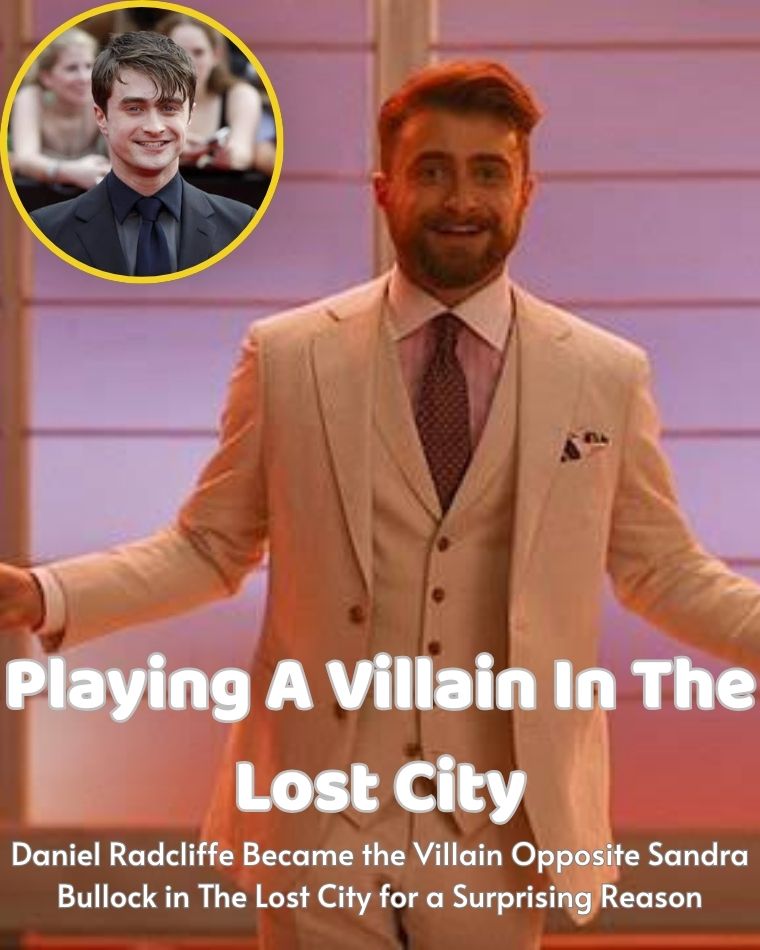
In the film, he portrays Abigail Fairfax, an extraordinarily wealthy and deeply eccentric billionaire.
Rather than trying to rescue anyone from danger, Fairfax actively creates the danger himself.
The narrative introduces Fairfax as a modern corporate heir who feels perpetually overshadowed by his family’s established accomplishments.
Driven by an overwhelming desire to secure his own historical legacy, Fairfax sets his sights on an elusive lost treasure.
This ancient prize is hidden deep within a remote, lush volcanic island.
Unlike traditional action villains who command armies with menacing stoicism, Fairfax approaches his quest with frantic vanity.
He wears sharply tailored three-piece suits even while navigating the unforgiving humidity of an overgrown tropical jungle.
His immense wealth provides him with private aircraft, heavily armed mercenaries, and advanced expedition gear.
Yet, despite all his tactical advantages, Fairfax completely lacks the practical competence required to survive in the wild.
This sharp contrast between supreme personal arrogance and hilarious physical inadequacy forms the comedic backbone of the entire performance.
Radcliffe completely threw himself into the absurdity of the role without hesitation.
Cre: Wikimedia Commons
The Irresistible Charm of the Screenplay
In a detailed March 2022 interview with Sharp Magazine, Radcliffe discussed what originally convinced him to join The Lost City.
He explained that the high quality and genuine humor of the screenplay immediately grabbed his attention upon his very first reading.
In mainstream Hollywood, large-scale adventure comedies with original premises have become increasingly rare projects.
The script for The Lost City managed to evoke the classic nostalgic charm of beloved 1980s adventure films.
It successfully blended screwball romantic comedy with high-stakes island survival scenarios.
Radcliffe was particularly impressed by how carefully every single character beat had been crafted on the page.
The jokes were not merely superficial one-liners designed to fill awkward silences between generic action sequences.
Instead, the comedy arose naturally from the authentic personalities, flaws, and misunderstandings of each protagonist.
Radcliffe noted that finding a script that balances genuine physical stakes with fast-paced comedic rhythm is an absolute rarity.
The screenplay never required Fairfax to feel like a watered-down cartoon without genuine narrative consequences.
His threats carried authentic urgency for the main characters, which grounded the movie’s adventure elements.
At the exact same time, his dramatic overreactions and wounded pride provided endless moments of high-level comedy.
Radcliffe recognized that the script gave him an ideal platform to experiment with physical comedy and elevated vocal delivery.
He appreciated that the filmmakers fully committed to the larger-than-life tone of an old-fashioned studio production.
Every scene felt purposeful, energetic, and unapologetically entertaining to read.
The screenplay’s sheer confidence gave Radcliffe all the assurance he needed to enthusiastically sign on to the project.
The Liberating Freedom of Playing the Antagonist
One of the most compelling insights Radcliffe shared about his role was the unique psychological liberation that comes with playing a villain.
Throughout his formative career, he shouldered the heavy emotional burden of portraying sympathetic protagonists.
A classic leading hero must constantly navigate audience expectations and maintain relatable moral integrity.
Every choice a heroic protagonist makes must ultimately keep the audience emotionally invested and rooting for their survival.
Playing Abigail Fairfax allowed Radcliffe to abandon those restrictive creative guardrails entirely.
As a comedic antagonist, Fairfax has zero obligation to be morally upright, emotionally responsible, or universally liked.
He can be petty, irrational, wildly demanding, and completely blinded by his own privilege without confusing the audience.
Radcliffe explained in his media discussions that not having to carry the sympathetic weight of a production felt profoundly refreshing.
He could lean completely into Fairfax’s narcissistic worldview and ridiculous temper tantrums.
There is an exhilarating creative momentum when an actor is encouraged to behave as unpredictably as possible.
Fairfax genuinely believes that he is the undisputed hero of his own grand cinematic narrative.
He views the other characters merely as temporary obstacles or ungrateful tools in his quest for historical greatness.
This self-delusion creates a rich layer of dramatic irony that Radcliffe mined for constant comedic value.
Whenever Fairfax loses his composure, the audience experiences pure entertainment rather than tragic heartbreak.
Radcliffe embraced this narrative dynamic with visible delight across every single scene.
Playing an antagonist also allowed him to explore physical mannerisms that differed dramatically from his prior dramatic performances.
He used sharp, agitated gestures and sudden vocal spikes to convey Fairfax’s rapidly deteriorating patience.
The role proved that Radcliffe possesses an exceptional instinct for villainous character work when given the proper creative room.
Teaming Up with Sandra Bullock and Channing Tatum
Beyond the strength of the script, the opportunity to collaborate alongside Sandra Bullock and Channing Tatum was a massive draw for Radcliffe.
Bullock stars in the production as Loretta Sage, a reclusive romantic adventure author grieving personal loss.
Loretta has spent years writing popular historical romance paperbacks set in fictional ancient civilizations.
Her creative plots revolve around heroic quests and hidden treasures, drawing heavily on actual archaeological research.
Tatum portrays Alan Caprison, the well-meaning but somewhat dim cover model who graces every one of Loretta’s book covers.
Alan has built a successful celebrity image posing as “Dash McMahon,” the heroic protagonist of Loretta’s novels.
When Fairfax kidnaps Loretta right off the street after a promotional book event, Alan decides to attempt a real-life rescue.
Alan hopes to prove to Loretta that he is more than just a handsome face plastered across glossy book jackets.
The collision of these three wildly contrasting creative personalities produces nonstop comedic friction.
Radcliffe expressed boundless admiration for Bullock’s masterclass in comedic timing, professional discipline, and natural warmth.
As both the leading actress and a lead producer on the film, Bullock established an open and joyful working atmosphere on set.
Radcliffe noted how effortlessly Bullock grounded her character’s cynical reluctance amid chaotic jungle survival scenarios.
Working directly across from her required Radcliffe to bring his sharpest verbal banter to every dialogue exchange.
At the same time, Radcliffe marveled at Tatum’s exceptional physical comedy skills and natural charisma.
Tatum’s portrayal of Alan provided a hilarious foil to Fairfax’s hyper-intellectual and snobbish posturing.
While Alan struggles clumsily to act like a real action hero, Fairfax struggles just as clumsily to act like an intimidating mastermind.
The natural comedic chemistry between the three performers elevated the production far beyond standard genre fare.
Radcliffe repeatedly emphasized in interviews how fortunate he felt to share the screen with two masters of the modern comedy genre.
A Crucial Central Antagonist in an Island Odyssey
It is essential to understand that Abigail Fairfax was never designed as a brief cameo appearance or passing novelty.
He serves as the primary engine driving the entire narrative of The Lost City forward from beginning to end.
Without Fairfax’s desperate, unlawful ambitions, Loretta Sage would never have been forced into the jungle in the first place.
Fairfax believes Loretta holds the single key to deciphering an ancient parchment that pinpoints the legendary “Crown of Fire.”
When Loretta refuses to assist his illicit private expedition, Fairfax takes matters ruthlessly into his own hands.
He arranges her sudden abduction using his personal fleet of security vehicles and transport aircraft.
Transporting her to the remote Atlantic island, Fairfax expects Loretta to work strictly under duress.
This aggressive decision triggers the entire chain of hilarious rescue attempts and jungle survival misadventures.
Radcliffe’s presence anchors the external threat that constantly pushes Loretta and Alan across dangerous island terrain.
Even when Fairfax is off-screen coordinating his search parties, his looming presence dictates the pacing of their escape.
Radcliffe gave the villain an unsettling intensity that kept the stakes surprisingly tangible throughout the story.
Fairfax is not merely mildly annoying; he is genuinely willing to risk lives to possess the ancient crown.
Yet, because Radcliffe never loses touch with the character’s inherent absurdity, the movie never descends into dark melodrama.
He calibrated his performance so that Fairfax feels dangerous enough to matter, yet ridiculous enough to laugh at.
This delicate balancing act is notoriously difficult for actors to pull off in broad action-adventure comedies.
Radcliffe’s dedicated commitment ensured that every confrontation between the villain and the heroes felt energetic and memorable.
His substantial screen time allowed the audience to thoroughly enjoy every ridiculous dimension of Fairfax’s personality.
The character remains an indispensable component of what made the 2022 film resonate so strongly with global audiences.
Behind the Scenes in the Dominican Republic
Filming The Lost City required the cast and crew to spend months working on location in the lush landscapes of the Dominican Republic.
The authentic tropical environments added stunning visual texture and tangible scale to the finished film.
However, shooting an elaborate adventure movie in real outdoor settings presented plenty of physical challenges for everyone involved.
The production had to contend with intense tropical heat, torrential rainfall, dense jungle foliage, and unpredictable coastal waters.
Radcliffe frequently remarked on the sheer contrast between the film’s luxurious aesthetic and the muddy reality of filming.
While his character was meant to look impeccably groomed, the sweltering island conditions made that an ongoing battle.
He spent long production days dressed in formal designer suits while standing under the blazing Caribbean sun.
Radcliffe took genuine amusement in how uncomfortable the character’s clothing was relative to the untamed wilderness around him.
The physical discomfort actually fed directly into Fairfax’s escalating onscreen frustration and irritability.
Bullock was notoriously navigating jungle rivers and muddy cliffs while wearing an elaborate sparkling magenta jumpsuit.
Tatum was performing taxing physical stunts, mud crawls, and frantic sprints through dense vegetation.
The collective endurance of the entire cast created a shared camaraderie that translated directly onto the screen.
Radcliffe praised the tireless dedication of the directors, Adam and Aaron Nee, for keeping morale exceptionally high.
The production team balanced complex logistical safety setups with plenty of room for comedic improvisation.
Whenever the cameras rolled, the actors were encouraged to play with lines and explore spontaneous comedic reactions.
Radcliffe found this collaborative environment completely invigorating after working on more rigidly structured productions.
The authentic tropical backdrops grounded the humor, making the characters’ struggles feel wonderfully visceral and real.
Expanding an Unconventional Acting Repertoire
Radcliffe’s portrayal of Abigail Fairfax represents an important milestone in his ongoing career evolution.
Since completing the final Harry Potter film in 2011, Radcliffe has consistently avoided conventional Hollywood leading-man paths.
Many child stars struggle to redefine their artistic identities once they age out of their breakout franchise roles.
Some retreat entirely from the entertainment industry, while others become trapped playing repetitive variations of the same character.
Radcliffe chose a radically different path, using his financial independence to pursue daring and unexpected creative risks.
He headlined deeply unconventional films such as Swiss Army Man, in which he portrayed a talking, flatulent corpse.
In Guns Akimbo, he played an ordinary computer programmer who suddenly wakes up with pistols bolted to his hands.
He tackled intense horror in The Woman in Black and historical biographical drama in Escape from Pretoria.
His willingness to take creative leaps extended to acclaimed musical theater productions on Broadway and in the West End.
Joining a major studio comedy like The Lost City proved that Radcliffe could effortlessly operate within large-scale commercial cinema.
More importantly, it showed that he could do so on his own creative terms, choosing characters that genuinely excited him.
Playing an eccentric antagonist allowed him to flex comedic muscles that general audiences had rarely seen on this scale.
He proved that he did not need to play a charming romantic interest or a conventional hero to command the screen.
Fairfax allowed Radcliffe to demonstrate his complete lack of vanity as an established performing artist.
He was more than happy to let his character look foolish, cowardly, and wildly outmatched by his circumstances.
This fearless approach to character work has earned Radcliffe widespread respect from both critics and fellow industry professionals.
His performance in The Lost City solidified his reputation as one of the most versatile and fearless actors working today.
Redefining the Hollywood Comedic Villain
In classic Hollywood cinema, comedic villains occupy a beloved and highly entertaining tradition.
From frantic oil barons to pompous corporate executives, these characters allow films to poke fun at unearned authority and greed.
Abigail Fairfax fits comfortably within this classic cinematic lineage while offering a distinctly modern satirical update.
Radcliffe crafted Fairfax as a sharp parody of modern tech and corporate billionaires who believe their wealth entitles them to history.
Fairfax genuinely assumes that throwing enough money and private security at a problem will bend historical reality to his will.
His petulant frustration when ancient history refuses to cooperate highlights the absurdity of unrestrained modern privilege.
Radcliffe played these thematic beats with remarkable subtlety, never turning the character into an empty political lecture.
Instead, the social satire remains woven into the organic fabric of Fairfax’s comedic interactions with Loretta.
When Fairfax insists that Loretta translate ancient symbols, his patronizing tone perfectly captures an entitled executive at work.
When his mercenary henchmen fail to follow his overly complicated instructions, his exasperation feels instantly recognizable.
Radcliffe understood that the best comedic villains are those who take themselves with absolute, deadly seriousness.
The moment an antagonist winks at the camera or shows that they know they are being funny, the comedy falls flat.
Radcliffe never once broke character or played down to the absurdity of the material.
He committed wholeheartedly to Fairfax’s obsessive desires, making the character’s eventual downfall satisfying and hysterical.
Audiences recognized and appreciated this authentic commitment when The Lost City hit global movie theaters.
Moviegoers responded enthusiastically to seeing a familiar hero embrace such an unabashedly flawed and pompous persona.
The performance demonstrated that playing the bad guy can often be the most rewarding creative challenge of all.
The Lasting Legacy of The Lost City
When The Lost City arrived in theaters in the spring of 2022, it arrived at a pivotal moment for theatrical moviegoing.
Audiences were seeking joyful, communal theatrical experiences that offered pure, unpretentious escapism.
The film went on to become a notable box-office success, grossing over $190 million worldwide against its production budget.
Critics and audiences alike singled out the infectious chemistry of the ensemble cast as the production’s greatest strength.
Radcliffe’s turn as Abigail Fairfax earned widespread praise for bringing a sharp, chaotic energy to the entire narrative.
Reviewers noted that his performance avoided all the generic pitfalls of standard action-movie villainy.
Rather than blending into the tropical scenery, Radcliffe created an antagonist who remained thoroughly memorable long after the credits rolled.
The film proved that star-driven original comedies could still draw massive crowds to movie theaters worldwide.
For Radcliffe personally, the experience affirmed his instinct to follow exciting scripts wherever they might lead.
His interview with Sharp Magazine captured an artist who is completely comfortable with his professional legacy and excited for the future.
He spoke about the production not merely as a commercial job, but as a genuinely enriching creative adventure.
Working with Sandra Bullock and Channing Tatum gave him lifelong creative memories and an elevated comedic platform.
The character of Abigail Fairfax remains a vibrant high point in Radcliffe’s post-franchise cinematic journey.
It stands as definitive proof that the former Boy Who Lived can conquer any genre, any tone, and any character.
Whether navigating an ancient island tomb or arguing over translation notes in a private jet, Radcliffe delivered an absolute triumph.
Để lại một phản hồi