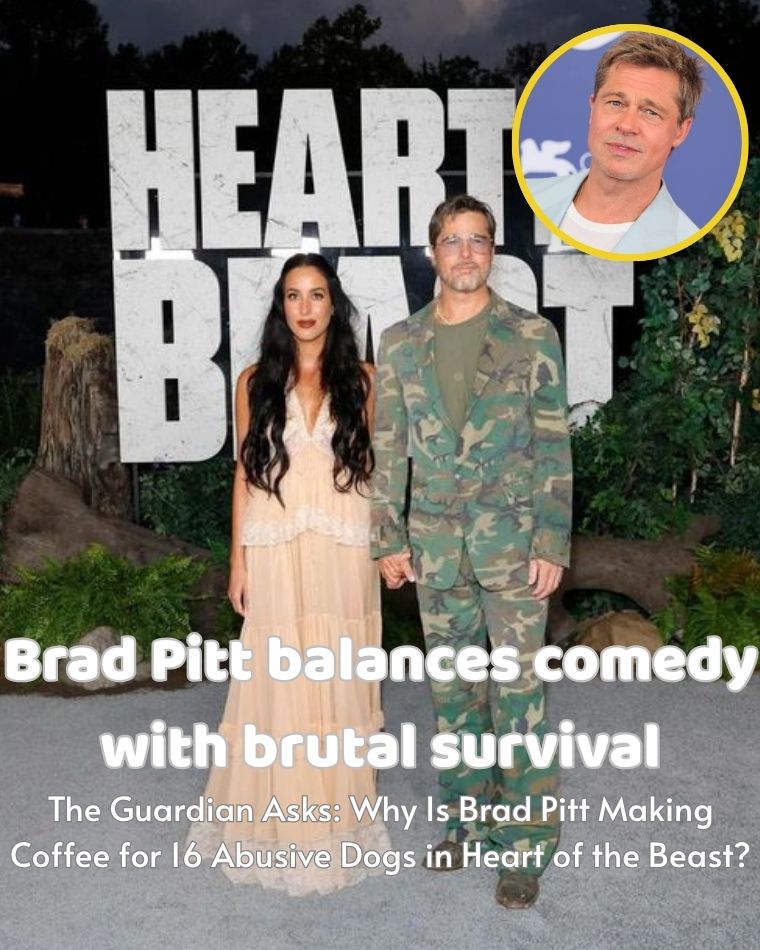
On September 9, 2026, The Guardian published a delightfully provocative headline that instantly set entertainment circles abuzz: “Inglourious baristas: why is Brad Pitt making coffee for 16 abusive dogs?”
The playful query juxtaposed two wildly contrasting pop-culture moments, highlighting both Pitt’s wry sense of humor and his willingness to embrace projects that completely defy conventional Hollywood molds.
Behind that eccentric framing lies an unexpected narrative that links an offbeat global coffee campaign with David Ayer’s raw wilderness survival epic, Heart of the Beast.
The Provocative Headline That Captured the Internet
When film critic Stuart Heritage penned the tongue-in-cheek piece for The Guardian, movie fans were initially bewildered by the mental image of Brad Pitt playing a bullied barista for canine companions.
The headline seized public attention because it sounded simultaneously like an absurd internet parody and a legitimate avant-garde indie pitch.
Readers quickly discovered that the phrase had been inspired by a surreal collision of Pitt’s simultaneous autumn projects.
On one hand, Pitt was headlining David Ayer’s physically brutal and emotionally intense survival drama Heart of the Beast, where an ex-soldier relies on an unbreakable bond with his combat dog to stay alive.
On the other hand, Pitt was appearing in an outrageously deadpan global commercial directed by Academy Award winner Spike Jonze, where he serves coffee while being verbally berated by sixteen opinionated canine roommates.
The juxtaposition was irresistible to cultural commentators, contrasting Pitt as an embattled wild-man battling elements with a dog against Pitt as a subservient housemate fetching caffeine for a pack of sharp-tongued hounds.
Cre: Wikimedia Commons — CC BY-SA 4.0 / Glenn Francis
Deconstructing the “16 Abusive Dogs”: Commercial Absurdity Meets Prestige Auteurism
To understand what the “16 abusive dogs” phrase truly means, one must examine Spike Jonze’s high-profile advertising collaboration with De’Longhi and creative agency LOLA Madrid.
Rather than delivering a generic luxury commercial where a movie star sips espresso against a sun-drenched Italian villa, Jonze crafted a surreal comedy of domestic exasperation.
In the spot, Pitt navigates an upscale modern home inhabited by sixteen demanding canine roommates who view him not as an Oscar-winning icon, but as their live-in domestic staff.
The dogs question his morning schedule, complain about dirty dishes in the sink, critique his wardrobe choices, and loudly demand their personalized morning beverages.
Pitt plays the dynamic with pitch-perfect deadpan exhaustion, patiently operating an automatic espresso machine while being treated like an unappreciated barista in his own kitchen.
The surreal humor thrives on the fact that Hollywood’s ultimate leading man is subjected to unrelenting domestic micro-aggressions from a room full of pets.
Jonze, who had spent years away from conventional narrative filmmaking, used the commercial canvas to deliver an offbeat miniature comedy that only Brad Pitt could ground with such nonchalant charisma.
The Guardian’s article noted the extreme tonal whiplash between that humorous kitchen subservience and Pitt’s concurrently releasing feature film.
While Pitt was taking orders from sixteen pampered dogs on television screens, theater audiences were witnessing him fight for his life alongside a single, battle-tested canine in the unforgiving northern wilderness.
Inside David Ayer’s Heart of the Beast: A Brutal Wilderness Crucible
Far removed from comedic living rooms, Heart of the Beast marks a dramatic reunion between director David Ayer and Brad Pitt following their acclaimed collaboration on the 2014 World War II tank thriller Fury.
The screenplay introduces retired Special Forces Command Sergeant Major James Belmont, an emotionally wounded veteran carrying severe post-traumatic stress.
Belmont’s sole companion is Odin, a traumatized German Shepherd combat dog who served alongside him through harrowing military deployments.
When Belmont’s seaplane suffers a mechanical disaster and plunges into a remote Alaskan lake, the routine flight turns into an immediate fight for survival.
Stranded dozens of miles from modern civilization, Belmont and Odin find themselves trapped in a freezing, unforgiving expanse that tests every ounce of their physical endurance.
Ayer strips away Hollywood glamour in favor of punishing environmental realism.
Filming across rugged, remote New Zealand landscapes standing in for Alaska, the production forced cast and crew to brave freezing glacial waters, steep terrain, and volatile weather patterns.
Belmont must navigate shattered bones, hypothermia, hostile wildlife, and his own deteriorating cardiovascular health during an agonizing 58-mile trek toward safety.
Yet Ayer does not treat the wilderness simply as an obstacle course of adrenaline-fueled action set pieces.
Instead, the harsh landscape functions as a spiritual crucible where two battered war veterans—one human, one animal—confront their trauma and reaffirm their will to survive.
Beyond the “Man and Dog” Trope: Ayer’s Radical Framing of Interspecies Equality
On paper, a survival movie pairing a grizzled soldier with a devoted dog can sound dangerously close to sentimental genre melodrama.
Cinema history is packed with manipulative canine stories designed merely to extract cheap tears from vulnerable audiences.
David Ayer explicitly set out to subvert those predictable formulas by establishing Belmont and Odin as tactical partners rather than master and pet.
Ayer has described the core relationship not as an exercise in animal ownership, but as a genuine interspecies love story built on hard-won mutual respect.
Throughout their military service and subsequent civilian isolation, Belmont and Odin have already pulled each other back from psychological darkness.
In the Alaskan wilderness, that dynamic manifests through reciprocal acts of life-saving devotion.
When Belmont slips from a precarious river crossing and shatters his arm in rushing rapids, Odin braves the water to haul his handler ashore.
When a pack of gray wolves encircles their makeshift camp under the cover of night, Belmont wields an improvised spear while Odin guards his flank in vicious close-quarters combat.
Crucially, the canine performance was anchored by a remarkable German Shepherd named Uber, whose naturalistic reactions lent the film profound authenticity.
Ayer avoided overt digital anthropomorphism, allowing Uber’s raw instincts and quiet observational gazes to carry dramatic weight.
Producer Richard Raymond even addressed audience anxiety prior to release, publicly guaranteeing that the story was not designed to exploit animal mortality for emotional shock value.
The tension arises not from wondering whether Belmont will abandon the animal, but from seeing how far both beings will push their bodies to keep each other alive.
Why Brad Pitt Was Drawn to an Unconventional Survival Challenge
For Brad Pitt, signing on to Heart of the Beast was both an artistic calculation and a grueling physical commitment.
Now in his sixties, Pitt has achieved virtually every accolade the film industry can bestow, from Academy Awards to worldwide box office dominance.
With nothing left to prove commercially, his project choices are driven by creative curiosity and the desire to inhabit challenging, unvarnished human spaces.
At the 74th San Sebastián International Film Festival, where the film debuted to critical acclaim, Pitt spoke candidly about his connection to the material.
He described the experience of sharing nearly every scene with an animal co-star as one of the most deeply moving chapters of his acting career.
Working with an animal required Pitt to abandon rigid scripted mechanics and embrace radical moment-to-moment presence on set.
Animals do not care about camera marks, lighting setups, or movie-star pedigrees; they respond solely to genuine energy and truthful emotional presence.
Pitt found freedom in that unpredictability, reacting instinctively whenever Uber improvised behaviors that reshaped scenes in unexpected ways.
The production was also notoriously punishing on Pitt’s body.
Long sequences demanded that he submerge himself in glacial rivers, navigate treacherous rocky inclines, and endure freezing rain alongside stunt double Joel Abadal.
Instead of relying heavily on soundstages or digital environments, Pitt threw himself into real wilderness elements to capture the exhaustion of a wounded veteran running out of time.
He grounded James Belmont with a quiet, raspy dignity, speaking sparingly and letting physical fatigue convey years of unexpressed grief.
It is a performance that operates almost entirely without conventional dialogue, requiring Pitt to communicate vulnerability through micro-expressions and shared silence with a dog.
Defying Expectations: The Critical Triumph at San Sebastián
When early industry loglines described Heart of the Beast, cynical observers questioned whether David Ayer could avoid the overly macho tropes of modern survival thrillers.
Yet when the film screened at the prestigious San Sebastián International Film Festival, critics praised the movie for its unexpected emotional restraint and thematic maturity.
Reviewers recognized that the film successfully balances a premise that sounds simple on paper with an execution marked by genuine spiritual weight.
Festival dispatches singled out the undeniable screen alchemy between Pitt and Uber, noting that their shared screen presence felt deeply lived-in and earned.
Rather than delivering a generic action vehicle, Ayer delivered a meditation on survival, grief, and the profound therapeutic bond that exists between damaged creatures.
The critical reception proved that audiences respond strongly when filmmakers treat pulp-adjacent material with uncompromising craftsmanship.
Critics noted that the survival scenes—including heart-stopping wolf ambushes and desperate river crossings—felt tactile and dangerous because the film never lost sight of Belmont’s internal journey.
Supporting performances from J.K. Simmons as a mysterious fellow traveler and Anna Lambe as a crucial figure in the film’s climax added narrative resonance to Belmont’s journey.
By the time the festival wrapped its official selection slate, Heart of the Beast had established itself as one of the most compelling dramatic offerings of Pitt’s recent career.
The Maverick Archetype: Pitt’s Lifelong Pattern of Subverting Movie Stardom
Seen in a broader historical light, Pitt’s simultaneous embrace of a Spike Jonze dog comedy and a David Ayer survival drama perfectly reflects his career-long philosophy.
Ever since he broke into global stardom in the early 1990s, Pitt has actively resisted being boxed into standard romantic-lead or blockbuster archetypes.
Whenever Hollywood executives attempted to crown him the traditional golden-boy leading man, Pitt deliberately sought out eccentric auteurs, dark subject matter, and subversive scripts.
He followed commercial triumphs with unhinged turns in Terry Gilliam’s 12 Monkeys and David Fincher’s Fight Club, playing characters that were grotesque, chaotic, and psychologically fractured.
He collaborated with Guy Ritchie in Snatch to play an unintelligible bare-knuckle boxer, and with the Coen brothers in Burn After Reading to portray an oblivious personal trainer.
Even in high-budget genre cinema like Quentin Tarantino’s Inglourious Basterds or Andrew Dominik’s The Assassination of Jesse James by the Coward Robert Ford, Pitt prioritized idiosyncratic character work over vanity.
His willingness to appear in an advertisement where dogs mock his housekeeping demonstrates that Pitt has never taken his superstar image too seriously.
Simultaneously, his commitment to Heart of the Beast proves that he remains unafraid of grueling physical demands and emotionally taxing drama.
Pitt understands that true longevity in cinema belongs to actors who remain genuinely adventurous and open to tonal risk.
Whether making artisanal coffee for sixteen pampered canines or crawling through freezing Alaskan mud alongside a faithful German Shepherd, Pitt continues to navigate modern Hollywood entirely on his own distinctive terms.
Để lại một phản hồi