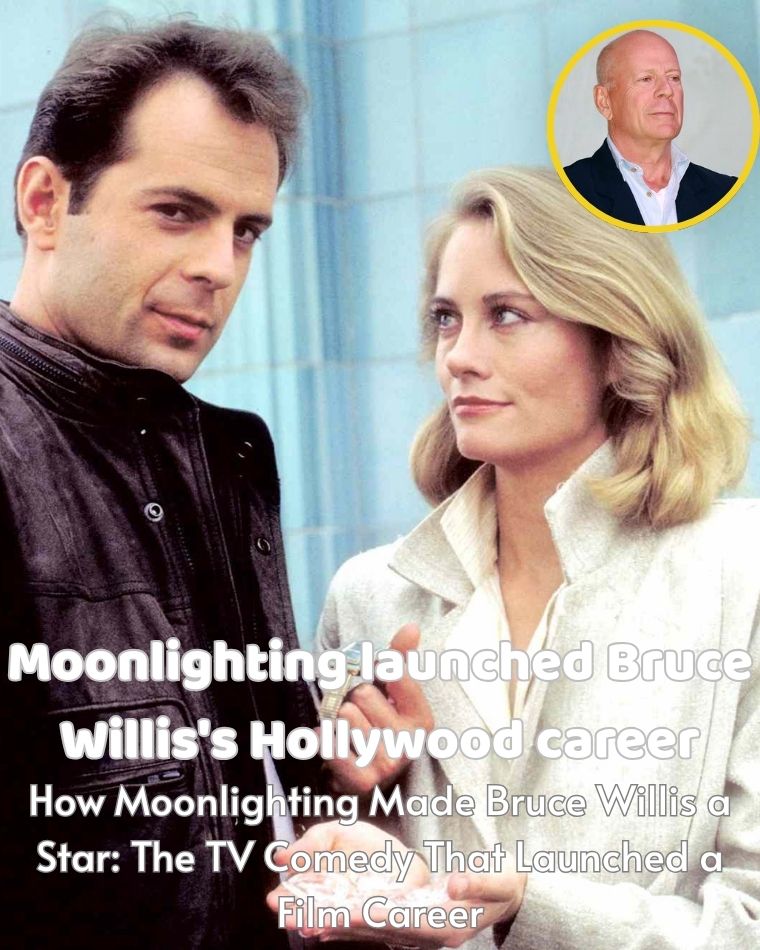
Before becoming an international action hero, Bruce Willis captured America’s attention as David Addison in the groundbreaking ABC detective comedy Moonlighting. Running from 1985 to 1989, the series showcased his unmatched comedic timing, establishing the charismatic foundation that redefined modern screen stardom.
Long before he ever stepped into the worn undershirt of John McClane, Bruce Willis was a struggling New York actor chasing his defining break.
He worked odd jobs and tended bar in Manhattan while auditioning tirelessly for stage productions and minor television parts.
Few industry insiders could have anticipated that an unorthodox romantic detective dramedy would transform him into a household name practically overnight.
Moonlighting emerged on ABC in March 1985, instantly defying the conventional network television formats of its era.
Created by Glenn Gordon Caron, the series refused to fit cleanly into standard police procedural formulas.
Instead, the show presented an ambitious blend of classic screwball comedy, neo-noir detective mystery, and self-referential satire.
At the center of this dynamic universe was the City of Angels detective agency known as Blue Moon Investigations.
Former fashion model Maddie Hayes, portrayed by established star Cybill Shepherd, finds herself bankrupt after being embezzled by her accountant.
Among her few remaining financial assets is a failing detective firm operated by the irreverent, wisecracking David Addison Jr.
Rather than liquidating the agency for quick capital, Maddie decides to take active control of the business alongside David.
The premise served as a modern revitalization of the rapid-fire battle-of-the-sexes comedies pioneered in 1930s Hollywood cinema.
Cre: Wikimedia Commons — Gage Skidmore (CC BY-SA 3.0)
Willis brought an electrifying kinetic energy to David Addison that felt startlingly raw compared to standard network television protagonists of the mid-1980s.
His character was cocky, quick-witted, fiercely loyal, and continually capable of talking his way out of catastrophic peril.
David Addison was not an infallible detective who relied solely on deduction and solemn authority.
He relied on relentless banter, street-smart instincts, and an irrepressible sense of playfulness.
Glenn Gordon Caron actively pushed Willis to lean directly into his natural improvisational instincts and personal charisma.
The dialogue between Willis and Shepherd was famous across the television industry for its extraordinary density and blistering speed.
Typical television scripts of the period ran roughly sixty pages for a standard one-hour commercial broadcast.
In stark contrast, Moonlighting scripts regularly exceeded ninety to one hundred pages to accommodate the rapid-fire exchange of lines.
Characters frequently overlapped dialogue, traded machine-gun quips, and broke into spontaneous musical numbers without warning.
Willis proved capable of delivering tongue-twisting monologues while executing complex physical comedy across crowded office sets.
The creative chemistry between Willis and Shepherd became the undisputed engine driving the entire production forward each week.
Viewers tuned in religiously not merely to see cases solved, but to witness the intoxicating friction between their contrasting personalities.
Maddie represented structured elegance, patrician intellect, and composed professional authority.
David represented chaotic working-class irreverence, unvarnished charm, and relentless rule-breaking behavior.
This perpetual tension established one of television history’s most celebrated “will-they-or-won’t-they” romantic dynamics.
Millions of viewers debated whether the two partners would ever surrender to their undeniable mutual attraction.
The show made bold creative risks a weekly trademark that separated it from competing network broadcasts.
Characters routinely shattered the fourth wall by addressing home viewers directly in the middle of scenes.
Actors made direct references to commercial breaks, script revisions, and television production budgets right on camera.
Moonlighting explored avant-garde narrative formats that challenged the traditional boundaries of episodic drama.
One famous episode reimagined William Shakespeare’s The Taming of the Shrew in full rhyming iambic pentameter.
Another celebrated installment opened with an introduction by legendary director Orson Welles filmed entirely in black-and-white.
Through every creative experiment, Willis anchored the narrative with an approachable, disarming honesty.
His performance demonstrated an uncanny ability to balance broad slapstick comedy with genuine dramatic vulnerability.
Audiences recognized that beneath Addison’s smirk and smarmy exterior resided a deeply protective and earnest heart.
The entertainment industry quickly showered the young actor with widespread professional acclaim.
Willis captured the Golden Globe Award for Best Actor in a Television Series – Musical or Comedy.
In 1987, his extraordinary achievements culminated in winning the Primetime Emmy Award for Outstanding Lead Actor in a Drama Series.
Taking home an Emmy cemented Willis’s status as a legitimate heavyweight actor rather than a fleeting television novelty.
His victory sent a loud signal throughout Hollywood that network television had nurtured a truly singular talent.
Studio executives began paying close attention to how comfortably Willis commanded screen space and audience loyalty.
His rising profile on the small screen immediately triggered opportunities in the commercial film landscape.
Before Moonlighting concluded its run, Willis began testing his appeal across theatrical feature films.
He showcased his comedic versatility alongside Kim Basinger in the 1987 romantic comedy Blind Date directed by Blake Edwards.
He followed that performance by playing legendary Western lawman Tom Mix in the 1988 mystery feature Sunset.
These initial cinematic ventures demonstrated that his magnetic camera presence translated effortlessly onto the big screen.
However, the real Hollywood revolution arrived when Willis signed on to headline an ambitious action thriller titled Die Hard.
At the time, Hollywood action cinema was dominated by hyper-muscular icons like Arnold Schwarzenegger and Sylvester Stallone.
Those action heroes typically presented indestructible physiques and delivered stoic, unflinching violence against global threats.
Casting an irreverent television comedy actor in an intense big-budget action movie bewildered industry observers initially.
Promotional materials for Die Hard initially downplayed Willis’s face on early movie posters due to executive anxiety.
Yet the creative genius of casting Willis was precisely rooted in the unique qualities he had mastered on Moonlighting.
John McClane was fundamentally a high-stakes cinematic extension of David Addison under extreme physical duress.
Like Addison, McClane was an underdog everyman who relied heavily on sharp sarcasm to mask inner anxiety and physical agony.
He was a vulnerable protagonist who bled, suffered bruised ribs, complained about barefoot travel, and cracked desperate gags while crawling through vents.
Willis injected blue-collar realism, authentic charm, and improvisational wit directly into the center of the action genre.
Die Hard debuted in the summer of 1988 and became an instant global phenomenon at the worldwide box office.
The film radically altered the expectations of what an action movie hero could look and sound like.
Audiences cheered McClane precisely because he was relatable, fragile, and fiercely determined despite impossible odds.
That triumphant cinematic breakthrough coincided directly with the final production chapter of Moonlighting back on television.
The television production had become increasingly complex and demanding for everyone involved behind the scenes.
Intricate scripts, perfectionist production schedules, and frequent script delays created notorious logistical headaches.
Episodes frequently aired out of order, were replaced by reruns, or missed scheduled national broadcast slots entirely.
The show’s central dynamic also underwent a major narrative evolution when the central characters finally consummated their romance.
Resolving the lingering romantic tension proved challenging for screenwriters attempting to sustain the series’ original playful momentum.
By the time Moonlighting reached its fifth and final season in 1989, Willis had already ascended into full-blown Hollywood superstardom.
The final episode of Moonlighting aired in May 1989, closing a magnificent five-year chapter in television history.
The series concluded with its signature self-awareness, showing the sets being dismantled around the actors by network technicians.
Willis stepped away from the small screen with his reputation firmly established as an undeniable leading man.
The versatility he forged under Glenn Gordon Caron’s guidance paved the way for one of cinema’s most legendary filmographies.
During the decade that followed, Willis demonstrated a creative range that few of his action contemporaries could match.
He moved comfortably from blockbuster thrillers into bold auteur cinema like Quentin Tarantino’s landmark 1994 masterpiece Pulp Fiction.
He delivered quiet, emotionally disciplined performances in suspense classics such as M. Night Shyamalan’s The Sixth Sense.
He brought deadpan comedic brilliance to dark comedies, science-fiction adventures, and sweeping historical dramas alike.
Yet across all of his celebrated performances, the quintessential Bruce Willis persona remained anchored to David Addison.
The wry half-smile, the quick comeback under pressure, and the playful wink toward the audience were born on Moonlighting.
The series served as an intensive creative laboratory where Willis sharpened every comedic and dramatic instinct he possessed.
Television historians frequently cite Moonlighting as a pioneering milestone that elevated episodic television production standards.
It proved that network series could be stylish, post-modern, intellectually demanding, and wildly entertaining all at once.
It transformed ordinary weekly broadcasts into major cultural events that engaged millions of households nationwide.
More importantly, it proved that television had the creative power to forge a generational Hollywood movie star from scratch.
When film critics analyze Bruce Willis’s extraordinary cinematic legacy, the conversation invariably gravitates toward Die Hard.
That historic film undoubtedly altered the grammar of commercial action cinema across the globe forever.
However, John McClane’s enduring humor and heart were undeniably forged within the chaotic halls of the Blue Moon agency.
Without Glenn Gordon Caron’s ambitious writing, Willis might never have discovered the exact cadence of his signature screen persona.
Without Cybill Shepherd’s formidable counterpoint, television audiences might never have witnessed the full electrical potential of his screen presence.
And without the 1987 Emmy recognition, Hollywood producers might never have taken the fateful gamble on Die Hard.
Moonlighting was far more than an affectionate nostalgic television memory from the vibrant middle of the 1980s.
It was the crucial artistic crucible that tested, shaped, and unleashed an iconic performer onto the world.
Bruce Willis arrived on television as an unproven talent eager for an opportunity to demonstrate his abilities.
He walked away from the series as an indelible pop culture icon whose career reshaped American entertainment for generations.
Để lại một phản hồi