Thirty years after its theatrical debut on September 20, 1996, Walter Hill’s Last Man Standing remains one of the most intriguing genre experiments of Bruce Willis’s career. The film reworked Akira Kurosawa’s foundational 1961 classic Yojimbo, mirroring the very path Clint Eastwood took in 1964 with A Fistful of Dollars. Today, this stylized Prohibition-era neo-western stands as a fascinating bridge connecting three cinema eras and their iconic lone-gunman antiheroes.
Thirty years ago, Hollywood saw an unusual fusion of hard-boiled crime fiction and rugged frontier myth when Last Man Standing arrived in theaters on September 20, 1996.
The film arrived during an era when Bruce Willis commanded unmatched box-office power across global cinemas.
Yet instead of delivering another high-energy, quip-heavy contemporary action spectacle, Willis made a deliberate detour into dusty, brooding genre cinema.
He strapped on a pair of Colt M1911 semi-automatic pistols and drove a lonely automobile into a sun-baked border outpost.
The resulting motion picture transported viewers into Jericho, Texas, a desiccated ghost town caught in the violent grip of Prohibition-era bootlegging.
Behind the camera was Walter Hill, an American director legendary for his gritty, uncompromising vision of cinematic violence and urban westerns.
Together, they embarked on a creative project that carried deep ties to cinema history.
Most notably, the film created a fascinating, direct line linking Willis to the legendary Clint Eastwood.
Both actors had walked through nearly identical story beats three decades apart.
Each star had taken on a narrative blueprint first forged across the Pacific by Japanese master Akira Kurosawa.
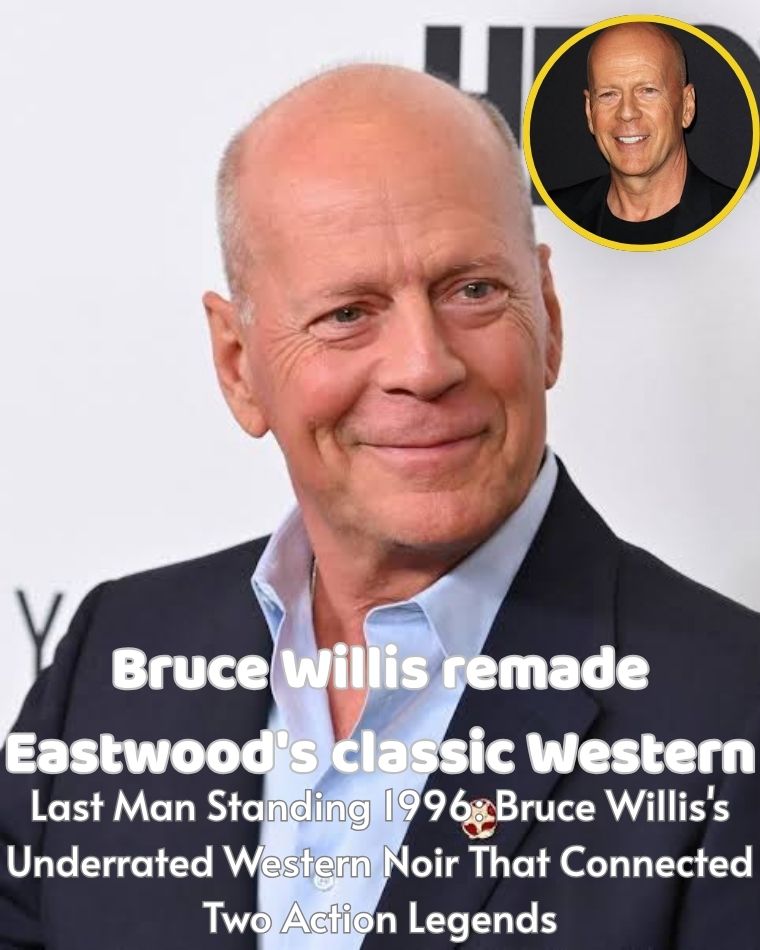
Cre: Wikimedia Commons — Gage Skidmore / CC BY-SA 2.0
The Shared Lineage of Akira Kurosawa’s Masterpiece
To understand Last Man Standing, one must examine the story’s original masterwork, Akira Kurosawa’s 1961 masterpiece Yojimbo.
In that foundational work, legendary Japanese actor Toshiro Mifune portrayed Sanjuro, a wandering masterless samurai who strolls into a town torn apart by two rival criminal factions.
Rather than aligning himself with either corrupt gang, the ronin coldly plays both sides against each other.
His cunning manipulations steadily lead to the complete mutual annihilation of both factions.
Kurosawa’s vision captivated European and American filmmakers who immediately recognized the universal power of its moral ambiguity.
Only three years later, Italian visionary Sergio Leone transposed the samurai tale into the deserts of southern Europe for A Fistful of Dollars in 1964.
That seminal Spaghetti Western cast Clint Eastwood as the enigmatic Man with No Name.
Eastwood’s character was an unnamed drifter wrapped in a poncho, smoking cheroot cigars, and ruthlessly manipulating two feuding frontier families.
The role launched Eastwood into international superstardom and redefined the archetype of the cinematic antihero for generations.
When Walter Hill stepped forward in the mid-1990s to direct Last Man Standing, he explicitly acknowledged this profound cinematic ancestry.
Official credits on the 1996 film properly attributed the original story to Akira Kurosawa and co-writer Ryuzo Kikushima.
Contemporary film reviewers, including the Los Angeles Times, immediately recognized the throughline connecting Mifune, Eastwood, and Willis.
Across three distinct decades and three different filmmaking traditions, three major movie stars had stepped into the exact same wandering antihero archetype.
Walter Hill and the Perils of Reimagining a Legend
Taking on a project with such revered forebears was never an easy creative assignment.
Walter Hill was acutely aware of the artistic risks inherent in reinterpreting a world-renowned masterwork.
Recalling his initial reaction when the project was first conceived, Hill confessed that he considered adapting Kurosawa to be sheer insanity.
Hill openly stated that Kurosawa’s original movie was exceptionally good and described the Japanese master as probably our most revered filmmaker.
Despite his hesitation, Hill possessed the precise aesthetic sensibilities required to adapt such gritty material.
Over previous decades, Hill had earned a major reputation with muscular classics like The Warriors, Hard Times, and 48 Hrs.
His films consistently operated as modern westerns disguised as urban crime thrillers.
For Last Man Standing, Hill chose to shift the setting to Texas during the dry heat of the summer of 1931.
This historical setting allowed him to merge two distinct genres: the classic dusty Western and the hard-boiled gangster film.
The American Film Institute Catalog accurately categorizes Last Man Standing as both a Western and a drama.
The physical landscape remained pure Western, filled with tumbleweeds, wooden saloons, scorching heat, and relentless wind.
Yet the weaponry, automobiles, and criminal dynamics belonged entirely to the realm of Prohibition-era organized crime.
The warring factions in the story were not Old West cattle barons or feudal merchant guilds.
Instead, they were competing bootlegging syndicates smuggling illicit liquor across the Mexican border.
One side was led by an Irish mob faction, while the other was commanded by an Italian mafia syndicate.
Between these lethal groups walked Bruce Willis’s drifter, introducing himself to townspeople under the nondescript pseudonym John Smith.
Bruce Willis as the Taciturn Noir Antihero
For Bruce Willis, Last Man Standing represented a striking departure from his established star persona.
During the late 1980s and early 1990s, Willis built his global reputation on charismatic vulnerability and witty banter.
His legendary portrayal of John McClane in Die Hard had fundamentally changed action cinema by presenting an ordinary, relatable cop who talked constantly to cope with pain and panic.
In sharp contrast, John Smith in Last Man Standing barely spoke at all.
Hill directed Willis to deliver a performance characterized by severe emotional restraint, cold deadpan stares, and stony stoicism.
Instead of charm, Willis projected tired cynicism, speaking largely through hard-boiled voiceover narration.
Costumed in a dark pinstripe three-piece suit, fedora, and suspenders, Willis carried two heavy .45-caliber pistols with lethal grace.
The action sequences discarded realistic gunplay in favor of operatic, heightened violence.
Every time Willis pulled the trigger, muzzle blasts shattered the silence, knocking adversaries clean off their feet and propelling them backwards through doors and wooden windows.
This exaggerated, stylized violence paid homage to both classical samurai choreography and heroic bloodshed cinema.
Willis embraced the cold amorality of the protagonist with absolute conviction.
John Smith was not a noble crusader out to bring justice to an oppressed populace.
He was an exhausted drifter with blood on his hands, looking for a payday while acknowledging that everyone around him was morally bankrupt.
The supporting cast featured exceptional character actors who elevated the grim tension.
Christopher Walken delivered a chilling performance as Hickey, a ruthless, disfigured enforcer armed with a submachine gun.
Bruce Dern appeared as the hopelessly corrupt town sheriff who simply waited for both sides to destroy one another.
The dynamic between Willis and Walken crackled with menace, anchoring the final act in genuine dramatic gravity.
Mixed Critical Reception and a Divisive Legacy
When Last Man Standing premiered in American cinemas on September 20, 1996, the critical response was sharply polarized.
Audiences expecting the breezy humor and explosive joy of Willis’s typical blockbusters found themselves confronted with an unremittingly dark, melancholic piece of filmmaking.
Many major film critics were caught off guard by the movie’s relentless cynicism and bleaker-than-usual worldview.
Legendary film critic Roger Ebert delivered a devastating appraisal of the production.
Awarding the movie just a single star, Ebert described Last Man Standing as such a desperately cheerless film.
Ebert concluded his critique by remarking on how sad and deeply lonely the entire cinematic experience felt.
In his review, Ebert also explicitly pointed back to Kurosawa’s original Yojimbo, criticizing Hill’s version for stripping away the sly, biting dark comedy that made the Japanese masterwork work so effectively.
Other critics lamented that the film took its grim premise far too seriously, suffocating the narrative under layers of sepia dust and nihilism.
Today, review aggregator Rotten Tomatoes records a modest 41% rating on the Tomatometer for the film.
The critical consensus on the site acknowledges the striking visual atmosphere and vigorous gunplay, but faults the narrative execution as hollow and overly detached.
At the box office, the film struggled to find a massive commercial footing against its hefty production budget.
Yet over the ensuing three decades, movie aficionados and genre scholars have steadily reconsidered the picture’s artistic merits.
Liberated from contemporary 1996 box-office expectations, the film reveals itself as an uncompromising exercise in pure visual style.
Cinematographer Lloyd Ahern drenched the movie in burnished amber tones, baking heat, and relentless windstorms.
Ry Cooder’s haunting, atmospheric musical score gave the film an otherworldly, funeral rhythm that set it entirely apart from 1990s action cliches.
A Crucial Milestone in Bruce Willis’s Eclectic Filmography
Looking back 30 years later, Last Man Standing holds a distinctive position within Bruce Willis’s remarkable cinematic canon.
The mid-1990s was a period of daring artistic exploration for the star.
Following the massive triumph of Quentin Tarantino’s Pulp Fiction in 1994, Willis frequently used his superstar capital to collaborate with distinctive auteur directors.
He worked alongside visionary filmmakers like Terry Gilliam in 12 Monkeys and Luc Besson in The Fifth Element.
His willingness to tackle Walter Hill’s austere neo-western demonstrated a genuine commitment to pushing his own boundaries as an actor.
Willis actively chose not to rely on his trademark smirk and charm.
Instead, he tested his screen presence through stillness, physical gravity, and minimalist underplaying.
In doing so, Willis earned his place in an elite cinematic genealogy.
He became the third titan of international cinema to walk down that dust-blown main street between two deadly gangs.
Toshiro Mifune brought samurai nobility and feral cunning to the archetype in 1961.
Clint Eastwood brought lean, laconic coolness to the character in 1964.
Bruce Willis brought weary, bruised urban fatalism to the role in 1996.
While Last Man Standing may not have matched the box-office heights of Die Hard or Armageddon, its reputation has grown richer with age.
It stands as an audacious cinematic time capsule from an era when major Hollywood studios still financed uncompromising, adult-oriented genre films.
Three decades after John Smith first rolled into Jericho, Walter Hill’s ambitious film remains a captivating chapter in the enduring myth of the wandering American gunfighter.
Để lại một phản hồi