When Project Hail Mary captured audiences worldwide, it shattered long-standing Hollywood assumptions about what mainstream moviegoers can handle. By trading mindless spectacle for scientific ingenuity and emotional sacrifice, the film proved that complex storytelling still commands a massive cultural footprint. Now, major industry moves—including a newly reported Netflix thriller from the same creative team—demonstrate that studios are finally recognizing the commercial power of trusting the audience.
The modern cinematic landscape has spent over a decade grappling with formula fatigue.
Audiences have grown noticeably weary of standard studio recipes built entirely around noisy visual effects.
For years, studio executives operated under an unspoken rule that mainstream blockbusters required radical simplification.
Traditional studio development often dictated that plots must be reduced to their most digestible parts to appeal to global demographics.
Every significant conflict was expected to resolve with a massive physical battle or an explosive set piece.
Complex intellectual problems were routinely scrubbed from screenplays during revisions.
Yet Project Hail Mary openly rejected that entire philosophy from the ground up.
The film embraced Andy Weir’s dense source material rather than watering it down for casual viewers.
Instead of hiding the math, the adaptation made physics, biology, and chemistry the primary drivers of its dramatic tension.
The result was an undeniable critical and commercial triumph that reshaped conversations across the entertainment industry.
Hollywood suddenly found itself confronted with a production that succeeded purely because it demanded focused engagement.
Viewers did not turn away from technical jargon; they leaned in.
The triumph sent shockwaves through studio offices that had spent years underestimating moviegoers.
MovieWeb underscored this industry shift by reporting on a major new Netflix thriller officially announced from the exact creative team behind the sci-fi hit.
Streaming platforms and major studios rarely invest heavily in high-concept creative packages without rigorous proof of market demand.
The fact that Netflix moved swiftly to secure the same filmmaking team demonstrates that executives view their methodology as a dependable commercial engine.
Industry observers note that this new development is not merely routine talent retention.
It represents a direct endorsement of a specific storytelling standard championed by Phil Lord, Chris Miller, and Ryan Gosling.
Studios are recognizing that these creatives have cracked the code for creating intelligent, high-stakes entertainment.
When a creative unit demonstrates that audiences will turn out for smart drama, distributors take notice.
The greenlight for their upcoming thriller shows an industry eager to replicate that distinct narrative balance.
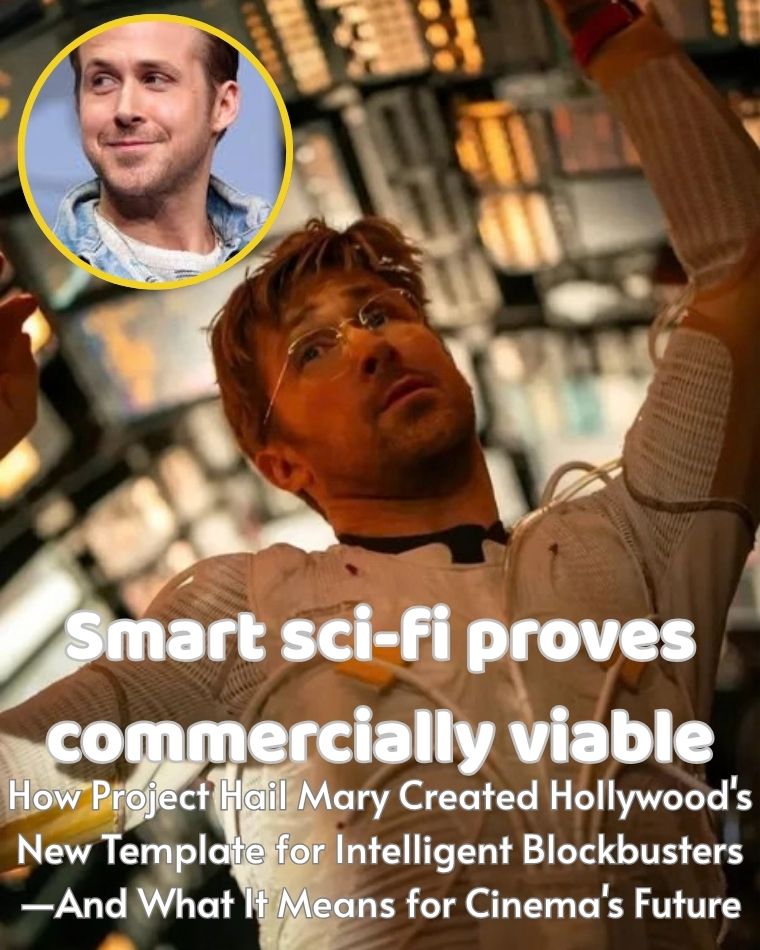
Cre: Wikimedia Commons — Gage Skidmore / CC BY-SA 3.0
The enduring resonance of the film was further cemented by leading film authority Collider.
In a recent analytical feature, Collider listed Project Hail Mary among the sci-fi movies boasting the greatest crowd-pleasing endings.
Sci-fi cinema has historically tilted toward bleak dystopias, ambiguous finales, or tragic cautionary tales.
Achieving a truly crowd-pleasing conclusion in hard science fiction is an extraordinarily rare cinematic feat.
Most crowd-pleasing blockbusters rely on villain defeats, exploding starships, or last-minute military rescues.
Project Hail Mary achieved that status through an entirely different structural approach.
The climax relies fundamentally on advanced astrophysics, moral responsibility, and emotional restraint.
There are no laser dogfights in the closing act.
There are no synthetic twists designed to shock viewers without narrative justification.
The dramatic resolution hinges entirely on meticulous scientific calculation and selfless sacrifice.
Audiences left theaters deeply moved because the payoff was earned through problem-solving rather than sensory overload.
Recognizing the finale among the genre’s best crowd-pleasers highlights how deeply the emotional stakes connected.
When storytelling prioritizes genuine character bonds, audiences invest completely in every calculation.
The partnership between Ryland Grace and Rocky stands as the beating heart of that journey.
Their cross-species communication was treated as a rigorous linguistic and mathematical puzzle.
Audiences watched two minds bridge light-years of distance using sound waves, metrics, and mutual trust.
Because the process felt genuine, the ultimate sacrifice felt devastating and profound.
The emotional catharsis arrived as a direct consequence of scientific perseverance.
This emotional resonance proves that intellectual plots and heartwarming stories are not mutually exclusive.
What makes Project Hail Mary so important to modern film discourse is that it serves as an actionable template rather than an unrepeatable anomaly.
Too often, studio executives dismiss unexpected hits as lightning in a bottle.
When an unconventional project succeeds, Hollywood frequently misdiagnoses the true reasons behind the triumph.
In this instance, the core ingredients are transparent, disciplined, and entirely repeatable.
First, filmmakers must select rich, conceptually challenging subject matter with authentic substance.
Second, the creative team must place absolute trust in the audience’s intelligence.
Third, the script must cultivate deep, authentic character relationships that provide emotional grounding.
Finally, the narrative must allow authentic, grounded stakes to drive suspense rather than artificial urgency.
When a production respects its viewers, the viewers reward the production with enthusiastic advocacy.
Dumbing down material often alienates the very viewers who would otherwise champion the film.
Sophisticated audiences can immediately detect when a studio loses faith in their attention span.
By preserving genuine scientific dilemmas, the film treated its audience as capable partners in the discovery.
Every obstacle presented a clear physical logic that the audience could track in real time.
That shared comprehension amplified the suspense tenfold.
Tension is far more gripping when viewers understand exactly how dangerous an environmental failure truly is.
When oxygen supplies or heat thresholds become clear mathematical deadlines, suspense develops organically.
Directors Phil Lord and Chris Miller brought a formidable creative history to this undertaking.
Throughout their careers, the filmmaking duo has consistently demonstrated a unique gift for deconstructing complex ideas.
They previously proved this mastery by steering the Spider-Verse franchise through intricate multiverse concepts.
Where other franchises became tangled in timeline mechanics, Lord and Miller made complex dimensions intuitive, energetic, and visually exhilarating.
They understood that audiences could effortlessly follow multilayered quantum theories if the personal stakes remained sharp.
With Project Hail Mary, Lord and Miller successfully transplanted those storytelling instincts into grounded, live-action hard science fiction.
They approached scientific exposition not as a tedious burden to endure, but as a thrilling sequence of events.
Each discovery was filmed with kinetic momentum and visual clarity.
The directors transformed laboratory procedures and whiteboard equations into cinematic spectacles.
Their direction ensured that thinking through a problem carried just as much visual momentum as a chase sequence.
Complementing their vision was an extraordinary lead performance from Ryan Gosling.
Gosling carried the immense burden of solitary screen time while guiding audiences through complex logic.
He portrayed Ryland Grace not as an infallible superhero, but as an ordinary teacher thrust into an unimaginable crucible.
His performance required viewers to track legitimate scientific problem-solving step by step.
Gosling made the intellectual process compelling through curiosity, humor, and vulnerable resolve.
Every hypothesis, failed experiment, and eureka moment was etched across his expressions with complete conviction.
His chemistry with a non-human digital counterpart grounded the narrative in absolute emotional truth.
Without an actor capable of communicating technical deduction with effortless charm, the narrative could have collapsed under its own weight.
Gosling managed to make scientific inquiry feel relatable, harrowing, and triumphant.
The collaboration among Lord, Miller, and Gosling established a standard for high-budget commercial filmmaking.
They demonstrated that a blockbuster can feature rigorous scientific discipline while still delivering profound emotional catharsis.
The commercial viability of this method represents a critical development for theatrical cinema.
Scientific accuracy is often treated by studio executives as a commercial liability.
Conventional wisdom long insisted that strict adherence to physical laws drains a movie of fun and escapism.
Project Hail Mary completely exposed the falsehood of that assumption.
The film proved that genuine physical constraints actually heighten the dramatic stakes.
When rules cannot be bent by magical technology or convenient coincidences, solutions require genuine genius.
The laws of physics became an immovable antagonist that the protagonist had to outthink rather than overpower.
That authenticity created a level of immersion that synthetic action spectacles consistently fail to generate.
Audiences felt the terrifying cold of space, the immense friction of orbital maneuvers, and the relentless ticking clock of stellar extinction.
The realism grounded the fantasy, making every small breakthrough feel like a massive triumph.
The entertainment industry currently stands at a decisive crossroads.
Years of franchise fatigue have eroded traditional theatrical reliability across multiple legacy studios.
Audiences are making it abundantly clear that brand recognition alone is no longer enough to guarantee turnout.
Lowest-common-denominator storytelling is rapidly losing its commercial potency.
Viewers are actively looking for films that surprise them, challenge them, and treat their intellect with dignity.
Project Hail Mary stands as a powerful demonstration that narrative ambition and commercial profitability can coexist harmoniously.
The decisive reaction from Netflix in securing the team’s next thriller suggests the wider industry is observing these shifts closely.
When top executives see creative rigor translate into passionate audience loyalty, production priorities begin to pivot.
The true test moving forward is whether rival studios will internalize the proper lessons from this achievement.
The takeaway from Project Hail Mary is not simply that audiences want more space missions or more adaptations of Andy Weir novels.
The real lesson is that audiences crave storytelling integrity, compelling problem-solving, and emotional sincerity.
Superficial imitations that copy the aesthetics without honoring the intellectual depth will inevitably struggle.
To replicate this success, studios must abandon their instinct to oversimplify challenging concepts.
They must empower filmmakers who view their audiences as intelligent collaborators rather than passive consumers.
The creative momentum generated by Lord, Miller, and Gosling has reopened doors that many believed were permanently shut.
It has reaffirmed that original thought, scientific curiosity, and high-budget filmmaking belong in the same room.
As the team prepares their upcoming thriller, the expectations of both the industry and the public have evolved significantly.
Viewers now understand that blockbusters do not have to settle for the lowest common denominator to find global resonance.
They have experienced a film that respected their intellect while still sweeping them away with profound human warmth.
That standard will inevitably shape how future science fiction projects are conceived, written, and produced.
If Hollywood chooses to heed these lessons, cinema may well be entering a refreshing era of mature, ambitious entertainment.
Project Hail Mary proved that when filmmakers aim higher, audiences will enthusiastically rise to meet them.
The blueprint for the modern intelligent blockbuster has officially been drawn, and the screen will be all the better for it.
Để lại một phản hồi