Brad Pitt has broken his customary silence on personal struggles to deliver an extraordinarily raw reflection on his path through sobriety, emotional darkness, and mental health maintenance.In a wide-ranging conversation highlighted by ABC7 San Francisco and originally featured in Esquire, the Academy Award-winning star revealed the intense psychological battles that lurked beneath decades of global fame. The interview signals a major shift in tone for the veteran actor, offering unprecedented transparency into how even Hollywood’s most celebrated figures confront profound internal hardship.
For decades, Brad Pitt has maintained a disciplined boundary around his private interior world.
The global public knows his cinematic triumphs, his high-profile career milestones, and his carefully curated promotional appearances.
Yet behind that polished facade, the Oscar winner has endured severe emotional turbulence.
In this latest interview, Pitt chose to strip away the protective armor that has long shielded his emotional life.
He addressed the reality of living through severe emotional distress and confronted the fragile balance of his mental health.
The revelations immediately captured worldwide attention, sparking meaningful conversations across the entertainment industry.
The discussion marks one of the most direct and vulnerable public dialogues Pitt has ever offered regarding psychological well-being.
Rather than presenting an idealized narrative of effortless resilience, Pitt chose to present the unfiltered complexities of human recovery.
His reflections highlight how psychological distress can challenge anyone, regardless of professional stature, financial comfort, or cultural influence.
The candid admission underscores the universal nature of mental health vulnerability.
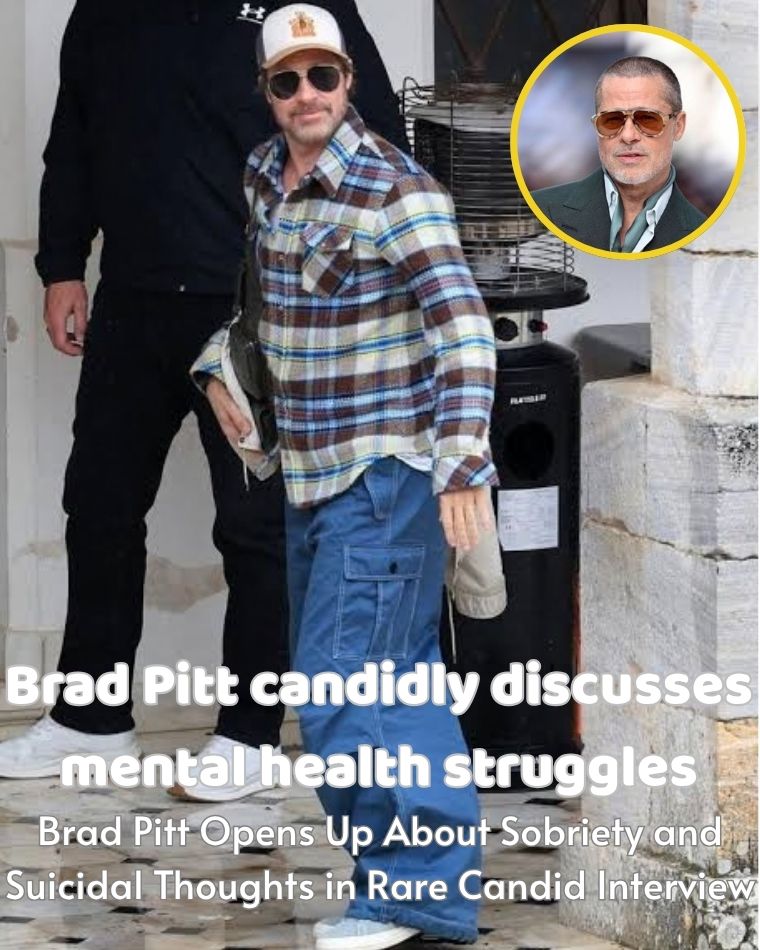
Cre: Wikimedia Commons
Confronting Dark Periods and Facing Suicidal Thoughts
Among the most startling admissions in the interview was Pitt’s discussion of experiencing suicidal thoughts during an intensely stressful chapter of his life.
Hollywood icons rarely speak on this topic with such directness, given the intense stigma attached to self-harm ideation.
Pitt framed this painful revelation within the reality of overwhelming personal and emotional turmoil.
He pointed to a specific period marked by acute family hardship, noting that the weight of the moment became crushing.
“I’ve never been suicidal except for one little period,” Pitt confessed during the interview.
He explained that during that brief, terrifying interval, he struggled to envision any possible way forward.
“In that one little period, I just thought — I just couldn’t — just didn’t see a way out,” he shared.
He characterized the emotional sensation at the time as completely “oppressive”.
The actor noted that suicide, in that dark headspace, began to look less like a desire to cease living and more like an attempt to find relief from relentless emotional pain.
He described how suffering can distort human perception until escape appears to be the only viable mechanism.
Pitt recognized that his core nature had traditionally leaned toward resilience and congenital optimism.
Yet even a naturally optimistic disposition could not entirely safeguard him from being overwhelmed by acute psychological agony.
He credited a powerful, deep-seated survival instinct for stepping in to pull him back from the precipice.
“Like, listen: This s*** ain’t easy,” Pitt remarked candidly.
“And you’re talking to a guy who won the lottery,” he added, acknowledging the vast gap between external success and internal peace.
That single statement captured the profound disconnect that often exists between material fortune and genuine mental stability.
It demonstrated that outward blessings do not confer immunity against debilitating inner crises.
His willingness to articulate that struggle publicly serves as a stark reminder of how insidious depression and despair can be.
The conversation validated the reality of psychological pain for countless individuals who may feel ashamed of their own dark thoughts.
Mental health professionals consistently emphasize that acknowledging suicidal ideation without shame is a crucial step toward recovery.
By speaking on it directly, Pitt helped puncture the wall of silence that often traps people facing psychological crises.
His transparency emphasizes that reaching for survival is a courageous, necessary act of self-preservation.
The Complex Realities of Sobriety and the Ongoing Journey
Beyond discussing mental health emergencies, Pitt offered an equally nuanced perspective on his relationship with alcohol.
Sobriety has formed a central part of his personal narrative for several years, dating back to significant life shifts in the late 2010s.
Pitt originally embraced complete abstinence, spending seven straight years completely sober.
During that extended sober period, he engaged deeply with recovery support networks.
He previously attended Alcoholics Anonymous meetings for roughly a year and a half, describing the environment as a sanctuary.
In past conversations, Pitt had reflected on how powerful it felt to sit in rooms filled with vulnerable men sharing their deepest flaws without judgment.
He had also expressed sincere gratitude to fellow actor Bradley Cooper for providing invaluable guidance during his early transition into sobriety.
Those years of total sobriety allowed Pitt to rebuild his emotional equilibrium and examine behavioral patterns he had ignored for decades.
However, the latest interview revealed that his personal relationship with alcohol has evolved into a new, delicate chapter.
Pitt disclosed that he is no longer strictly abstinent, having stepped away from rigid sobriety after seven continuous years.
“I was sober for seven years,” Pitt explained straightforwardly.
“And then I got back off the wagon,” he confessed, detailing how he re-entered the space with cautious boundaries.
He described approaching drinking in what he termed a far more restrained manner.
“I got overconfident a couple times, went, ‘Yep, nope, not good for me. Not in big quantities,'” he recalled.
He noted that while he might enjoy a few glasses of wine on occasion, he understands his strict limitations.
“Well . . . I can have a few. But I can’t have a lot. I have to be professional about it,” he explained.
This candid admission defies the neat, linear narrative that culture frequently expects from celebrity recovery journeys.
Addiction and recovery experts often note that individuals frequently navigate intricate paths regarding substance management.
Rather than presenting himself as a flawless spokesperson for absolute abstinence, Pitt chose to admit his personal navigation.
He recognized that maintaining balance demands constant vigilance and sharp self-awareness.
His candor demonstrates the emotional maturity required to evaluate one’s limits truthfully.
Navigating vices requires relentless accountability, particularly for someone whose life is scrutinized by millions.
By sharing his real-world calibration, Pitt provided an honest look at the messy reality of long-term behavioral management.
Breaking Away From Hollywood’s Guarded Media Tradition
Brad Pitt’s disclosures represent a pronounced departure from standard entertainment publicity playbooks.
For most of his thirty-five-year career, the actor has handled press interactions with measured charm and deliberate privacy.
He understood early on that celebrity culture frequently consumes personal narratives for sensationalist headlines.
In the 1990s, the crushing wave of fame led him to withdraw socially to escape invasive public scrutiny.
He previously described feeling deeply uncomfortable with the cacophony of external expectations and moral judgments.
Because of those experiences, Pitt spent decades cultivating an intensely protective perimeter around his private emotional life.
When major celebrities give high-profile magazine interviews, conversations typically center on upcoming films, fitness regimens, or artistic achievements.
Very few top-tier leading men choose to discuss their deepest vulnerabilities or periods of despair in national print.
By choosing this level of transparency at age 62, Pitt demonstrated a conscious refusal to maintain an artificial image.
He opted instead to speak with the hard-won authenticity of someone who has weathered profound storm systems.
This decision reflects a cultural evolution within male celebrity discourse, where vulnerability is increasingly recognized as a virtue.
Historically, Hollywood leading men were conditioned to project stoic invulnerability at all costs.
Any admission of emotional weakness, depression, or loss of control was feared as a potential career liability.
Pitt’s openness challenges that obsolete archetype directly.
He shows that an acclaimed action star, producer, and enduring sex symbol can speak honestly about mental health crises without diminishing his stature.
The reaction from public commentators and industry observers has been broadly supportive.
Many have praised his refusal to sugarcoat the messy, ongoing nature of psychological self-care.
His demeanor suggests that reaching genuine maturity involves accepting one’s broken pieces rather than hiding them.
The interview serves as a blueprint for how high-profile figures can utilize their cultural visibility responsibly.
Transparency transforms personal pain into a potential source of shared understanding.
Cultural Resonance and the Broader Mental Health Movement
The ripple effects of Pitt’s interview extend well beyond the borders of Hollywood entertainment reporting.
Mental health advocates have long emphasized the unique impact that high-profile figures have on public perceptions of mental illness.
When an internationally recognized figure admits to experiencing suicidal ideation, it disrupts dangerous stereotypes about who suffers.
Depression and despair do not discriminate on the basis of fame, prestige, or wealth.
Hearing a cultural icon discuss his darkest moments can demystify the crisis for ordinary individuals fighting identical battles in private.
It sends a clear message that seeking help and admitting despair is a universal human reality rather than a personal failure.
In conjunction with reporting on Pitt’s admissions, media outlets including ABC News and local affiliates highlighted vital support resources.
Coverage routinely included access information for the 988 Suicide & Crisis Lifeline, which provides continuous, confidential assistance.
These resources serve as a critical safety net for individuals undergoing sudden psychological crises.
The inclusion of crisis support details alongside celebrity reporting transforms entertainment news into an opportunity for life-saving public intervention.
Pitt’s remarks also arrive at a moment of cultural re-evaluation regarding men’s mental health.
Men across the world continue to face elevated rates of suicide, frequently driven by reluctance to voice emotional distress.
Traditional masculinity has often discouraged emotional disclosure, leading many men to suffer in silence until it is too late.
When someone with Pitt’s cultural standing speaks openly about oppressive pain and needing survival instincts, it alters the social script.
It gives men permission to acknowledge when life feels unmanageable.
Furthermore, his discussion of substance use addresses the frequent intersection between self-medication and emotional suffering.
Many individuals turn to alcohol or substances as a coping mechanism for underlying psychological distress.
Pitt’s journey illustrates that untangling substance use and psychological wounds requires continuous, intentional dedication.
Recovery is rarely a completed event; it is an ongoing, lifelong practice.
The widespread reception of his interview shows a public eager for honest, imperfect narratives.
People find far more solace in authentic struggles than in manufactured tales of effortless triumph.
Looking Forward: Creative Energy and Personal Equilibrium
Even as he reflected on his darkest personal moments, Pitt emphasized that life continues to move forward.
At 62 years of age, the actor remains one of the busiest, most prolific figures in global cinema.
He balances active on-screen acting with producing extensive film slates through his production company.
Among his upcoming cinematic releases is the high-stakes survival drama Heart of the Beast.
In the film, directed by David Ayer and written by Cameron Alexander, Pitt stars as a former Special Forces officer.
His character, James Belmont, navigates severe danger alongside a combat dog named Odin when stranded in the Alaskan wilderness.
Pitt serves as both lead actor and producer on the project, which co-stars J.K. Simmons and Anna Lambe.
The demanding physical and creative roles he undertakes show an artist still passionately engaged with storytelling.
Yet his recent commentary reveals that creative drive is now tempered by a much deeper grounding in self-preservation.
Pitt understands that external career accomplishments cannot replace internal emotional stability.
He continues to emphasize the value of finding joy, maintaining genuine friendships, and acknowledging personal limits.
The actor’s transparent revelations prove that processing pain is a non-negotiable part of the human experience.
He has demonstrated that survival is not merely about enduring hardship, but about learning to live with honesty on the other side.
His candid admission reminds audiences that no level of success exempts someone from the hard work of living.
By sharing his journey, Pitt has contributed a powerful and compassionate chapter to the ongoing global dialogue on mental health.
His words offer hope to those walking through their own dark valleys, proving that even in moments of severe darkness, survival remains entirely possible.
Để lại một phản hồi