Nearly three decades after its theatrical release, The Waterboy endures not merely as a high-grossing sports comedy, but as the foundational archetype that defined Adam Sandler’s screen career. By anchoring absurdist physical humor and an outrageous voice inside an emotionally wounded outsider, director Frank Coraci and Sandler created an emotional architecture that Hollywood continues to study.
Why does Bobby Boucher still work after all these years?
Strip away the exaggerated Cajun dialect, the lawnmower rides, and the bizarre dietary claims, and a deeply resonant comic engine immediately reveals itself.
On the surface, the film presents an unapologetic barrage of slapstick and Southern sports parody.
Beneath the cartoonish exterior, however, lies an intricately constructed study of social isolation, suppressed rage, and hard-earned vindication.
Released in 1998, The Waterboy arrived at a transformative moment in Hollywood comedy.
Directed by Frank Coraci, the film placed Adam Sandler at the center of college football culture as Bobby Boucher Jr.
Bobby serves as the fiercely dedicated, socially awkward water distribution specialist for the University of Louisiana Cougars.
Bullied relentlessly by coaches and players alike, he views high-grade hydration as his sacred calling.
When he is abruptly fired, Bobby relocates to the struggling South Central Louisiana State University Mud Dogs.
There, an explosive release of long-repressed anger uncovers his supernatural talent for tackling ball carriers.
Audiences responded on an unprecedented scale to this underdog sports narrative.
The film generated over $190 million worldwide against a modest production budget.
That commercial haul cemented Sandler’s status as an undeniable box-office titan during the late 1990s.
Yet the lasting cultural footprint of The Waterboy extends far beyond its box-office receipts.
As the film approaches its twenty-eighth anniversary in 2026, looking toward its thirtieth milestone, its artistic structure deserves rigorous re-examination.
The movie established the precise comic template that Sandler would iterate across his most beloved films.
Understanding Bobby Boucher requires analyzing the convergence of character psychology, maternal codependency, and populist cinema.
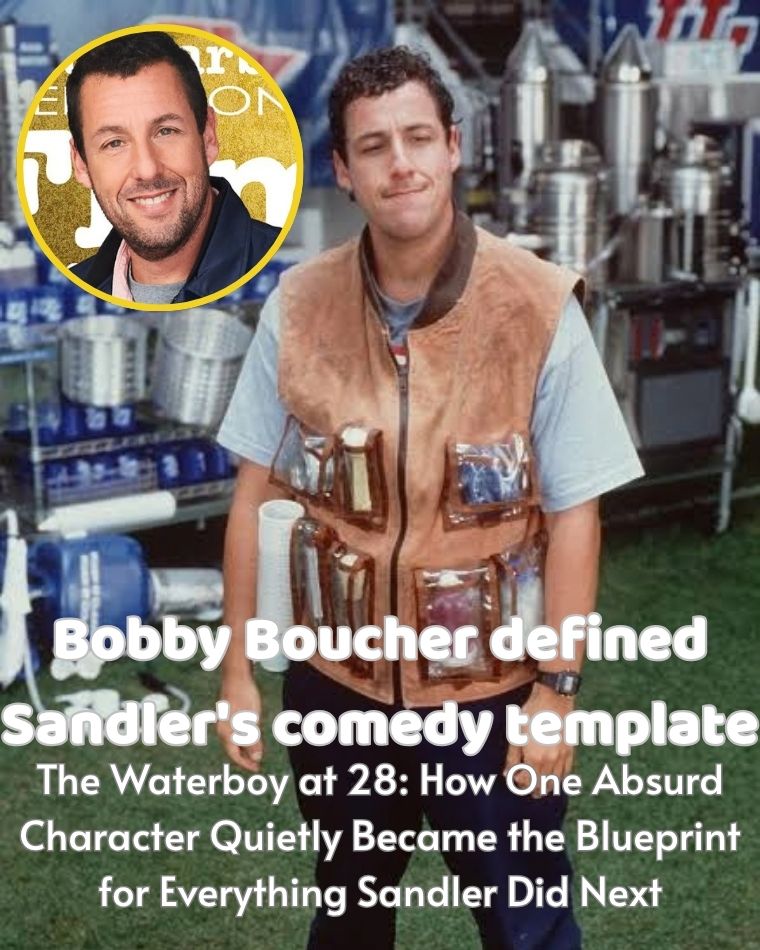
Cre: Wikimedia Commons
The Bobby Boucher Architecture: Vulnerability Beneath Absurdity
Every enduring cinematic comedian relies on a primary persona that grounds their humor.
For Charlie Chaplin, it was the resilient elegance of the Little Tramp navigating industrial poverty.
For Adam Sandler, the defining persona reached its creative maturity in Bobby Boucher.
Bobby embodies the classic underestimated outsider whose eccentricities shield profound emotional vulnerability.
He speaks with a pronounced stutter and clings to childlike innocence well into adulthood.
He carries a portable water filtration device as though it were life-saving medical equipment.
These exaggerated traits initially read as broad comic caricatures designed for quick laughs.
However, the screenplay carefully connects Bobby’s eccentricities to real, unaddressed psychological trauma.
His father allegedly abandoned the family in the Louisiana bayou when Bobby was an infant.
His mother convinced him that outside society is populated by malevolent figures waiting to destroy him.
Consequently, water serves as Bobby’s sole psychological safe haven.
It is pure, reliable, and completely incapable of rejecting or humiliating him.
When opponents mock his devotion to hydration, they are not merely insulting his job.
They are attacking the only foundation of dignity and security that Bobby possesses.
His catastrophic, bone-crushing tackles on the gridiron are not acts of cold athletic aggression.
Instead, they represent pure emotional catharsis bursting through years of social alienation.
Audiences identify with that emotional release on an instinctive, physical level.
We all understand the agony of feeling unheard, belittled, and dismissed by arrogant authority figures.
When Bobby charges across the line of scrimmage, he exacts sweet revenge for every bullied outsider in the room.
The emotional wound justifies the cartoon violence, transforming slapstick into genuine crowd liberation.
The Kathy Bates Factor: Grounding Bayou Codependency
The comedic machinery of The Waterboy would fail without the dramatic anchor provided by Kathy Bates.
Casting an Academy Award-winning dramatic powerhouse as Mama Helen Boucher was a stroke of comedic genius.
Bates does not approach the bayou mother as a superficial sketch-comedy prop.
Instead, she plays Helen Boucher with lethal conviction, intense emotional gravity, and fierce maternal possessiveness.
Helen’s fear of abandonment fuels an suffocating domestic world in their isolated swamp cabin.
Everything beyond their porch is labeled as the “devil,” from school to women to modern football.
She serves alligator dinners and insists that public education leads straight to moral ruin.
Because Bates delivers these absurd proclamations with unblinking seriousness, the stakes feel surprisingly real.
A lesser actor might have played Helen with tongue-in-cheek detachment or casual irony.
Bates, by contrast, gives Helen genuine terror at the prospect of losing her son to the wider world.
Her intense commitment forces Sandler to match her emotional frequency in their shared dramatic scenes.
When Bobby finally challenges her authority to play in the championship game, the conflict feels earned.
It is not just a joke setup; it is a painful, necessary milestone of adult individuation.
Mama’s eventual ride to the stadium on her tractor provides an emotional payoff alongside the visual gag.
Her acceptance of Bobby’s maturity validates his independence without severing their mutual bond.
The mother-son dynamic provides the emotional spine that keeps the absurd sports narrative from collapsing.
The Box Office Revolution of 1998
When The Waterboy opened in November 1998, industry analysts were caught off guard by the sheer velocity of its success.
The film conquered the domestic box office immediately, breaking opening-weekend records for the month of November.
It marched relentlessly toward an astounding worldwide gross of over $190 million.
For a mid-budget comedy without massive action sequences or heavy digital effects, these numbers were phenomenal.
The commercial triumph delivered a massive wake-up call to major Hollywood studios.
It demonstrated that Adam Sandler had mobilized a passionate, intensely loyal demographic of moviegoers.
Mainstream film critics often dismissed Sandler’s brand of humor as crude, infantile, and disposable.
Yet the ticket sales reflected a completely different reality among everyday cinema patrons.
The audience recognized a comedic artist who prioritized emotional connection over cynical irony.
Sandler did not look down on his characters or mock their lower-middle-class environments.
The Waterboy respected the rural, working-class landscape it depicted, even while indulging in cartoon satire.
The Mud Dogs represented an ignored community desperate for a collective sense of pride and victory.
By leading that ragtag team to glory, Bobby Boucher galvanized audiences who felt equally overlooked by coastal tastemakers.
The film proved that mid-budget original comedies could rival blockbuster franchises when anchored by a distinct comedic voice.
Studios quickly recalibrated their production slates to accommodate Sandler’s expanding creative footprint.
His production company, Happy Madison, solidified its position as an institutional powerhouse in modern comedy.
The commercial foundation laid by The Waterboy granted Sandler creative autonomy for the next quarter-century.
Tracing the Boucher Blueprint Across Decades of Comedy
While Bobby Boucher stands out as an iconic creation, he did not emerge out of a creative vacuum.
Rather, he represents the pinnacle of an archetype Sandler had been refining since his early cinematic outings.
In 1995’s Billy Madison, Sandler introduced the overgrown child struggling with maturity and adult responsibility.
Billy possessed an unpredictable temper, but his childlike perspective stemmed from sheltered privilege rather than trauma.
In 1996’s Happy Gilmore, Sandler combined the man-child persona with sudden athletic brilliance and volatile rage.
Happy used hockey aggression to excel on golf courses, motivated by his desire to rescue his grandmother’s house.
Yet Happy remained aggressive, brash, and confrontational from the opening frame.
The Waterboy inverted that dynamic by placing the aggression beneath layers of pure gentleness.
Bobby Boucher does not want to fight anyone; he desires nothing more than to serve chilled water in peace.
His violence is purely reactive, triggered only when emotional cruelty pushes him past his breaking point.
This subtle inversion transformed the hothead persona into a universally sympathetic underdog figure.
Once Sandler perfected this narrative formula with director Frank Coraci, it became his signature creative weapon.
We can trace the Boucher template directly to 2020’s Hubie Halloween, where Sandler plays another town pariah.
Hubie Dubois shares Bobby’s speech impediment, extreme vulnerability, fierce devotion to an elderly mother, and unwavering kindness.
Even in animation, such as the 2023 musical comedy Leo, the core emotional mechanics remain recognizable.
The aging lizard protagonist is an overlooked classroom observer who possesses hidden wisdom and saves children from anxiety.
The constant thread throughout these varied projects is the redemptive potential of the gentle outcast.
Sandler understands that audiences will forgive almost any degree of absurdity if the protagonist’s heart remains pure.
Physicality, Voice, and the Art of Emotional Misdirection
A crucial element of The Waterboy’s enduring charm lies in its brilliant use of vocal and physical performance.
Sandler’s vocal delivery as Bobby Boucher is an astonishing technical feat of comedic misdirection.
The high-pitched, stuttering cadence immediately lowers the audience’s guard and creates rapid comedic distance.
Viewers instinctively laugh at the strange inflections, unusual rhythms, and naive word choices.
Yet that very same voice also acts as an impenetrable shield against deeper melancholy.
Whenever Bobby encounters rejection, the voice becomes slightly more fragile, revealing his internal heartbreak.
The speech pattern signals that Bobby’s psychological development was frozen the day his father walked out.
His physical posture reinforces that psychological stagnation with remarkable consistency throughout the film.
Sandler carries himself with hunched shoulders, a shuffling stride, and an awkward, defensive gait.
He clutches his water bottles and coolers close to his chest like a child holding a security blanket.
Then, in a fraction of a second, that defensive posture transforms into a terrifying, explosive athletic tackle.
The physical contrast produces an exhilarating shock that fuels both comedy and sports drama.
The hits in The Waterboy look remarkably painful, cinematic, and genuinely thunderous.
Frank Coraci directs the tackling sequences with the kinetic visual energy of a superhero blockbuster.
When Bobby envisions his tormentors on the opposing line, the camera zooms into his widened, wild eyes.
He visualizes his elementary school teachers, cruel bullies, and sneering coaches laughing at his misfortune.
The subsequent tackle obliterates the hallucinated tormentor in a cloud of dust and flying turf.
It represents pure psychological projection translated into dynamic physical comedy.
The audience laughs at the absurdity of the vision while cheering the emotional triumph of the impact.
Few comic performers understand how to weaponize physical contrast as effectively as Sandler does here.
The Craft of Crowd-Pleasing Cinema
Contemporary film culture frequently treats broad populist comedy as an inferior cinematic art form.
Complex dramas and high-concept genre films routinely receive deep critical analysis and scholarly praise.
Meanwhile, commercial comedies like The Waterboy are often dismissed as simple studio products designed for quick profits.
Yet crafting an original comedy that maintains its crowd-pleasing power for nearly thirty years requires exceptional skill.
Comedy ages far more rapidly and brutally than almost any other narrative genre.
Jokes that capture the cultural zeitgeist in one decade often feel confusing, dated, or offensive in the next.
Social attitudes shift, comedic rhythms change, and pop culture references inevitably lose their bite.
Why, then, do college sports stadiums and internet memes still celebrate Bobby Boucher in 2026?
The answer lies in the fundamental honesty of the film’s narrative construction and thematic core.
The Waterboy does not rely on topical cultural references that expire after six months on home video.
It builds its comedy on timeless archetypes: the overprotective parent, the washed-up coach, the loyal community, and the redemption arc.
Director Frank Coraci maintains a brisk, relentless narrative pace that ensures the energy never flags.
Every secondary character, from Henry Winkler’s nervous Coach Klein to Fairuza Balk’s rebellious Vicki Vallencourt, serves a clear purpose.
Winkler brings sweet vulnerability to a broken mentor who must rediscover his courage alongside Bobby.
Balk provides genuine romantic warmth without patronizing Bobby’s social differences or trying to change him.
Even the outrageous athletic commentary provided by real-life sports broadcasters lends the spectacle genuine gravity.
The film understands that sports comedies require authentic sports excitement to achieve true greatness.
When the Bourbon Bowl reaches its climactic final drive, the audience is genuinely invested in the outcome.
We want the Mud Dogs to win not merely because it is funny, but because Bobby deserves his moment in the sun.
That delicate synthesis of genuine investment and absurd slapstick represents commercial screenwriting at its most effective.
Looking Ahead: The Legacy at 28 and Beyond
As The Waterboy approaches its twenty-eighth anniversary, cinema landscapes look radically different from 1998.
Mid-budget theatrical studio comedies have largely vanished from traditional movie theater marquees.
Streaming algorithms and superhero spectacles have replaced the shared, raucous laughter of weekend multiplexes.
This profound cultural shift makes the ongoing popularity of The Waterboy feel increasingly precious and nostalgic.
The film represents a golden era of original Hollywood comedy that trusted singular star power and unbridled imagination.
For Adam Sandler, Bobby Boucher remains the definitive character that unlocked the rest of his legendary career.
Without the commercial leverage of Bobby, Sandler might never have pursued daring dramatic departures in Punch-Drunk Love or Uncut Gems.
Intriguingly, the emotional DNA of those celebrated dramatic roles connects directly back to the bayou of Louisiana.
The repressed rage of Barry Egan in Punch-Drunk Love is simply Bobby Boucher stripped of his comedic safety net.
Sandler has always understood the thin, fragile line dividing comic isolation from genuine human tragedy.
In The Waterboy, he walked that precise tightrope with remarkable confidence and unmatched crowd sympathy.
Bobby Boucher taught an entire generation of film fans that being strange, vulnerable, and different is not a life sentence.
With the right encouragement, genuine love, and proper hydration, even the most overlooked outsider can become a champion.
That enduring, heartfelt message ensures The Waterboy will continue to tackle audiences with laughter for decades to come.
Để lại một phản hồi