The animated sequel has officially cemented its status as the second highest-grossing Halloween film in cinematic history, turning spooky seasonal family entertainment into a massive worldwide triumph.
This milestone highlights Adam Sandler’s exceptional performance as Count Dracula, while cementing the animated adventure as one of the most profitable and beloved projects in Sony Pictures Animation history.
Below is an in-depth look at how the film earned this historic ranking, transformed Sandler’s cinematic legacy, and bridged generational comedy into a multibillion-dollar franchise.
The Box Office Landmark of Hotel Transylvania 2
When Hotel Transylvania 2 debuted in theaters, it instantly set a new high-water mark for fall animated releases.
The sequel earned a historic domestic opening weekend of $48.5 million, breaking the record for the biggest September box office launch at that time.
By the end of its global theatrical run, the animated feature hauled in approximately $475 million worldwide against an $80 million production budget.
Those staggering ticket sales pushed the film into rare box office territory for holiday-adjacent cinema.
According to box office tracking, Hotel Transylvania 2 officially ranks as the second highest-grossing Halloween-themed film in global box office history.
The accomplishment is especially notable given the diverse competition across the spooky season marketplace.
Hollywood studios often rely on horror thrillers and slasher franchises to capture moviegoers throughout September and October.
Instead, Sony Pictures Animation tapped into all-ages monster nostalgia to build an enduring autumn powerhouse.
By appealing directly to parents and children seeking spirited seasonal entertainment without graphic terror, the movie maximized its replay value and theatrical attendance.
Audiences flocked to theaters multiple times throughout the autumn corridor to celebrate the holiday with Dracula and his crew.
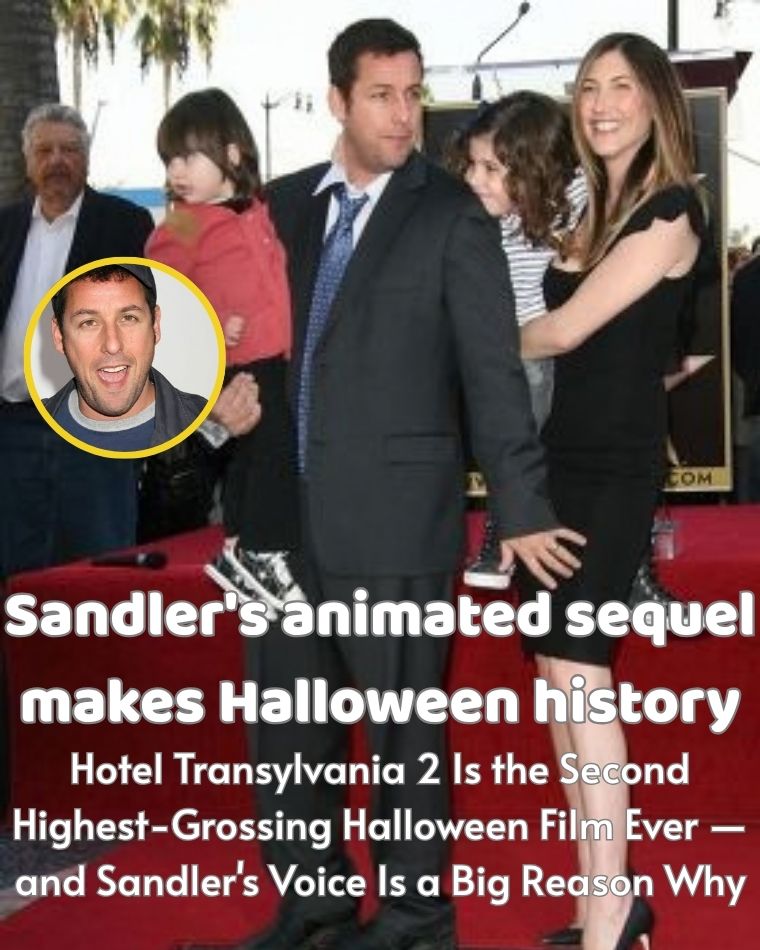
Cre: Wikimedia Commons — CC BY-SA 3.0 / Georges Biard
Reassessing Adam Sandler’s Underrated Voice Acting Craft
While Adam Sandler is renowned for his signature live-action slapstick comedies and acclaimed dramatic roles, his voice acting career represents a distinct masterclass in vocal timing.
In Hotel Transylvania 2, Sandler reprises his role as Count Dracula, infusing the legendary vampire with equal parts manic hysteria, comedic exasperation, and protective tenderness.
Delivering jokes solely through a recording booth demands a completely different skill set than reacting physically in front of a live camera.
Voice actors cannot rely on facial expressions, physical posture, or impromptu body language to convey an emotional beat.
Sandler compensated for this by exaggerating his vocal inflections, pitch modulation, and theatrical phrasing.
His stylized Transylvanian accent became instantly iconic, subverting classic Gothic horror tropes into accessible, lighthearted humor.
Catchphrases like “I do not say ‘bleh, bleh, bleh'” showcased his sharp awareness of classic pop-culture parodies.
Underneath the rapid-fire line deliveries and comic screams, Sandler layered a deeply touching emotional core into the character.
Dracula’s maternal paranoia, his anxiety over family acceptance, and his devotion to his grandson Dennis provided genuine heart.
That authentic emotional grounding allowed the comedy to resonate with adults while keeping younger viewers invested in the family drama.
Many voice roles in modern computer animation rely on straight celebrity cameo appearances without transformative effort.
Sandler, conversely, crafted a fully developed character who felt entirely distinct from his conventional live-action screen personas.
Building a Monster-Filled Commercial Empire at Sony Animation
The success of Hotel Transylvania 2 played a vital role in transforming an ambitious animated comedy into one of Sony Pictures Animation’s flagship properties.
The original 2012 Hotel Transylvania proved that audiences embraced the concept of a sanctuary where legendary monsters could hide from human society.
However, sequels often carry immense financial risk, frequently suffering from diminishing box office returns and creative fatigue.
Hotel Transylvania 2 reversed that familiar industry trend by significantly outperforming its predecessor at the worldwide box office.
The sequel expanded the universe by introducing mixed monster-human marriages, multi-generational parenting disputes, and grandfatherly angst.
This narrative expansion kept the franchise fresh, setting the stage for future theatrical releases, television spinoffs, video games, and theme park attractions.
Directed by animation legend Genndy Tartakovsky, the visual style embraced elastic 2D cartoon physics inside a 3D animated world.
Tartakovsky’s dynamic visual pacing worked hand in hand with Sandler’s comedic rhythm.
The film’s visual slapstick gave every frame energy, ensuring that visual gags complemented Sandler’s vocal performances seamlessly.
The studio realized it had uncovered a rare, self-sustaining family brand that could consistently perform across multiple autumn movie cycles.
The Harmony of Comedic Rhythm and Modern Animation
Animation requires extreme precision, often recording actors years before animators finalize visual sequences.
Comedy relies on spontaneity, quick timing, and conversational flow, creating an inherent challenge for animated productions.
Sandler succeeded in bridging this divide by treating the recording booth as an energetic comedic laboratory.
He collaborated closely with frequent comedy partners in the ensemble cast, including Kevin James as Frankenstein, Steve Buscemi as Wayne the Werewolf, David Spade as Griffin the Invisible Man, and Keegan-Michael Key as Murray the Mummy.
Their real-life creative shorthand helped replicate organic ensemble banter within a fragmented production environment.
The characters frequently talk over each other, bicker over trivial details, and exchange rapid one-liners just like seasoned stage performers.
Sandler’s comedic instincts guided the tempo of each scene, allowing animators to mold the physical gags around his vocal pauses.
When Dracula loses his temper or panics over a hidden secret, the vocal delivery accelerates into chaotic perfection.
When he reassures his daughter Mavis, voiced by Selena Gomez, his voice drops into a soft, vulnerable warmth.
This broad emotional range proved that Sandler’s comedic strengths extend well beyond the live-action parameters of Happy Madison productions.
His innate comedic rhythm translated cleanly into digital animation, cementing his reputation as an elite vocal talent in family cinema.
Cultivating a New Generation of Family Audiences
Throughout the 1990s and 2000s, Adam Sandler established a massive, loyal following through edgy PG-13 and R-rated theatrical comedies.
Cult classics like Billy Madison, Happy Gilmore, and The Waterboy defined a specific era of rebellious, college-age irreverence.
However, as those original moviegoers matured, got married, and raised children, their media consumption patterns shifted dramatically.
Hotel Transylvania 2 provided the ideal creative bridge for this generational transition.
Millennial parents who grew up laughing at Sandler’s rebellious live-action antics could now introduce their kids to his humor in a safe, charming environment.
The movie avoided crude adult themes while retaining Sandler’s signature absurdity, silly voices, and heart-on-sleeve sentimentality.
For young children in the 2010s, Adam Sandler became synonymous with Count Dracula rather than his classic Saturday Night Live sketches.
This reinvention introduced his artistic voice to a completely new demographic that had never seen his earlier work.
The film managed to unite three generations: grandparents, parents, and young children enjoying a lighthearted holiday film together.
Very few modern Hollywood movie stars have successfully pivoted across demographics with such immense financial success.
Sandler broadened his cultural footprint, establishing an evergreen holiday presence that re-emerges every single October.
Where the Film Stands in Animated Sequel History
Sequels in the animated film sector face unique creative and commercial challenges compared to live-action counterparts.
Many follow-ups fail to recapture the magic of the initial world-building, settling for lower box office totals and lukewarm reception.
Hotel Transylvania 2 defied these historical odds by generating roughly $109 million more than the first film globally.
The production budget remained disciplined at $80 million, maximizing the studio’s eventual return on investment.
Deadline Hollywood reported that the film yielded an estimated net profit of nearly $160 million after distribution and marketing expenses.
This financial efficiency established the series as one of the most bankable animation franchises in Hollywood.
Within the realm of Halloween cinematic achievements, this accomplishment is even more striking.
The Halloween box office category has historically been dominated by adult horror films with limited international appeal due to strict age ratings.
By delivering a worldwide gross of $475 million, Hotel Transylvania 2 proved that family-friendly spooky cinema holds unmatched commercial upside.
Its overseas performance of over $305 million proved that the appetite for Halloween comedy transcends North American cultural borders.
The sequel demonstrated that family audiences worldwide crave celebratory seasonal movies that turn horror conventions upside down.
It set a standard that few subsequent Halloween releases have managed to match on the global theatrical stage.
A Blueprint for Modern Holiday Family Entertainment
The long-term legacy of Hotel Transylvania 2 reaches far beyond opening weekend statistics and cumulative earnings.
It provided a functional template for how modern studios should approach Halloween-themed content for children and families.
Historically, Hollywood treated Halloween primarily as a horror movie holiday, leaving younger audiences with very few theatrical choices.
Sony Pictures Animation recognized that children love the aesthetics of monsters, vampires, werewolves, and haunted castles as much as adults do.
The franchise stripped away the genuine violence and terror of classic monster mythology, replacing them with comedic neuroticism and warm family dilemmas.
Dracula is not a bloodthirsty predator; he is an overprotective grandfather trying to teach his half-human grandson how to fly.
Frankenstein is not a dangerous creature; he is an anxious uncle terrified of fire and self-conscious about his public image.
This clever inversion made classic monster lore comforting and accessible to toddlers, adolescents, and adults simultaneously.
The sequel’s release timing in late September allowed it to dominate theatrical screens through October 31st with virtually no animated competitors.
Streaming platforms and home media have since amplified this annual tradition, turning the film into standard viewing whenever the leaves turn brown.
It carved out a seasonal home entertainment niche comparable to beloved Christmas classics.
The movie proved that a smartly constructed Halloween family comedy can generate sustained revenue decades into the future.
How Genndy Tartakovsky Elevate the Visual Storytelling
A major factor behind the sequel’s global appeal is the exceptional visual direction provided by director Genndy Tartakovsky.
Tartakovsky, celebrated for classic animated television series like Dexter’s Laboratory and Samurai Jack, brought a distinct sensibility to 3D computer animation.
At the time, most computer animation studios focused on realistic physics, subtle lighting, and grounded character models.
Tartakovsky pushed against that prevailing industry trend, insisting on extreme squash-and-stretch animation techniques.
He instructed his animators to bend and deform character models to achieve expressive, dynamic silhouette poses.
Dracula’s cape twists into impossible geometric shapes, his limbs stretch across wide rooms in a split second, and his facial expressions shift rapidly.
This visual styling gave the film an infectious, breathless kinetic energy that enchanted young viewers.
More importantly, it matched the manic energy of Adam Sandler’s vocal performance perfectly.
When Sandler delivered a high-pitched comedic screech, Tartakovsky’s team matched it with an equally wild visual distortion on screen.
This rare synergy between director and lead voice talent gave the sequel an artistic identity that stood apart from generic computer-animated fare.
It showcased that computer graphics could honor the zany spirit of golden-age hand-drawn cartoons while delivering big-budget spectacle.
The Enduring Legacy of Adam Sandler’s Dracula
As Hollywood looks back at the evolution of holiday entertainment, Hotel Transylvania 2 stands as a monumental creative and financial triumph.
It solidified Adam Sandler’s status as a versatile performer capable of carrying a massive animated tentpole to the top of the box office charts.
The character of Count Dracula remains one of the most recognizable and enduring roles in his four-decade career.
It proved that Sandler’s comedic brand could adapt across genres, media formats, and age brackets without losing its authentic appeal.
Finishing as the second highest-grossing Halloween film in history is a rare theatrical badge of honor.
It reflects smart studio scheduling, groundbreaking animation direction, brilliant voice ensemble work, and heartfelt seasonal storytelling.
Whenever October arrives, audiences around the world continue to revisit this cheerful haunted castle for laughs and spooky holiday comfort.
Hotel Transylvania 2 will long be remembered as the sequel that took a monstrous gamble and turned it into box office history.
Để lại một phản hồi