Daniel Radcliffe became an inescapable global figure playing the world’s most famous boy wizard on camera.
Yet his prolonged, daring devotion to live theatrical performance reveals where his real artistic soul resides.
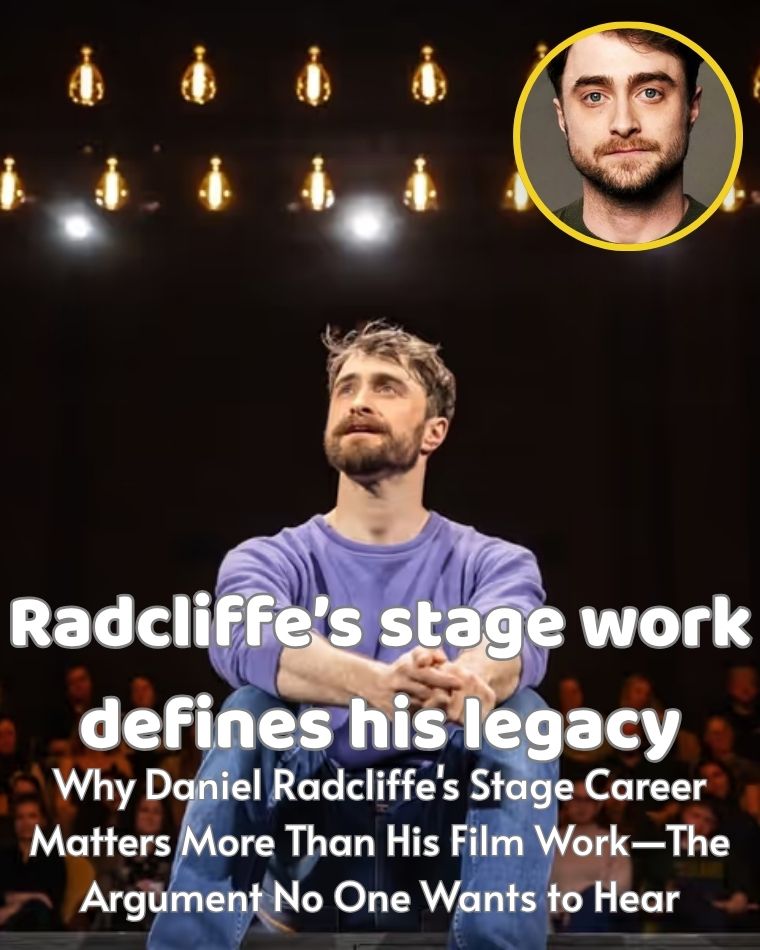
By consistently braving the unforgiving demands of the stage, Radcliffe has built a stage legacy that rivals his screen achievements.
The transition from a blockbuster franchise lead to a respected stage actor represents one of modern acting’s most improbable transformations.
Most child stars emerging from monumental franchises retreat into comfortable Hollywood indie projects or permanent semi-retirement.
Radcliffe chose a diametrically opposed route by embracing the terrifying exposure of live theatrical stages.
The theater world does not grant unearned courtesy to movie stars merely looking for temporary artistic credibility.
Broadway and West End audiences can immediately sense when a famous film name is treating their space as a vanity showcase.
From his earliest stage outings, Radcliffe made it unmistakable that he regarded the stage as an artistic sanctuary rather than a stepping stone.
His work across classic dramas, razor-sharp comedies, modern tragedies, and demanding musical revivals illustrates an actor seeking relentless friction.
The stage demands physical stamina, vocal endurance, and emotional exposure in ways camera lenses simply cannot capture.
Radcliffe’s recurring returns to London and New York stages establish an unmistakable baseline of craft, courage, and creative purpose.
While cinematic history will forever remember his cinematic visage, the theater is where Radcliffe unlocked his full artistic identity.
Cre: Joella Marano / Wikimedia Commons
The Audacity of Equus and Shattering the Boy Wizard Myth
When Radcliffe signed on to star in Peter Shaffer’s psychological drama Equus, the entertainment world experienced genuine shock.
Taking on the emotionally fractured role of Alan Strang was a calculated refusal of commercial safety.
The part demanded intense vulnerability, violent emotional outbursts, and complete physical nudity on a West End stage.
At the time, millions of filmgoers still associated his name exclusively with family-friendly fantasy blockbusters.
A failed production could have derailed his transition into serious adult acting before it even gathered momentum.
Instead, the production proved to be an electrifying showcase that silenced skeptics and astonished veteran critics.
Radcliffe did not rely on charming cinematic mannerisms or calculated youthful star power to carry the psychological drama.
He immersed himself in Strang’s complex mental torment with remarkable technical commitment and unyielding discipline.
Advance ticket sales broke box office records as curious audiences flooded the West End and later Broadway.
Audiences quickly forgot the celebrity persona within minutes of watching his intense performance under the stage lights.
Equus demonstrated to industry peers that Radcliffe possessed genuine stage authority and an appetite for raw artistic risks.
That pivotal staging established the ambitious benchmark for every theatrical pursuit that followed across his career.
Mastering Musical Rhythm and Pure Comedic Timing
Conquering a dark psychological drama proved Radcliffe had courage, but musical comedy tested entirely different technical skill sets.
When he accepted the role of J. Pierrepont Finch in Broadway’s revival of How to Succeed in Business Without Really Trying, critics raised eyebrows.
Musical theater requires precise vocal projection, relentless dance conditioning, and magnetic comedic timing.
Radcliffe spent months undergoing rigorous voice lessons and rigorous physical dance training to prepare for eight shows a week.
When the curtains rose, he commanded the Broadway stage with buoyant charisma, exuberant dancing, and razor-sharp humor.
The performance earned widespread admiration throughout the Broadway community and secured high-profile theatrical award nominations.
He proved that his early success in drama was no singular fluke born of raw shock value.
Radcliffe possessed the rare ability to headline a complex, fast-paced Broadway musical while honoring its vaudevillian legacy.
His portrayal of Finch demonstrated an actor who understands theatrical collaboration, choreography, and group musical dynamics.
Broadway veterans marveled at his humility, work ethic, and refusal to demand privileged film-star shortcuts during exhausting runs.
By conquering the Golden Age musical idiom, Radcliffe expanded his expressive range beyond conventional Hollywood casting categories.
The production solidified his standing as a versatile performer capable of charming live theater audiences night after night.
Exploring Tragedy and Darkness in The Cripple of Inishmaan
Radcliffe consistently avoids complacent casting choices by seeking out characters marked by vulnerability and complex struggle.
In Martin McDonagh’s darkly comic masterpiece The Cripple of Inishmaan, he accepted the challenging title role of Billy Claven.
The character of Billy is physically disabled, socially ostracized, and desperately yearning for dignity in a rural Irish community.
Such a sensitive role carries substantial creative risk and demands extraordinary empathy from any performing artist.
Radcliffe delivered a performance marked by emotional nuance, biting humor, and heartbreaking psychological truth.
He conquered the intricate cadence of McDonagh’s dialogue with impressive linguistic dexterity and tonal precision.
The London production enjoyed tremendous critical acclaim before transferring triumphantly to Broadway’s Cort Theatre.
Rather than softening the uncomfortable edges of the text, Radcliffe highlighted Billy’s bitter survival instincts and internal resolve.
Critics praised his complete refusal to sentimentalize disability or indulge in theatrical melodrama.
He understood that Billy’s internal world required sharp realism, subtle dignity, and profound physical containment.
The Cripple of Inishmaan illustrated Radcliffe’s dedication to brilliant ensemble work where no star outshines the storytelling.
His stage repertoire was becoming a masterclass in varied dramatic literature and complex character studies.
The Raw Discomfort of High-Concept Contemporary Drama
Beyond period dramas and classic musicals, Radcliffe continuously challenges modern performance boundaries with experimental pieces.
His turn in Privacy at The Public Theater demonstrated a keen instinct for contemporary, socially urgent material.
The production explored modern government surveillance, digital footprints, and the complete erosion of individual autonomy.
Radcliffe embraced an unconventional, direct-address staging that required him to interact directly with real audience devices.
He guided the auditorium through labyrinthine digital questions with energetic wit, restless curiosity, and acute vulnerability.
Later, he tackled the daunting absurdist heights of Samuel Beckett in a celebrated West End staging of Endgame.
Performing Beckett represents one of the most grueling tests of vocal control, intellectual stamina, and stylistic rigor.
Radcliffe threw himself into Beckett’s grim existential comedy with fierce intellectual clarity and athletic commitment.
He held his own alongside established classical titans, proving his command of minimalist, dialogue-driven theater.
These daring selections reveal an artist who actively seeks creative terror rather than comfortable theatrical prestige.
Radcliffe views the stage as a living laboratory where an actor must constantly disassemble and rebuild their toolkit.
The Unforgiving Arena of Live Performance Versus the Safety of Film
The fundamental differences between acting for cameras and performing live theater illuminate why Radcliffe’s stage presence feels so magnetic.
Cinematic acting is fundamentally an art of microscopic stillness, edited perfection, and technical repetition.
If an actor drops a crucial line or misses an emotional transition on a film set, the director calls for another take.
Post-production sound designers, colorists, and editors shape film performances long after the actor has left the location.
The theater strips away every protective barrier between the performer and thousands of observing human eyes.
On stage, an actor must generate their own energy, sustain narrative continuity, and project genuine truth across cavernous auditoriums.
Every physical miscalculation, vocal tremble, or lapse in concentration is immediately visible to everyone in the room.
Radcliffe has frequently noted how live theater demands a total, frightening surrender to the present moment.
There are no safety nets, no digital fixes, and no opportunities to hide behind cinematic framing tricks.
To hold an audience captive across two and a half unbroken hours requires unwavering presence and mental fortitude.
Radcliffe thrives within that perilous artistic arena precisely because the danger forces complete authenticity.
His stage career proves that he values unrepeatable live human connection above cinematic sheen.
Structuring Life Around the Rigors of Eight Shows a Week
Many Hollywood stars view theatrical runs as temporary publicity stops to promote upcoming movie slates.
They appear in limited four-week vanity runs, skip challenging matinees, and depart as soon as award eligibility concludes.
Radcliffe approaches theatrical scheduling with the unyielding commitment of a genuine lifelong repertory actor.
He routinely signs on for demanding open-ended engagements or grueling multi-month Broadway runs.
Performing eight grueling shows every single week requires punishing vocal discipline, physical recovery, and personal sacrifice.
Actors must protect their health, preserve vocal stamina, and maintain consistent energy for packed matinee audiences.
Radcliffe prioritizes these stage runs as the foundational anchors of his yearly creative calendar rather than side detours.
He fits screen projects around his theatrical commitments rather than treating stage roles as secondary interruptions.
This consistent operational choice reveals an actor who measures career fulfillment through artistic sweat rather than red-carpet glamour.
His presence in rehearsal rooms is renowned among directors for humble punctuality, tireless enthusiasm, and zero ego.
He arrives off-book, eager to take notes, and determined to lift up every ensemble member sharing the stage boards.
This deep institutional respect for the theatrical culture is why both the West End and Broadway embrace him wholeheartedly.
The Tonal Shift in Critical Reception Across Two Decades
Tracking the evolution of critical reception toward Radcliffe reveals a fascinating artistic trajectory.
Early in his career, film critics often viewed his cinematic performances through the restrictive prism of his iconic child wizard role.
Even as he chose daring independent film roles, screen commentators debated whether he could ever truly escape his cinematic origins.
On the stage, however, the critical narrative shifted rapidly from patronizing curiosity to profound respect.
Theatrical reviewers in London and New York are notoriously resistant to celebrity stunt casting.
Yet theater critics repeatedly praised his vocal dexterity, comic rhythm, emotional commitment, and physical precision.
Reviewers recognized that Radcliffe was not merely visiting their world; he was studying it with profound devotion.
His stage notices consistently highlight an electric, generative presence that elevates surrounding ensemble players.
While his movie choices earned respectable reviews, his theater work routinely generated breathless, deeply admiring critical essays.
The stage became the undisputed arena where critics finally recognized Radcliffe as a formidable actor of great technical depth.
This critical consensus confirmed what observant theatergoers had known since his first appearances on the West End.
Radcliffe had quietly built an exceptional stage resume that stood entirely independent of his childhood screen fame.
Defying Commercial Pressures to Build a Permanent Legacy
Radcliffe’s unique economic independence allowed him to make artistic choices untethered from Hollywood box-office pressures.
Having secured astronomical commercial success as an adolescent, he had no financial imperative to chase generic superhero franchises.
Instead of hunting repetitive blockbuster paychecks, he channeled his freedom into uncompromised theatrical exploration.
He chose challenging stage revivals, complex modern plays, and intense collaborations with visionary stage directors.
This creative bravery offers a refreshing model for what a massive childhood star can become in adulthood.
Radcliffe demonstrates that true artistic longevity comes from honoring the rigorous foundations of dramatic storytelling.
He understands that screen stardom can be fleeting, but theatrical mastery builds an unshakeable artistic legacy.
Every time he steps onto a stage, he reaffirms his bond with the fundamental roots of dramatic literature.
The smell of backstage floorboards, the hush of a darkened theater, and live applause represent his real artistic home.
Audiences who witness him perform live carry away indelible memories of raw human emotion, comic energy, and athletic presence.
The Theater as Radcliffe’s Permanent Artistic Home
When historians evaluate Daniel Radcliffe’s extensive body of work decades from now, his filmography will certainly command respect.
Yet his sustained dedication to live theater will stand as his most profound contribution to modern performing arts.
His stage career is not an intriguing footnote or a charming hobby squeezed between lucrative camera shoots.
It is the beating heart of his entire artistic journey and the purest expression of his dramatic talents.
From the raw vulnerability of Equus to the breathless musicality of How to Succeed, he has continually challenged himself.
He has tackled tragedy, absurdism, high-concept political drama, and ensemble comedy with equal grace and ferocious focus.
In an entertainment landscape increasingly dominated by digital effects and algorithmic franchises, Radcliffe chooses live human theater.
He chooses the sweat, the danger, the unrepeatable mistakes, and the communal intimacy of the theatrical stage.
That enduring commitment elevates him from a famous movie star into a truly exceptional stage artist of our time.
Để lại một phản hồi