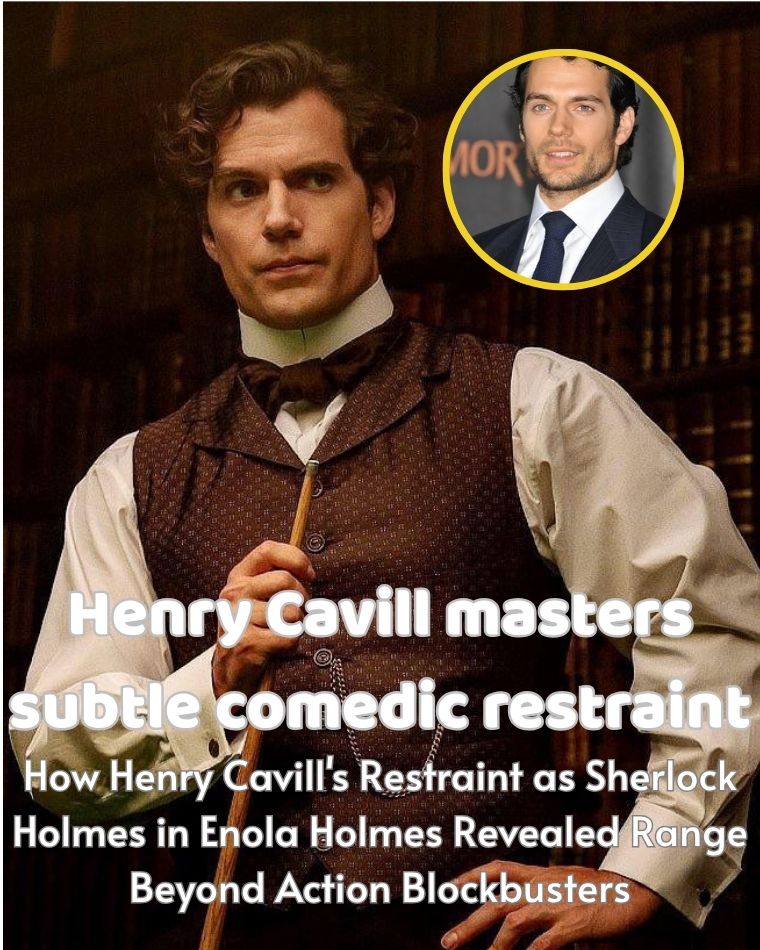
When Henry Cavill stepped into the shoes of Sherlock Holmes for Netflix’s Enola Holmes, audiences braced for an inevitably physical take on Victorian literature’s greatest detective. Instead of dominating the screen, Cavill delivered an exercise in comic timing and emotional subtlety that completely redefined his on-screen persona. This measured performance challenged Hollywood typecasting and proved that his true range extends far beyond explosive action spectacle.
Henry Cavill built his global profile through sheer, undeniable screen gravity.
For nearly a decade, his cinematic footprint was defined by invincible gods and lethal operatives.
In Man of Steel and Batman v Superman, he carried the literal weight of Earth on his shoulders.
In Mission: Impossible – Fallout, he delivered a ferociously intense performance punctuated by brute hand-to-hand combat.
In The Witcher, his Geralt of Rivia was an imposing warrior defined by guttural grunts and kinetic swordplay.
Each of those high-profile roles required Cavill to seize the center of the frame and anchor massive franchises through physical power.
Because of this imposing resume, when Entertainment.ie reported his casting as Sherlock Holmes, reactions were mixed with curiosity and skepticism.
Critics and fans questioned whether an actor celebrated for towering muscle could credibly embody an analytical mind.
Sherlock Holmes has historically been depicted as nervous, high-strung, and manic.
Pop culture had recently been saturated with fast-talking, hyperactive iterations of the detective.
Yet director Harry Bradbeer’s adaptation of Nancy Springer’s novel had a completely different dynamic in mind.
In this story, Sherlock was neither the titular sleuth nor the narrative engine.
He was the supportive older brother to Millie Bobby Brown’s rebellious Enola Holmes.
Taking on that dynamic meant Cavill had to consciously dismantle the very habits that made him a blockbuster superstar.
He had to step back into the ensemble, dial down the physical dominance, and master the art of listening.
Cre: Wikimedia Commons — Gage Skidmore, CC BY-SA 3.0
The Power of Restraint in Key Scenes
The brilliance of Cavill’s Sherlock is best observed in the quieter corners of the film.
Consider the railway station reunion where Sherlock and Mycroft first encounter their teenage sister after years apart.
Sam Claflin plays Mycroft with theatrical indignation and Victorian rigidity.
Mycroft frets over Enola’s untamed hair, missing gloves, and lack of traditional decorum.
An actor accustomed to leading tentpoles might try to match that energy with competing verbal fireworks.
Instead, Cavill stands slightly back and observes the chaos with subtle amusement.
His Sherlock does not lecture Enola or belittle her appearance.
Instead, he offers a gentle, amused micro-smirk that immediately establishes an affectionate sibling bond.
With a single arched eyebrow, Cavill tells the audience that Sherlock sees his sister as an intellectual equal rather than a nuisance.
This minimalist choice grounds the scene and keeps the comedic spotlight squarely on Claflin and Brown.
Another key sequence occurs when Sherlock visits Enola at the repressive finishing school run by Miss Harrison.
Dressed in a tailored three-piece suit, Cavill occupies physical space without ever weaponizing his bulk.
He sits comfortably, leans forward, and lets genuine warmth register behind his eyes.
He does not hand Enola an escape plan or stage a daring prison break.
Instead, he delivers quiet counsel, allowing her to realize that she possesses the ingenuity to forge her own destiny.
The restraint in this conversation is breathtakingly intentional.
Cavill communicates Sherlock’s profound protective instinct while respecting his sister’s autonomy.
Later in the film, when Sherlock pieces together the clues left behind by his mother, his deduction is free of frantic pacing.
He reads the coded newspaper messages and allows a faint, proud smile to cross his lips.
It is a portrait of intellect processed internally rather than shouted at the audience.
By stripping away the theatrical bluster typically associated with Holmes, Cavill crafts a detective defined by quiet empathy.
The Craft of Supporting a Younger Lead
Transitioning from an undisputed franchise lead to a secondary support figure is a notoriously tricky maneuver for action stars.
Leading a superhero vehicle demands total ownership of every camera setup.
The camera orbits the protagonist, tracking their emotional crises and visual presence.
In Enola Holmes, however, Millie Bobby Brown carries the emotional and comedic core of the narrative.
Brown constantly breaks the fourth wall, addressing the viewer directly with frantic energy and teenage charm.
Had Cavill played Sherlock with broad eccentricities, the movie would have suffered from conflicting tonal centers.
The brother-sister dynamic would have collapsed into an exhausting wrestling match for audience attention.
Cavill understood that his primary technical role was to serve as a steady anchor.
When Brown’s Enola bounces across the room with rapid-fire deductions, Cavill remains still.
His stillness creates the exact comedic canvas that makes Enola’s irreverence pop off the screen.
In acting terminology, he plays the ideal straight man to her comedic dynamo.
He catches her witty retorts with dry nods and unhurried vocal pacing.
He never rushes his responses, forcing the scene to inhale whenever he speaks.
This dynamic requires exceptional technical ego control.
Many leading men struggle when relegated to listening while another actor drives the exposition.
Cavill turns active listening into a masterclass of character support.
Every time Enola outsmarts Scotland Yard or uncovers a hidden message, Cavill’s reactions validate her growth.
His eyes register surprise, followed immediately by quiet pride.
By choosing not to compete with Brown, Cavill actually elevates her performance while cementing his own value in the ensemble.
The sibling chemistry succeeds entirely because of this balanced technical calibration.
Dry Comedy and Timing vs. Kinetic Choreography
For most of his career, Cavill’s rhythm on set was dictated by stunt choreographers and CGI animators.
An action sequence relies on explosive rhythm: punch, counter, roll, and reload.
Physical choreography is mathematical and relies on physical momentum.
Comedy, by contrast, operates on psychological tension and conversational negative space.
In Enola Holmes, Cavill demonstrated an innate grasp of dry British comic timing.
His humor is deadpan, relying heavily on understated delivery rather than physical slapstick.
When confronting Inspector Lestrade, Sherlock dismisses bureaucratic incompetence with calm politeness.
He delivers biting intellectual critiques as though they were mild observations about the weather.
The humor lands precisely because there is no exaggerated punchline emphasis.
Cavill lets the comedic irony breathe in the silence after he speaks.
Consider the contrast between his physical presence and his comedic restraint.
Cavill possesses a linebacker physique that could easily dominate any Victorian parlor.
Yet he employs subtle physical gestures to subvert that imposing scale.
He examines small scrapbooks with delicate, meticulous finger movements.
He tips his hat with deliberate gentleness.
He pours tea with measured, quiet domesticity.
This clever contrast between his immense frame and delicate mannerisms produces organic humor.
It is a brand of character comedy that cannot be manufactured through flashy editing.
It requires the actor to trust the intelligence of the viewer.
Cavill does not wink at the camera or signal where the audience ought to laugh.
He plays the truth of the scene, allowing the comedy to emerge from authentic human behavior.
This delicate touch proved that his timing is just as refined in dialogue-driven drawing rooms as it is in high-octane brawl sequences.
Navigating Range and Overcoming the Musclebound Trap
Hollywood has a notorious habit of reducing physically gifted actors to one-dimensional archetypes.
When an actor possesses heroic jawlines and immense physicality, casting directors rarely look past action fare.
Early in his career, Cavill riskily hovered near the boundary of the generic action hero label.
While his work in The Man from U.N.C.L.E. hinted at charismatic wit, big-studio blockbusters kept pulling him back toward stoic brute force.
Accepting the role of Sherlock Holmes in an ensemble project signaled a deliberate career choice.
It demonstrated that Cavill was acutely aware of the narrow perceptions surrounding his talent.
He recognized that prolonged longevity in cinema demands more than physical fitness and intense scowls.
By stepping into Enola Holmes, Cavill willingly chose a project where his muscles were an irrelevant asset.
Sherlock does not engage in bare-knuckle fistfights in this film.
He does not sprint across rooftops or perform physics-defying stunts.
Every obstacle he encounters must be resolved through intellect, deduction, and emotional diplomacy.
Cavill embraced this limitation as a creative playground rather than a professional constraint.
He consciously stripped away the brooding aggression that characterized Geralt of Rivia.
He replaced brooding cynicism with warmth, intellectual modesty, and patience.
This calculated pivot proved that Cavill understands the architecture of his own screen persona.
He understood that audiences were accustomed to seeing him impose his will through power.
Subverting that expectation by presenting a gentle, thinking detective delivered a refreshing jolt to his filmography.
It was an undeniable statement that he possesses the technical curiosity of a true character actor trapped in the body of a leading man.
Setting the Stage for Ensemble and Character-Driven Work
Cavill’s success in Enola Holmes reshapes the trajectory of his future career.
In modern cinema, action heroes face an inevitable expiration date if they rely solely on raw physical spectacle.
The actors who enjoy enduring, multi-decade careers are those capable of seamlessly blending into sophisticated ensemble casts.
Cavill demonstrated that he can function as a generous scene partner who enhances the collective quality of a production.
Directors searching for prestige drama or sharp ensemble comedy can look at his Sherlock as definitive proof of adaptability.
He can modulate his intensity down to a conversational whisper without sacrificing an ounce of charismatic presence.
He can support younger actors, yield the thematic spotlight, and elevate the overall narrative without vanity.
This performance opens up lucrative possibilities beyond traditional comic-book adaptations and action thrillers.
Cavill is uniquely positioned to take on witty murder mysteries, intricate espionage dramas, and historical period pieces.
He has proven that his presence can enrich a scene through silent reaction shots alone.
Industry producers no longer have to view him purely through the prism of a solitary superhero saving the world.
Instead, they can view him as a versatile ensemble player capable of delivering genuine emotional intelligence.
By expanding into character-driven material, Cavill has broadened his artistic longevity significantly.
He demonstrated that an actor known for flying through digital skies can be equally compelling sitting across a wooden table solving riddles.
The Action Star Pivot: Lessons from Hollywood History
Cavill’s transition into restraint places him in an esteemed lineage of action stars who successfully expanded their range.
Historically, the most compelling action icons are those who discovered the power of comedic vulnerability and dramatic control.
Arnold Schwarzenegger unlocked an entirely new chapter of his career when he embraced deadpan comedy in Twins.
Sylvester Stallone surprised critics when he abandoned superhuman excess to play a weathered, subdued sheriff in Cop Land.
More recently, Chris Hemsworth revitalized his portrayal of Thor by infusing the character with self-deprecating wit and comedic timing.
Similarly, Dave Bautista purposefully sought out nuanced, dialogue-heavy roles in Blade Runner 2049 and Knives Out to escape physical typecasting.
Like Bautista and Hemsworth, Cavill realized that continuous brooding is an artistic dead end.
Audiences eventually grow numb to invincible figures who never crack a genuine smile or admit emotional vulnerability.
What makes Cavill’s turn in Enola Holmes distinctive is how gentle the transformation feels.
He did not rely on self-parody or slapstick humiliation to demonstrate his versatility.
Instead, he chose classic dramatic restraint, refined posture, and understated British charm.
He honored Sir Arthur Conan Doyle’s famous sleuth while giving him a compassionate, human pulse that matched the spirit of Nancy Springer’s source novels.
It is an approach that prioritizes grace over loudness and collaboration over ego.
As Hollywood continues to hunt for mature leading men who can balance gravitas with charm, Cavill’s Sherlock Holmes stands as a shining blueprint.
It serves as enduring evidence that an actor’s greatest power is not how hard he hits, but how carefully he listens.
Để lại một phản hồi