When studio executives negotiate multi-million-dollar corporate sponsorship deals for global blockbuster franchises, actors are usually expected to smile, hold the branded prop on camera, and cash their paychecks.
Daniel Craig, however, approached the world of James Bond with an uncompromising artistic stubbornness that perpetually disrupted standard Hollywood commercial transactions.
Rather than passively endorsing whatever gadget generated the highest marketing rebate, Craig fought high-level studio executives over the exact smartphone his 007 would carry.
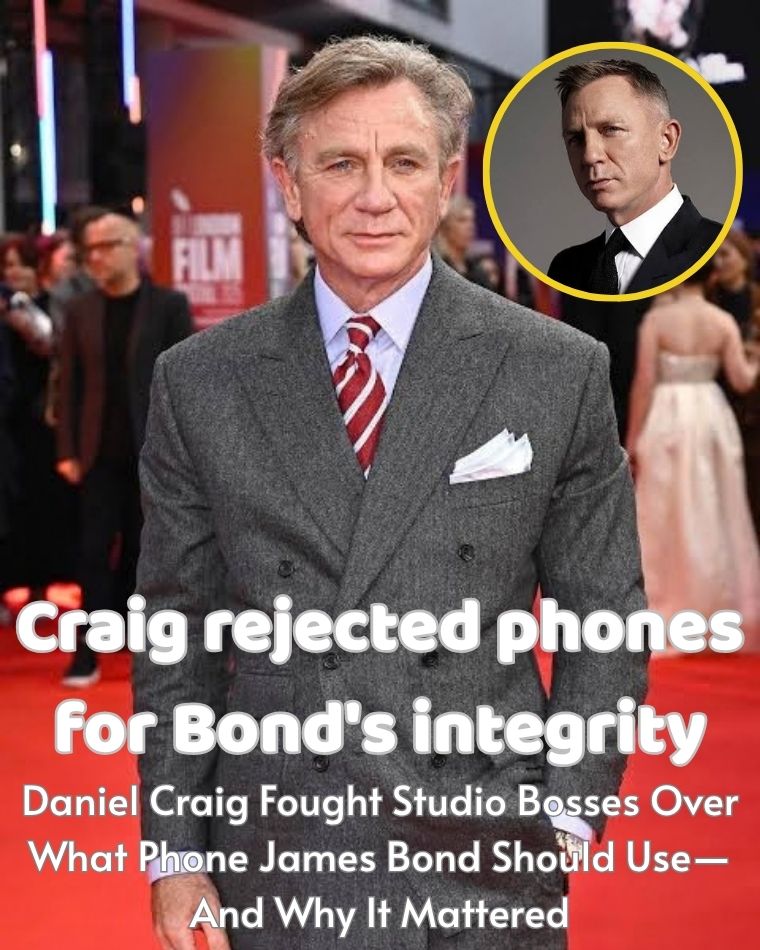
Cre: Wikimedia Commons
The Clash Between Luxury Storytelling and Big-Budget Commercial Product Placement
Big-budget cinema has long depended on lucrative product placement deals to offset dizzying production overheads.
The James Bond franchise represents the undisputed crown jewel of this commercial apparatus, blending luxury timepieces, sports cars, bespoke tailoring, and cutting-edge consumer electronics into a seamless two-hour display.
Corporate partners do not just purchase brief background appearances; they bid astronomical sums to have Ian Fleming’s secret agent physically interact with their flagship products on screen.
Yet this financial imperative creates an inevitable narrative friction between corporate monetization and narrative believability.
When commercial branding feels overly forced, the cinematic illusion cracks, reducing an elite espionage thriller into an expensive commercial compilation.
During the pre-production phases of the 24th Bond film, Spectre, this commercial tension erupted into an intense creative standoff.
Leaked internal communications from Columbia Pictures and Sony Pictures revealed that tech giants engaged in a high-stakes bidding war to put their mobile phones into 007’s hand.
Sony offered a package totaling approximately 5 million dollars for Craig to hold their flagship handset, complemented by an 18 million dollar marketing commitment.
Tech rival Samsung counter-offered an even larger commercial proposal, floating tens of millions of dollars in promotional backing.
Yet instead of celebrating these lucrative financial bids, Daniel Craig and director Sam Mendes flatly pushed back against the studio suits.
As Andrew Gumpert, then President of Worldwide Business Affairs and Operations for Columbia Pictures, explained in leaked internal emails: “BEYOND the $$ factor, there is, as you may know, a CREATIVE factor whereby Sam and Daniel did not think the phone was ‘the best’ and James Bond only uses ‘the best'”.
For Craig, this was never an issue of mere aesthetic snobbery or personal vanity.
It was a matter of character integrity.
The secret agent’s tools had to reflect elite tradecraft, operational precision, and refined personal taste rather than executive boardroom expediency.
Meticulous Hands-On Control: Wardrobe, Props, and Spycraft
Daniel Craig did not view acting as a process confined solely to memorizing lines and executing physical stunts.
From the moment he was cast in Casino Royale, Craig immersed himself deeply in the tactical materiality of the character.
He understood instinctively that in visual storytelling, what a protagonist wears, grips, drives, and operates communicates character depth instantly.
Every single physical prop on Bond’s body carried narrative weight.
Craig took personal command of Bond’s wardrobe, working directly with luxury designers such as Tom Ford to cultivate a tailored silhouette that balanced athletic flexibility with upper-class refinement.
He personally evaluated prop firearms, holsters, watches, tactical sunglasses, and boots to ensure they felt authentic to a battle-tested operative.
If an item felt clumsy, fragile, or stylistically artificial, Craig made no secret of his dissatisfaction.
This rigorous attention to detail extended directly to digital communications gear.
In modern field operations, a smartphone is not a toy or a consumer accessory; it is a life-or-death tactical tool for encryption, geospatial navigation, intelligence coordination, and surveillance.
Craig maintained that an elite assassin operating at the bleeding edge of British intelligence would never carry a generic, glitchy, or second-rate consumer mobile phone.
If Her Majesty’s Secret Service issued tactical communications hardware, or if Bond procured personal mission burner phones, the hardware had to represent the pinnacle of reliability, sleek engineering, and operational sophistication.
Sacrificing that narrative grounding just to appease a corporate electronics sponsor went directly against Craig’s philosophy of authentic acting.
When studio executives demanded product compliance, Craig reminded them that audiences intuitively detect when a scene serves a corporate sponsor rather than the story.
The Evolution of 007’s Tactical Hardware Across the Craig Era
Examining the tech ecosystem across Daniel Craig’s five-film arc illuminates how gadgetry helped track Bond’s psychological journey.
In Casino Royale (2006), the franchise deliberately stripped away the whimsical, campy sci-fi contraptions of previous eras.
Gone were the invisible sports cars, laser-firing wristwatches, and weaponized ballpoint pens of earlier decades.
The film grounded Bond’s equipment in realistic tactical utilities: medical defibrillators synced directly to MI6 headquarters, covert tracking microchips implanted under the skin, and early Sony Ericsson multimedia handsets like the K800i and M600i.
These tools reflected an aggressive, newly promoted double-O operative who was rough around the edges and surviving violent scrapes on pure physical grit.
By Quantum of Solace (2008), technology grew increasingly fluid and sleek, mirroring a hyper-connected, volatile geopolitical landscape.
Handsets like the Sony Ericsson C902 featured integrated facial recognition databases, allowing Bond to snap candid images at an Austrian opera house and identify shadow conspirators in real time.
When Skyfall arrived in 2012, the narrative deliberately contrasted obsolete cold-war fieldcraft against modern cyber warfare.
Ben Whishaw’s youthful Q pointedly informed Bond that MI6 no longer distributed exploding pens, handing him only a Walther PPK coded to his palm print and a tiny radio beacon.
Bond wielded a Sony Xperia T throughout the film, yet the story continually highlighted how vulnerable consumer networks were to digital sabotage.
By the time Spectre entered production in 2015, the franchise confronted massive surveillance networks and ubiquitous digital tracking.
The studio was pushing hard for the Sony Xperia Z4 and Z5, wanting Bond to prominently flash the hardware.
Craig’s resistance forced the filmmakers to treat mobile hardware with tactical restraint.
Instead of lingering product placement close-ups showing Bond navigating consumer mobile software, the final cut largely diverted commercial phone duties away from 007 himself.
Naomie Harris’s Miss Moneypenny handled the Xperia promotional heavy lifting in associated commercial campaigns, allowing Craig’s Bond to maintain his narrative distance from overt electronics peddling.
Finally, in No Time to Die (2021), Bond used functional, utilitarian hardware, reflecting a retired operative pulled back into an era dominated by targeted nanobots and hyper-complex biological weapons.
At every stage of this decade-and-a-half evolution, Craig pushed for props that served the script’s emotional logic rather than corporate sales targets.
Negotiating Creative Power: Craig’s Evolution from Hired Actor to Producer
Daniel Craig’s ability to tell multi-billion-dollar corporations “no” was not an accidental luxury; it was hard-won executive leverage.
When producers Barbara Broccoli and Michael G. Wilson originally selected Craig in 2005, intense media skepticism greeted his casting.
Critics questioned his appearance, his brooding demeanor, and whether he could match the suave charisma established by Sean Connery and Pierce Brosnan.
Craig silenced those doubts by delivering the most critically acclaimed and commercially successful run in the franchise’s six-decade history.
As each subsequent film shattered international box-office records, Craig steadily renegotiated his contractual authority.
He graduated from a conventional actor-for-hire into an active co-producer holding genuine creative veto power.
He weighed in on director selection, championing sophisticated filmmakers like Sam Mendes and Cary Joji Fukunaga.
He insisted on bringing acclaimed writers like Phoebe Waller-Bridge into the writers’ room to overhaul dialogue, character dynamics, and comedic timing.
He fought for complex thematic narratives that allowed Bond to age, sustain physical injuries, endure severe heartbreak, and confront genuine moral reckonings.
His refusal to rubber-stamp the studio’s smartphone deals was a direct manifestation of this hard-earned producer authority.
In most film productions, an actor attempting to overturn a multi-million-dollar corporate sponsorship would be swiftly reprimanded or legally pressured into compliance.
Craig possessed both the professional stature and the narrative conviction to challenge corporate executives directly.
He knew that the James Bond brand drew its immense cultural power from an aura of unshakeable prestige.
If the titular hero compromised his taste for a corporate payout, the entire luxury mythology sustaining the franchise would begin to erode.
Why Behind-the-Scenes Conviction Defined the Grounded Realism of the Craig Era
Looking back across Daniel Craig’s fifteen-year tenure as 007, his legacy is fundamentally defined by grounded, gritty realism.
He dismantled the invulnerable, smug caricature of James Bond and replaced it with a bruised, vulnerable, yet relentless human being.
That realism was not achieved merely through physical fight choreography or raw stunt execution.
It was forged through countless small, fierce behind-the-scenes skirmishes over character consistency.
Every time Craig questioned a scripted line, demanded a costume alteration, or rejected a corporate product placement, he was protecting the emotional truth of his character.
The high-profile smartphone dispute represents the perfect case study of that artistic integrity.
To an accountant or a marketing executive, an Android handset in 007’s hand was simply an interchangeable prop carrying an eight-figure sponsorship fee.
To Craig, that handset was a crucial narrative cue signaling whether James Bond still possessed the supreme taste and uncompromising standard that audiences have revered since 1962.
By standing his ground and insisting that James Bond only uses the very best, Craig preserved the soul of the franchise against creeping commercial dilution.
As Eon Productions prepares to cast the seventh cinematic James Bond and launch a new cinematic era, Craig’s successor will inherit enormous shoes to fill.
Yet the greatest lesson Daniel Craig left behind for future 007 actors has nothing to do with handling shaken martinis or driving exotic sports cars.
It is the courage to stand up to studio boardrooms, reject easy corporate compromises, and defend the integrity of an iconic character down to the very phone in his pocket.
Để lại một phản hồi