On a chilly February night in 2003, Madison Square Garden bore witness to a transformative collision of live instrumentation and raw lyrical mastery.
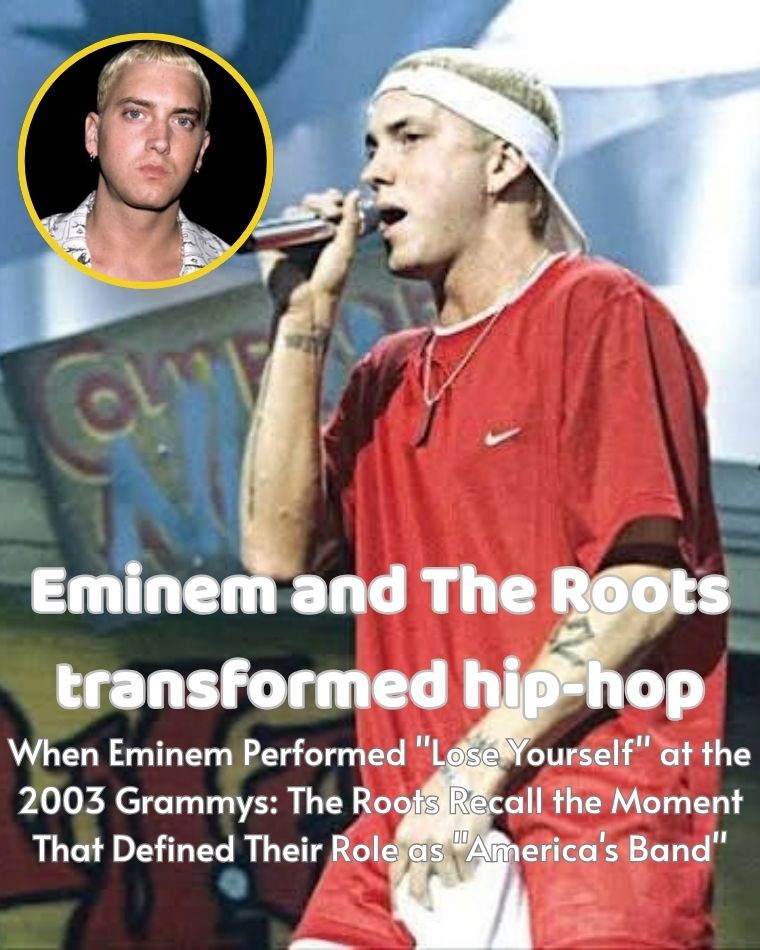
Eminem joined forces with Philadelphia legendary outfit The Roots to deliver a blistering rendition of “Lose Yourself” at the 45th Annual Grammy Awards.
The explosive televised broadcast immediately altered the cultural landscape, demonstrating that mainstream hip-hop could thrive through organic musicianship on music’s most prestigious stage.
A Revolutionary Meeting at Madison Square Garden
The 45th Annual Grammy Awards took place on February 23, 2003, returning to New York City under immense national spotlight.
Hip-hop sat at a complex crossroads with the recording academy, frequently generating massive sales while encountering institutional hesitation.
Eminem entered the ceremony riding an unprecedented wave of global critical acclaim following the release of the semi-autobiographical film 8 Mile.
“Lose Yourself,” recorded for the movie’s soundtrack, had evolved from a chart-topping anthem into an inescapable cultural phenomenon.
The track showcased his intricate lyrical rhythm, urgent narrative drive, and personal vulnerability.
Yet translating that distinct studio kineticism to an awards telecast required a daring presentation.
Instead of turning to standard backing tracks or prerecorded playback, Eminem recruited The Roots to provide the sonic backbone.
Cre: Wikimedia Commons — CC BY-SA 4.0
The Roots had already established themselves as the preeminent live hip-hop collective in modern music history.
Founded by drummer Ahmir “Questlove” Thompson and lead emcee Tariq “Black Thought” Trotter, the group prioritized organic instrumentation over digital loops.
Bringing The Roots onto the Grammy stage represented an uncompromising artistic alliance.
It bridged Detroit’s aggressive lyrical realism with Philadelphia’s celebrated neo-soul and boom-bap organic traditions.
The announcement sparked tremendous anticipation across both the underground rap scene and mainstream broadcast audiences.
Viewers understood that this alliance was designed to challenge traditional award-show production norms.
The stage configuration stripped away unnecessary theatrics to place pure musicianship at the center of the broadcast.
Crafting the Sound: Technical Brilliance and Live Instrumentation
Translating the intricate production of “Lose Yourself” to a live stage presented formidable musical challenges.
The original studio version depended upon an iconic, chugging piano motif alongside crisp, metronomic drum machine percussion.
Questlove accepted the task of translating digital drum cadence into organic, dynamic acoustic force.
His steady, resonant snare strikes provided an assertive tempo that grounded the entire venue.
Guitarist “Captain” Kirk Douglas injected sharp distortion and urgent chord progressions that intensified the record’s underlying tension.
The live bass lines provided deep resonance, filling the cavernous acoustic environment of Madison Square Garden.
The organic acoustic attack elevated the composition beyond the confines of a traditional studio reproduction.
The dynamic shifts followed Eminem’s cadence, swelling during narrative peaks and tightening during verse transitions.
Rather than competing with the lyrical flow, the live band created an responsive pocket that propelled the emcee forward.
Eminem seized that musical momentum with unmistakable vocal endurance and physical intensity.
He prowled across the boards in trademark athletic attire, gripping the microphone with unwavering focus.
His delivery matched the precision of his studio take while gaining palpable grit and spontaneous theatrical presence.
Every lyric landed with renewed resonance because the band adjusted intuitively to his real-time pacing.
The natural acoustic room reverberation created an expansive sound that captivated both viewers and critics.
The performance disproved persistent misconceptions that hip-hop could not match rock or orchestral music in raw instrumental power.
It validated live instrumental hip-hop before an audience of industry gatekeepers who had historically minimized the genre’s musicianship.
The synchronization between the rhythm section and the rapid-fire lyrical delivery highlighted hours of disciplined craft.
Broadcast cameras captured the collective intensity vibrating between the rhythm section and the front of the stage.
The Genesis of “America’s Band”
Years later, members of The Roots looked back on that winter night as an essential milestone in their artistic odyssey.
Questlove famously remarked that the collaboration represented the beginning stages of their evolution into “America’s Band.”
At that time, The Roots occupied a respected position as critical favorites with a devoted subcultural following.
They were celebrated innovators who had released ground-breaking LPs like Things Fall Apart and Phrenology.
Nevertheless, performing on prime-time international television alongside the biggest rap superstar on Earth unlocked an entirely different platform.
It demonstrated that their peerless adaptability could elevate any artist across diverse musical categories.
The Grammy stage forced traditional television producers to acknowledge the ensemble’s unmatched reliability and versatility.
Instead of standing in the background as an anonymous backing group, they brought unmistakable identity and presence.
Their performance proved they could bridge generational, stylistic, and industry divides without sacrificing artistic credibility.
This pivotal showcase directly influenced their later journey into mainstream television prominence.
The performance planted early seeds for their eventual landmark tenure as the house band on late-night television.
It established that live instruments could serve as the universal glue uniting disparate genres on national television.
Industry executives who witnessed the Madison Square Garden broadcast retained a vivid impression of the group’s musical discipline.
For The Roots, backing Eminem was a conscious cultural declaration rather than a typical commercial assignment.
It affirmed their long-held philosophy that organic rhythm sections belonged at the heart of hip-hop expression.
The success of that set confirmed that hip-hop purism and prime-time visibility could exist in total harmony.
Shockwaves Across the Recording Academy
When the final cymbal crashed and the television broadcast cut to commercial, the auditorium erupted into sustained applause.
Peer artists seated throughout the arena stood in recognition of the historic collaboration.
Critics immediately singled out the collaboration as the undeniable creative high point of the 2003 telecast.
Major media outlets emphasized that the segment bypassed standard television pop formulas in favor of visceral artistry.
The critical consensus underscored that hip-hop had finally demanded uncompromising institutional respect.
For decades, award ceremonies had treated hip-hop acts as temporary novelties or relegated them to brief medleys.
Eminem and The Roots completely dismantled that condescending approach with an airtight, stadium-caliber showcase.
The critical reception reverberated well beyond television review columns.
Radio programmers and cultural commentators praised the track’s live presentation as an artistic triumph for the entire culture.
The performance proved that rap anthems carried dynamic versatility comparable to historic rock, funk, or soul standards.
It silenced skeptics who argued that hip-hop was tied exclusively to studio sampling and playback machines.
The industry quickly noted how the organic format captivated both lifelong rap fans and casual music consumers.
Eminem gained additional professional respect for stepping outside predictable touring routines to present an original arrangement.
By elevating The Roots alongside his own stardom, he highlighted the communal foundation of hip-hop excellence.
The performance resonated globally, airing across international territories where viewers celebrated its unvarnished urgency.
Archivists and music historians continually rank the set among the definitive award-show appearances of the early 2000s.
It showed that high production values did not require pyrotechnics when musicians possessed authentic stage command.
The cultural impact of that evening altered how live hip-hop would be funded and produced going forward.
Redefining Live Hip-Hop on Prime-Time Television
The 2003 collaboration fundamentally restructured how television producers approached hip-hop acts for future award telecasts.
Prior to that night, television networks often insisted on backing tracks to minimize unpredictable audio variables.
The flawless execution of “Lose Yourself” with a full band eliminated those administrative anxieties.
In the years that followed, the Grammys routinely paired high-profile emcees with live rhythm sections and orchestras.
Subsequent award broadcasts began incorporating diverse ensembles to back artists like OutKast, Kanye West, and Kendrick Lamar.
The visual presence of live drummers, brass players, and keyboardists became a gold standard for rap awards segments.
The performance also inspired contemporary artists to recruit full-time touring bands for international festival runs.
Live musicianship evolved from an occasional novelty into a standard of excellence for stadium-level rap acts.
Touring budgets adjusted to incorporate skilled instrumentalists who could translate complex modern production to massive arenas.
Musicians across genres recognized the creative potential in collaborating with dedicated hip-hop innovators.
The performance opened institutional pathways for backing musicians who specialized in urban, funk, and jazz traditions.
It highlighted how live rhythm players could infuse existing compositions with urgent, unexpected sonic textures.
The Roots demonstrated that an elite ensemble could elevate a superstar while maintaining its own distinct brand identity.
Music schools and emerging players drew inspiration from Questlove’s dynamic control and architectural arrangements.
The legacy of the broadcast reached far beyond award statistics, reshaping live production culture permanently.
It redefined stage authenticity for an entire generation of performers coming of age in the new millennium.
Live sound engineers adjusted their technical setups to accommodate hybrid arrangements balancing heavy low-end with acoustic clarity.
The standard established in 2003 continues to serve as an industry blueprint for televised rap performances.
The Enduring Cultural Power of “Lose Yourself”
Decades after that fateful night in New York City, “Lose Yourself” remains an enduring monument in popular music.
The song continues to resonate across sports arenas, gym workouts, and personal milestones worldwide.
Its universal message regarding seizing opportunity under heavy pressure speaks to diverse audiences across generations.
Yet among its countless public airings, the 2003 live collaboration remains an unrivaled peak of raw creative power.
The arrangement stripped away all studio safety nets to expose the pure heart of the composition.
It revealed how lyrical urgency and rhythmic ingenuity can merge to create timeless performance art.
The shared stage moment celebrated the collaborative spirit that defines hip-hop at its highest level.
Both Eminem and The Roots established a high watermark for cross-stylistic integrity and mutual respect.
The performance stands as proof that great compositions can evolve, expand, and astonish when entrusted to visionary musicians.
As cultural historians continue analyzing the milestones of televised music, that 2003 performance endures as an unrepeatable triumph.
It captures an extraordinary era when lyrical mastery met instrumental genius under the brightest lights in the world.
Để lại một phản hồi