Released on February 23, 1999, Eminem’s major-label debut “The Slim Shady LP” shattered industry expectations and permanently shifted the boundaries of modern music.
Through razor-sharp rhyming, shocking satire, and Dr. Dre’s masterful West Coast production, the album catapulted Marshall Mathers into unprecedented superstardom.
Twenty-seven years later, the record stands as a cultural watershed moment that rewrote the rulebook for lyrical storytelling, mainstream hip-hop, and artistic freedom.
The Dawn of Slim Shady: An Unprecedented Cultural Shockwave
On February 23, 1999, Aftermath Entertainment and Interscope Records released an album that fundamentally disrupted global pop culture.
Before that pivotal Tuesday, hip-hop in the late 1990s was heavily defined by polished, shiny-suit radio anthems and street-hardened tales of urban resilience.
Marshall Bruce Mathers III arrived from the underground Detroit rap battle circuit with a radically different, jarring artistic vision.
Performing under his titular alter ego, Slim Shady, Eminem presented an unpredictable, cartoonishly violent, and deeply sarcastic persona that captivated suburban teens and alarmed social critics.
The persona allowed Mathers to channel his darkest personal frustrations, economic hardships, and family instability through hyper-stylized comedic extremes.
Unlike any mainstream rap figure before him, Eminem delivered a complex mixture of razor-sharp technical lyricism and unapologetic shock value.
The shock factor was neither random nor improvised, serving instead as a deliberate mechanism to demand mainstream attention.
Listeners and radio programmers across the United States were confronted with a soundscape that refused to sanitize its rough edges.
Almost overnight, the platinum-blonde rapper became the epicenter of an international pop-cultural wildfire.
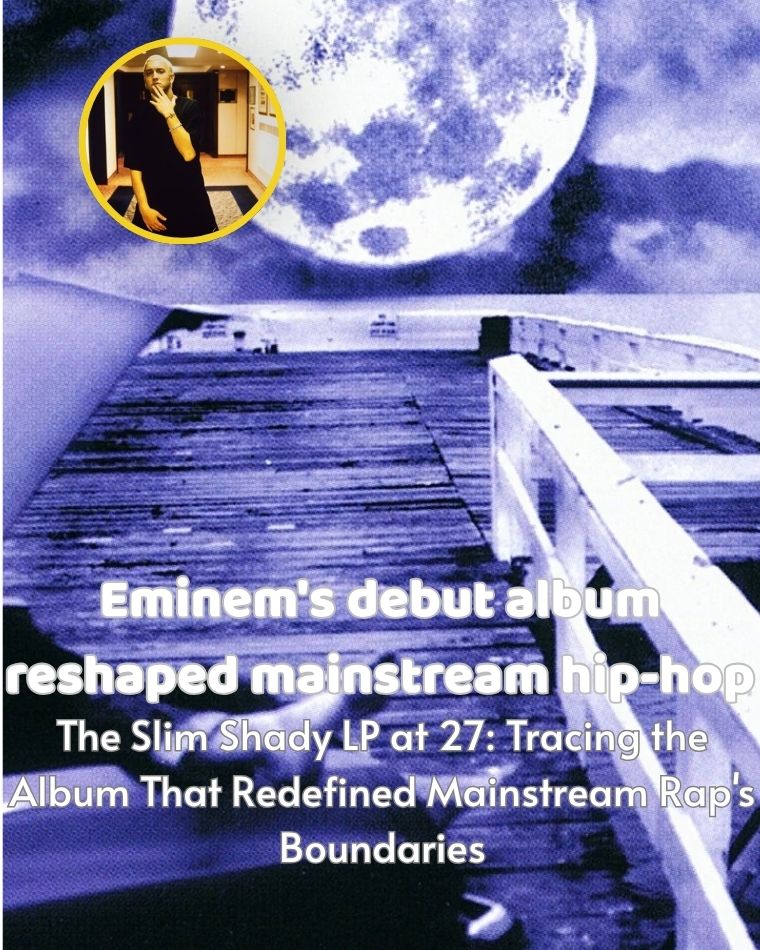
cRE: Interscope Records / Aftermath Entertainment
Dr. Dre’s Visionary Bet and the Industry’s Blindsiding
The genesis of “The Slim Shady LP” traces back to a make-or-break moment at the 1997 Rap Olympics held in Los Angeles.
Mathers placed second in the rap battle tournament, but an Interscope intern named Dean Geistlinger passed a cassette of Eminem’s early underground work to label chief Jimmy Iovine.
Iovine quickly played the cassette tape for hip-hop pioneer Dr. Dre, who had founded Aftermath Entertainment following his turbulent departure from Death Row Records.
Dre was immediately transfixed by Mathers’ breathless flow, multi-syllabic rhyme structures, and unorthodox cadence.
Industry skeptics cautioned Dre against signing an unknown white rapper from Detroit, noting that previous attempts at white rap crossover acts had often ended in commercial mockery.
Dre completely disregarded the warnings, trusting his unmatched sonic instincts over industry tradition.
Within hours of their first meeting in a North Hollywood recording studio, Dre and Eminem laid the creative foundation for their inaugural collaborative hits.
Dre provided sleek, bass-heavy, rhythmically dynamic funk production that balanced Eminem’s blistering, manic microphone delivery.
Their creative symbiosis provided Eminem with top-tier musical credibility while simultaneously revitalizing Dre’s status as hip-hop’s premier sonic architect.
The creative partnership forged during those early recording sessions would ultimately alter the course of modern music for decades to come.
Commercial Explosion and Critical Defiance
When “The Slim Shady LP” hit record stores across the country, it shattered every prevailing sales prediction.
The album debuted at number two on the US Billboard 200 chart, selling over 283,000 copies in its first week alone.
Only TLC’s blockbuster R&B record “FanMail” prevented Eminem from securing the top spot during his opening frame.
Within months, the album attained multi-platinum certification from the Recording Industry Association of America, eventually surpassing four million sales in the United States.
Critics were sharply divided by the record’s explicit lyrical themes, but they were almost unanimous in praising Eminem’s technical virtuosity.
Publications like The Source, Rolling Stone, and Spin marveled at the newcomer’s breath control, complex internal rhyme schemes, and narrative dexterity.
At the 42nd Annual Grammy Awards in early 2000, “The Slim Shady LP” captured the prize for Best Rap Album.
Its lead single, “My Name Is,” simultaneously took home the award for Best Rap Solo Performance, validating the LP in the eyes of the music industry establishment.
Eminem proved that visceral shock and uncompromising underground skill could achieve massive commercial crossover success without sacrificing artistic bite.
The commercial triumph proved that a new demographic of music listeners was hungry for uncensored, unfiltered emotional expression.
Anatomy of the Tracks: “My Name Is” and “97′ Bonnie & Clyde”
The cultural ignition point of the entire rollout was the whimsical, infectious lead single titled “My Name Is.”
Built around an iconic, bouncy bassline sampled from Labi Siffre’s 1975 British track “I Got The…”, the song provided Eminem’s alter ego with a triumphant global entrance.
With an eccentric, satirical delivery, Eminem introduced Slim Shady by mocking celebrities, ripping school teachers, and laughing in the face of domestic misery.
The accompanying high-rotation music video on MTV featured Eminem dressing up as diverse pop icons, from Marilyn Manson to President Bill Clinton.
The single demonstrated that extreme shock humor could be transformed into accessible, inescapable radio pop.
Yet the core of “The Slim Shady LP” lay in its harrowing, darker conceptual deep cuts.
No track illustrated Eminem’s controversial psychological depth more vividly than the chilling “97′ Bonnie & Clyde.”
Recorded originally on the underground “Slim Shady EP,” the song is structured as an eerie, singsong lullaby addressed to his infant daughter, Hailie Jade.
Over a soft, breezy, melancholic groove, Mathers narrates a fictional scenario where he disposes of his partner’s body in a lake with his toddler in the backseat.
The stark juxtaposition between tender parental affection and macabre lyrical horror horrified traditional media pundits while fascinating narrative critics.
The track made it clear that Eminem intended to use music as a cinematic, boundary-free canvas for emotional catharsis.
Other landmark tracks, including the cautionary anthem “Guilty Conscience” featuring Dr. Dre, illustrated Eminem’s brilliance as a dramatic comedic actor.
In “Guilty Conscience,” Eminem and Dre embody the dueling moral impulses of regular citizens, playing the devil and angel over characters caught in moral dilemmas.
The album demonstrated that rap could transcend party-starting tropes and serve as an elaborate audio theater of the absurd.
The Censorship Wars and Cultural Turmoil
With enormous commercial fame came immediate, unprecedented socio-political pushback.
As “The Slim Shady LP” penetrated middle-class American households, advocacy groups and conservative organizations sounded public alarms.
Organizations such as GLAAD and various family morality councils condemned Eminem for misogynistic storytelling and offensive slurs.
Critics argued that his violent imagery posed a direct moral hazard to millions of impressionable young listeners.
Political leaders held congressional hearings on explicit entertainment marketing directed toward minors, frequently referencing Eminem’s lyrics as exhibit A.
Interscope and Aftermath were forced to release a heavily edited clean version of the album that muted numerous explicit scenarios and drug references.
Despite intense legislative pressure and calls for retailer boycotts, Eminem steadfastly refused to apologize for his theatrical writing style.
He repeatedly pointed out in interviews that Slim Shady was a fictional, satirical character meant to provoke, not an instruction manual for real life.
He emphasized that his lyrics should be evaluated in the same artistic light as Hollywood horror films or Quentin Tarantino movies.
The fiery censorship disputes only amplified Eminem’s anti-authoritarian mystique, turning him into a folk hero for an alienated generation.
The national controversy proved that music could still provoke genuine cultural debate in the digital age.
Redefining Mainstream Rap: Technical Prowess and White Identity in Hip-Hop
Beyond the screaming headlines and conservative outrage, “The Slim Shady LP” radically transformed the technical mechanics of mainstream rap.
Prior to 1999, technical battle-rap complexity with intricate multi-syllabic rhymes was largely confined to underground subcultures.
Eminem brought an elite battle-rap discipline directly into top-forty radio rotations.
He paired rhythmic internal rhymes with impeccable enunciation, allowing listeners to catch every single syllable even at rapid tempos.
He wrote lines where four or five rhyming syllables chained across multiple bars, inspiring an entire generation of MCs to elevate their pen game.
Equally significant was how Mathers navigated racial dynamics in a genre created and dominated by Black artists.
Instead of adopting false street postures or attempting to conceal his background, Eminem laid bare his low-income trailer park upbringing.
He openly acknowledged his whiteness, disarming potential racial critiques through self-deprecating humor and undeniable respect for the pioneers of hip-hop.
His unmatched technical skill earned him the deep respect of peer legends, including Rakim, Nas, Jay-Z, and the Wu-Tang Clan.
Eminem demonstrated that an outsider could belong in hip-hop by honoring the craft, mastering the fundamentals, and telling an authentic truth.
By refusing to shy away from poverty, addiction, and class resentment, he forged a visceral connection with working-class youth worldwide.
He transformed marginalized trailer park experiences into vivid, high-art American gothic storytelling.
The 27-Year Retrospective: A Lasting Legacy at the 2026 Milestone
Looking back from the vantage point of 2026, twenty-seven years after its release, “The Slim Shady LP” retains its primal, electrifying vitality.
The album served as the essential launching pad for one of the greatest and most enduring recording careers in modern history.
Without the initial breakthrough of “The Slim Shady LP,” the monumental commercial and artistic heights of “The Marshall Mathers LP” and “The Eminem Show” would never have materialized.
The record opened the floodgates for unconventional artists who rejected polished corporate molds across all genres.
Generations of contemporary rap superstars, from Tyler, The Creator and Kendrick Lamar to Juice WRLD, have cited Eminem’s unfiltered vulnerability as a foundational influence.
His brave willingness to explore mental illness, depression, and personal chaos paved the way for modern emo-rap and introspective lyricism.
Moreover, the technical blueprint introduced on the album remains a masterclass in rhyme design, comedic pacing, and dramatic tension.
Decades later, tracks like “Brain Damage,” “Rock Bottom,” and “Just Don’t Give a Fuck” remain essential listening for any serious student of American poetry and hip-hop.
The record captured an artist performing with his back against the wall, fighting poverty and obscurity with pure linguistic ammunition.
It remains a monument to creative fearlessness, showing what can happen when raw talent meets uncompromising vision.
Continuing Relevance in a Rapidly Evolving Music Landscape
As hip-hop celebrates ongoing historical milestones, the timeless appeal of Mathers’ early catalog continues to inspire debate and discovery.
In an era of fleeting streaming trends and algorithmic playlist production, the immersive world-building of “The Slim Shady LP” feels like a lost art form.
Mathers managed to create a fully realized three-dimensional universe across fourteen songs and five skits.
Every character, from the stressed store clerk to the neighborhood bully, was rendered with cinematic sharpness.
Listeners did not merely consume the music; they entered a vivid psychological funhouse.
That level of narrative dedication continues to reward repeated listening twenty-seven years after its initial public unveiling.
Modern listeners consistently rediscover the album’s emotional core beneath the surface provocations.
Songs like “Rock Bottom,” recorded when Mathers had mere dollars in his bank account, provide a poignant, heartbreaking glimpse into American poverty.
The desperate plea to provide basic security for his daughter balances out the exaggerated, chaotic revenge fantasies of his alter ego.
This fundamental duality between the vulnerable human being Marshall Mathers and the cartoon villain Slim Shady gave the record its soul.
It is precisely this fragile humanity that prevents the project from becoming a dated novelty shock record.
Generations of fans still turn to the album during their own periods of anger, hardship, and isolation.
An Unshakable Foundation in Music History
The enduring greatness of “The Slim Shady LP” lies in its audacity to push artistic expression into unchartered waters.
Mathers took immense personal and professional risks, refusing to soften his sound to meet conservative standards of respectability.
Supported by Dr. Dre’s cinematic production, Eminem tore down traditional barriers to prove that raw hip-hop lyricism could capture the global imagination.
The album challenged mainstream society to confront its own hypocrisies, double standards, and hidden resentments.
Twenty-seven years later, the record stands as a towering testament to artistic defiance, exceptional lyrical craftsmanship, and creative truth.
As music continues to evolve, the initial arrival of Slim Shady remains one of the most transformative, defining, and unforgettable chapters in hip-hop history.
Để lại một phản hồi