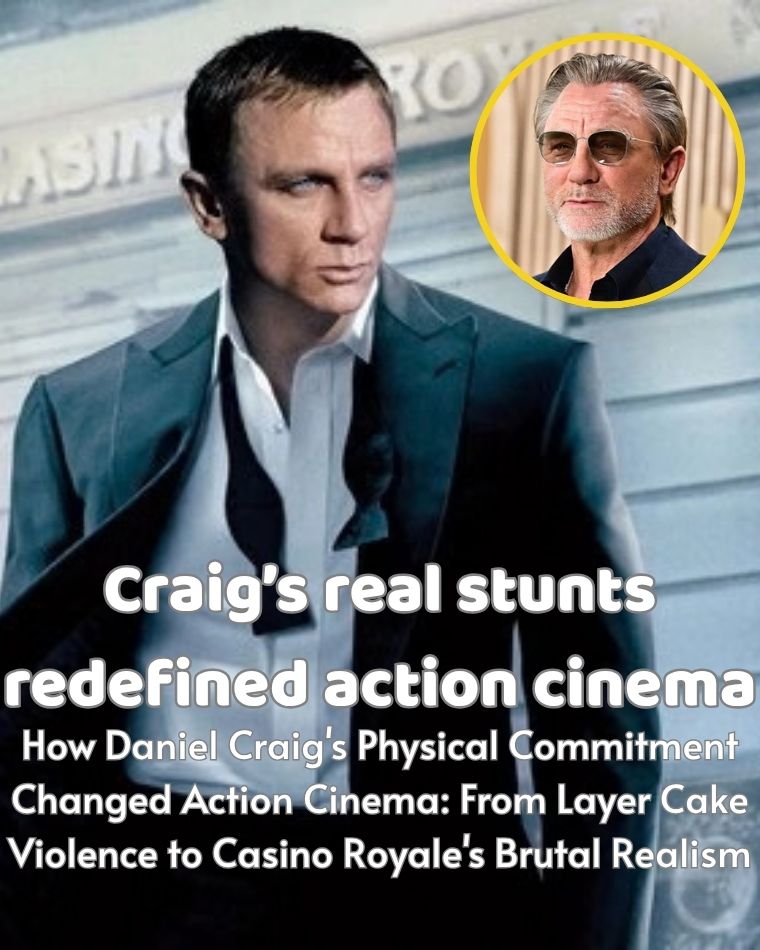
Daniel Craig did not just revitalize the James Bond franchise with raw grit; he fundamentally transformed contemporary action cinema by putting his own body on the line. Through five grueling films, his insistence on visceral, consequence-heavy practical stunts shattered the era of digital safety and established a high-impact benchmark that reshaped expectations for leading men across Hollywood.
When Daniel Craig sprinted across an elevated platform on the set of Spectre in Mexico, his knee buckled under the immense physical strain.
The ruptured anterior cruciate ligament would have halted most major studio productions for months.
Instead of stepping aside for a stunt double, Craig underwent arthroscopic surgery and returned to filming just weeks later wearing an elaborate bionic knee brace hidden beneath his Tom Ford trousers.
This was not an isolated incident of bad luck, but the direct consequence of a deliberate creative philosophy.
From the moment he accepted the license to kill, Craig insisted that audiences should see his face during every bone-crunching impact.
He believed that action scenes lose their dramatic stakes the instant an editor cuts away to hide a stunt double’s profile.
To make James Bond matter in the twenty-first century, Craig felt the character had to bleed, bruise, and endure palpable exhaustion.
This physical commitment established an uncompromising standard of authenticity that altered the DNA of modern blockbuster filmmaking.
Long before he ever put on the iconic tuxedo, Craig laid the groundwork for this grounded approach in Matthew Vaughn’s 2004 British crime thriller, Layer Cake.
In Layer Cake, Craig portrayed an unnamed cocaine distributor navigating the treacherous criminal underworld of London.
Unlike the polished, unflappable gangsters common in Hollywood cinema, Craig’s character was deeply vulnerable to violence.
Every punch landed in that film left visible swelling, ruptured skin, and lasting physical trauma.
When his character was dragged into a physical brawl in a diner tea room, Craig deliberately avoided stylized martial arts.
He opted instead for an awkward, frantic, and desperate wrestling match where survival felt genuinely uncertain.
The camera lingered on his bloodied nose and disheveled appearance across subsequent scenes, refusing to wipe the slate clean.
Producers Barbara Broccoli and Michael G. Wilson were captivated by this specific performance when searching for Pierce Brosnan’s successor.
They saw an actor capable of stripping away the gadget-laden complacency that had begun to weigh down the 007 franchise.
Layer Cake served as the definitive proof of concept that audiences would embrace a protagonist who visibly absorbed punishment.
It proved that visceral stakes elevate narrative tension far more than effortless invulnerability ever could.
When Casino Royale entered production in 2006, director Martin Campbell knew the opening sequence had to make a declarative statement.
The film opened not with high-tech cars or lasers, but with a raw, black-and-white execution in an office bathroom.
Craig threw himself against tiled walls, shattering porcelain sinks and grappling on wet stone floors.
There was no balletic wirework or clean choreography in the sequence.
The struggle looked filthy, claustrophobic, and genuinely exhausting for both combatants.
Craig deliberately gasped for air between blows, capturing the sheer panic and adrenaline of close-quarters combat.
That opening scene immediately put moviegoers on notice that this Bond lived in an unforgiving world of friction and gravity.
Cre: Wikimedia Commons — CC BY-SA 3.0 / Rudolf Schürer
The film immediately doubled down on this physical reality by transitioning into the now-legendary Madagascar chase.
The sequence pitted Craig’s James Bond against Mollaka, played by free-running pioneer Sébastien Foucan.
Rather than matching Foucan’s effortless, acrobatic parkour flourishes, Craig played Bond like an unstoppable human freight train.
Where Mollaka smoothly slid through high-wire openings, Craig smashed straight through drywall and safety glass.
The sequence required Craig to sprint along the narrow steel girders of a construction crane suspended over a hundred feet in the air.
He performed the dizzying leap between two cranes secured only by safety cables, requiring absolute mental and physical fortitude.
Craig spent months working with personal trainers and conditioning coaches to build the dense, athletic muscle necessary for such feats.
He trained like an Olympic decathlete, focusing on explosive power, grip strength, and sprint mechanics.
During the filming of that crane chase, Craig took an accidental blow to the jaw that knocked out his two front teeth.
The production had to fly his personal dentist to the remote location to repair the damage so filming could resume without delay.
Far from being discouraged, Craig viewed the incident as validation that the scene carried real danger.
The audience could sense that real human beings were navigating real vertical drops, elevating the scene into an instant classic.
By grounding the parkour sequence in brute physical force, the film rewired audience expectations for action pacing.
Spectators no longer wanted to watch glossy, weightless CGI avatars flipping across rooftops without consequence.
They wanted to feel the shockwave in their own joints when Bond landed hard on concrete.
This approach set the tone for Craig’s entire fifteen-year tenure as Agent 007.
Yet enduring such heavy impacts over five massive feature films took an immense, documented toll on Craig’s body.
While filming 2008’s Quantum of Solace, Craig suffered a severe tear to his right shoulder labrum during an intense wire stunt.
The injury required extensive surgery and the permanent insertion of six titanium screws to stabilize the joint.
On that same production, a close-range fight sequence went wrong, resulting in the slicing off of the tip of one of his fingers.
Shortly thereafter, Craig required multiple facial stitches after taking an accidental kick during an explosive pursuit.
Rather than taking extended medical leaves, Craig routinely masked the pain to prevent hundreds of crew members from facing production shutdowns.
When production moved to 2012’s Skyfall, the physical demands shifted toward punishing endurance work in extreme environments.
Craig ruptured his calf muscles while sprinting across the frozen terrain of Scotland for the climactic home-defense sequence.
He worked through the agonizing muscle tears with daily physical therapy sessions scheduled before dawn call times.
The cumulative damage became even more severe during the production of 2015’s Spectre.
Beyond the catastrophic ACL rupture sustained during the Mexican fight choreography, Craig repeatedly bruised his ribs and damaged his wrists.
The physical toll reached a point where Craig openly questioned whether he could ever endure another installment.
Yet he returned for one final mission in 2021’s No Time to Die, determined to finish the narrative arc on his own terms.
During early location shooting in Jamaica, Craig slipped awkwardly during a high-speed sprint across a wooden dock.
The accident resulted in a severe ankle ligament rupture that required immediate orthopedic surgery in New York.
Within two weeks of the operation, photographs emerged of Craig working out in a gym wearing a protective boot.
He refused to let the injury sideline the production, pushing through intensive rehabilitation to perform the stairwell fight in the third act.
Across his five Bond films, Craig accumulated at least seven major documented injuries that required medical interventions.
These injuries were not the result of negligence or inadequate safety protocols on set.
They were the inevitable byproduct of an actor demanding to be in the center of real pyrotechnics, moving vehicles, and physical brawls.
Craig understood that safety teams could minimize risk, but they could never eliminate the fundamental physics of practical stunt work.
His willingness to absorb those consequences sent shockwaves through the entertainment industry.
Before Craig’s debut, Hollywood had become heavily reliant on green screens and digital doubles for leading actors.
The early 2000s were dominated by visual effects that allowed actors to perform impossible, physics-defying acrobatics.
While visually striking, these sequences often lacked dramatic tension because the human stakes felt entirely artificial.
Craig inverted that trend, demonstrating that practical stunt execution could generate massive global box-office returns.
His success opened the door for a wider industry revival of actor-driven practical action.
Tom Cruise, already a dedicated proponent of practical stunts, pushed his Mission: Impossible franchise into unprecedented territory following Craig’s arrival.
Cruise recognized that audiences were responding enthusiastically to the visible reality of an actor performing perilous maneuvers.
Sequences like scaling the Burj Khalifa or clinging to an airborne cargo plane were designed around holding wide shots on Cruise’s face.
Similarly, Keanu Reeves took inspiration from this grounded physical philosophy when preparing for the John Wick franchise in 2014.
Reeves spent months mastering judo, Brazilian jiu-jitsu, and tactical gun handling to perform extended single-take fight scenes.
Like Craig, Reeves allowed his character to absorb relentless physical trauma, limping and bruising across the narrative.
The lineage from Craig’s Casino Royale bathroom fight directly influenced the frantic, tactile combat design of John Wick.
Charlize Theron similarly redefined female action heroics in Atomic Blonde by performing punishing, long-take stairwell combat sequences herself.
Theron cracked multiple teeth during rehearsals, channeling real physical exhaustion into her character’s brutal fight for survival.
Even veteran icons like Harrison Ford found renewed appreciation for performing practical car chases and fistfights well into their later careers.
Hollywood suddenly realized that audiences had developed a sophisticated eye for artificiality.
Modern moviegoers can instantly spot the subtle disconnect between an actor’s head digitally composited onto a stunt performer’s body.
When a computer-generated double moves through space, it frequently lacks the authentic micro-hesitations of human muscle under stress.
Real stunt work carries inherent imperfections that computer algorithms cannot replicate.
A foot slipping slightly on gravel or an off-balance recovery adds an element of raw chaos to a scene.
Practical stunts force filmmakers to respect the fundamental laws of gravity, inertia, and momentum.
When an actor physically leaps across a gap, their facial muscles contract and their breath hitches in genuine exertion.
That micro-expression conveys mortal danger far more effectively than any post-production visual effect.
CGI remains an indispensable tool in modern filmmaking, but its optimal role is enhancement rather than replacement.
In Craig’s Bond films, visual effects were masterfully utilized to erase safety harnesses, wire rigs, and protective pads.
Digital artists cleaned up background elements and removed crash mats, allowing Craig to perform dangerous actions with a vital safety net.
This hybrid approach represents the pinnacle of modern action filmmaking.
The practical stunt provides the authentic human core, while digital tools provide the necessary margin of safety.
When productions rely entirely on CGI to generate action, the audience’s subconscious detachment is almost immediate.
Viewers recognize that a digital character faces zero actual peril, reducing life-or-death scenarios to weightless video game cutscenes.
Craig understood this psychological reality better than almost anyone of his generation.
He recognized that James Bond is fundamentally a character defined by his capacity to endure pain.
Bond is not a superhero endowed with supernatural resilience or bulletproof armor.
He is an ordinary human being whose only true superpower is a relentless, pathological refusal to quit.
By taking the blows himself, Craig closed the distance between the actor and the mythic character.
The sweat dripping into his eyes during an interrogation sequence was not sprayed from an atomizer; it was real.
The labored breathing heard as he dragged himself up a flight of stairs came from genuine physical depletion.
This visible vulnerability created an unprecedented emotional resonance with audiences worldwide.
Spectators root harder for a protagonist when they can see the cost of victory written across the performer’s body.
In Skyfall, this vulnerability was elevated into the central thematic core of the entire narrative.
The film explicitly tackled the reality of Bond’s aging, damaged body after years of traumatic impacts.
Craig portrayed an operative failing his physical fitness tests, shaking with tremors while attempting to aim his sidearm.
Because viewers had watched Craig sustain real injuries for years, the character’s physical decline felt devastatingly authentic.
The audience was not merely suspending disbelief; they were witnessing the actual wear and tear of time and impact.
This thematic honesty transformed Skyfall into one of the most critically acclaimed and commercially successful action films in cinema history.
It proved that physical vulnerability does not diminish a legendary hero; it immortalizes him.
Craig’s legacy extends far beyond box-office totals and cinematic records.
He fundamentally changed what it means to be an action star in the modern era of filmmaking.
The archetype of the detached, immaculate action hero who never musses his hair or takes a bruising punch is largely obsolete.
Today’s audiences demand commitment, physical transparency, and real human stakes in their blockbuster cinema.
Leading actors are now expected to step into martial arts gyms, tactical shooting ranges, and stunt training facilities.
Craig proved that audiences will reward authenticity with immense loyalty and box-office dominance.
His willingness to endure ruptured ligaments, broken teeth, and surgical repairs redefined the creative relationship between actor and action.
By treating stunt performance as an essential component of dramatic acting, he elevated the entire action genre.
James Bond may be a fictional creation, but the bruises Daniel Craig carried across five films were undeniably real.
That physical sacrifice ensured his tenure as Agent 007 will stand as a watershed moment in cinematic history.
Để lại một phản hồi