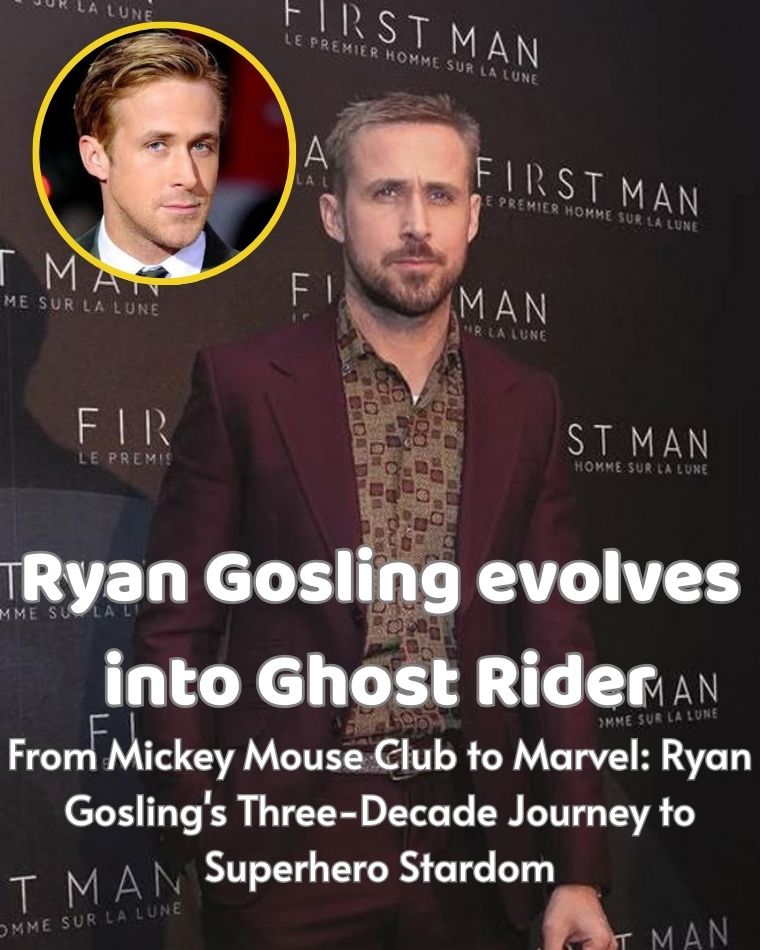
Ryan Gosling’s official casting as Johnny Blaze in Marvel Studios’ upcoming Ghost Rider marks the definitive zenith of a deliberate, thirty-year artistic odyssey. From child performer on The Mickey Mouse Club to indie luminary and worldwide blockbuster headliner, the Canadian actor has systematically rewritten the playbook of modern movie stardom. Here is the comprehensive chronicle of an extraordinary career defined by bold reinvention, uncompromising creative independence, and the patience to enter comic-book cinema entirely on his own terms.
When Marvel Studios President Kevin Feige welcomed Ryan Gosling onto the Hall H stage at San Diego Comic-Con, the deafening reaction from the audience signaled far more than standard superhero hype.
The announcement that Gosling would headline a standalone Ghost Rider feature film, directed by Shawn Levy, crystallized a monumental shift in the modern franchise landscape.
For years, comic-book fans and industry insiders had persistently pitched Gosling for nearly every marquee costumed vigilante across major cinema franchises.
Yet unlike many contemporaries who leaped at franchise multi-picture contracts at the first blush of fame, Gosling waited three decades to make his comic-book leap.
The actor did not simply accept a generic studio offer, but actively developed and pitched his creative vision directly alongside Levy to Kevin Feige.
That careful discernment is precisely what makes Gosling’s ascendancy to the superhero pantheon feel earned, singular, and artistically authentic.
He is not an up-and-coming talent chasing instantaneous mainstream validation through spandex and computer-generated spectacles.
Instead, Gosling arrives at Marvel as an accomplished, three-time Academy Award nominee who commands undisputed authority over his creative identity.
His professional evolution began more than thirty years ago in the squeaky-clean corridors of Disney’s television production studios.
Understanding the magnitude of his current triumph requires examining the humble, highly disciplined roots where his craft was first forged.
Cre: Wikimedia Commons
The Mickey Mouse Club Crucible: Discipline and Foundation
In 1993, a twelve-year-old Canadian kid from London, Ontario, secured a spot on Disney Channel’s revival of The Mickey Mouse Club.
Gosling shared the soundstage with a remarkable cadre of future international pop icons, including Justin Timberlake, Britney Spears, and Christina Aguilera.
While some of his peers were already gifted with powerhouse vocal ranges, Gosling had to carve out his space through distinct charisma and physical performance.
He spent two full years on the variety series between 1993 and 1994, absorbing the intense professional discipline demanded by live television production.
The grueling schedules taught the young performer how to hit marks, handle spontaneous choreography, memorize scripts rapidly, and command camera lenses.
Gosling has frequently reflected on that childhood period not with embarrassment, but with profound professional gratitude.
He recognized early on that variety television provided an indispensable boot camp in stage presence and audience engagement.
Working alongside generational musical talents instilled an innate humility that kept him grounded even as his natural screen charisma blossomed.
Following his Disney tenure, Gosling spent the late 1990s methodically working through the demanding world of Canadian and American television.
He headlined youth series such as Young Hercules and Breaker High, gaining hundreds of hours of precious on-camera experience.
Many child stars find themselves permanently trapped inside the narrow confines of their youthful television images.
Gosling, however, recognized that television was merely an apprentice workshop rather than the final destination for his burgeoning ambitions.
By the turn of the millennium, he deliberately cut ties with adolescent programming to seek serious dramatic opportunities in independent cinema.
His breakthrough in serious drama arrived with the critically acclaimed 2001 indie feature The Believer.
Portraying a conflicted Jewish neo-Nazi in The Believer required an intense, fearless psychological vulnerability that stunned film festival critics worldwide.
The raw dramatic power of that performance proved beyond any doubt that Gosling possessed the instincts of an elite character actor.
He followed with calculated supporting turns in psychological thrillers like Murder by Numbers alongside Sandra Bullock and The Slaughter Rule.
Those foundational years established an enduring creative standard: Gosling refused to take easy roles designed merely to bolster superficial popularity.
Every choice was an active investigation into complex human contradictions, emotional wounds, and morally challenging perspectives.
The Notebook Phenomenon: Rejecting the Conventional Heartthrob Mold
In 2004, director Nick Cassavetes cast Gosling as Noah Calhoun in the cinematic adaptation of Nicholas Sparks’ novel The Notebook.
Starring alongside Rachel McAdams, Gosling poured fierce, grounded sincerity into what could easily have been a melodramatic romance cliché.
The Notebook captured the global cultural zeitgeist in historic fashion, becoming an enduring romantic touchstone for an entire generation.
Gosling’s passionate, soaked-in-the-rain confession cemented him overnight as the definitive Hollywood romantic leading man and teen idol.
Studio executives immediately flooded his representatives with high-paying offers for cookie-cutter romantic comedies and mainstream popcorn thrillers.
Most actors in their early twenties would have willingly surrendered to the intoxicating financial rewards of immediate studio stardom.
Yet Gosling executed an unprecedented pivot that startled the film industry and forever defined the trajectory of his career.
Rather than cashing in on his heartthrob status, he retreated into the low-budget, gritty trenches of American independent cinema.
He recognized that conforming to Hollywood’s commercial heartthrob machinery would slowly asphyxiate his artistic instincts and creative growth.
His subsequent choice for a feature project stunned studio insiders who expected another massive commercial play.
In 2006, Gosling starred as Dan Dunne in Ryan Fleck’s low-budget independent drama Half Nelson.
His raw portrayal of an inner-city middle school history teacher battling severe substance abuse was a masterclass in nuanced performance.
Gosling captured both the tragic decay of addiction and the luminous nobility of an educator desperately trying to inspire young minds.
Film critics lavished universal praise on his devastatingly honest, unglamorous interpretation of the character.
At just twenty-six years old, Gosling earned his first Academy Award nomination for Best Actor, cementing his peerless critical prestige.
Rather than an overnight fluke, the Oscar nomination validated his radical decision to walk away from superficial studio stardom.
He proved that creative integrity and artistic courage could command greater industry respect than standard commercial blockbusters.
The following year, he continued his eccentric streak with the tender, bittersweet independent comedy-drama Lars and the Real Girl.
Playing a socially paralyzed, painfully introverted man who forms an emotional bond with an anatomical doll was a massive creative gamble.
In lesser hands, Lars could have devolved into tasteless mockery or uncomfortable absurdity.
Gosling, however, approached the character with such earnest, aching tenderness that audiences and critics were deeply moved.
The performance garnered him a Golden Globe nomination and further underlined his fearless commitment to unorthodox cinematic narratives.
The Indie Masterclasses: Emotional Honesty and Auteur Alliances
As the 2010s arrived, Gosling’s relentless pursuit of authentic character studies culminated in one of modern cinema’s most devastating romantic dramas.
In Derek Cianfrance’s 2010 release Blue Valentine, Gosling paired with Michelle Williams to chronicle the agonizing dissolution of a marriage.
The actors spent years developing their roles, immersing themselves in improvised living conditions to cultivate genuine intimacy and heartbreak.
Gosling’s raw, unflinching depiction of a man watching his life’s great love crumble revealed an actor operating without any vanity.
Blue Valentine reaffirmed that Gosling viewed cinema not as an ego exercise, but as a vehicle for profound psychological exploration.
The following year proved to be the absolute turning point that redefined modern screen masculinity and neo-noir aestheticism.
In 2011, Gosling partnered with visionary Danish auteur Nicolas Winding Refn to create the stylized crime thriller Drive.
Portraying the nameless stuntman and criminal getaway driver, Gosling revolutionized the archetype of the laconic, brooding screen hero.
Cloaked in his iconic scorpion jacket, Gosling communicated intense volumes of emotion through minimal dialogue, steady gazes, and sudden violence.
Drive captivated the Cannes Film Festival, winning Refn the Best Director prize and achieving instantaneous cult-classic immortality.
The film proved that Gosling could effortlessly command action cinema while preserving an uncompromising, arthouse auteur sensibility.
That exact same year, Gosling illustrated his extraordinary dynamic range by starring in two vastly different studio triumphs.
He delivered a sharp, effortlessly charming performance alongside Steve Carell in the acclaimed romantic comedy Crazy, Stupid, Love.
Simultaneously, he went toe-to-toe with George Clooney in the political drama The Ides of March, holding the screen with commanding authority.
Having conquered three entirely distinct genres within a single calendar year, Gosling stood undisputed as Hollywood’s most versatile leading man.
He continued collaborating with ambitious filmmakers who challenged conventional cinema structures, reteaming with Cianfrance for The Place Beyond the Pines.
Playing Luke Glanton, a heavily tattooed motorcycle stuntman driven to bank robbery to support his newborn son, Gosling delivered ferocious emotional resonance.
His experience on that production notably reinforced his deep cinematic affinity for motorcycles, high-speed stunts, and tortured, redemptive souls.
Even when choosing experimental and polarizing projects like Refn’s Only God Forgives, Gosling never compromised on his commitment to auteur-driven visions.
He consistently prioritized working with directors who possessed distinct artistic voices over safe, formulaic commercial studio ventures.
📸 [ẢNH: Ryan Gosling rạng rỡ giao lưu cùng báo chí và người hâm mộ]
Link: https://upload.wikimedia.org/wikipedia/commons/3/33/Ryan_Gosling_Cannes_2011.jpg
Nguồn: Wikimedia Commons — Ảnh chụp bởi Georges Biard (Giấy phép CC BY-SA 3.0)
The Mainstream Conundrum: Balancing Auteur Ambitions with Mega-Productions
By the mid-2010s, Gosling faced the classic dilemma confronting every world-class actor: how to navigate monumental studio budgets without losing soul.
His answer was characteristically methodical, choosing ambitious large-scale studio productions helmed only by top-tier directorial visionaries.
In 2015, he starred in Adam McKay’s financial comedy-drama The Big Short, bringing caustic wit and sharp narration to Wall Street cynicism.
The following year, Gosling reunited with Emma Stone in Damien Chazelle’s breathtaking musical masterpiece La La Land.
Gosling trained for months to master complex jazz piano pieces without the use of CGI or musical hand doubles.
His bittersweet, poignant performance as jazz purist Sebastian Wilder earned him his second Academy Award nomination for Best Actor.
La La Land was a worldwide cultural and financial juggernaut, demonstrating that original, music-driven studio films could still dominate the box office.
Rather than resting on that Oscar triumph, Gosling immediately stepped into one of the most perilous sequels in cinematic history: Blade Runner 2049.
Stepping into the dystopian universe established by Ridley Scott was an immense risk fraught with sky-high expectations.
Under the masterful direction of Denis Villeneuve, Gosling delivered a haunting, exquisitely restrained performance as Officer K.
His portrayal of an artificial replicant yearning for a soul and searching for meaning grounded the film’s magnificent visual grandeur.
Gosling next reunited with Damien Chazelle for the 2018 historical space epic First Man, stepping into the pressurized boots of Neil Armstrong.
Depicting Armstrong not as a swashbuckling space cowboy, but as an intensely introverted, grief-stricken engineer, Gosling showcased breathtaking internal discipline.
The film demonstrated an actor willing to subdue his own movie-star charisma completely to honor historical truth and psychological nuance.
Whenever Gosling accepted large-scale studio projects, he consistently infused them with the depth, vulnerability, and seriousness of indie cinema.
He proved repeatedly to studios that commercial scale did not necessitate artistic triviality or lowest-common-denominator storytelling.
The Ken Renaissance: Subverting Stardom and Embracing High Camp
In 2023, Greta Gerwig’s Barbie became a historic global box office titan, grossing over 1.4 billion dollars worldwide.
At the epicenter of that worldwide cultural hurricane was Ryan Gosling’s universally celebrated, tour-de-force performance as Ken.
Taking on the role of a plastic doll burdened with existential dread and comedic fragility was a high-wire creative risk.
Yet Gosling fully surrendered to the absurdity of the concept, elevating the character into an iconic, multi-layered cultural sensation.
He delivered devastatingly precise deadpan comedy while simultaneously conveying genuine, heartbreaking emotional vulnerability beneath the bleach-blonde veneer.
His performance of the anthemic power ballad “I’m Just Ken” became a global viral phenomenon and topped worldwide music charts.
At the 96th Academy Awards, Gosling delivered an electrifying live performance of the song that instantly entered Oscar history lore.
The Ken performance earned Gosling his third Academy Award nomination, this time for Best Supporting Actor.
More importantly, it proved that Gosling possessed the supreme artistic confidence to satirize his own movie-star persona without hesitation.
He demonstrated an absolute lack of vanity, embracing pure camp while executing every dramatic beat with surgical artistic precision.
Following Barbie, Gosling headlined David Leitch’s 2024 action-comedy romance The Fall Guy, paying tribute to the unheralded stunt industry.
Drawing directly upon his lifelong reverence for physical performance, Gosling executed complex, punishing action sequences with unmatched comedic timing.
The Fall Guy solidified his standing as a rare Hollywood treasure capable of generating chemistry, laughter, and high-octane thrills simultaneously.
By 2026, Gosling had accomplished virtually everything imaginable across three full decades of dedicated screen acting.
He had conquered romantic drama, gritty neo-noir crime, high-concept musical, cerebral science fiction, and subversive mainstream comedy.
The only mountain left unclimbed was the dominant genre of the modern cinematic era: the comic-book superhero blockbuster.
Entering the Marvel Universe: Ghost Rider and the Culmination of Craft
For over a decade, Marvel fans and critics continually speculated about which comic-book titan Ryan Gosling might eventually portray.
Rumors linked his name to characters ranging from Doctor Strange and Nova to various iterations of the X-Men.
Yet Gosling consistently resisted signing multi-picture contracts for characters that felt generic or overly constrained by existing franchise formulas.
When asked over the years about his comic-book aspirations, Gosling repeatedly singled out one specific antihero: Johnny Blaze, the Ghost Rider.
Ghost Rider represents one of Marvel Comics’ most visceral, supernatural, and tragic character mythologies.
First brought to life on the comic page by Gary Friedrich, Roy Thomas, and Mike Ploog in 1972, Johnny Blaze is a daredevil stunt motorcyclist who bargains with Mephisto to save his mentor’s life.
Bound to the demonic Spirit of Vengeance, Blaze transforms into a leather-clad warrior with a flaming skull, exacting retribution upon the wicked.
The character demands a unique combination of high-speed motorcycle stunt mastery, gritty street realism, and deep supernatural tragedy.
When Kevin Feige confirmed at San Diego Comic-Con that Shawn Levy would direct Gosling in Ghost Rider for a July 28, 2028 release date, the logic was unmistakable.
Gosling’s celebrated filmography reads like an intentional thirty-year preparation course for this specific role.
His peerless motorcycle stunt work in The Place Beyond the Pines demonstrated his natural comfort and authenticity atop high-powered bikes.
His iconic turn behind the wheel in Drive established his unrivaled ability to portray stoic, brooding drivers with violent, protective instincts.
His Academy Award-nominated mastery of internal torment in Half Nelson and Blue Valentine ensures that Blaze’s cursed existence will carry real psychological weight.
Director Shawn Levy noted that the project materialized because Gosling came to the table with an uncompromising, fully realized artistic vision for the character.
This is not a young up-and-comer surrendering his career autonomy to fit into an assembly-line superhero template.
This is an elite, veteran screen artist seizing control of an iconic supernatural mythology to build an electrifying cinematic experience.
Gosling’s willingness to ride into the Marvel Cinematic Universe in flames proves that superhero cinema can still attract world-class talent when executed on the artist’s terms.
What Ryan Gosling’s Trajectory Teaches Hollywood About Longevity
Ryan Gosling’s thirty-year career evolution offers an indispensable case study in sustainable artistic longevity within an notoriously fickle industry.
In an era where overnight internet fame often burns out within months, Gosling built his career on patience, craft, and unwavering discipline.
He consistently resisted the allure of short-term financial windfalls in favor of long-term artistic credibility and creative sovereignty.
By prioritizing challenging character studies over generic studio vehicles, he established a brand synonymous with quality and artistic courage.
When he finally chose to embrace big-budget franchise filmmaking, he did so from a position of absolute creative strength and prestige.
Gosling’s journey from a child dancer on The Mickey Mouse Club to Johnny Blaze proves that longevity is not about avoiding commercial work.
Rather, artistic longevity is about retaining your unique creative soul regardless of the scale of the canvas on which you paint.
As he prepares to ignite the screen in Ghost Rider, Ryan Gosling remains what he has always been: a fearless artist exploring the boundaries of his craft.
Để lại một phản hồi