Marvel Studios President Kevin Feige reshaped superhero cinema history through an unexpected post-production meeting in 2010.
By pitching Loki as the primary threat for The Avengers before Thor even debuted in theaters, the studio executive validated actor Tom Hiddleston’s layered performance and set a decade-long franchise arc into motion.
That critical conversation transitioned a traditional comic book villain into a deeply humanized cornerstone of cinematic continuity.
The Marvel Cinematic Universe stands today as a groundbreaking cinematic achievement, but its earliest phases were defined by bold creative risks.
In 2010, the studio was still working tirelessly to establish individual superhero franchises while preparing an unprecedented crossover event.
Actor Tom Hiddleston had recently completed principal photography on Kenneth Branagh’s fantasy epic, Thor.
At the time, the British theatrical performer had delivered his portrayal of Loki without any contractual guarantee of a future beyond that single standalone release.
Supervillains in contemporary Hollywood blockbusters were traditionally disposable figures written to meet defeat in the final act.
Audiences had grown accustomed to comic book adaptations discarding their main adversaries after a solitary cinematic outing.
Hiddleston had poured immense classical training into making the Asgardian trickster sympathetic, emotionally wounded, and mentally volatile.
Shortly after cameras stopped rolling on Thor, Marvel Studios president Kevin Feige reached out to arrange a private discussion.
During that quiet sit-down, Feige delivered unexpected news that altered the actor’s professional trajectory forever.
Feige revealed that Marvel Studios envisioned Loki not merely returning to the screen, but serving as the central antagonist of The Avengers.
The decision was extraordinary because the public had not yet witnessed a single frame of Hiddleston’s work on screen.
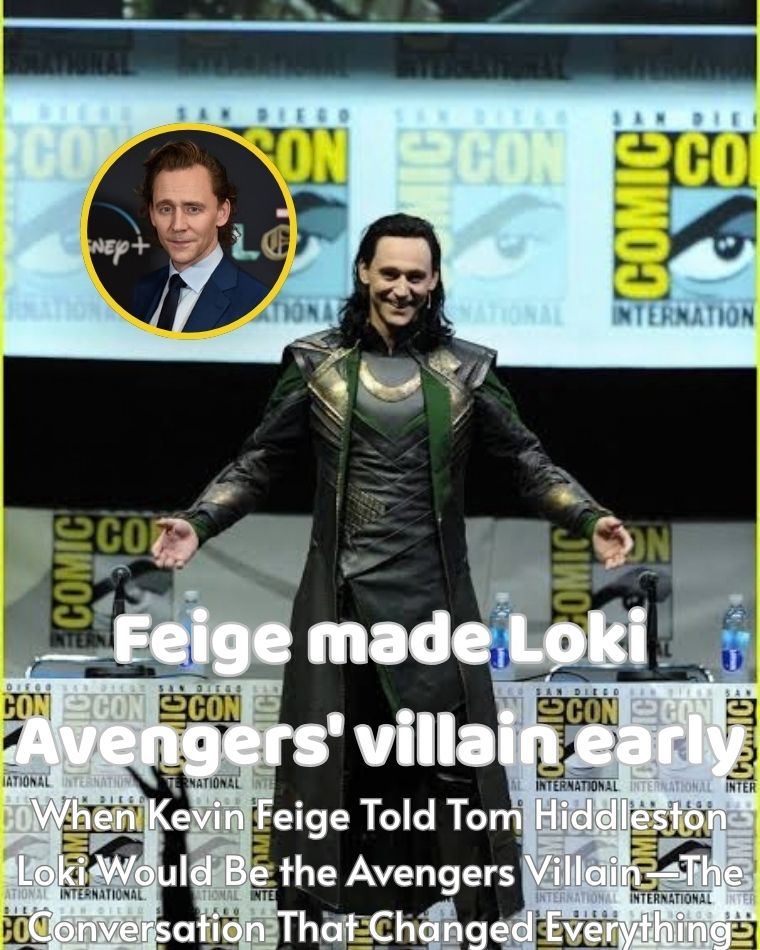
Cre: Wikimedia Commons
Feige’s proactive pitch demonstrated an unwavering internal conviction within Marvel’s creative leadership.
The studio had reviewed early assembly cuts and recognized that Hiddleston brought something entirely distinct to the screen.
Loki was never treated on set as a stereotypical, scenery-chewing antagonist seeking gratuitous destruction.
Instead, the performance balanced royal grandeur with deep familial insecurity and fractured fraternal affection.
Marvel was already committed to an ambitious narrative architecture that had never been attempted on such a scale.
Building toward The Avengers was widely considered by Hollywood insiders to be a massive commercial gamble.
No modern film studio had successfully assembled distinct headline heroes from independent film properties into a cohesive shared storyline.
Introducing a completely new adversary for that team-up movie could have fractured the audience’s emotional investment.
A new villain would have required substantial exposition, backstory explanation, and precious screen time to establish personal stakes.
By anchoring the crossover around Loki, Feige recognized that the emotional groundwork was already complete.
The sibling rivalry between Thor and Loki provided an immediate, organic emotional engine for the entire ensemble.
The Earth-bound heroes would not simply fight an anonymous cosmic warlord with vague destructive intentions.
They would stand together to defend humanity against a broken brother whose royal vendetta crossed planetary boundaries.
Feige’s proposal validated the nuanced dramatic choices Hiddleston had fought to embed within the character’s physical and verbal mannerisms.
The executive made it clear that Marvel prioritized enduring narrative continuity over generic superhero spectacle.
For Hiddleston, the unexpected summons felt like both a monumental creative challenge and an immense artistic honor.
The actor was suddenly tasked with embodying an existential threat capable of challenging six individual icons simultaneously.
Loki needed to possess the strategic cunning to outwit Tony Stark, Steve Rogers, and Nick Fury all at once.
At the same time, the narrative demanded that the god of mischief retain his fragile sense of personal identity.
Feige’s pitch gave Hiddleston the rare freedom to develop an evolving psychological profile across continuous feature films.
Rather than repeating the exact same emotional beats from Thor, the creative team planned to showcase Loki’s spiraling mental state.
Cast out from Asgard and exposed to dark cosmic forces, the character could become sharper, colder, and increasingly desperate for validation.
The creative trust bestowed by Marvel Studios allowed Hiddleston to approach the ensemble script with supreme creative confidence.
Director Joss Whedon built upon that foundation by granting Loki biting dialogue and theatrical bravado throughout the 2012 production.
When The Avengers eventually debuted in theaters, global box office records shattered within a single weekend.
Critics and moviegoers praised the spectacle, but Hiddleston’s magnetic antagonist received extraordinary universal acclaim.
His magnetic screen presence proved that an antagonist’s emotional complexity directly enhances the heroic unity of the protagonists.
The success of the picture cemented Feige’s initial instinct as one of the most brilliant strategic decisions in cinematic history.
Loki had successfully transitioned from an Asgardian prince into a globally recognized cultural phenomenon.
The longevity of the character in subsequent installments proved that Feige never intended Loki to be a one-note foil.
In Thor: The Dark World, the studio brought the character back into the fold to navigate devastating familial loss.
Imprisoned beneath the shining spires of Asgard, Loki was forced to confront the violent death of his mother, Frigga.
The fragile truce formed between Thor and Loki in that sequel demonstrated the endless possibilities of their complex brotherhood.
Audiences responded enthusiastically whenever the brothers shared the screen, captivated by their shifting allegiances and sharp verbal sparring.
Rather than remaining a stagnant presence, Loki evolved organically in response to the changing landscape around him.
By the time director Taika Waititi took the helm for Thor: Ragnarok, the dynamic reached new dramatic and comedic heights.
Ragnarok deconstructed the regal pretensions of Asgard while giving Hiddleston room to showcase brilliant comedic timing.
Beneath the playful banter, the narrative retained genuine emotional resonance regarding destiny, exile, and reconciliation.
Loki finally chose to fight alongside his brother to defend the remnants of the Asgardian population from total annihilation.
The character had gradually shed the skin of a megalomaniacal villain to embrace the mantle of a reluctant antihero.
That transformative transformation paid off during the tragic opening sequence of Avengers: Infinity War.
Loki’s defiance in the face of insurmountable odds provided the definitive emotional punctuation to his primary cinematic arc.
His desperate sacrifice highlighted how profoundly the character had grown since his initial scheming days in 2010.
Even after a seemingly definitive demise on the big screen, the foundation laid by Feige and Hiddleston proved resilient.
The launch of the Disney Plus streaming platform opened an unprecedented narrative canvas for the Marvel Cinematic Universe.
Marvel Studios greenlit a dedicated solo series titled Loki, placing Hiddleston front and center as an existential lead.
The series explored the multiverse, alternate timelines, and the fundamental question of free will versus predestination.
Stripped of his magical royal status and royal weapons, Loki was forced to look inward and analyze his lifetime of failures.
The production transformed the former conqueror into an introspective protector of temporal reality.
Critical reaction to the two-season series praised its philosophical weight, visual imagination, and exceptional central performance.
Reviewers marveled at how a character introduced over a decade earlier could still discover profound new thematic layers.
Loki’s eventual rise to the center of the multiverse completed one of the most sophisticated character arcs in popular modern fiction.
None of that artistic evolution would have been feasible under the traditional Hollywood studio model.
In conventional franchise filmmaking, villainous characters were routinely treated as single-use obstacles designed to elevate the hero.
Feige’s radical philosophy treated antagonists with the same dramatic dignity, narrative patience, and long-term investment as their heroic counterparts.
The famous 2010 conversation remained the foundational spark that made such sustained storytelling possible.
Hiddleston had entered that fateful meeting unsure of his future employment in American feature films.
He emerged from it carrying the narrative weight of Marvel’s most pivotal multi-film crossover event.
Looking back across more than a decade of blockbuster cinema, that post-Thor dialogue remains a masterclass in long-term narrative planning.
Marvel Studios proved that genuine continuity requires more than simple cameo appearances and post-credits easter eggs.
True continuity demands emotional follow-through and a deep respect for an actor’s emotional interpretation of the script.
Hiddleston’s unwavering dedication to portraying Loki’s vulnerability prevented the character from sliding into villainous parody.
Feige’s intuitive willingness to spot that quality early preserved an extraordinary character who defined an entire era of cinematic storytelling.
The God of Mischief grew from a royal pretender into the heart of an interconnected narrative tapestry spanning twelve separate projects.
His journey demonstrated to the film industry that audiences crave complex moral shades rather than straightforward black-and-white archetypes.
As the superhero landscape continues to shift and redefine itself, the partnership between Kevin Feige and Tom Hiddleston stands as a timeless benchmark.
It serves as enduring proof that great cinematic universes are built not solely on spectacle, but on foresight, character integrity, and creative conviction.
Để lại một phản hồi