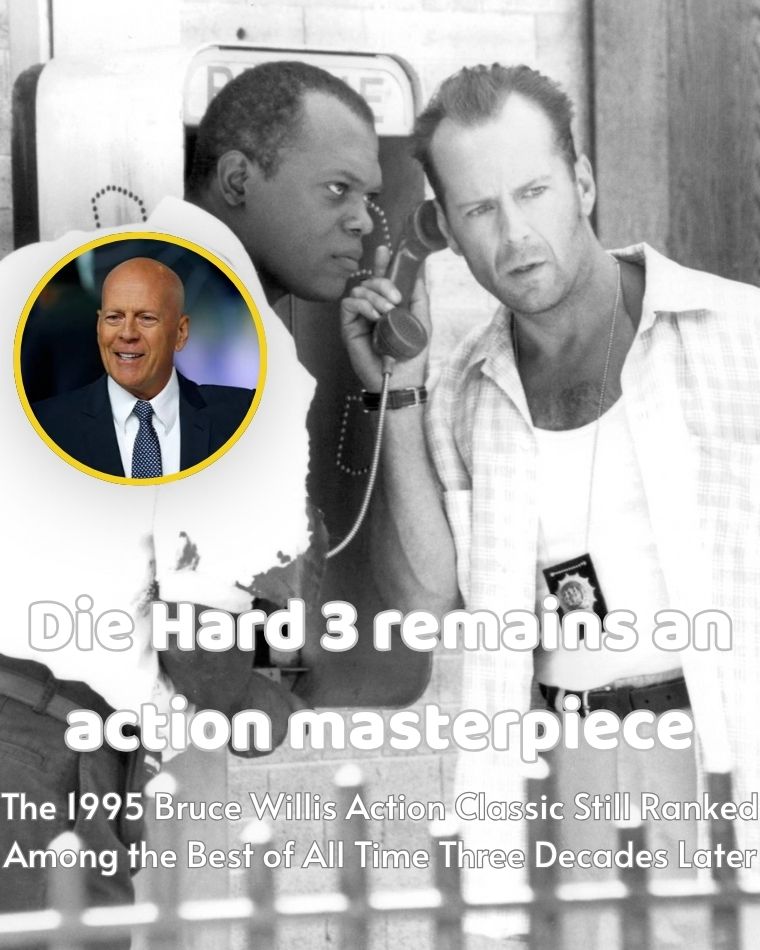
Three decades after roaring into theaters in the summer of 1995, Die Hard with a Vengeance stands tall as a masterclass in blockbuster action cinema. The third installment reunited Bruce Willis with director John McTiernan, pairing the iconic John McClane with Samuel L. Jackson’s Zeus Carver in a relentless, high-stakes sprint across New York City. By fusing blistering practical spectacle with razor-sharp intellectual puzzles, the film revolutionized the franchise and cemented its status on all-time best lists.
The Legacy of a 1995 Action Landmark
When Die Hard hit theaters in 1988, it fundamentally redefined what an action hero could look like on the silver screen.
Bruce Willis traded the invincible, bullet-spraying machismo of the 1980s for vulnerability, wit, and bruised human frailty.
Seven years later, after a commercially successful but formulaic airport sequel in 1990, the franchise returned to the creative stewardship of original director John McTiernan.
The result was Die Hard with a Vengeance, an electrifying thrill ride that debuted on May 19, 1995, and grossed over $366 million worldwide to become the biggest box office triumph of that entire calendar year.
Thirty years later, critical retrospectives routinely celebrate the movie as a rare sequel that equals the cultural impact of its legendary progenitor.
Action cinema in the 1990s was undergoing a profound transition toward increasingly polished, high-budget spectacles.
Yet few productions captured raw kinetic energy and urban urgency quite like this sun-drenched Manhattan masterpiece.
Instead of retreating into safe nostalgia, the filmmakers took audacious creative leaps that permanently expanded the mythos of John McClane.
Today, cinephiles and industry critics frequently rank the production among the finest action movies ever committed to celluloid.
The enduring legacy of the film stems from its flawless construction, authentic pacing, and deep respect for the intelligence of the audience.
Cre: 20th Century Fox / Wikimedia Commons =
Reinventing the Blueprint: From Trapped Architecture to Urban Playground
The groundbreaking brilliance of the original 1988 film lay in its confined, vertical geography inside Nakatomi Plaza.
For years afterward, Hollywood replicated that isolated premise with a deluge of imitators set on battleships, passenger buses, and mountain peaks.
Rather than falling into the trap of another claustrophobic setting, Die Hard with a Vengeance boldly shattered the established formula.
The creative team transformed the entire bustling expanse of New York City into an open-air obstacle course.
McClane was no longer an unwanted outsider trapped in a corporate skyscraper in Los Angeles.
He was back on his home turf as a world-weary NYPD detective lieutenant navigating the sweltering streets of his own city.
This monumental change gave the narrative an exhilarating sense of authentic scale and unpredictable movement.
The five boroughs ceased being simple decorative backdrops and became dynamic combatants in the unfolding drama.
From the gritty streets of Harlem to Wall Street, Central Park, and the aqueducts of upstate New York, the geography feels tactile and immediate.
By opening up the physical landscape, McTiernan turned ordinary city infrastructure into stages for thrilling set pieces.
Subway stations, public parks, construction sites, and congested avenues became deadly arenas governed by strict, unforgiving deadlines.
This expanded scale liberated the franchise from the restrictive “Die Hard in a building” trope that had threatened to exhaust its creative viability.
It allowed the film to breathe, race, and pulse with the authentic, cacophonous rhythms of mid-1990s Manhattan.
The Ticking-Clock Riddle Structure
At the core of the film’s enduring narrative power is a brilliant script by Jonathan Hensleigh.
The project originated as an independent spec script titled Simon Says before being expertly adapted into the definitive third chapter for McClane.
Unlike standard shoot-’em-ups that lean entirely on blunt force, this story operates as an intricate, psychological puzzle-box.
The narrative engine is driven by a series of lethal nursery rhymes, word games, and arithmetic challenges issued by a mysterious terrorist.
This mastermind calls himself Simon, a cold and methodical voice on the other end of public payphones.
Simon forces McClane and Carver to play a sadistic game of “Simon Says” under the constant threat of catastrophic urban detonations.
The protagonists must decipher cryptic riddles in real time while racing through rush-hour traffic.
Remember the classic riddle about the man going to St. Ives with seven wives and their sacks and cats?
The film forces both its heroes and the viewers to work through the logic of the puzzle before a digital timer hits zero.
Equally iconic is the high-tension scene at the Tompkins Square Park fountain involving three-gallon and five-gallon water jugs.
The heroes must measure exactly four gallons of water to disarm a volatile explosive device placed right beside them.
These cerebral set pieces demonstrate that suspense is magnified exponentially when the characters must rely on quick thinking rather than endless ammunition.
The ticking-clock framework keeps viewers leaning forward, actively solving the equations alongside the exhausted leads.
The Intellectual Duel with Simon Gruber
A legendary action movie requires a villain of formidable intellect, and the film found its dark engine in Jeremy Irons.
Irons portrays Simon Peter Gruber, the brother of Hans Gruber, the urbane thief played so memorably by Alan Rickman in the 1988 original.
The bloodline immediately establishes a deeply personal grudge that grounds the entire plot in emotional vengeance.
Yet Simon is far more than an emotionally blinded brother seeking raw payback.
Irons infuses the antagonist with icy European precision, sardonic humor, and aristocratic detachment.
Every telephone interaction between Simon, McClane, and Carver crackles with psychological warfare and barbed banter.
What elevates Simon into the pantheon of cinema’s finest antagonists is the sheer audacity of his real objective.
The elaborate public games and frantic bomb hunts turn out to be an ingenious, citywide sleight of hand.
While diverting the entire New York City police department to search local schools for explosives, Simon executes a bold heist.
His actual target is the Federal Reserve Bank of New York, where billions of dollars in gold bullion sit waiting to be drained.
This brilliant narrative twist mirrors the subversive spirit of Hans Gruber’s vault heist in the original film.
It reframes the antagonist not as an ideological fanatic, but as a ruthless criminal genius hiding corporate-scale greed behind geopolitical rhetoric.
The intellectual counterweight provided by Irons makes every victory earned by McClane feel hard-fought and genuinely deserved.
Zeus Carver: The Perfect Antagonist to McClane’s Chaos
Perhaps the greatest creative triumph of the film is the introduction of Samuel L. Jackson as Zeus Carver.
Fresh off his Oscar-nominated turn as Jules Winnfield in Pulp Fiction, Jackson arrived on set with commanding presence and razor-sharp comic timing.
The script pairs him with Bruce Willis not as a generic sidekick, but as an accidental, deeply reluctant partner.
Zeus is an intelligent Harlem shopkeeper who only gets drawn into the nightmare after noticing a hungover McClane walking into dangerous peril.
By intervening to defuse a lethal situation, Zeus earns the wrath of Simon and gets tethered to McClane for the rest of the adventure.
The dynamic between Willis and Jackson generates instantaneous, unforgettable cinematic fireworks.
Their partnership feels authentic, grounded in real social tensions, mutual skepticism, and rapid-fire verbal sparring.
Zeus challenges McClane at every turn, questioning his reckless instincts and refusing to let him wallow in cynical self-pity.
He is not a seasoned combat operative; he is a sharp-witted civilian forced to survive through resourcefulness and sheer will.
His frustration with McClane’s propensity for attracting explosive disasters provides hilarious, grounded commentary on classic action conventions.
The Friction and Chemistry of an Unlikely Duo
Most buddy-cop movies rely on tired buddy tropes and manufactured camaraderie that feels superficial from the first scene.
Die Hard with a Vengeance avoids that trap by allowing the friction between McClane and Carver to simmer with genuine tension.
Their bond is forged purely under fire, constructed minute by minute through shared survival and mutual perseverance.
When they commandeer a yellow cab to cut straight through the green meadows of Central Park, their panic and exasperation feel completely spontaneous.
Jackson’s exasperated delivery complements Willis’s bruised, sardonic deadpan with absolute perfection.
Neither character overshadows the other on screen.
Willis plays McClane at his most ragged, exhausted, and physically battered state, wrestling with personal failure and severe dehydration.
Jackson provides the electric spark of moral outrage and quick-witted insight that pulls McClane back from the brink of despair.
Their verbal sparring in the speeding taxi, on the subway platforms, and inside the subterranean tunnels represents some of the best dialogue in 1990s cinema.
Audiences quickly realize that Zeus is not merely assisting McClane; he is frequently saving McClane’s life through observational intellect.
This mutual dependency transforms their pairing into one of the most beloved and balanced double-acts in action history.
John McTiernan’s Masterclass in Visual Pacing
The visionary behind the camera, John McTiernan, brought an unmatched visual sophistication back to the franchise.
McTiernan was the undisputed master of spatial coherence and practical geography in late-twentieth-century cinema.
In an era before digital CGI began to dominate large-scale set pieces, McTiernan executed complex practical stunt sequences with tactile weight.
Every explosion, vehicle collision, and shattered window in the movie carries genuine physical consequence.
Consider the harrowing underground subway bombing sequence early in the film’s first act.
The visual progression builds mounting terror through cross-cutting between a ringing public telephone and a moving transit train.
When the bomb detonates, the visceral shock of flying steel, shattering glass, and derailment strikes the viewer like a physical blow.
McTiernan captures the chaotic aftershocks without ever losing narrative focus or spatial clarity.
The camera moves with fluid, muscular confidence through crowded city avenues and tight subway corridors.
McTiernan frequently deploys wide-angle lenses to capture the sheer velocity of speeding vehicles against the towering verticality of Manhattan architecture.
The pacing is relentless, yet McTiernan wisely inserts brief pauses for breath where characters can regroup, assess injuries, and strategize.
This rhythmic control prevents action fatigue and ensures that each escalating set piece feels earned and dangerous.
Practical Spectacle in an Analog Golden Age
One of the definitive reasons the movie retains its raw power three decades later is its dedication to practical filmmaking.
Modern action movies frequently suffer from weightless visual effects, floaty green-screen backgrounds, and sterile digital environments.
In 1995, capturing a dump truck surfing a torrent of water inside an underground aqueduct required massive physical engineering.
The production team built extensive physical sets and flushed thousands of gallons of real rushing water through enclosed tunnels.
When McClane is blasted out of an aqueduct vent hole into the open air by a wall of water, the stunt work looks astonishingly real.
Audiences can instinctively feel the cold spray, the bruising concrete surfaces, and the violent suction of the torrent.
The film’s famous sequence involving a speeding train derailing into Wall Street subway station remains an extraordinary technical achievement.
The crew utilized a full-scale locomotive mock-up propelled through carefully choreographed, practical destruction.
Dust, debris, and real crushed metal fill the frame, grounding the cataclysm in visceral, terrifying reality.
Even smaller combat scenes, such as an elevator shootout where McClane realizes he is surrounded by undercover operatives, crackle with suffocating tension.
The muzzle flashes illuminate the actors’ panicked faces in tight, enclosed quarters, creating unforgettable kinetic impact.
Because these scenes were filmed on location with real physical materials, the movie does not look dated today.
It stands as a gleaming monument to Hollywood’s finest era of analog stunt work and practical pyrotechnics.
The Enduring Charm of a Bruised, Flawed Hero
The movie also cemented Bruce Willis’s legacy by refusing to sanitize or glorify John McClane as an invincible superhero.
When we meet McClane in the opening act, he is at his lowest professional and personal nadir.
Suspended from duty, nursing a blinding hangover, and separated from his family, he is completely unprepared for war.
He does not want to run across Manhattan; his head aches, his feet bleed, and he constantly complains about the absurdity of his predicament.
This profound vulnerability is the precise ingredient that makes McClane the ultimate everyman hero of American cinema.
He succeeds not because he possesses superhuman strength, but because he refuses to quit when trapped in miserable situations.
Willis plays this stubborn resilience with magnificent charm, self-deprecating irony, and desperate emotional honesty.
Every punch McClane takes leaves a mark, and every narrow escape takes a noticeable physical toll on his body.
By the climactic confrontation at the Canadian border, he looks battered, bruised, and emotionally exhausted.
Yet his determination to protect innocent lives and solve the final riddle never wavers.
This grounded humanity provides the narrative with genuine emotional stakes that flashy digital blockbusters simply cannot duplicate.
Why Die Hard with a Vengeance Withstands the Test of Time
Three decades after its debut, Die Hard with a Vengeance remains an unassailable benchmark for the action genre.
It proved that an action sequel could radically reinvent its physical structure while honoring the core soul of its characters.
By pairing Bruce Willis and Samuel L. Jackson at the absolute peak of their charismatic powers, the film achieved lightning-in-a-bottle chemistry.
By trusting the intelligence of its audience, the story delivered puzzles and psychological games that remain genuinely engaging on repeated viewings.
And through the peerless direction of John McTiernan, the production captured Manhattan with unforgettable visual velocity.
Subsequent sequels in the franchise would chase higher technology, larger digital explosions, and increasingly far-fetched premises.
Yet none ever recaptured the raw, sweaty, heart-pounding intensity of McClane and Carver tearing across New York in a yellow taxi.
The movie represents the apex of analog action filmmaking—smart, relentless, funny, and relentlessly entertaining from its first boom to its final frame.
As film historians and fans revisit the milestones of 1990s cinema, the third Die Hard adventure retains its rightful place on the throne.
It is not just a triumph of its own era; it is enduring proof of how breathtaking pure cinema can be when brains and adrenaline collide.
Để lại một phản hồi