James Bond is officially returning to the silver screen in a sweeping theatrical revival designed to honor the cinematic legacy of cinema’s most famous secret agent.
Daniel Craig’s celebrated 2006 debut as 007 in Casino Royale anchors an exclusive retrospective lineup hitting cinemas this autumn.
Audiences across the country will have the rare chance to re-experience Craig’s intense and transformative performance in the exact premium visual format originally intended by the filmmakers.
The Return of Six Defining James Bond Masterpieces
Regal Theaters has formally announced an exclusive theatrical series dedicated to celebrating the rich history of the James Bond saga.
The limited-run showcase begins on Monday, October 5, coinciding directly with the global celebration known as International Bond Day.
International Bond Day marks the historic anniversary of October 5, 1962, when the very first official 007 motion picture, Dr. No, debuted in cinemas.
Rather than limiting the celebration to a single title, the exhibition spans six weeks of dedicated Monday screenings extending through November 9.
The program presents an exceptional retrospective that spotlights every single actor who has officially portrayed Ian Fleming’s secret agent on film.
Leading the charge is Casino Royale, the landmark 2006 film that permanently reshaped modern action filmmaking and introduced Daniel Craig to worldwide audiences.
Tracing backward across the franchise’s extensive timeline, the five accompanying films represent seminal chapters from earlier eras of the storied British franchise.
The lineup features Pierce Brosnan’s blockbuster 1995 outing GoldenEye, which successfully revitalized 007 for late-twentieth-century cinema audiences.
Timothy Dalton is represented by the gritty 1989 revenge thriller Licence to Kill, an intense entry that foreshadowed the modern tone of the franchise.
Roger Moore’s celebrated tenure is showcased through the grand 1977 globetrotting spectacle The Spy Who Loved Me.
George Lazenby’s singular yet deeply influential 1969 performance in On Her Majesty’s Secret Service returns to celebrate its renowned emotional storytelling.
Finally, Sean Connery’s definitive 1964 masterwork Goldfinger rounds out the retrospective by bringing the quintessential James Bond adventure back to movie theaters.
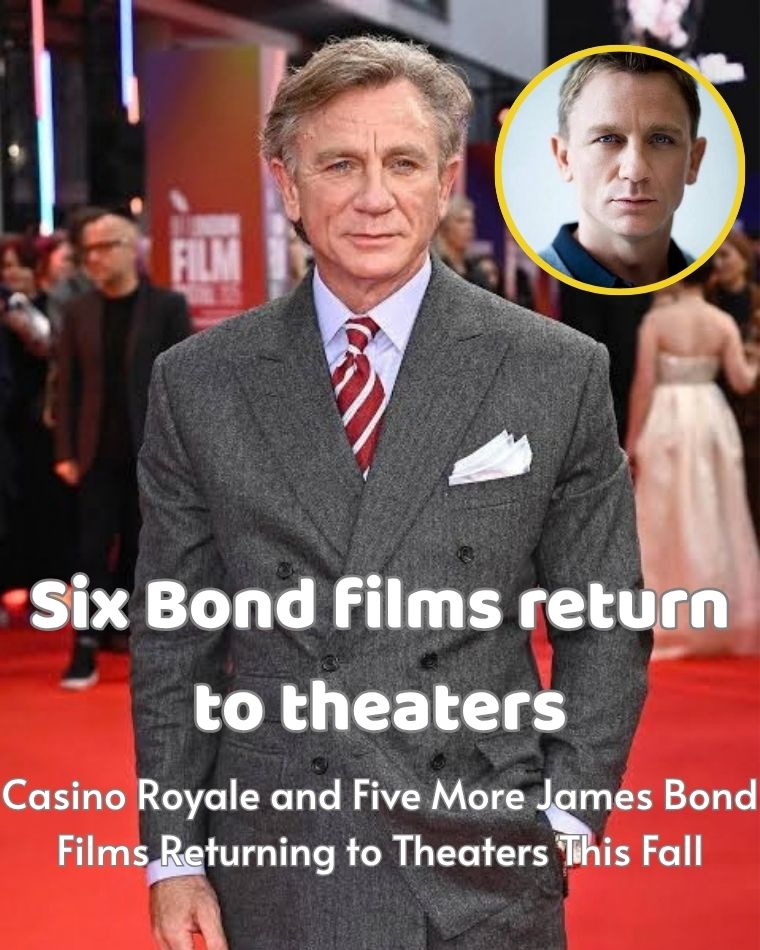
Cre: Los Angeles Times / Greg Williams / Getty Images
Why Casino Royale Remains a Historic Turning Point
When Casino Royale debuted in theaters in late 2006, the James Bond franchise stood at a pivotal artistic crossroad.
The preceding installments had increasingly leaned into flamboyant special effects, exaggerated technological gadgets, and theatrical villainy.
Director Martin Campbell and Eon Productions made the audacious decision to wipe the slate clean through an uncompromising narrative origin story.
The film stripped away decades of accumulated camp and self-parody to construct a lean, stripped-down portrayal of James Bond earning his 00 status.
The narrative stripped 007 of his traditional invulnerability, showing a protagonist who bleeds, makes tactical errors, and endures real psychological strain.
Instead of facing an apocalyptic supervillain with a space laser, Bond faced a mathematically precise financial criminal operating in real-world shadow markets.
The result was an electrifying shock to the film industry that proved a decades-old franchise could reinvent itself without losing its fundamental essence.
Critical reception was overwhelmingly positive, praising the film’s grounded dramatic weight alongside its pulse-pounding practical stunt choreography.
Casino Royale proved that James Bond did not need overblown CGI to remain relevant in a cinematic landscape increasingly dominated by realistic espionage thrillers.
The film established an entirely new aesthetic template that would guide the franchise throughout the subsequent fifteen years of Craig’s cinematic tenure.
By exploring Bond’s earliest field mission, the movie gave audiences unprecedented insight into the emotional hardening of a lethal government operative.
The tragic romantic narrative at the center of the story provided dramatic stakes that had rarely been witnessed in previous espionage adventures.
Twenty years later, the production still stands as one of the most successful character reinventions in Hollywood history.
Iconic Action Sequences Engineered for the Big Screen
Experiencing Casino Royale inside a modern movie theater offers a sensory intensity that home video setups simply cannot replicate.
The film immediately establishes its visceral tone with a stark black-and-white prologue detailing Bond’s brutal initial assassinations.
That gritty opening gives way to the legendary foot chase through a construction site in Madagascar, widely regarded as one of the greatest practical action set pieces ever filmed.
Bond relentlessly pursues bomb-maker Mollaka across crane girders, unfinished concrete buildings, and active embassy grounds.
The sequence introduced mainstream cinema audiences to the acrobatic discipline of parkour through breathtaking stunt coordination.
The sharp contrast between the quarry’s fluid acrobatics and Bond’s relentless, wall-smashing brute force remains masterclass physical storytelling.
On an expansive theater screen, the dizzying camera angles high above the ground generate authentic physical suspense for the audience.
The booming sound design amplifies every crushing blow, heavy breath, and crumbling concrete structure during the exhausting chase.
Later sequences, such as the desperate fight in the stairwell of the Casino Royale, emphasize close-quarters brutality and frantic desperation.
Even the high-stakes poker matches inside the casino carry an electric tension that fills the auditorium with palpable quiet.
The movie substitutes computerized wizardry with meticulous practical stunt work, culminating in the destruction of a sinking Venetian palazzo.
Viewing that climatic aquatic collapse on a massive theatrical screen allows viewers to appreciate the sheer scale of the practical set construction.
The immersive theatrical setting heightens David Arnold’s driving orchestral score, accentuating the dramatic heartbeat of every confrontation.
Daniel Craig’s Grounded Intensity and Performance
Daniel Craig’s selection as the sixth cinematic James Bond was originally met with intense skepticism by segments of the press and public.
Craig was officially unveiled as the new 007 aboard an HMS President naval vessel on October 14, 2005, in London.
Skeptics questioned whether a blonde, fiercely physical actor could embody the refined British gentleman spy created by Ian Fleming.
All doubts evaporated the moment Casino Royale premiered and audiences witnessed the ferocious commitment Craig brought to every frame.
Craig portrayed Bond with an arresting balance of razor-sharp menace, athletic ferocity, and unexpected psychological vulnerability.
His version of 007 was a blunt instrument being polished into a lethal weapon, capable of profound arrogance yet burdened by personal trauma.
His physical preparation transformed the visual language of the character, giving Bond the authentic physique of a former military operative.
Beneath the physical intensity, Craig delivered nuanced dramatic acting during quiet, dialogue-driven conversations.
His on-screen chemistry with Vesper Lynd grounded the narrative in emotional reality rather than formulaic romantic diversion.
Craig allowed viewers to witness Bond’s guarded armor slowly fall, making the subsequent betrayal genuinely devastating.
That complex emotional architecture made Craig’s debut not just a thrilling action movie, but an exceptional dramatic film.
His interpretation reshaped audience expectations, establishing that action heroes could display profound emotional depth without sacrificing masculine authority.
The foundational choices Craig made in 2006 sustained his acclaimed character journey across five consecutive feature films spanning fifteen years.
The Enduring Cultural Impact of James Bond
Few cinematic franchises in world history possess the longevity and intergenerational appeal of the James Bond series.
The upcoming theatrical revival demonstrates that these classic films possess timeless qualities that extend far beyond their original theatrical windows.
Each title in the six-film retrospective represents a distinct cultural moment and cinematic philosophy across seven different decades.
Sean Connery’s Goldfinger established the world-famous blueprint of glamorous locations, lethal henchmen, and customized sports cars that defined 1960s pop culture.
George Lazenby’s On Her Majesty’s Secret Service demonstrated the dramatic potential of exploring Bond’s capacity for genuine love and profound tragedy.
Roger Moore’s The Spy Who Loved Me epitomized the sweeping entertainment, charismatic humor, and massive scale of 1970s blockbusters.
Timothy Dalton’s Licence to Kill pushed boundaries by exploring gritty personal vengeance within a contemporary, hard-edged late-1980s landscape.
Pierce Brosnan’s GoldenEye proved that 007 could adapt to the post-Cold War world while inspiring revolutionary entertainment across multiple entertainment mediums.
Finally, Craig’s Casino Royale revitalized the entire concept of the modern action thriller for the twenty-first century.
The continued demand to experience these motion pictures in packed auditoriums proves that Bond remains a vital touchstone in modern popular culture.
James Bond continues to captivate global audiences because each era reimagines the character to reflect the anxieties and aspirations of the world around him.
Cinemas provide a communal temple where different generations of moviegoers can gather to share the thrills of legendary cinema.
Younger fans who only discovered the franchise on domestic streaming platforms can now encounter these masterpieces under pristine projection and booming theatrical sound.
Older moviegoers have the nostalgic privilege of revisiting the defining films of their youth surrounded by enthusiastic fellow fans.
This theatrical celebration reinforces that the legendary secret agent belongs permanently to the grand theatrical tradition.
Theatrical Availability and What Moviegoers Can Expect
The 2026 James Bond theatrical retrospective will run exclusively at participating Regal Theaters locations across the United States.
Screenings are scheduled across six consecutive Monday evenings beginning on October 5 and concluding on November 9.
The series opens on October 5 with the 20th anniversary presentation of Casino Royale, honoring the international festivities of Bond Day.
Subsequent Mondays will showcase the remaining five titles in reverse chronological order, guiding audiences through decades of cinematic history.
Each film will be presented using modern digital projection and theater-grade surround sound systems to ensure maximum audiovisual impact.
Tickets for all six retrospective screenings are being made available through Regal box offices, mobile applications, and official theater ticketing websites.
Given the limited nature of the engagement, moviegoers are advised to secure reservations early for prime seating locations.
For passionate cinephiles, the retrospective represents an unprecedented opportunity to trace the structural evolution of action filmmaking over sixty uninterrupted years.
Whether marveling at Sean Connery’s cool poise in 1964 or Daniel Craig’s kinetic brawling in 2006, the retrospective honors cinematic craftsmanship at the highest level.
Cinema owners recognize that curated repertory programming offers audiences unique reasons to return to neighborhood theaters.
The James Bond retrospective delivers pure, unadulterated escapism wrapped in sophisticated production values and world-class storytelling.
As the house lights dim this autumn, audiences will once again hear the unmistakable brass notes of Monty Norman’s iconic theme song ring out across darkened rooms.
James Bond has returned to the big screen, reminding audiences everywhere why cinema’s most famous secret agent has never truly left the cultural consciousness.
Để lại một phản hồi