In January 1997, Diana travelled to Angola with the British Red Cross to witness the ongoing human toll of unexploded ordnance in one of the most heavily mined nations on earth.
Accompanied by demining technicians from the HALO Trust, she walked down a narrow, freshly cleared path across a live minefield in Huambo while wearing a protective ballistic visor and body armor.
The resulting photographs were distributed worldwide, transforming a complex disarmament treaty into an urgent global humanitarian priority.
The Walk Down the Cleared Lane
The physical reality of the walk was defined by meticulous technical preparation and severe visual contrast.
Huambo was a city recovering from prolonged conflict, surrounded by open grounds that remained lethally active beneath the soil.
Diana agreed to step into a marked lane that had been swept by clearance workers from the HALO Trust immediately before the international press corps arrived.
She wore a heavy body armor jacket bearing the HALO Trust insignia alongside an oversized ballistic plastic visor over her face.
Every step was strictly bounded by white tape and painted posts designating the exact parameters where ordnance had been safely removed.
Demining supervisors walked within arm’s reach to ensure nobody deviated from the swept strip.
A pack of photojournalists and television crews was positioned at the terminal end of the cleared path.
They watched as she stepped forward quietly against the backdrop of overgrown grasses and warning signs.
The image stripped away conventional royal protocol in favor of stark, functional protective equipment.
By agreeing to be photographed in working tactical gear, she consciously offered her global visibility to an operation that had historically struggled for sustained public attention.
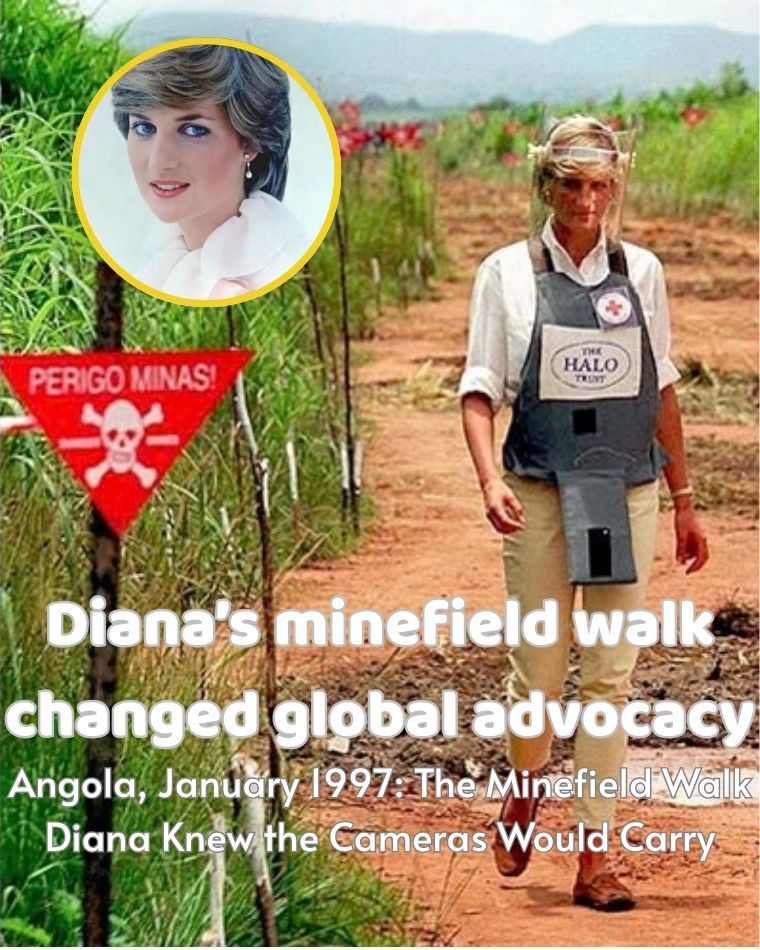
Cre: Wikimedia Commons — Public domain / Open humanitarian media archive
Why Angola and the British Red Cross
The choice of Angola was driven by the sheer scale of the crisis facing its civilian population in the late 1990s.
Decades of civil conflict had left vast swathes of agricultural land, roadsides, and urban fringes saturated with hidden explosive devices.
The British Red Cross had spent years documenting the sustained civilian casualties resulting from buried anti-personnel landmines.
Humanitarian workers continuously reported that women gathering firewood and children walking to school were the most frequent victims.
Health infrastructure across the country was strained by the permanent need for surgical amputations and long-term physical rehabilitation.
Demining organizations faced immense funding deficits because clearing buried weapons by hand was tedious, costly, and inherently perilous.
Diana accepted the invitation from the Red Cross to observe the operational realities on the ground firsthand.
Her objective was neither political debate nor legislative negotiation, but direct humanitarian witness.
She sought to observe the exact mechanisms by which ordinary communities were prevented from reclaiming their homes and farmlands.
By traveling directly to Huambo, she brought the world’s most aggressive press apparatus straight into an active clearance zone.
Reporters who usually documented palace affairs found themselves filing dispatches on explosive remnants of war and local logistics.
The presence of the Red Cross provided institutional grounding, ensuring every site visit highlighted specific civilian protection mandates.
Local authorities and demining teams welcomed the attention, recognizing that international funding followed public awareness.
The physical terrain of Angola made it clear that landmines did not distinguish between combatants and non-combatants.
Decades after initial deployments, devices manufactured thousands of miles away remained buried in Angolan soil, waiting for accidental contact.
For humanitarian organizers, having a figure of immense global renown present in that landscape broke years of donor fatigue.
What the Visor and Armor Signified
The photographs of Diana in a ballistic visor and flak jacket disrupted traditional representations of public figures visiting aid projects.
Historically, high-profile figures visited hospitals or relief distributions in tailored clothing, keeping a visible barrier between themselves and the hazard.
In Huambo, the safety gear was not a photo opportunity accessory but an absolute condition of entering the site.
The HALO Trust enforced rigid safety protocols that applied equally to clearance specialists, technicians, and foreign visitors.
The heavy blue flak jacket highlighted the genuine bodily peril faced daily by local mine clearers.
The clear polycarbonate visor shielded the face against potential blast fragments, forcing cameras to capture facial expressions through heavy plastic.
The resulting images possessed an unvarnished, utilitarian directness.
There was no soft staging or decorative framing possible within a marked minefield.
Viewers saw a fragile corridor of safe ground carving through land that remained fundamentally deadly.
The stark visual dichotomy between a high-profile figure and military protective gear captured front pages across five continents within twenty-four hours.
Media outlets that routinely ignored disarmament conferences placed the Huambo images on morning television broadcasts.
Visual communication experts subsequently categorized the walk as one of the most deliberate, concentrated exercises in public advocacy ever recorded.
She did not deliver long policy speeches from behind a podium in the capital city.
Instead, she let the physical presence of the hazard communicate the argument entirely through photographs.
The visor reflected the bright African sky, while the lane behind her remained empty except for red warning skull markers.
The simplicity of the picture made the issue immediately intelligible to audiences with no prior knowledge of international treaties.
Meeting Survivors and Witnessing Field Clearance
Beyond the photographed minefield walk, the itinerary in Huambo focused on the permanent consequences borne by civilians.
Diana spent considerable time visiting orthopedic clinics supported by the Red Cross, sitting beside patients who had lost limbs to explosions.
She observed local technicians fabricating prosthetic limbs from leather, wood, and lightweight polymers.
Many of the survivors undergoing physical therapy were young people injured years after active military clashes had moved away from their villages.
She listened through translators as individuals described stepping on small buried blast mines along ordinary community footpaths.
Medical staff demonstrated the complex, multi-stage surgeries required to repair limbs shattered by upward blast detonations.
In many instances, patients faced a lifetime of repeated operations as their bodies grew or bone structures deteriorated.
Diana spent quiet hours beside clinic beds, holding hands and speaking softly with injured individuals and their families.
Her demeanor in the hospital wards mirrored the physical openness she had demonstrated in earlier medical engagements worldwide.
She did not hesitate to touch scarred skin, examine prosthetic joints, or crouch down to speak at eye level with injured children.
Outside the hospitals, she observed the meticulous operational methods used by HALO Trust personnel to detect hidden weapons.
Deminers worked on their hands and knees, using metal probes to test the soil at shallow angles every few centimeters.
She saw the physical exhaustion and extreme mental discipline required to clear just a few square meters of earth each working day.
Every detected mine had to be excavated by hand or destroyed in situ with controlled explosive charges.
The contrast between the split second required to lay a mine and the months required to remove it left an indelible impression.
She observed demonstrations of controlled demolitions, feeling the ground shake as abandoned ordnance was safely detonated in open pits.
These practical demonstrations emphasized that clearance was not an abstract theory, but an agonizingly slow, manual chore.
The survivors she visited represented only a small fraction of those who survived the initial blast; countless others in remote regions never reached clinical care.
Every interaction highlighted that the physical injury was accompanied by prolonged economic hardship for rural families.
Agricultural workers who lost a leg were frequently unable to return to farming, plunging entire households into acute poverty.
The human meetings provided the emotional substance that gave weight to the dramatic photographs captured earlier in the field.
How Press Images Functioned as Global Advocacy
The Huambo journey demonstrated an acute understanding of how late-twentieth-century mass media operated.
At that time, international negotiations surrounding the Ottawa Convention—a proposed total ban on anti-personnel landmines—were progressing slowly through diplomatic channels.
Military establishments and weapons manufacturers regularly defended the tactical utility of mines during territorial conflicts.
Diplomatic delegations argued endlessly over legal definitions, exceptions, and transition timetables in closed conference rooms.
The images from Angola bypassed technical legislative debates by elevating the civilian cost into an unassailable moral issue.
When the global press corps printed photos of the minefield walk, editors were obligated to explain the mechanics of the weapons alongside the pictures.
Audiences who opened newspapers to see Diana’s clothes found detailed diagrams explaining how pressure plates triggered concealed explosives.
Feature stories outlined the millions of unexploded devices remaining active across Asia, Africa, and Southeast Asia.
The photographs functioned as visual shorthand, collapsing complex humanitarian logistics into a clear message about human vulnerability.
Public advocacy groups recognized the shift immediately, using the media surge to accelerate pressure on reluctant governments.
Editorial boards worldwide published opinion pieces questioning why weapons that targeted non-combatants remained legal under international conventions.
Charitable donations to demining organizations and prosthetic clinics surged in the weeks following the global media coverage.
Demining workers who had spent years operating in remote anonymity suddenly found their field techniques analyzed on prime-time news broadcasts.
The coverage established an enduring standard for how personal visibility could be leveraged to dismantle bureaucratic resistance.
Diana understood that visual symbols often achieved what policy briefs and statistical tables failed to accomplish.
She gave reporters the exact photograph they required, knowing the image carried the humanitarian message into millions of households.
The tactical visor became an unexpected symbol of personal conviction, reflecting an individual willing to stand in an active hazard zone.
By refusing to soften the visual framing, she compelled observers to look directly at the reality of modern weapon contamination.
The Bosnia Journey Later That Year
The commitment to the landmine issue was not a singular media appearance confined to the Angolan journey.
In August 1997, Diana travelled to Bosnia and Herzegovina to follow up on the humanitarian concerns highlighted in Huambo.
The Balkan conflict had concluded recently, leaving residential neighborhoods, farmlands, and mountain roads heavily seeded with booby traps and hidden ordnance.
Unlike the heavily photographed Angolan tour, the Bosnian visit was organized with deliberate privacy alongside the Landmine Survivors Network.
She visited damaged communities surrounding Sarajevo and rural districts where families lived alongside uncleared hazard zones.
Accompanied by humanitarian organizers Ken Rutherford and Jerry White, she entered private homes to speak quietly with survivors.
She observed how landmine contamination fragmented post-war reconstruction, preventing refugees from returning safely to rebuild their properties.
In Bosnia, the hazard was integrated into urban rubble, schoolyards, and overgrown suburban garden plots.
She met survivors struggling with economic isolation and social marginalization in the wake of catastrophic trauma.
The visits proceeded without major press conferences or organized media pools, focusing instead on listening to personal survivor narratives.
Humanitarian workers who accompanied her noted that she sought to understand the ongoing social stigma experienced by amputees.
She repeatedly emphasized that surviving the blast was merely the beginning of an exhausting, lifelong struggle for dignity and employment.
The Bosnian itinerary reinforced her belief that unexploded ordnance represented a prolonged human rights crisis that outlived formal peace agreements.
Demining officials in Bosnia briefed her on the specific challenges of detecting plastic-cased mines buried in dense mountain soil.
The trip underscored that mine contamination was a global crisis, not a challenge unique to a single continent or terrain.
Her engagement with Bosnian communities generated renewed momentum among European civic organizations campaigning for disarmament.
The quiet, direct work in Sarajevo confirmed to international observers that her involvement was rooted in enduring dedication.
Her interactions with survivors in their living rooms mirrored the empathy she had displayed months earlier in the clinics of Angola.
These sequential journeys formed a coherent, sustained humanitarian campaign that defined the final months of her life.
How Humanitarian Organisations Reference the Legacy
Decades after the walk in Huambo, humanitarian organizations and demining agencies continue to reference the January 1997 mission.
The Ottawa Treaty, formally known as the Mine Ban Treaty, was adopted in Oslo in September 1997 and opened for signature in Ottawa later that year.
International observers widely acknowledged that the global groundswell generated by the Angola coverage helped overcome entrenched diplomatic inertia.
The International Campaign to Ban Landmines (ICBL), along with its coordinator Jody Williams, was awarded the Nobel Peace Prize in late 1997.
In official retrospectives, demining leaders routinely identify the Huambo photographs as the decisive tipping point in modern public disarmament advocacy.
The HALO Trust has repeatedly highlighted how the images transformed public understanding of the technical discipline required to clear minefields.
Decades later, the specific minefield Diana walked in Huambo has been completely cleared of all ordnance.
What was once a dangerous strip of cordoned earth has been transformed into a bustling community with residential homes, schools, and paved streets.
The physical transformation of Huambo serves as concrete proof that dedicated demining operations achieve measurable, permanent progress.
Modern clearance teams still utilize the safety gear, metal probes, and procedural discipline seen in the archival 1997 photographs.
Whenever global campaigns emerge to address cluster munitions, unexploded artillery shells, or modern improvised explosive devices, the Angolan walk is recalled as the benchmark for successful advocacy.
The photographs demonstrated that complex global crises can be illuminated by placing a singular human witness into the heart of the challenge.
Humanitarian agencies continue to teach the Angola journey as a case study in ethical, high-impact public engagement.
The focus remained strictly on the plight of civilians, the resilience of survivors, and the dedication of technical clearance workers.
By walking the cleared lane with purpose and composure, Diana ensured that the invisible peril beneath the soil would never again be ignored by the international community.
Để lại một phản hồi