Over two decades after its landmark debut, Eminem’s signature track continues to define the intersection of hip-hop and Hollywood excellence. The Oscar-winning anthem captured raw creative desperation while setting an untouchable benchmark for cinematic storytelling.
The release of the 8 Mile soundtrack in October 2002 altered the trajectory of modern popular music forever.
At the epicenter of that cultural shift stood a cinematic anthem titled “Lose Yourself.”
The record captured the sheer desperation and hunger of Jimmy “B-Rabbit” Smith Jr., the fictionalized counterpart of Marshall Mathers.
It also bridged an enormous divide between mainstream cinematic appreciation and underground battle rap culture.
Before this watershed moment, hip-hop tracks had frequently accompanied motion picture releases with varying degrees of commercial success.
Yet rarely had an original hip-hop composition carried the singular narrative spine of an entire feature film.
The cultural landscape in 2002 was prime for a collision between authentic street poetry and prestigious studio filmmaking.
Eminem was already operating at an unprecedented peak of commercial and critical dominance worldwide.
His previous solo albums had shattered industry sales benchmarks and generated endless public debates.
Nevertheless, stepping onto the silver screen presented a completely unproven artistic challenge for the Detroit rapper.
Under the direction of filmmaker Curtis Hanson, the gritty semi-autobiographical project needed an undeniable sonic anchor.
That anchor arrived in the form of an urgent, propulsive musical statement built around driving guitars and hypnotic piano chords.
When the dust settled, the track rewrote the rulebook of Hollywood recognition.
It made history by becoming the very first rap song to win the Academy Award for Best Original Song.
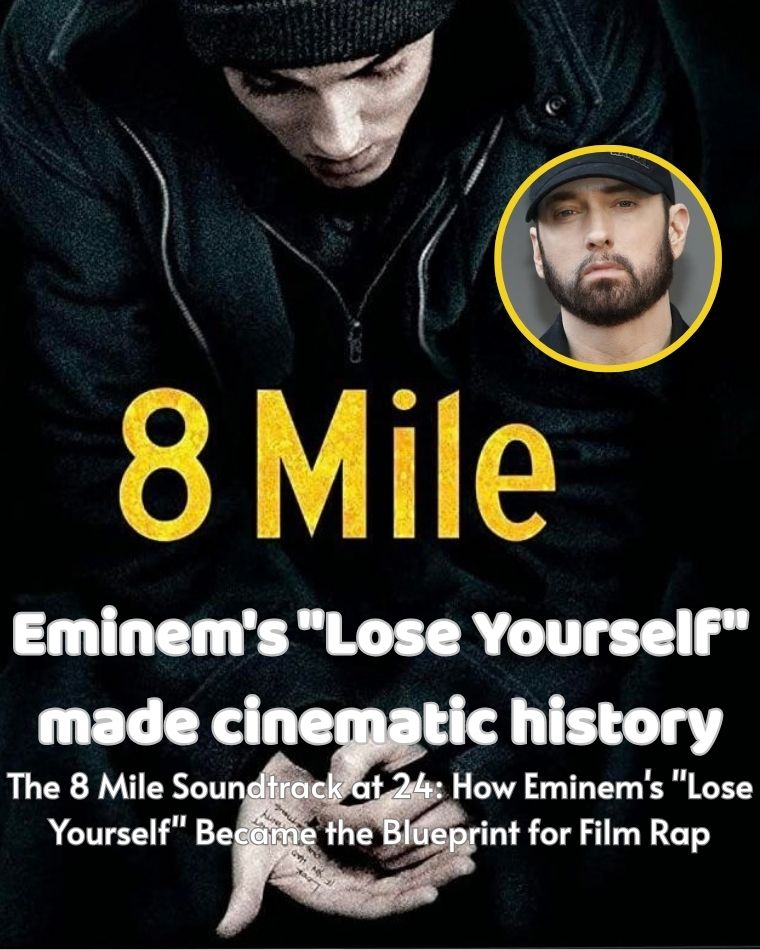
Cre: Rotten Tomatoes — Tư liệu quảng bá phim chính thức từ Universal Pictures
The architecture of “Lose Yourself” remains a masterclass in tension and narrative momentum.
Unlike conventional radio singles designed around easily digestible hook repetitions, the track unfolds like a short psychological drama.
The opening piano notes immediately establish an atmosphere of heavy suspense and profound inner dread.
Eminem’s opening spoken-word monologue forces listeners to confront a high-stakes crossroads where hesitation means failure.
From the first beat drop, the song establishes a relentless rhythmic tempo that mimics a racing pulse.
The lyrical narrative plunges directly into Rabbit’s immediate physiological turmoil before an underground rap battle.
Every physical symptom is documented with vivid, photographic clarity.
The sweaty palms and trembling knees mirror the universal dread felt by anyone facing a life-altering crossroad.
Rather than relying on vague inspirational cliches, the writing grounds itself in tangible working-class details.
The transition between external observation and internal psychological breakdown is seamless.
As the first verse progresses, the camera pans from the stage back to the cold realities of daily existence.
The song structure features three distinct verses that steadily escalate in vocal delivery, lyrical complexity, and volume.
Each verse raises the emotional stakes beyond the claustrophobic confines of a dingy underground venue.
By the second verse, the focus shifts to the economic pressures of raising a child in systemic poverty.
The lyrics navigate the grueling routine of an industrial factory floor juxtaposed against the impossible dream of musical escape.
This narrative layering gives the record its rare cinematic gravitas.
The absence of needless melodic detours ensures that the forward motion never dissipates for a single second.
Every syllable serves the overarching narrative arc without indulging in unnecessary lyrical filler.
Even the chorus operates not as a pop reprieve, but as a severe existential command to seize the fleeting moment.
It demands total psychological immersion and relentless commitment from the narrator and the listener alike.
This unyielding structural design shattered the standard formula of contemporary commercial rap singles.
It proved beyond all doubt that an uncompromising rap record could hold the complete emotional weight of a feature film.
The physical creation of the song took place under extraordinarily demanding conditions.
Filming on location in Detroit required exhausting twelve-to-sixteen-hour days on freezing soundstages and industrial sites.
Eminem was simultaneously starring in almost every scene of the grueling production.
To capture the lightning-in-a-bottle energy of the script, audio engineers set up a portable recording trailer directly on the film set.
Between complex camera setups and dramatic takes, Mathers would retreat straight into the mobile recording booth.
He carried a crumpled notepad everywhere, frantically scribbling verses while sitting inside production trailers.
The creative pressure was immense, yet the environment fueled the song’s unmistakable urgency.
Legend surrounds the final vocal delivery of the record.
Longtime studio collaborators have verified that the primary vocal takes were captured in an explosive, single-session burst of focus.
Mathers channeled the immediate exhaustion, frustration, and survival instincts of his cinematic character.
There was no psychological disconnect between the character on camera and the artist behind the microphone.
Jimmy Smith Jr.’s struggle against poverty and self-doubt was Mathers’ own lived reality only years prior.
Producer Jeff Bass played an indispensable role in developing the driving instrumentation that supported Eminem’s lyrical assault.
Together, they refined the driving guitar riff that drives the tempo forward like a freight train.
The layered keyboard arrangements added an ominous layer of suspense underneath the heavy percussion.
By capturing the track directly on set, the music absorbed the raw grit and authentic chill of a Detroit winter.
The resulting recording felt immediate, unpolished, and completely devoid of corporate calculation.
It was an unfiltered sonic transmission from the trenches of artistic ambition.
The completed master was rushed into post-production, instantly becoming the emotional centerpiece of the movie’s soundtrack.
When the 8 Mile soundtrack hit retail shelves in late October 2002, it proved to be a historic commercial juggernaut.
The compilation was far from a solo endeavor, featuring major contributions from hip-hop luminaries across the landscape.
Heavyweights such as 50 Cent, Jay-Z, Nas, and Macy Gray delivered standout performances for the project.
Yet among an elite roster of legendary voices, “Lose Yourself” stood tall as an undeniable titan.
The record ascended rapidly to the summit of the Billboard Hot 100 chart.
Once it captured the number one position, it refused to surrender the throne for twelve consecutive weeks.
It established an iron grip on radio airplay, dominating both urban stations and pop programming simultaneously.
The track’s appeal crossed generational, geographic, and cultural boundaries with remarkable velocity.
It transcended its role as film promotional material to become a universal anthem for the dispossessed.
High school athletes blasted the record in locker rooms before championship games to channel focus and determination.
Entrepreneurs and dreamers adopted its ferocious chorus as a daily personal mantra against failure.
The infectious energy of the track captured something fundamental about the human desire to overcome adversity.
Even listeners who had never engaged with hardcore battle rap found themselves shouting every lyric word-for-word.
The track went on to achieve diamond-tier commercial sales numbers across the globe.
It solidified Eminem’s position as not merely a rap superstar, but as an undeniable force in worldwide popular culture.
Few soundtrack singles in entertainment history had ever generated such massive, sustained resonance across mainstream society.
It turned the bleak urban divide of 8 Mile Road into a universally recognized symbol of endurance and triumph.
The unprecedented cultural momentum eventually carried the song into the hallowed halls of the Academy of Motion Picture Arts and Sciences.
The 75th Academy Awards ceremony took place in March 2003 under an atmosphere of intense industry anticipation.
A nomination for Best Original Song was already an unprecedented milestone for an authentic rap record.
Historically, the category had been heavily dominated by sweeping Disney ballads and veteran pop crooners.
Traditional Academy voters had never rewarded hardcore lyrical hip-hop with Hollywood’s highest cinematic honor.
Eminem himself was convinced that the Academy would never hand its prestigious award to a controversial rapper.
Assuming that his chances of winning were virtually non-existent, Mathers decided against attending the glamorous gala in Los Angeles.
Instead of sitting in the Dorothy Chandler Pavilion or Kodak Theatre in a formal tuxedo, the rapper stayed home in Michigan.
Reports from those close to him later revealed that he spent that historic evening fast asleep with his daughter.
Meanwhile, actress and singer Barbra Streisand walked up to the podium to announce the winner of the coveted trophy.
When she ripped open the envelope and declared “Lose Yourself” as the winner, history was officially made.
Co-writer and producer Luis Resto took the stage alone to accept the golden statuette on behalf of the collaborative team.
The quiet victory sent shockwaves through both the conservative Hollywood establishment and the global hip-hop community.
The win dismantled long-standing institutional barriers that had marginalized rap music for decades.
It validated street-level narrative songwriting as legitimate high art capable of standing alongside elite cinematic traditions.
The unexpected triumph proved that raw artistic truth could conquer the most conservative awards institutions in entertainment.
Years later, the absence would remain one of the most famous and charming pieces of Oscar lore.
Decades have elapsed since that historic release, yet the cultural footprints of “Lose Yourself” remain indelible.
In modern streaming ecosystems, the song regularly ranks as Eminem’s most frequently streamed and downloaded recording.
It has continuously found new life among younger generations who were not yet born during its original radio reign.
The composition established a revolutionary template for how hip-hop could be integrated into serious narrative filmmaking.
In subsequent years, cinematic projects across the industry routinely recruited major rap artists to compose original narrative works.
The barrier-shattering Oscar win paved the way for subsequent hip-hop triumphs on Hollywood’s grandest platform.
It opened the doors for artists like Three 6 Mafia, Common, and Kendrick Lamar to earn Academy recognition in subsequent years.
Beyond the metrics of industry accolades, the song stands as the definitive artistic summit of Eminem’s storied catalog.
It captured an artist performing at the absolute height of his storytelling and rhythmic powers.
The song proved that an artist does not need to dilute their grit or compromise their lyrical identity to achieve universal greatness.
It transformed the personal anxieties of a struggling young factory worker in Michigan into an eternal monument of perseverance.
The legacy of the 8 Mile soundtrack endures because it refused to treat movie music as disposable merchandising material.
It remains a vital chapter in the canon of American popular culture, capturing lightning in a bottle that will never fade.
Để lại một phản hồi