Recorded and released in 1964, “Walk On By” stands as a monumental achievement in modern popular music that permanently altered the landscape of sophisticated songwriting.
The legendary partnership among singer Dionne Warwick, composer Burt Bacharach, and lyricist Hal David produced a recording that married ambitious orchestration with intense emotional vulnerability.
Decades later, the song remains an enduring blueprint for how commercial pop can achieve intellectual depth without sacrificing accessibility.
The Historic 1964 Collaboration
In 1964, the collaborative team of Dionne Warwick, Burt Bacharach, and Hal David reached a defining peak in their shared musical journey.
Bacharach provided the innovative harmonic architecture and complex musical structure.
David crafted lyrics marked by understated narrative clarity and piercing emotional resonance.
Warwick served as the vital human instrument capable of articulating their demanding musical ideas.
Prior to this session, the trio had already established a working chemistry that challenged conventional industry expectations.
Yet the recording of “Walk On By” expanded their artistic ambition to an entirely new level.
Pop music in the early 1960s often relied on predictable verse-chorus formulas and standard chord changes.
The creative team intentionally abandoned those conservative formulas to build something unprecedented.
Their goal was not merely to produce a catchy single for radio broadcast.
Instead, they sought to craft a sophisticated pop composition that could compete with the elegance of classical arrangements and jazz harmonics.
The session united technical discipline with deep expressive freedom in the recording space.
The resulting sound captured an undeniable sense of timeless craft that feels just as vital today.
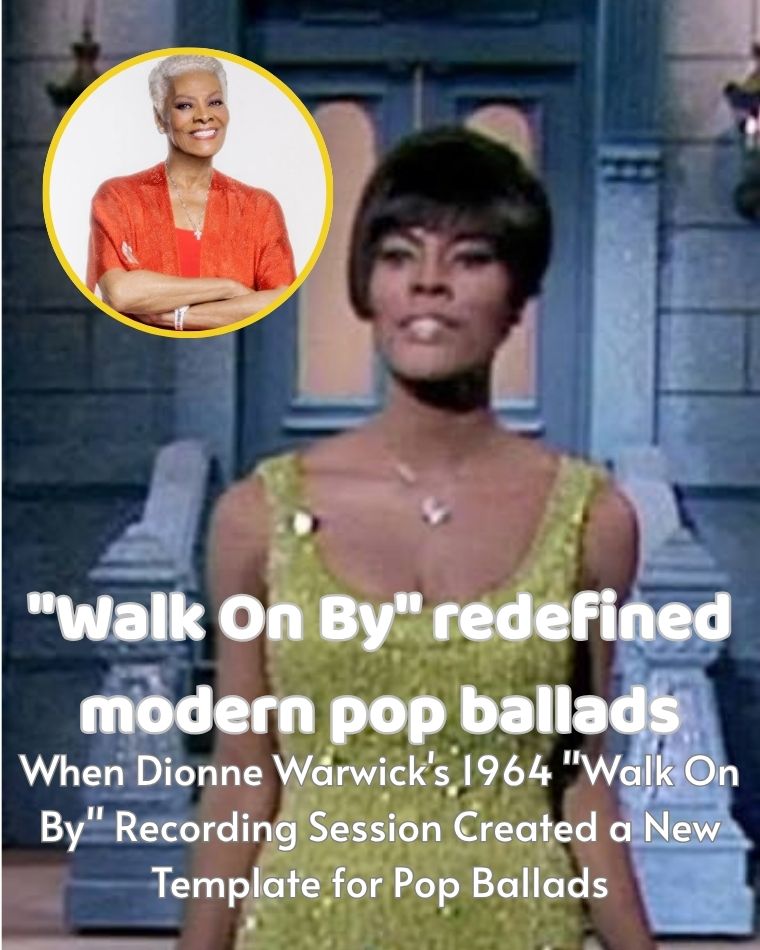
Cre: Wikimedia Commons — Public Domain / Nationaal Archief
Bacharach’s Unconventional Arrangement and Time Signatures
The architectural genius behind “Walk On By” rests heavily upon Burt Bacharach’s fearless approach to pop orchestration.
Bacharach chose to incorporate an unusual 5/4 time signature in specific sections of the composition.
In an era dominated by uniform 4/4 time, introducing asymmetric meters into a mainstream single was a daring compositional gambit.
The sudden shift into 5/4 creates an unsettling rhythmic hesitation that mirrors the emotional distress of the protagonist.
The listener feels the internal tremor of the encounter before fully processing the structural mechanics behind it.
Beyond the shifting time signature, Bacharach enriched the track with complex chord progressions rarely attempted on commercial pop radio.
The harmonic changes glide through sophisticated intervals that evoke deep melancholy and quiet suspense.
The orchestration makes calculated use of tension and release throughout the entire arrangement.
Dramatic string passages swell subtly behind the vocal line to heighten the unfolding drama.
Bacharach’s strings do not simply coat the melody in superficial sweetness.
Instead, the orchestration operates as a dynamic narrative counterweight to the singer’s voice.
Delicate instrumental flourishes underscore the singer’s vulnerability while building immense dynamic contrast.
The sophisticated orchestration ensures that every instrument serves an exact narrative function within the larger design.
Warwick’s Masterclass in Restraint and Phrasing
While the instrumental framework was meticulously planned, Dionne Warwick’s vocal delivery transformed the piece into a timeless masterpiece.
Warwick adopted an approach marked by remarkable emotional restraint and nuanced phrasing.
Many vocalists of the era favored belting and grand theatrical displays to communicate devastation.
Warwick understood that genuine grief often manifests in quiet stillness rather than explosive volume.
She deliberately avoided oversinging during every passage of the recording.
Her voice breathes gently inside the complex meter, leaving ample space between phrases.
This subtle pacing allows the raw vulnerability of the song to emerge naturally.
Every sustained note carries an undercurrent of sorrow managed with absolute self-control.
Warwick navigated the difficult interval leaps and asymmetric bar counts with effortless precision.
Her technical accuracy allowed her to focus entirely on the emotional subtext of each syllable.
By resisting the urge to dramatize the vocal delivery, she intensified the dramatic gravity of the scene.
Her phrasing communicates a fragile balance between personal devastation and unyielding resolve.
This masterclass in understated vocal performance established a new standard for pop ballad interpretation.
The Lyrical Narrative: Dignity Amid Public Heartbreak
Hal David’s lyrical contributions to “Walk On By” provided the essential emotional narrative of the track.
The storyline centers on an excruciatingly familiar human predicament: encountering an ex-lover in public.
The protagonist unexpectedly spots the person who broke her heart walking in her direction.
Rather than staging a dramatic confrontation, she makes a humble, desperate plea.
She asks the former lover to simply walk on by and pretend they never crossed paths.
The lyrics capture the acute anxiety of facing devastating grief in an open public setting.
The protagonist wishes to hide her tears and preserve whatever dignity remains.
David’s words express the deep terror of public humiliation during a moment of heartbreak.
The phrase “walk on by” serves as both a defensive wall and an admission of total ruin.
The lyrics avoid melodramatic self-pity in favor of plainspoken, heartbreaking authenticity.
This focus on dignity in the face of loss elevates the song above standard romantic laments.
The quiet suffering described in the verses resonates powerfully across cultures and generations.
The narrative reveals that walking away in silence is sometimes the bravest choice one can make.
David captured an entire psychological drama inside a few spare, elegant stanzas.
Chart Performance and Immediate Pop Impact
Upon its release in 1964, “Walk On By” quickly asserted itself as a substantial commercial success.
Audiences recognized the unique sonic atmosphere of the recording from its first spins on the airwaves.
The single climbed rapidly up the competitive music sales charts of the United States.
It secured high positions on both mainstream pop rankings and rhythm and blues listings.
The recording proved that complex, artful orchestration could achieve immense commercial popularity.
Radio program directors marveled at how smoothly the sophisticated track blended into daily broadcast rotations.
Listeners responded immediately to the raw vulnerability embedded in Warwick’s restrained delivery.
The song’s commercial performance established Dionne Warwick as a premier recording artist on the global stage.
It also cemented the reputation of Bacharach and David as the most adventurous songwriting duo of their era.
International audiences soon embraced the track with equal enthusiasm across global markets.
The success of the single challenged industry assumptions about what general record buyers would accept.
Music critics praised the production for refusing to condescend to teenage listeners with simplified melodies.
The song proved that sophisticated composition and mainstream chart viability were entirely compatible.
The 1964 release signaled a profound maturation of the pop single as an artistic medium.
The Long-Term Blueprint for Modern Pop Balladry
The profound influence of “Walk On By” extended far beyond its immediate chart performance.
The track established a foundational blueprint that countless musicians, arrangers, and producers would consult for decades.
It showed generations of rising vocalists the power of trusting subtlety over raw vocal power.
Prior to Warwick’s interpretation, vocalists frequently assumed that intensity had to be shouted to be understood.
“Walk On By” demonstrated that whispered hesitation can hit harder than an operatic belt.
Record producers also took note of Bacharach’s adventurous approach to orchestration and pacing.
The track encouraged contemporary arrangers to introduce orchestral complexity and non-standard time meters into commercial songs.
The song dismantled the artificial boundary between highbrow musical composition and accessible pop radio.
It validated pop music as a serious creative discipline capable of immense harmonic sophistication.
Decades after its 1964 debut, songwriters still cite the track as an undisputed benchmark of vocal phrasing.
The recording remains a mandatory study for anyone interested in the interplay of melody, meter, and lyrical subtext.
Its legacy endures because every element of the recording serves a unified emotional purpose.
The creative team set an enduring precedent for how pop music can balance craft and feeling.
Reinterpretation and Enduring Cover Versions
The enduring brilliance of “Walk On By” is demonstrated by the diverse range of artists who have recorded notable interpretations.
Each cover version approaches the material with deep respect for the architectural sophistication of the original piece.
In 1969, soul visionary Isaac Hayes radically transformed the ballad for his landmark album Hot Buttered Soul.
Hayes took the delicate, heartbroken track and expanded it into an epic, slow-burning funk-soul journey lasting over twelve minutes.
His version retained the underlying emotional ache while wrapping it in sweeping cinematic strings and fuzzed guitars.
Hayes recognized the inherent strength of Bacharach’s chord changes and leveraged them to build prolonged instrumental tension.
Later, the English punk-rock band The Stranglers recorded their own striking interpretation of the song in the late 1970s.
The Stranglers brought an unexpected, gritty edge to the delicate arrangement.
Their cover introduced aggressive basslines and abrasive keyboard runs without destroying the harmonic foundation of the original composition.
The fact that a punk outfit found inspiration in an orchestral pop ballad proves the boundless adaptability of the song.
In more recent decades, British soul artist Seal also recorded a notable rendition of the classic track.
Seal leaned into the song’s timeless romantic vulnerability with a warm, soulful vocal timbre.
His interpretation highlighted the enduring clarity of Hal David’s lyrics for a contemporary audience.
These disparate cover versions, spanning soul, rock, and modern pop, confirm that the composition possesses exceptional structural durability.
Each performer discovered personal expressive freedom within the intricate framework built in 1964.
The Timeless Legacy of an Unrivaled Partnership
The collaboration among Dionne Warwick, Burt Bacharach, and Hal David on “Walk On By” represents a golden standard in recorded music.
Their collective achievement illustrates how distinct creative voices can elevate one another toward extraordinary heights.
Bacharach’s willingness to introduce unconventional 5/4 meter sections laid a complex, modern foundation.
David’s focus on dignity amid sudden heartbreak grounded the complex chords in direct human emotion.
Warwick’s vocal poise delivered the narrative with impeccable taste, nuance, and restraint.
The recording remains completely immune to changing production trends and passing industry fads.
Decades after that 1964 studio session, the track retains its ability to astonish and move audiences worldwide.
It proved decisively that popular music could achieve deep intellectual and technical complexity while remaining universally resonant.
The masterpiece continues to walk on through music history as a shining monument to artistic collaboration.
Để lại một phản hồi