The official home video and digital release of Project Hail Mary offers fans a deeper glimpse into director duo Phil Lord and Christopher Miller’s adaptation of Andy Weir’s acclaimed science fiction novel.
Among the bonus materials featured on the disc, five distinct deleted scenes highlight how the filmmakers navigated the massive scope of the book while attempting to protect narrative momentum.
Most notably, these excised sequences delve into an essential theoretical and emotional bond between Dr. Ryland Grace and his extraterrestrial partner Rocky, providing book lovers with critical context that was trimmed from the theatrical cut.
Cre: Wikimedia Commons — CC BY-SA 2.0
The theatrical cut of Project Hail Mary prioritized cinematic urgency, moving swiftly through interstellar crisis management to save humanity from stellar extinction.
Translating a dense novel heavily reliant on internal monologue, laboratory calculations, and evolutionary biology naturally required ruthless editorial decisions.
According to analysis from Winter is Coming and Reactor Magazine, the bonus footage clarifies several character motivations and philosophical ideas that define Andy Weir’s writing.
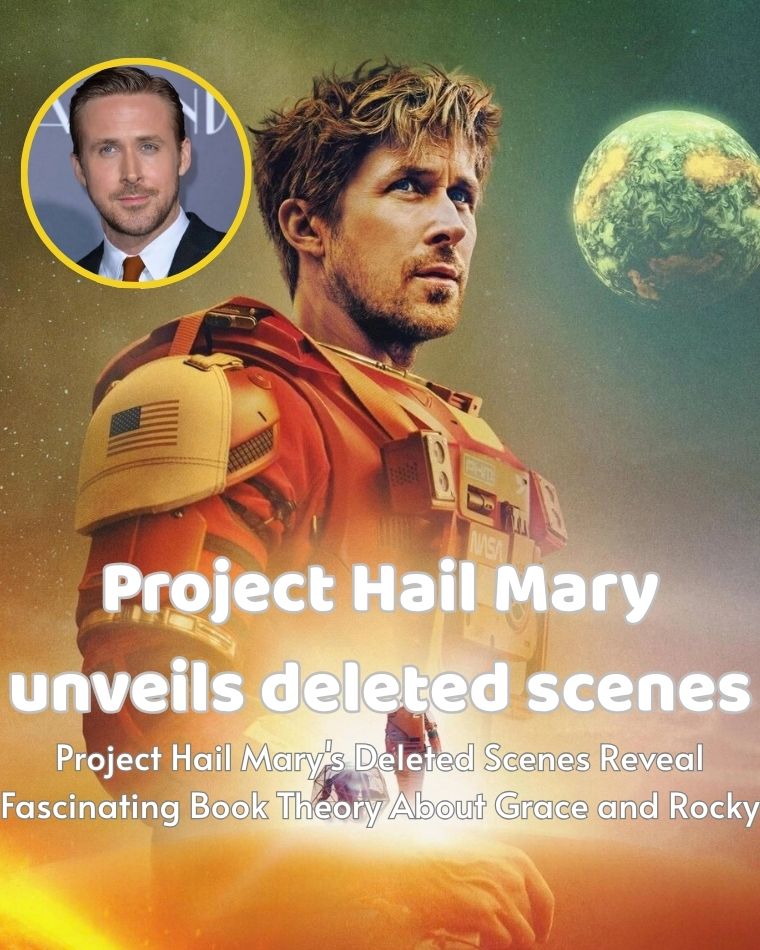
The most prominent cut material focuses directly on the relationship between Dr. Ryland Grace, portrayed by Ryan Gosling, and the Eridian engineer Rocky.
In Weir’s bestselling novel, the bond between Grace and Rocky transcends standard buddy-comedy tropes, grounding itself in evolutionary biology and comparative psychology.
Eridians evolved under circumstances entirely alien to humanity, developing an organic social structure dictated by their biology.
Because Eridians fall into an absolute, coma-like sleep state where sensory perception shuts down completely, unmonitored rest in dangerous environments proved fatal during their evolutionary history.
To survive, their species developed a mandatory instinctual vigil system where individuals watch over one another during periods of unconscious vulnerability.
Rocky carried the tragic trauma of having lost his entire crew during their solitary mission to Tau Ceti, having kept vigil over his dying companions while powerless to rescue them.
When Rocky relocated his habitat directly above Grace’s sleeping bunk aboard the Hail Mary, his insistence on maintaining watch represented deep psychological loyalty rather than mere curiosity.
In the deleted sequence titled “You Sleep, I Watch,” the physical and cultural friction of this instinctual habit takes center stage.
Grace finds himself profoundly uncomfortable attempting to fall asleep while an alien creature perches directly above his bed, tapping out rhythmic seconds in absolute focus.
When Grace politely requests that Rocky reposition himself out of his direct eye line, the Eridian temporarily complies before shuffling back into position to maintain visual security.
The scene further enriches their dynamic as Grace struggles to explain the human concept of dreaming to an alien whose neurology possesses no equivalent phenomenon.
Grace describes dreaming as living another life where impossible events unfold yet feel completely sensible, leaving Rocky to process an idea completely detached from Eridian biology.
The ranked evaluation by Winter is Coming placed “You Sleep, I Watch” at the top of all five deleted scenes due to its emotional resonance.
Critics noted that the sequence captures the delicate essence of two solitary survivors attempting to comprehend each other’s conscious existence across astronomical divides.
Another notable deleted scene explores the extended “Life is Reason” dialogue, touching upon the panspermia hypothesis detailed throughout the book.
In Weir’s text, Grace and Rocky formulate scientific theories explaining why two unrelated sentient species developed compatible cellular structures and biochemistry across disparate star systems.
By discussing common interstellar ancestry, the characters explore why organic life emerged across neighboring systems sharing fundamental molecular traits.
The inclusion of this conceptual conversation gives audiences a window into the expansive scientific discussions that populate Andy Weir’s printed work.
However, theatrical pacing dictated that the film move swiftly toward practical survival obstacles rather than lingering on speculative astrobiology.
The first deleted scene on the disc presents a significantly expanded, unvarnished depiction of Grace waking from his prolonged coma.
In Weir’s opening chapters, Grace awakens with amnesia inside an automated medical bay surrounded by deceased crewmates and attached to numerous invasive medical conduits.
While the final film minimized bodily distress to retain accessibility, the uncut sequence features Grace violently tearing free from his catheters and IV lines in panic.
This sequence also features expanded interactions with “Armando,” the ship’s automated robotic caretaker arm tasked with keeping the crew alive.
In the extended cut, Armando attempts to feed Grace nutrient paste like an infant, inadvertently smearing food across Grace’s face before issuing automated reprimands.
The second cut sequence features an alternative cut of Grace’s isolation montage during his solitary transit across deep space.
Directors Phil Lord and Christopher Miller confirmed during promotional interviews that they initially shot roughly thirty minutes of footage depicting Grace spiraling into grief and isolation.
Test audiences struggled with the prolonged melancholic pacing, prompting the filmmakers to compress the breakdown sequence into a single musical track.
The deleted alternative version utilizes Nat King Cole’s performance of “Let’s Face the Music and Dance” as Grace descends into eccentric coping mechanisms.
Grace creates makeshift dart games on navigation whiteboards, talks aloud to pre-recorded ocean documentary footage, and slow-dances with Armando across the laboratory floor.
The third sequence expands the technical preparation for Grace’s first extravehicular spacewalk.
In this extended material, Grace navigates cumbersome spacesuit protocols while attempting to retrieve an unknown canister hurled toward his ship by an unidentified vessel.
The physical awkwardness of the EVA suit highlights Grace’s status as a middle school science educator rather than an elite astronaut.
Throughout production, Ryan Gosling repeatedly highlighted that the friendship between Grace and Rocky served as the emotional anchor of the entire narrative.
These cut moments demonstrate the extensive performance nuances Gosling incorporated to portray a man balancing scientific curiosity against crushing loneliness.
Adapting a sprawling hard science fiction novel requires difficult compromises between literary fidelity and visual rhythm.
Screenwriter Drew Goddard and the directing team preserved the pivotal emotional milestones while removing theoretical digressions that threatened running time.
The presence of substantial deleted material highlights the sheer volume of cinematic assets captured during the shoot.
For enthusiasts of Andy Weir’s bibliography, these five physical media scenes offer invaluable perspective on the creative development of the adaptation.
Rather than dismissing secondary book subplots, the production actively staged and rendered them before refining the final theatrical cut.
The home entertainment bonus features reaffirm that the artistic team deeply valued the psychological authenticity underpinning the literary source.
Physical media collectors have praised the inclusion of these sequences as a testament to preserving creative experimentation.
As viewers revisit Project Hail Mary on home screens, the excised footage enriches the audience’s appreciation of two lonely space travelers uniting to safeguard their home planets.
The release of these five deleted scenes continues to fuel lively discussion across online fan communities.
Audiences appreciate seeing how even minor omitted dialogues reinforce the thematic weight of cross-species empathy and scientific determination.
Ultimately, the bonus materials demonstrate that even when scenes are trimmed for pacing, their underlying ideas continue to inform the spirit of the completed film.
Để lại một phản hồi