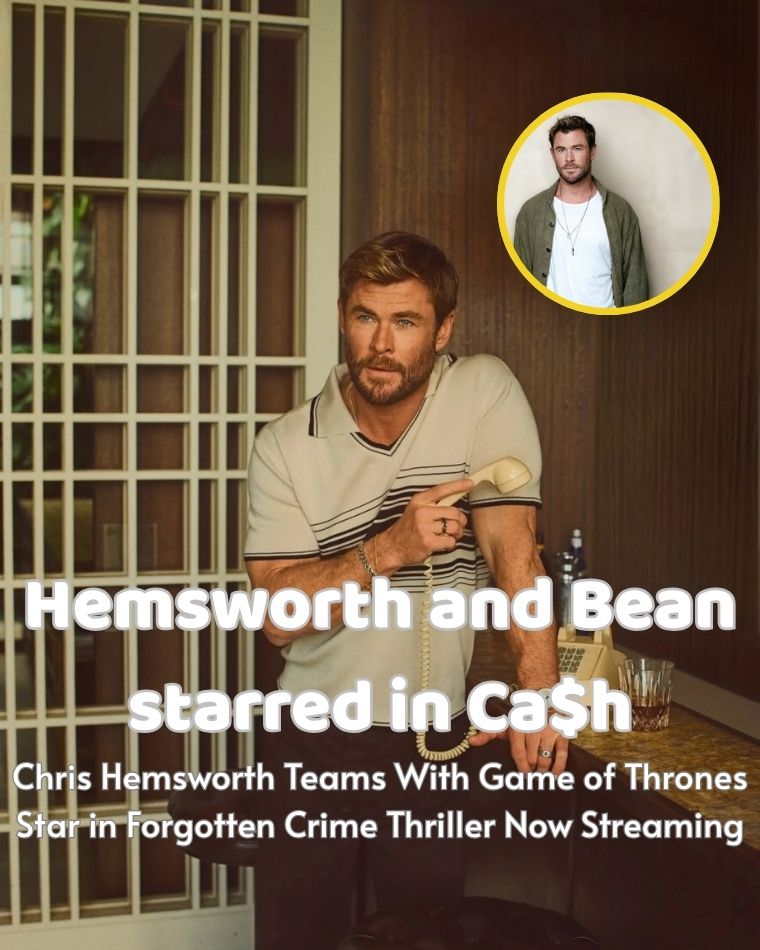
The 2010 independent project, titled Cash (stylized as Ca$h), paired the Australian actor alongside Sean Bean just before both stars stepped into the defining pop-culture roles of their careers[cite: 1].
Today, as contemporary viewers comb through digital streaming catalogs to explore Hemsworth’s pre-superhero catalog, this little-seen neo-noir thriller offers a fascinating window into his early dramatic capabilities[cite: 1].
Cre: Gage Skidmore / Wikimedia Commons
Directed and written by Stephen Milburn Anderson, the film presents a classic moral dilemma wrapped inside a tense psychological cat-and-mouse game[cite: 1].
The narrative follows a young suburban couple, Sam Phelan, played by Hemsworth, and his wife Leslie, portrayed by Victoria Profeta[cite: 1].
Drowning in severe debt, facing foreclosure, and struggling to stay afloat financially, the couple experiences an unexpected stroke of fortune when a lost briefcase packed with illicit currency drops onto their car[cite: 1].
Instead of contacting law enforcement or handing the briefcase over to local authorities, the desperate couple chooses to keep the discovered funds to settle their overwhelming financial obligations[cite: 1].
Their sudden relief proves remarkably brief when an ominous and calculated stranger named Pyke Kubic, played by Sean Bean, tracks them down and arrives unannounced on their front porch[cite: 1].
Kubic explains that the stolen loot belongs to his incarcerated twin brother, and he coldly demands every single cent back from the terrified couple[cite: 1].
Because Sam and Leslie have already spent a sizable portion of the cash on past-due bills, an expensive car, and routine living expenses, Kubic forces them into a harrowing spiral of escalating criminal acts to recover the lost balance[cite: 1].
The central dynamic between Hemsworth and Bean drives the psychological tension throughout the narrative[cite: 1].
Bean, who would go on to portray the honorable yet ill-fated patriarch Ned Stark in HBO’s television phenomenon Game of Thrones, brought a chilling, measured menace to his character[cite: 1].
Kubic does not operate as an unhinged, violent gangster; rather, he behaves like a polite, ruthless corporate auditor collecting an unpaid debt at gunpoint.
Hemsworth matches that cold detachment with anxious, grounded desperation, portraying a regular working-class husband pushed beyond his ethical limits.
The chemistry between them creates an engaging psychological contest where an ordinary man is stripped of his morals under extreme duress.
In terms of career chronology, Cash landed at an exceptionally delicate and transitional juncture for Hemsworth[cite: 1].
A year prior, in 2009, the Australian performer made a brief but memorable cinematic impression as George Kirk, the ill-fated father of James T. Kirk, in J.J. Abrams’ box-office hit Star Trek[cite: 1].
Despite that attention-grabbing sci-fi prologue, Hemsworth had not yet secured his position as an established Hollywood leading man[cite: 1].
Independent genre entries like Cash offered him the critical screen time required to demonstrate that he could shoulder a feature-length dramatic production[cite: 1].
Unfortunately for the production team, the movie failed to resonate with audiences or make an impression during its initial theatrical rollout[cite: 1].
The film operated on an visibly restrained independent budget, a reality evident throughout its limited locations and minimalist staging[cite: 1].
The independent distribution firm Roadside Attractions picked up the domestic rights for an exceedingly limited American theatrical run, while Lionsgate handled the subsequent home video distribution[cite: 1].
Without a substantial marketing campaign or wide theatrical footprint, Cash vanished from cinemas almost instantly upon arrival[cite: 1].
Mainstream film critics largely ignored the release, leaving it with very few prominent professional reviews on record[cite: 1].
General audiences who managed to seek out the movie were similarly underwhelmed, as evidenced by its modest 32% audience approval rating on Rotten Tomatoes[cite: 1].
The film became what industry observers describe as a disposable genre exercise that left virtually no mark on mainstream pop culture during its original release[cite: 1].
Yet, the quiet reception of the project ended up sparing everyone involved from any meaningful professional damage[cite: 1].
Because it slipped under the radar rather than collapsing as a publicized studio disaster, neither actor suffered career stagnation[cite: 1].
Bean maintained his steady standing as one of Britain’s most respected and sought-after screen actors, quickly filming his celebrated run as Lord Eddard Stark in Game of Thrones[cite: 1].
For Hemsworth, the commercial indifference surrounding the release became completely irrelevant just twelve months later[cite: 1].
In 2011, Kenneth Branagh’s Thor debuted in theaters worldwide, transforming the Marvel fantasy adaptation into an unexpected box-office triumph and establishing Hemsworth as a household name[cite: 1].
The subsequent success of The Avengers in 2012 locked him into Hollywood’s elite tier of blockbuster headliners[cite: 1].
Looking back at Cash through modern eyes, the performance elements distinguish it dramatically from the superhero persona that dominated his ensuing decade[cite: 1].
In the Marvel Cinematic Universe, Hemsworth built his worldwide reputation on godlike physicality, larger-than-life bravado, and a disarming comedic charm.
As Thor, his character commands power, summons thunder, and moves across mythological realms with mythic invulnerability.
In contrast, his portrayal of Sam Phelan in Cash relies entirely on vulnerability, terror, and physical frailty[cite: 1].
Hemsworth does not display supernatural combat prowess or indestructible endurance in this early feature.
Instead, his character sweats through his collar, trembles when faced with firearm violence, and fumbles through frantic decisions as his moral foundation crumbles[cite: 1].
He plays an everyday man confronting the crushing weight of economic anxiety, capturing authentic working-class panic without heroic posturing[cite: 1].
Watching his expressive panic in Cash highlights an actor capable of internal drama, nuance, and psychological unraveling.
This grounded sensitivity forms an essential through-line in Hemsworth’s broader career choices outside of pure superhero cinema.
Throughout his post-Marvel journey, the actor has repeatedly gravitated toward grounded, grittier genre projects that interrogate masculine vulnerability under intense pressure.
A clear parallel emerges when comparing his early showing in Cash to his performance as Tyler Rake in the acclaimed Extraction franchise.
While Extraction features punishing stunt choreography and high-octane mercenary action, the emotional core of the film centers on grief, trauma, and exhaustion.
Tyler Rake is a broken protagonist driven by regret, echoing the raw desperation that Hemsworth first explored opposite Sean Bean[cite: 1].
Similarly, in Joseph Kosinski’s 2022 psychological sci-fi thriller Spiderhead, Hemsworth traded heroic valor for something far more manipulative and ethically ambiguous.
Playing Steve Abnesti, a charismatic yet sociopathic pharmaceutical researcher running unethical penitentiary experiments, he leaned into the dark psychological tension that defined his scenes with Bean over a decade prior[cite: 1].
Another notable comparison lies in Michael Mann’s 2015 techno-thriller Blackhat, where Hemsworth portrayed Nicholas Hathaway, a convicted computer hacker pulled out of prison to pursue a cyber-terrorist syndicate.
Although Blackhat struggled commercially upon release, it reflected his conscious desire to collaborate with visionary auteurs and tackle realistic, grounded dramatic material.
In Blackhat, just as in Cash, the story places Hemsworth into murky moral environments where sheer physical strength cannot resolve the central conflict[cite: 1].
The streaming landscape has provided an unexpected second life for forgotten early-career titles like Cash[cite: 1].
Modern streaming platforms, specialized video-on-demand services, and physical media releases on Blu-ray and DVD have allowed viewers to revisit forgotten chapters of Hollywood stars’ filmographies[cite: 1].
Fans discovering Cash today often encounter it not as an obscure 2010 flop, but as an intriguing cinematic artifact featuring two major icons sharing screen time[cite: 1].
The juxtaposition of seeing the future King of Asgard being terrorized by the future Warden of the North delivers a surreal meta-appeal for contemporary pop-culture enthusiasts[cite: 1].
Moreover, the film demonstrates the unpredictable path that defines a major movie star’s rise in the entertainment industry[cite: 1].
Before global brand recognition, multimillion-dollar production budgets, and vast franchise continuity, actors frequently cut their teeth on independent genre films that test their resilience[cite: 1].
Hemsworth navigated from Australian television to a brief cameo in Star Trek, followed by an overlooked low-budget thriller, before eventually securing an audition that transformed his life[cite: 1].
The production of Cash serves as a reminder that an actor’s early filmography is rarely an unbroken chain of commercial hits[cite: 1].
Even as Hemsworth continues expanding his cinematic range—taking on unconventional roles like Dementus in George Miller’s Furiosa: A Mad Max Saga—his roots in low-key genre cinema remain part of his artistic foundation[cite: 1].
Để lại một phản hồi