Daniel Radcliffe accomplished what exceptionally few child franchise stars ever manage by systematically building a respected, versatile adult career that refuses to be defined solely by his iconic early role. Through deliberate choices and unapologetic risk-taking, the British actor deconstructed his global image by pursuing daring, unglamorous, and physically demanding projects across independent cinema and theater. His transformative path highlights a clear blueprint for artistic longevity, proving that true creative credibility comes from embracing professional discomfort rather than seeking commercial safety.
The phenomenon of early franchise stardom often resembles a gilded cage for young performers thrust into global prominence.
Actors who headline monumental blockbusters during their formative years routinely find themselves permanently branded by those signature fictional identities.
The entertainment industry historically struggles to separate the adult performer from the beloved childhood archetype celebrated by millions.
Many child stars face dwindling opportunities once their flagship series concludes, drifting toward obscurity or repetitive casting.
Others attempt to replicate their early commercial triumphs by chasing similar high-budget franchises, frequently encountering diminishing returns and artistic fatigue.
Daniel Radcliffe encountered this formidable crossroads following a full decade spent portraying the title character across eight historic Harry Potter films.
Rather than remaining complacent inside mainstream Hollywood comfort zones, Radcliffe initiated an aggressive and systematic campaign of professional reinvention.
He recognized early that escaping the inescapable gravitational pull of a multi-billion-dollar franchise required radical measures.
The actor consciously redirected his career trajectory toward projects that demanded radical vulnerability, strange storytelling, and extreme physical commitment.
His approach was neither accidental nor reactionary, but rather a methodical demonstration of creative independence.
Instead of chasing another prospective tentpole blockbuster, he positioned himself as an adventurous character actor who happened to possess universal name recognition.
This transformative journey reshaped public perception and redefined what post-franchise success can look like in modern cinema.
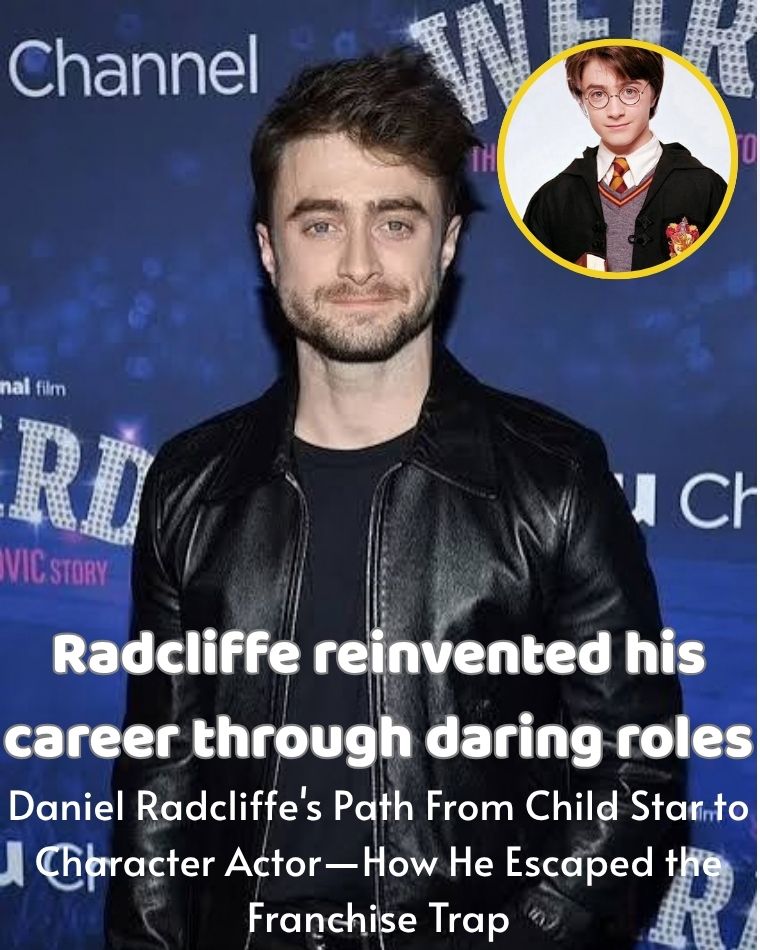
Cre: Wikimedia Commons — CC BY-SA 2.0 / Gordon Correll
The transition away from youthful fantasy began even before the final wizarding installment had completed its theatrical run.
Radcliffe took his initial leap into daring territory by taking the stage in Peter Shaffer’s challenging psychological drama Equus in London and on Broadway.
Appearing onstage in a demanding dramatic vehicle that required profound emotional exposure and full nudity shocked mainstream audiences and commentators.
That calculated stage performance signaled a resolute determination to abandon safe family entertainment for genuine artistic challenges.
It proved to industry gatekeepers that Radcliffe took the craft of acting seriously and was not merely the fortunate beneficiary of a massive production apparatus.
When the film franchise finally wrapped its decade-long production cycle, he steadfastly avoided standard leading-man action hero scripts.
He understood that conventional studio vehicles would only invite endless comparisons to his famous past.
Instead, Radcliffe leveraged his enormous financial independence to pursue uniquely unconventional cinematic visions that smaller independent studios championed.
His immense personal wealth allowed him to bypass commercial pressure entirely and focus solely on artistic curiosity.
Every script he chose seemed specifically engineered to challenge audience expectations and shatter preconceptions.
He gravitated toward scripts that other established leading men routinely rejected due to fear of damaging their commercial appeal.
Radcliffe embraced the bizarre, the grotesque, and the complex with evident enthusiasm.
He treated his famous identity not as a pedestal to preserve, but as a protective armor that allowed him to take massive creative gambles.
This counter-intuitive philosophy quickly distinguished him from nearly all his franchise-leading contemporaries.
While mainstream executives expected him to pursue prestigious costume dramas or modern superhero cinema, Radcliffe dove directly into the literary avant-garde.
In the 2013 biographical drama Kill Your Darlings, he tackled the complex real-life figure of Beat Generation poet Allen Ginsberg.
The role required Radcliffe to navigate intellectual fervor, sexual awakening, and criminal complicity during the formative years of Columbia University’s literary movement.
His performance stripped away any remaining remnants of adolescent innocence, replacing them with raw nuance and complicated emotional ambivalence.
Radcliffe captured the nervous intensity and emerging poetic voice of Ginsberg with convincing historical authenticity.
Critics took notice of his uncanny ability to dissolve entirely into an eccentric real-world literary figure.
Kill Your Darlings served as vital proof that Radcliffe possessed the dramatic range and emotional intelligence to headline serious auteur-driven independent drama.
The film allowed him to align himself with revered countercultural history rather than commercial pop culture.
He worked closely alongside challenging co-stars who pushed his technical boundaries and forced him to elevate his craft.
By immersing himself in mid-century American poetry and taboo themes, he expanded his artistic palette in front of critical festival audiences.
The performance garnered enthusiastic praise at major global festivals including Sundance and Venice.
It confirmed that his stage discipline translated effectively into complex adult dramatic acting on camera.
Yet rather than settling comfortably into prestigious indie biopic territory, Radcliffe pushed his adventurous instincts even further.
He demonstrated an ongoing refusal to allow the film industry to pigeonhole him into any single category or genre.
Whenever critics began to define his adult screen persona as a serious dramatic actor, he would immediately pivot to outrageous absurdity.
This relentless unpredictability kept audiences guessing and made every new project an intriguing curiosity.
He actively sought out first-time filmmakers, visionary storytellers, and radical directors whose scripts defied simple genre classification.
This fearless approach reached its ultimate cinematic realization when he agreed to headline the 2016 surrealist tragicomedy Swiss Army Man.
Directed by the innovative filmmaking duo known as the Daniels, the project presented what was arguably the strangest concept in recent film history.
Radcliffe committed fully to portraying Manny, a flatulent, talkative corpse that washes ashore on a deserted island.
To execute the role, Radcliffe spent weeks enduring grueling physical positioning, bizarre prosthetic work, and complex practical stunts.
He transformed what could easily have become an embarrassing one-note joke into a remarkably moving meditation on human loneliness, shame, and connection.
His physical comedy and vocal modulation breathed genuine humanity into an inanimate physical body.
Swiss Army Man polarized traditional critics upon its premiere at the Sundance Film Festival, prompting walkouts alongside standing ovations.
Yet industry insiders and cinephiles uniformly praised Radcliffe’s total, uninhibited commitment to the bizarre material.
The role stood as an undeniable manifesto of artistic liberation.
No actor desperately clinging to clean Hollywood prestige or protective franchise branding would ever contemplate playing an expulsive corpse.
By doing so with absolute earnestness and exquisite physical control, Radcliffe completed his total break from conventional celebrity expectations.
He proved that he was entirely unafraid of looking foolish or repulsive in service of an original creative vision.
The performance permanently redefined his standing in the cinematic community.
He was no longer merely a former child star searching for relevance, but a committed character actor possessing exceptional physical courage.
The audacity of the performance commanded widespread respect across Hollywood’s creative community.
It established Radcliffe as a dream collaborator for adventurous filmmakers who needed a recognizable star willing to embrace pure cinematic madness.
His filmography expanded rapidly to include absurd genre experiments, dark satires, and high-octane action comedies.
In Horns, directed by Alexandre Aja, he portrayed a grief-stricken young man who inexplicably sprouts demonic horns that compel people to confess their darkest sins.
In Guns Akimbo, he bounded through city streets in a bathrobe with firearms surgically bolted to his hands in an over-the-top commentary on internet bloodlust.
In Imperium, he shaved his head and immersed himself in psychological terror to depict an undercover FBI agent infiltrating white supremacist groups.
In Jungle, he underwent intense physical deprivation and dramatic weight loss to survive the brutal elements of the Amazon rainforest.
Each project demanded total immersion and carried significant creative or physical risk.
Radcliffe never treated these bizarre concepts as ironic novelties or beneath his talents.
He approached every eccentric script with the exact same rigorous dramatic seriousness that he applied to high-profile theater classics.
This steadfast consistency of effort gradually won over even the most skeptical industry observers.
Examining Radcliffe’s trajectory provides a stark contrast to the paths trodden by many other famous child actors.
The cinematic landscape is littered with performers who struggled to outgrow the defining triumphs of their youth.
Many child stars were steered by aggressive management teams into hollow teen-oriented projects that faded rapidly from memory.
Others found themselves trapped in continuous franchise extensions until their cultural relevance diminished entirely.
Even highly talented franchise leads frequently encounter intense typecasting that confines them to specific hero or ingénue archetypes for decades.
Radcliffe managed to bypass this trap by making himself effectively unrecognizable across multiple distinct artistic dimensions.
He did not attempt to erase his childhood fame, but rather built a massive, colorful body of work that rendered past roles merely the opening chapter of a much larger journey.
He consistently spoke of his breakthrough role with profound gratitude, affection, and respect.
He never exhibited the bitter resentment toward his famous origins that often alienates fans and poisons an actor’s public image.
By honoring his past while pursuing an entirely fearless creative future, he maintained an extraordinarily rare goodwill with global moviegoers.
Audiences recognized that his strange role choices were not angry rejections of his origins, but genuine explorations of artistic curiosity.
He transformed what is typically an actor’s greatest liability—inescapable global fame—into an extraordinary professional superpower.
Because the world already knew his name and face intimately, he had nothing left to prove in terms of commercial viability or universal recognition.
He was entirely liberated to serve the stories that genuinely fascinated him.
This radical freedom enabled him to seamlessly transition between high-concept low-budget indie features, television satires, and prestigious Broadway stages.
His willingness to return repeatedly to live theater kept his technical fundamentals sharp, versatile, and disciplined.
On the New York and London stages, an actor cannot rely on digital visual effects or protective editing to rescue a mediocre performance.
Radcliffe embraced the demanding rigor of eight live performances a week in complex dramas, boundary-pushing comedies, and classical revivals.
His work in Tom Stoppard’s Rosencrantz and Guildenstern Are Dead and Martin McDonagh’s The Cripple of Inishmaan highlighted his comedic timing and sharp stage command.
Theater became both a creative gym and a testing ground where he could continually test his emotional stamina.
The throughline connecting this seemingly random collection of projects is a steadfast commitment to professional courage.
Radcliffe consistently chose the project that frightened him the most, using personal anxiety as a reliable compass for creative growth.
If a script felt comfortable, conventional, or easy to execute, it held little attraction for his restless artistic sensibilities.
If a script appeared terrifying, absurd, physically daunting, or emotionally exposed, he ran directly toward it.
This philosophy replaced the traditional Hollywood metric of box office safety with a relentless pursuit of artistic discovery.
He understood that taking creative risks inevitably leads to occasional misfires, but safe mediocrity guarantees artistic stagnation.
By refusing to protect his celebrity brand, he paradoxically built one of the most durable, respected reputations in modern entertainment.
Filmmakers and theatrical directors know that casting Daniel Radcliffe brings not only global attention, but an unyielding, selfless work ethic.
His colleagues routinely praise his punctuality, professional generosity, humility, and total lack of ego on challenging sets.
He works tirelessly to elevate the entire ensemble, treating crew members and supporting actors with genuine warmth and respect.
This reputation for supreme professionalism ensured that doors remained wide open across every sector of the entertainment business.
Today, audiences do not look at an upcoming Daniel Radcliffe project expecting to see a boy wizard; they anticipate something bold, unexpected, and completely unpredictable.
He has transformed himself from a manufactured childhood superstar into an authentic, indispensable character actor of the highest order.
His career stands as an inspiring masterclass for any young artist navigating the perils of early commercial success.
He proved that an actor’s destiny is not dictated by the character that initially brought them fame, but by the quiet courage of their subsequent choices.
By prioritizing artistic growth over commercial prestige, Radcliffe unlocked the rarest achievement in modern entertainment: total creative autonomy.
His enduring longevity in contemporary cinema confirms that true creative liberation begins the precise moment an actor stops playing it safe.
Slug: daniel-radcliffe-escaped-child-star-curse-career-reinvention SEO Title: How Daniel Radcliffe Escaped the Child Star Curse SEO Description: Explore how Daniel Radcliffe redefined his career after Harry Potter through bold indie films like Swiss Army Man and courageous artistic reinvention. SEO Keywords: Daniel Radcliffe, child star, career reinvention, franchise trap, character actor, role choices, Harry Potter legacy, career strategy
Để lại một phản hồi