Daniel Radcliffe’s 2013 horror-fantasy film Horns is officially arriving on Paramount+, giving new audiences direct streaming access to one of the boldest performances of his career. Directed by French filmmaker Alexandre Aja and based on Joe Hill’s acclaimed novel, the movie stars Radcliffe as Ignatius “Ig” Perrish, an outcast accused of horrific violence who suddenly manifests literal demonic horns. Now available on a major subscription platform, the cult favorite offers viewers a fresh opportunity to reconsider how Radcliffe completely shattered his child-star image through pure tonal disruption.
The Supernatural Nightmare of Ignatius Perrish
Daniel Radcliffe’s journey beyond the wizarding world found one of its most unapologetically bizarre chapters in the 2013 dark fantasy horror feature Horns.
The film is officially joining the streaming lineup on Paramount+, bringing a widely overlooked supernatural title back into the spotlight.
This streaming debut provides a prime opportunity for audiences to revisit a project that divided commentators during its original limited theatrical run.
Adapted from the bestselling novel written by Joe Hill, the narrative drops viewers straight into an atmospheric and emotionally suffocating small town.
Alexandre Aja, the visionary French director known for visceral genre exercises, took the helm to steer this uniquely grotesque American fable.
At the center of the story stands Ignatius “Ig” Perrish, played by Radcliffe with a desperate, wounded ferocity.
Ig finds himself ostracized by his tight-knit community after being publicly accused of brutally murdering his beloved longtime girlfriend, Merrin.
Although legal authorities lack the definitive proof needed to convict him, the surrounding townspeople have already passed an irreversible social sentence.
Ig’s entire life unravels into an isolating fog of collective hatred, grief, and drunken despair.
The narrative takes a surreal and supernatural turn following an evening of severe, intoxicated blasphemy.
Waking up after a blackout, Ig discovers a pair of demonic horns visibly protruding from his forehead.
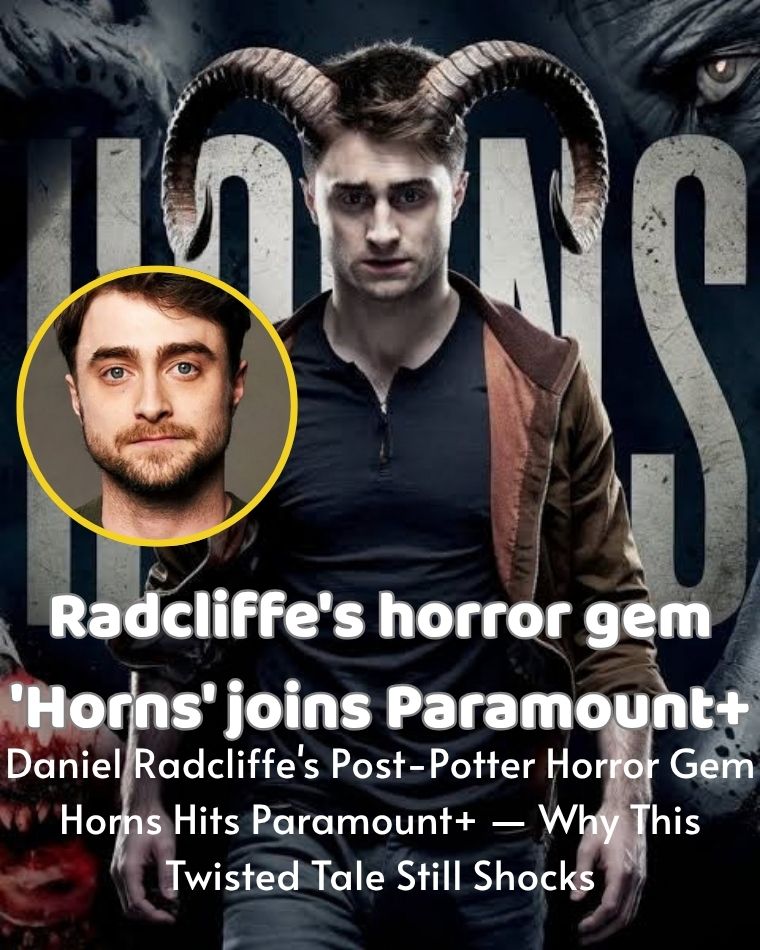
Cre: Wikimedia Commons — Gage Skidmore (CC BY-SA 3.0)
These bizarre appendages are far from a mere cosmetic curse.
Instead, the horns project an uncanny supernatural aura that obliterates the psychological inhibitions of every mortal who crosses Ig’s path.
Friends, family, and casual strangers suddenly feel an uncontrollable impulse to confess their most shameful impulses, buried secrets, and vile desires directly to him.
The affliction turns every standard social encounter into an agonizing confessional booth.
Ig quickly discovers that people instantly forget their confessions the moment they leave his presence.
Rather than running from this gruesome transformation, Ig decides to weaponize his demonic condition.
He uses the involuntary honesty of his neighbors to conduct an unfiltered investigation into who actually killed Merrin.
What begins as a standard murder mystery quickly morphs into an escalating psychological horror story.
The film constantly plays with classic biblical themes of temptation, original sin, and damnation.
Rather than portraying the devil as a purely malicious entity, the story frames Ig’s transformation as a tragic manifestation of human hypocrisy.
The very community that condemns him as an inhuman monster turns out to harbor unspeakable filth beneath its pleasant facade.
Radcliffe’s Absolute Commitment to Dark Comedy and Grotesque Physicality
Stepping into the role of Ig Perrish demanded far more than delivering solemn monologues about grief and loss.
Radcliffe threw himself entirely into the abrasive physical demands of a high-concept creature feature.
The actor spent extensive hours enduring intricate prosthetic makeup applications to bring the devilish horns to life on screen.
As the narrative progresses, Ig’s demonic appearance grows increasingly severe, requiring heavier layers of practical effects.
Radcliffe never treats these prosthetics as a visual gimmick or an excuse for detached irony.
He carries the physical weight of the horns with a heavy, slouching posture that communicates perpetual shame and exhaustion.
He walks through the film wearing a scuffed leather jacket, bloodshot eyes, and an aura of genuine spiritual decay.
Beyond the makeup chair, Radcliffe fully committed to the script’s pitch-black comedic impulses.
The supernatural premise places the character in wildly inappropriate, darkly funny scenarios.
Doctors, police officers, and neighborhood mothers strip away all civil politeness in front of him, unleashing chaotic violence and unfiltered hedonism.
Navigating this tonal minefield required precise timing and complete emotional vulnerability.
Radcliffe had to pivot seamlessly from gut-wrenching sequences of romantic longing to moments of deadpan absurdity.
One scene forces him to process an agonizing memory of his lost love, while the very next demands that he command a pit of serpents to torment local bigots.
Playing against an ensemble of characters losing their minds could easily have resulted in an exaggerated caricature.
Instead, Radcliffe grounds every absurdity in Ig’s persistent, human heartbreak.
His intense, unguarded blue eyes anchor the chaotic storytelling, ensuring the audience never forgets the sorrow fueling his vengeance.
The sheer physicality of the performance also involved interacting with genuine reptiles and enduring wet, muddy outdoor locations.
Director Alexandre Aja insisted on a visceral, sensory experience that captured the mossy, decaying atmosphere of the Pacific Northwest.
Radcliffe leaned into every uncomfortable scene without requesting flattering camera angles or conventional heroic framing.
He allowed his character to appear pathetic, spiteful, and morally compromised.
That lack of vanity is precisely what makes his depiction of Ig Perrish so magnetic.
He demonstrated an authentic appetite for theatrical grit that few mainstream leading men would dare attempt so early in their adult careers.
Tonal Ambition and the Divided Critical Reception
When Horns completed its production cycle and debuted on the festival circuit, film critics wrestled with its erratic cinematic identity.
The movie famously defies simple genre categorization, refusing to settle neatly into standard Hollywood boxes.
Is it a somber murder mystery about small-town grief?
Is it a satirical black comedy skewering societal morals and religious hypocrisy?
Or is it a full-throttle creature feature steeped in graphic practical effects and mythological body horror?
Alexandre Aja chose not to compromise on any of these elements, choosing instead to blend all three simultaneously.
For several prominent reviewers, this bold mashup produced a jarring, uneven viewing experience.
Some critics argued that the emotional weight of Merrin’s murder was undercut by the script’s broad, satirical slapstick.
Others felt that the whimsical supernatural logic clashed awkwardly with the movie’s grim, violent climax.
The narrative shifts abruptly between lush, nostalgic flashbacks of innocent teenage love and harrowing scenes of psychological depravity.
Yet even reviewers who dismissed the movie’s structural balance consistently praised Radcliffe’s relentless conviction.
Critics recognized that whatever shortcomings existed in the film’s pacing, the lead actor was executing his duties at full throttle.
His fierce dramatic focus provided an essential connective thread through the narrative’s wild tonal swings.
Radcliffe treated the absurd material with absolute narrative seriousness, never winking at the camera.
The film’s daring ambition is precisely what helped it cultivate a dedicated underground following after leaving theaters.
Cult cinema enthusiasts frequently celebrate genre movies that swing for the fences, even when the results are messy.
Horns does not play it safe for a single frame of its runtime.
The soundtrack balances brooding rock anthems with atmospheric choral melodies, mirroring the clash between holy purity and rebellious defiance.
Aja’s visual style is undeniably vivid, utilizing saturated autumnal color palettes that contrast beautifully with Ig’s dark silhouette.
The film offers a distinct visual flavor that stands out in an era dominated by homogenous studio blockbusters.
A Pivotal Step in Radcliffe’s Post-Franchise Reinvention
To truly appreciate what Horns accomplished, one must examine its place in Daniel Radcliffe’s broader professional trajectory.
Following the massive global conclusion of the Harry Potter series in 2011, Radcliffe found himself at a rare Hollywood crossroads.
Having starred as the titular boy wizard across eight films over an entire decade, he possessed generational fame and complete financial freedom.
Many young actors graduating from massive commercial franchises choose the safest available paths.
They often migrate into predictable romantic comedies, prestigious historical dramas, or adjacent action tentpoles designed to protect their status.
Radcliffe, however, made the deliberate decision to run directly toward eccentric, challenging, and unclassifiable indie projects.
He immediately gravitated toward unconventional narratives where he could test the limits of his screen presence.
Prior to Horns, he demonstrated his affinity for classic supernatural suspense by starring in The Woman in Black.
Yet Horns represented an entirely different level of artistic hazard.
Playing an antihero who literally grows the horns of Satan was a defiant declaration of creative independence.
It was an open invitation for audiences to stop viewing him as the polite hero of childhood fantasy.
This radical choice established a foundational template that would define Radcliffe’s adult filmography for the next decade.
The artistic courage on display in Horns directly paved the way for his most adventurous subsequent roles.
Without Ig Perrish, it is hard to imagine Radcliffe agreeing to portray a flatulent talking corpse in Swiss Army Man.
It laid the groundwork for his wild, manic energy in action comedies like Guns Akimbo.
It demonstrated that he was more interested in working with passionate visionaries than chasing guaranteed box office records.
Radcliffe clearly understood that true longevity as a character actor required destroying any remaining lingering preconceptions.
He actively sought out scripts that provoked, unsettled, or startled potential distributors.
By choosing Horns, he announced that he was eager to engage with grotesque makeup, dark humor, and deeply flawed moral protagonists.
The industry quickly took note of his fearlessness.
Directors recognized that Radcliffe was not merely a recognizable name for movie posters, but a tireless worker willing to submerge himself in demanding artistic visions.
The Power of Streaming for Indie Genre Rediscovery
The arrival of Horns on Paramount+ marks a vital next chapter for the life cycle of Joe Hill’s cinematic adaptation.
During its initial rollout, the film received only a very limited theatrical release.
Independent genre features with complex tonal blends often struggle to capture massive box office returns during brief multiplex engagements.
Mainstream theatrical marketing departments rarely know how to sell a film that refuses to fit into a singular promotional demographic.
As a consequence, vast segments of the moviegoing public completely missed the opportunity to see Horns upon its debut.
For years, the film drifted through secondary rental windows and obscure home-video channels.
Now, integrated into Paramount+’s vast digital streaming catalog, the barrier to entry has completely vanished.
Modern streaming platforms serve as modern preservation archives for idiosyncratic cinema.
They allow misunderstood or overlooked films to find the exact passionate audiences they were originally designed for.
Viewers browsing a subscription library are far more likely to take a chance on an eccentric two-hour genre experiment.
The title will naturally attract fans of Joe Hill’s horror literature, which has enjoyed a major cultural resurgence in recent years.
Readers who loved The Black Phone or NOS4A2 can trace the cinematic roots of Hill’s world directly through this dark adaptation.
Furthermore, audiences who have watched Radcliffe excel in recent offbeat projects can now witness the crucial turning point of his creative evolution.
Streaming also provides the luxury of home viewing, allowing audiences to absorb the story’s unusual pacing without theatrical expectations.
Viewers can appreciate the nuanced details of the film’s production design, from the moss-covered forests to the haunting visual metaphors.
Social media and film recommendation communities frequently drive unexpected resurgences for decade-old streaming additions.
Word of mouth can transform a forgotten theatrical oddity into a viral weekend viewing sensation.
Horns possesses all the necessary ingredients to thrive in the modern streaming ecosystem.
Its memorable imagery, arresting concept, and star power make it custom-built for digital rediscovery.
As subscribers stumble upon Ig Perrish’s tragic investigation, the film has a genuine opportunity to claim its rightful status as a modern cult treasure.
Why Radcliffe’s Performance Still Registers as Raw and Courageous
More than a decade after its original production, Horns retains a fierce, unvarnished power that has not dulled with time.
Many post-franchise vehicles produced during the 2010s feel calculated, cautious, and sanitized by corporate committee oversight.
In stark contrast, Radcliffe’s work here continues to jump off the screen because of its total lack of protective vanity.
He throws himself into every sequence with an emotional urgency that feels raw and almost dangerously exposed.
When Ig weeps over Merrin’s tragic fate, Radcliffe does not deliver neat, cinematic tears.
He portrays the hyperventilating, ugly, snot-streaked collapse of a broken human being.
When the demonic horns awaken Ig’s vindictive cruelty, the actor unleashes a chilling, bitter smirk that feels genuinely venomous.
This refusal to soften Ig’s edges is what preserves the film’s moral complexity.
The protagonist is not an infallible saint wrongly accused; he is a damaged soul holding tremendous resentment toward the world.
Watching Radcliffe navigate that inner turmoil while wearing prosthetic horns remains a breathtaking high-wire act.
One false beat could easily have plunged the entire production into unintentional camp.
Instead, Radcliffe maintains a laser-sharp emotional focus that commands respect from start to finish.
The supporting cast, featuring talented performers like Juno Temple, Max Minghella, and David Morse, elevates the high-stakes human drama around him.
Yet it is Radcliffe’s magnetic central gravity that binds the bizarre narrative universe together.
He proved indisputably that his natural talents were not confined to the halls of Hogwarts.
He revealed an actor possessing ferocious range, physical stamina, and an unmistakable passion for weird, challenging genre fiction.
In an industry where young stars are constantly advised to cultivate polished, unoffensive brand personas, his performance remains an exhilarating act of defiance.
Radcliffe took a messy, blood-soaked, blasphemous indie script and treated it with the same artistic devotion as high classical tragedy.
That singular dedication is precisely why the film endures among horror aficionados and open-minded movie buffs alike.
As Horns arrives on Paramount+, audiences will encounter a movie that is brazen, provocative, and completely unforgettable.
It stands as definitive evidence of an artist bravely shedding his past to discover the true, wild boundaries of his craft.
Whether you missed its original theatrical bow or simply wish to re-examine a fascinating turning point in modern horror, Horns demands another look.
Để lại một phản hồi