Released in 1998, The Waterboy marked a definitive turning point in Adam Sandler’s ascent to mainstream Hollywood superstardom.
The beloved comedy balanced outrageous physical humor with genuine emotional sincerity, introducing a storytelling template that would anchor Sandler’s cinematic career for decades.
Through the journey of Bobby Boucher, the film transformed a classic underdog sports narrative into a character-driven examination of personal independence, maternal devotion, and self-worth.
The Genesis of an Endearing Outsider
In 1998, director Frank Coraci and star Adam Sandler presented audiences with Bobby Boucher Jr., a socially sheltered 31-year-old water distribution technician.
Living in rural Louisiana, Bobby dedicates his entire existence to perfecting the quality and temperature of drinking water for college athletic teams.
Despite his gentle disposition and unwavering work ethic, Bobby suffers persistent ridicule and cruel pranks from the players he dutifully serves.
The character operates within a heightened comic reality, defined by an exaggerated Cajun accent, physical mannerisms, and innocent gullibility.
Yet, underneath the outlandish exterior lies an profoundly vulnerable figure seeking basic human dignity and social respect.
Sandler deliberately constructed Bobby to avoid becoming a mean-spirited caricature of regional culture or developmental delays.
Instead, the performance invites the audience to empathize with Bobby’s isolation from the opening frames of the story.
Viewers recognize his earnest desire to belong, which immediately establishes emotional investment in his ultimate journey.
This deliberate balance between bizarre character traits and pure-hearted motivation became the cornerstone of Sandler’s unique screen persona.
Rather than laughing solely at Bobby’s eccentricities, spectators actively cheer for his emotional and social vindication.
The early scenes carefully illustrate how years of repressed frustration accumulate beneath Bobby’s polite and timid exterior.
His dedication to hydration represents his primary method of contributing meaningfully to an indifferent world.
When that single source of personal pride is threatened by bullying, the narrative establishes a powerful foundation for dramatic catharsis.
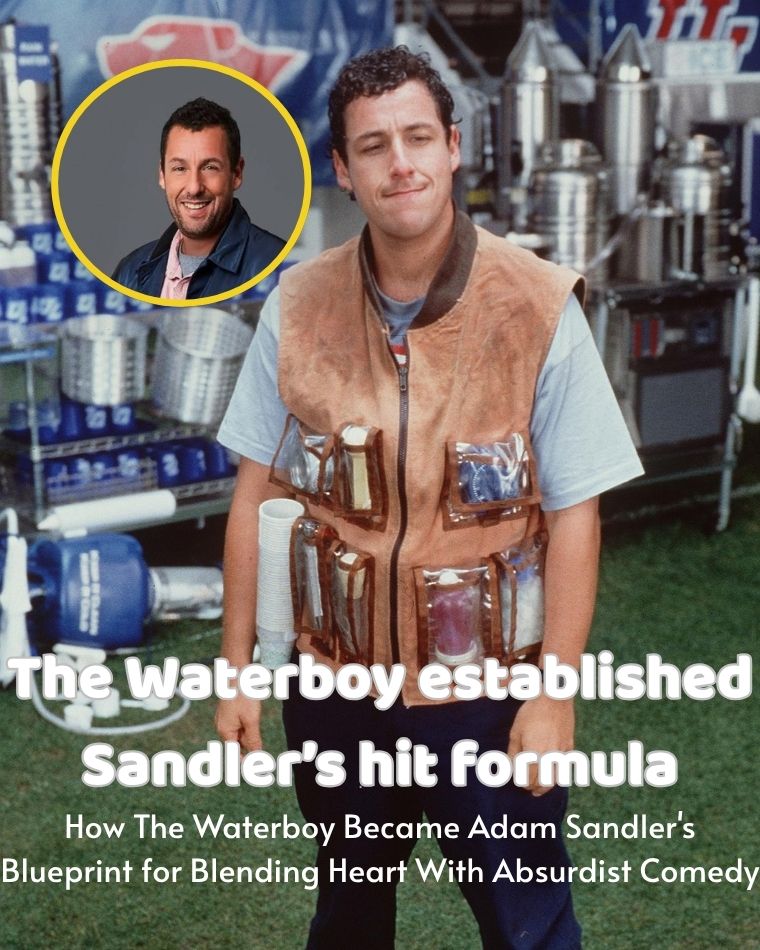
Cre: Touchstone Pictures / Wikimedia Commons
The Complex Dynamic of Maternal Protection
At the center of Bobby’s emotional life sits his fiercely protective and deeply superstitious mother, Helen “Mama” Boucher.
Portrayed with extraordinary commitment by Academy Award winner Kathy Bates, Mama represents both Bobby’s ultimate protector and his primary obstacle to adulthood.
Helen Boucher has convinced her son that virtually everything beyond their secluded bayou home is evil, dangerous, or sinful.
Her list of forbidden elements includes higher education, organized sports, modern medicine, and interactions with young women.
This controlling dynamic stems not from malice, but from a profound fear of losing her only companion to a deceptive world.
Bates plays the role with fierce maternal conviction, elevating what could have been a cartoonish villain into a genuinely affectionate parent.
The interactions between Sandler and Bates supply the film with its strongest emotional resonance and thematic weight.
Their quiet domestic scenes over bizarre home-cooked meals highlight a genuine bond built on mutual loyalty and shared isolation.
Bobby genuinely loves his mother and honors her wishes, even when her extreme mandates limit his personal growth.
This relationship introduces authentic moral complexity into an otherwise lighthearted slapstick comedy.
Bobby is torn between his burgeoning personal ambition and his absolute loyalty to his family.
When Bobby secretly attends college and joins the football squad, his central conflict involves preserving his mother’s happiness while pursuing his own path.
The screenplay recognizes that Bobby cannot achieve true maturity simply by succeeding on the athletic field.
He must also learn to establish healthy boundaries with the parent who raised him in profound isolation.
This maternal narrative grounds the film’s wilder comedic set pieces in recognizable domestic reality.
Every young adult must eventually confront the limitations imposed by overprotective parental figures.
By framing Bobby’s athletic journey around this familial bond, the production ensures that family reconciliations matter as much as championship trophies.
Gridiron Violence as Emotional Metaphor
Bobby’s life changes irreversibly when he is dismissed from his previous job and offers his free services to the struggling South Central Louisiana State University Mud Dogs.
The downtrodden Mud Dogs, coached by the timid Coach Klein, are enduring an infamous multi-season losing streak.
When a Mud Dogs player publicly insults Bobby, Coach Klein encourages the waterboy to finally stand up for his personal dignity.
What follows is an explosive display of physical power, as Bobby channels decades of suppressed rage into a devastating tackle.
The moment serves as the central visual and narrative catalyst for the entire second act of the film.
Bobby’s devastating hits on the football field operate as a direct physical metaphor for emotional liberation.
Whenever he prepares to tackle an opponent, Bobby mentally visualizes every bully, critic, and tormentor who ever humiliated him.
The football field becomes the single sanctioned arena where his painful memories can be transformed into productive power.
This mechanics provides intense psychological catharsis for both the protagonist and the viewing audience.
Under Coach Klein’s guidance, Bobby transforms into an unblockable defensive linebacker whose skills reverse the fortunes of the Mud Dogs.
The athletic sequences are captured with dynamic pacing that blends authentic sports intensity with slapstick physical comedy.
Importantly, Bobby never seeks to harm opponents out of malicious cruelty.
His ferocious play represents an instinctive reaction against persecution, injustice, and emotional abuse.
The sport of football provides Bobby with the structured peer community he had been denied throughout his entire youth.
In the locker room, his teammates gradually shift from viewing him as an oddity to honoring him as an indispensable brother.
Athletic camaraderie allows Bobby to discover self-worth completely separate from his mother’s overprotective embrace.
Henry Winkler and the Architecture of Mentorship
The success of the narrative relies heavily on the exceptional casting of Henry Winkler as the neurotic Coach Klein.
Winkler brings a fragile, sympathetic warmth to a football coach paralyzed by historic professional trauma and self-doubt.
Having seen his playbook stolen decades earlier by an unscrupulous rival coach, Klein has spent years hiding in fearful mediocrity.
His dynamic with Bobby Boucher mirrors the classic mentor-protégé bond seen in traditional dramatic cinema.
Both men are wounded outcasts who require the other’s specific strengths to overcome their respective fears.
Bobby needs Klein to give him permission to believe in his own natural capabilities.
Conversely, Klein needs Bobby’s fearless passion to rekindle his lost competitive courage and coaching ambition.
Winkler plays the role with gentle understatement, providing a grounding comedic counterweight to Sandler’s energetic persona.
The collaboration between Winkler and Sandler highlights Sandler’s distinct generosity as a comedic leading man.
Sandler routinely builds ensembles that allow veteran performers to deliver memorable, scene-stealing character moments.
Rather than monopolizing the audience’s attention, Sandler acts as the central conductor uniting diverse comedic styles.
Fairuza Balk adds another vital layer of support as Vicki Vallencourt, Bobby’s rebellious childhood acquaintance and eventual romantic partner.
Vicki immediately sees past Bobby’s awkwardness, recognizing his innate kindness and loyalty without judgment.
Her presence forces Bobby to imagine a future that extends beyond his mother’s immediate sightline.
The romantic subplot remains deliberately innocent, reinforcing Bobby’s purity of heart while supporting his personal autonomy.
Every member of the supporting ensemble functions to expand Bobby’s social universe in a meaningful direction.
Together, these interactions transform an eccentric individual study into a comprehensive story of collective community healing.
The Cajun Cultural Framework and Regional Parody
Set against the scenic waterways and bayous of Louisiana, the film employs deep regional textures to establish its fictional universe.
The production team utilized the swamps, Spanish moss, and waterways to build an atmospheric, almost fairy-tale setting.
The exaggerated Cajun accents and vernacular dialogue give the project a distinct auditory identity among 1990s studio comedies.
While the film freely exaggerates local customs and beliefs, it maintains an affectionate reverence for its setting.
The bayou community is depicted as eccentric, closely knit, and ultimately loyal to its own residents.
Bobby’s deep appreciation for regional cuisine, local wildlife, and pure spring water reflects a genuine love for his environment.
The humor arises not from regional degradation, but from the clashes between rural innocence and cynical institutional authority.
When urban university officials and arrogant athletic directors enter the bayou, their sophisticated cynicism appears hollow against Bobby’s sincerity.
The film continuously validates the values of kindness, hospitality, and honest physical labor over slick academic or commercial posturing.
Music plays an equally vital role in framing this regional narrative world.
The score and soundtrack mix traditional Southern rock, classic tracks, and swamp blues to emphasize the working-class origins of its characters.
This aesthetic consistency gives the film a durable identity that persists long after the specific jokes have concluded.
Audiences responded enthusiastically to this rich, immersive environment that felt distinctly separate from generic urban comedies.
The bayou serves as a safe harbor where Bobby’s unconventional lifestyle can flourish before being tested on the national stage.
By taking regional eccentricities and presenting them with infectious joy, the film invites viewers to celebrate nonconformity.
Establishing the Enduring Sandler Formula
The artistic and commercial breakthrough of The Waterboy provided the definitive operational blueprint for Adam Sandler’s future production slate.
Prior to 1998, Sandler had achieved significant cult recognition with titles like Billy Madison and Happy Gilmore.
Those earlier works established his talent for explosive rage, physical humor, and deadpan surrealism.
However, The Waterboy significantly refined this approach by embedding the comedic absurdity into a rigorous three-act emotional structure.
The narrative architecture relies upon a reliable formula that Sandler would deploy across diverse genres for the next two decades.
First, the protagonist is introduced as a deeply misunderstood outsider possessing a singular, unrecognized talent.
Second, the central character operates within an unconventional social structure governed by unusual moral or emotional rules.
Third, a major inciting incident forces the outsider into a traditional, often elitist institution that attempts to suppress him.
Fourth, the protagonist discovers a chosen family of fellow outcasts who validate his worth and benefit from his genuine loyalty.
Fifth, a crisis of truth separates the hero from his community, testing his emotional resilience and integrity.
Finally, an expansive public climax allows the protagonist to achieve both professional victory and personal reconciliation.
This exact narrative machinery functions seamlessly in later hits like Big Daddy, Mr. Deeds, and The Longest Yard.
The Waterboy demonstrated that audiences were eager to embrace Sandler’s aggressive slapstick if it was anchored by emotional heart.
The emotional stakes must always remain genuine, even when the surrounding scenarios border on complete fantasy.
By prioritizing sincerity over irony, Sandler created comedies that connected across generational and demographic divides.
His characters are never cynical spectators mocking their environments; they are passionate participants seeking love and connection.
This template allowed Sandler to transition from a sketch comedy icon into one of the most bankable leading actors in Hollywood history.
The Underdog Sports Trope Reimagined
Sports cinema has long depended on predictable tropes of redemption, perseverance, and team unity against overwhelming odds.
The Waterboy embraces these traditional conventions while simultaneously turning their standard presentation upside down.
Traditional sports films typically focus on an inspiring strategist or a gifted athlete overcoming internal arrogance.
Here, the athletic savior is an inexperienced water supplier who does not initially understand the basic rules of the game.
His motivation is not professional glory, athletic wealth, or personal prestige.
Bobby participates exclusively because he loves helping his peers and wants to pursue a college education without fear.
The culminating Bourbon Bowl confrontation against the arrogant University of Louisiana Bulldogs adheres strictly to classic sports drama mechanics.
The Mud Dogs fall behind early, face immense physical adversity, and must stage a dramatic second-half comeback.
Yet every play is saturated with unique comedic invention and genuine emotional payoff.
When Mama Boucher finally travels to the stadium to support her son, the sports narrative intersects directly with the family drama.
Her arrival signals that Bobby no longer needs to choose between the mother who protected him and the life he built for himself.
The athletic championship matters, but the true triumph occurs in the stands where acceptance and understanding are forged.
By honoring the classic rules of the sports genre, the film earns its triumphant crowd-pleasing finale.
Viewers experience the genuine visceral thrill of athletic competition alongside comedic relief.
This dual satisfaction cemented the film’s status as a quintessential 1990s underdog sports achievement.
The sports framework provided necessary narrative guardrails, preventing the comedic set pieces from devolving into chaotic, disconnected sketches.
Redefining Masculinity in 1990s Hollywood Comedy
In the landscape of late-1990s cinema, comedic leading men were frequently defined by cynical sarcasm, romantic vanity, or calculated irony.
Bobby Boucher presented a radical contrast to prevailing masculine archetypes of the era.
He is completely unconcerned with traditional social status, consumer wealth, or superficial athletic bravado.
Bobby openly expresses vulnerability, cries when his feelings are hurt, and prioritizes domestic peace over competitive glory.
His gentle gentility makes him an unconventional action hero on the gridiron.
His defensive dominance stems not from toxic aggression, but from a desperate defense of his human boundaries.
When Bobby tackles opponents, he is defending the sacred right of every vulnerable individual to exist without being tormented.
The film suggests that true masculine strength lies in protecting others, showing unvarnished loyalty, and standing up to bullies.
Bobby’s interactions with Coach Klein and his teammates reinforce this thematic exploration of supportive community.
The men of the Mud Dogs achieve victory only when they abandon mutual criticism and embrace collective support.
Even the romantic relationship avoids conventional conquest motifs common to the genre during that decade.
Vicki pursues Bobby because of his gentleness, integrity, and absolute honesty, rather than any projected machismo.
Their partnership celebrates mutual acceptance between two individuals discarded by conventional society.
By presenting a male protagonist who is unabashedly sweet and devoted to his family, Sandler broadened the emotional parameters of studio comedy.
Audiences embraced Bobby’s gentle nature, proving that vulnerability and commercial physical comedy could thrive together.
This subversion of traditional athletic heroism remains one of the film’s most enduring achievements.
It allowed the film to age gracefully into a beloved modern cultural touchstone rather than a dated period piece.
Critical Skepticism Versus Popular Adoration
Upon its theatrical debut in late 1998, The Waterboy generated a stark division between professional film critics and general audiences.
Many established reviewers struggled with the film’s reliance on exaggerated accents, broad physical humor, and sentimental plotting.
Critics frequently dismissed the work as lowbrow entertainment tailored strictly to adolescent sensibilities.
They questioned whether an adult actor should portray a character with such pronounced developmental naivety.
However, moviegoers across the world responded with overwhelming enthusiasm and passionate loyalty.
The theatrical audience immediately grasped the essential warmth and moral simplicity driving the story forward.
People recognized that the narrative championed the marginalized, punished the arrogant, and celebrated maternal devotion.
Word-of-mouth recommendations transformed the film into an unavoidable cultural sensation during the holiday movie season.
Catchphrases from the screenplay rapidly entered everyday popular vocabulary across school campuses and sports venues.
The profound disconnect between critical skepticism and commercial performance highlighted Sandler’s direct connection to mainstream audiences.
Sandler possessed an innate understanding of working-class entertainment values that academic critics frequently overlooked.
He understood that audiences crave sincere emotional resolution alongside uninhibited laughter.
Rather than altering his artistic sensibilities to appease hostile reviews, Sandler doubled down on this accessible philosophy.
The extraordinary public response proved that his creative instincts were entirely aligned with popular desires.
The film’s triumph granted Sandler unprecedented creative autonomy within the studio system for subsequent projects.
He had proven that his unique screen presence could anchor major commercial hits independent of established franchises.
The Long-Term Cultural Footprint
Decades after its 1998 premiere, The Waterboy maintains an enduring presence in contemporary popular culture.
Lines of dialogue concerning high-quality hydration and maternal wisdom continue to circulate widely across digital media platforms.
Athletes across various professional leagues regularly reference Bobby Boucher when executing surprising, ferocious defensive tackles.
The film is routinely cited by modern comedic performers as a formative text in physical character creation.
Its success demonstrated that original, character-driven comedies could generate massive cultural engagement without pre-existing source material.
Furthermore, the movie established lasting working partnerships that defined Happy Madison Productions for generations.
Collaborations with director Frank Coraci, writer Tim Herlihy, and a reliable troupe of supporting actors became standard industry practice.
Sandler cultivated a loyal creative family, ensuring consistent tone and camaraderie across dozens of subsequent film productions.
The film also paved the path for Sandler’s eventual excursions into serious dramatic performance.
Visionary directors like Paul Thomas Anderson recognized the profound emotional vulnerability hidden beneath Sandler’s comic persona in The Waterboy.
The intense, repressed rage and yearning for love that Bobby exhibited foreshadowed Sandler’s celebrated work in Punch-Drunk Love.
Without the foundational character work explored in his late-1990s hits, Sandler’s versatile dramatic range might never have been unlocked.
Ultimately, The Waterboy survives as more than a nostalgic collection of slapstick gags and quotable one-liners.
It represents a masterclass in accessible populist cinema, where humor serves to elevate human dignity rather than diminish it.
Bobby Boucher remains one of cinema’s most beloved outsiders, reminding audiences that even the most overlooked individuals possess extraordinary value.
Để lại một phản hồi