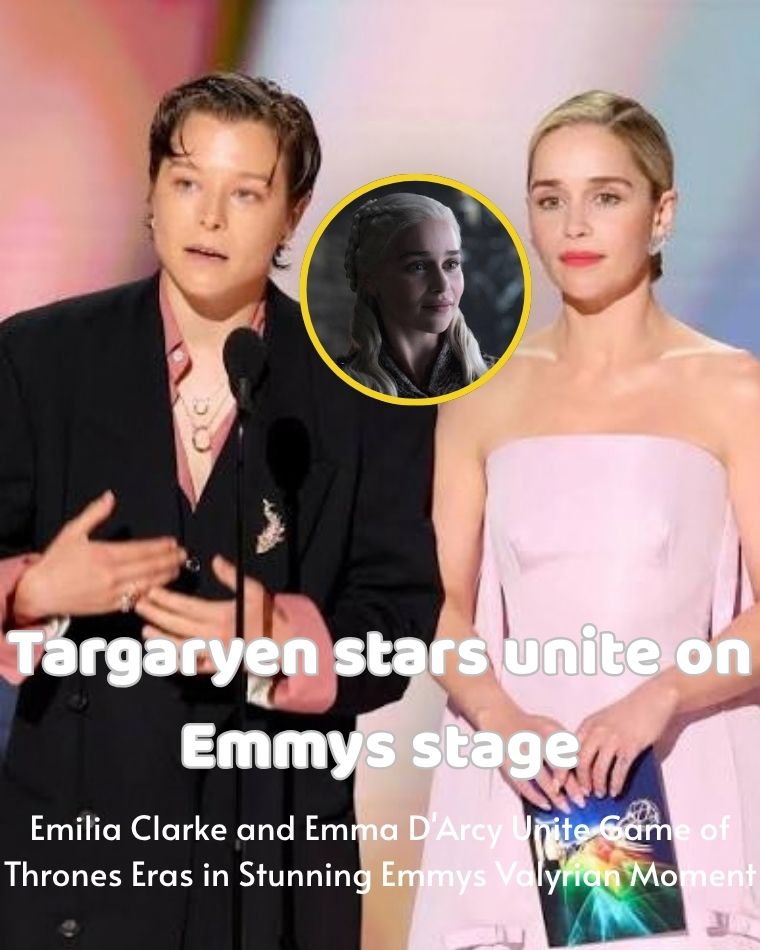
Television history witnessed an unprecedented fantasy crossover when Emilia Clarke and Emma D’Arcy took the stage together at the 78th Primetime Emmy Awards in 2026.
Representing two distinct eras of HBO’s sprawling Westeros saga, the two acclaimed actors delighted audiences worldwide by formally conversing in High Valyrian.
The unexpected collaboration celebrated the shared Targaryen dynasty while cementing the enduring cultural footprint of the Game of Thrones franchise.
The 2026 Emmy Awards brought countless memorable triumphs, but few moments generated the electric excitement seen when Clarke and D’Arcy walked out hand in hand.
Their joint appearance was kept completely under wraps by producers until the live broadcast revealed them walking to the center podium.
As the familiar strains of composer Ramin Djawadi’s iconic musical motifs echoed through the theater, attendees immediately understood the significance of the pairing.
Clarke, renowned for her transformative role as Daenerys Targaryen across eight seasons of Game of Thrones, beamed alongside D’Arcy, who commands the screen as Queen Rhaenyra Targaryen in House of the Dragon.
The visual juxtaposition of the two Targaryen leaders instantly ignited cheers across the auditorium.
It represented a convergence of television history that fans had imagined across message boards and social networks for years.
For the first time on a public global stage, the two performers stood shoulder to shoulder to celebrate their shared onscreen heritage.
Industry observers quickly noted that pairing the matriarch of the original saga with the central figure of the prequel series signaled the vast creative continuity of the franchise.
Both actors carried themselves with regal charisma, wearing distinct designer attire that subtly reflected the fiery elegance associated with House Targaryen.
Their entrance set the stage for an exchange that would dominate international entertainment headlines for days following the telecast.
Cre: Wikimedia Commons — Gage Skidmore (CC BY-SA 3.0)
Taking their positions behind the microphones, the pair did not begin with the standard award ceremony banter.
Instead, Clarke took a deep breath, adjusted her gaze toward the crowd, and launched directly into fluid, commanding High Valyrian.
Her delivery carried the exact rhythmic resonance and authoritative cadence that made Daenerys’s speeches legendary among fantasy enthusiasts.
The audience erupted into sustained applause the moment the complex syllables resonated across the sound system.
Beside Clarke, D’Arcy maintained complete composure, nodding in solemn agreement as Clarke addressed the assembly.
According to translations authenticated by fantasy outlets including Winter is Coming and Wiki of Thrones, Clarke’s remarks honored the creative peers in attendance.
Her translated statement read: “It is an honor and a privilege to stand before you all. To the Emmy nominees and winners, the television royalty who sit proudly upon the Iron Throne that is television on this marvelous evening.”
Clarke concluded her High Valyrian oration with the formal phrasing for: “And the Emmy goes to…”
The clever linguistic construction seamlessly wove modern television praise into the archaic syntax of George R. R. Martin’s universe.
Fans watching the broadcast recognized the authentic vocabulary crafted originally by renowned linguist David J. Peterson.
When Clarke finished her poetic address, D’Arcy leaned into the microphone to deliver a dry, deadpan English translation.
With comedic timing that brought down the house, D’Arcy succinctly translated the elaborate paragraph as simply: “Good evening”.
The comedic contrast between Clarke’s grand rhetoric and D’Arcy’s minimalist punchline generated immense laughter from Hollywood’s top creators.
This playful rapport highlighted how naturally both performers could honor their high-fantasy legacy while embracing lighthearted self-awareness.
The immediate reaction across digital platforms shattered engagement benchmarks for the 2026 broadcast.
Within seconds of the broadcast segment, video clips of the High Valyrian interaction spread across TikTok, Instagram, and X.
Hashtags celebrating both Targaryen queens surged into global trending positions within minutes of the telecast airing.
Longtime viewers marveled at Clarke’s ability to recall the precise diction of High Valyrian years after the conclusion of Game of Thrones.
Commentators highlighted the emotional resonance of hearing Clarke speak the mother tongue of Old Valyria once more.
Simultaneously, fans celebrated D’Arcy’s effortless stage presence and deadpan delivery, which have made the actor a fan favorite worldwide.
Entertainment publications published comprehensive scene breakdowns analyzing every syllable uttered during the segment.
Linguists and series historians examined the sentence structure used during the presentation, confirming its adherence to Peterson’s established grammar.
Online language communities, including active learners studying High Valyrian via digital platforms, actively dissected the script.
The television academy’s decision to pair the stars was widely praised as the most memorable presentation bit of the evening.
Many television critics observed that awards telecasts often struggle with scripted presenter segments that can feel forced or awkward.
In contrast, the seamless blend of beloved intellectual property and natural comedic timing resonated across demographics.
The moment served as compelling evidence of the profound connection audiences still maintain with Westeros lore.
Beyond pure entertainment value, the moment highlighted the monumental growth of the Game of Thrones expanded universe.
When Game of Thrones debuted in 2011, few could have anticipated that constructed fantasy languages would enter mainstream pop culture.
Over eight groundbreaking seasons, Emilia Clarke turned Daenerys Targaryen into an indelible television icon.
Her character’s speeches in Astapor, Meereen, and King’s Landing defined modern cinematic fantasy television.
When House of the Dragon premiered in 2022, Emma D’Arcy faced the immense challenge of carrying on the royal Targaryen mantle.
D’Arcy’s nuanced portrayal of Rhaenyra Targaryen captured critical acclaim and solidified the spinoff’s artistic legitimacy.
By sharing the Emmys stage, the two performers visually unified the past and present of HBO’s most prized franchise.
Their presence demonstrated that House of the Dragon is not merely living in the shadow of its predecessor, but expanding its cultural reach.
The presentation honored the chronological lineage established in George R. R. Martin’s companion histories.
In the canon of Westeros, Rhaenyra Targaryen rules centuries prior to the birth of Daenerys Stormborn.
Seeing the two actors together gave visual form to a lineage that spanned hundreds of fictional years.
It provided closure to fans who had long debated how the two monarchs might interact if timeline boundaries dissolved.
The respect exhibited between the two artists affirmed their mutual stewardship of this sprawling narrative world.
📸 [ẢNH: Diễn viên Emilia Clarke tại sự kiện thảm đỏ quốc tế]
Link: https://upload.wikimedia.org/wikipedia/commons/1/1a/Emilia_Clarke_Cannes_2018.jpg
Nguồn: Wikimedia Commons — Georges Biard (CC BY-SA 3.0) / Hình ảnh tư liệu nữ diễn viên Emilia Clarke
The linguistic dimension of the presentation underscored the serious craftsmanship embedded in the franchise.
Constructed languages in television often risk coming across as mere novelty or gimmicky background dressing.
However, linguist David J. Peterson developed High Valyrian into a fully operational language with complex grammatical cases and phonology.
Both Clarke and D’Arcy have spoken extensively in past interviews about the intense vocal training required to perform in the dialect.
Clarke spent months memorizing lengthy monologues during the early seasons of Game of Thrones to ensure naturalistic cadences.
D’Arcy likewise mastered rolling consonants and rhythmic stresses to bring Rhaenyra’s courtly commands to life.
Their joint fluency during a live, unedited awards presentation demonstrated their profound dedication to the craft.
Neither actor stumbled over complex pronunciations despite the pressurized atmosphere of a live broadcast.
The moment resonated as a sincere tribute to the writers, linguists, and crew who built the cinematic world of Westeros.
It proved that fantasy languages can command the same respect on prestigious stages as traditional theatrical dialogue.
Network executives in attendance noted how rare it is for a television universe to command such cross-generational devotion.
The presentation reinforced the continued commercial and cultural viability of forthcoming Westeros spinoff projects.
As Clarke and D’Arcy opened the golden envelope to announce the winner, the auditorium fell into respectful silence.
The brief comedic detour gave way to professional grace as they presented the category trophy to the recipient.
Yet even after the winner departed the stage with their statue, conversation in the press room centered heavily on the Targaryen reunion.
Journalists and industry figures continued to discuss the historic visual impact of the joint presentation.
The broadcast segment illustrated the unique power of long-form television to build persistent mythologies that outlive individual seasons.
Seven years after Game of Thrones aired its finale, its visual and linguistic imagery retains immense global currency.
Meanwhile, House of the Dragon continues to carry that storytelling flame forward with exceptional artistic distinction.
Clarke and D’Arcy proved that the legacy of dragons, royalty, and ancient kingdoms remains unmatched in the landscape of prestige television.
For audiences around the world, witnessing two iconic queens share the stage was an unforgettable celebration of cinematic storytelling.
Để lại một phản hồi