Henry Cavill transformed television fantasy when he stepped onto the screen as Geralt of Rivia in the Netflix series The Witcher on Wikimedia Commons
.
His portrayal fundamentally disrupted standard television tropes by replacing theatrical heroics with calculated restraint and physical authenticity.
The resulting performance set a modern precedent for how franchise protagonists can honor complex source material while commanding global audiences.
A Minimalist Revolution in Modern Fantasy Dialogue
Television fantasy protagonists traditionally command attention through elaborate monologues and grand theatrical declarations.
Henry Cavill deliberately broke away from that convention when approaching Geralt of Rivia.
The actor recognized that Geralt is fundamentally a weary professional who navigates an unforgiving world rather than an orator.
Cavill actively pared down lines across his scripts to craft an intensely internal protagonist.
He recognized that a lethal monster hunter raised in isolation would naturally communicate through brevity.
Silence became Geralt’s most potent communicative tool under Cavill’s interpretation.
Instead of lengthy explanations, Cavill relied on a low, rumbling vocal tone and micro-expressions to convey meaning.
The character’s signature low growl and expressive “hmm” quickly captured the collective cultural imagination.
That quiet syllable communicated impatience, hesitation, skepticism, and dry humor without uttering a single sentence.
It allowed the audience to lean in closer to understand what Geralt was processing underneath his stoic armor.
By withholding dialogue, Cavill transformed every spoken phrase into an event of significant narrative weight.
When Geralt did choose to speak at length, audiences understood that the conversation carried genuine stakes.
This restrained cadence preserved the emotional isolation inherent to witchers while making the character instantly recognizable.
The choice proved that a fantasy leading man could anchor a multi-million-dollar production through minimalist understatement.
Viewers were captivated by what Geralt kept hidden behind his golden eyes rather than what he boasted openly.
The vocal design reflected a deep understanding of pacing and screen charisma.
Cavill avoided modern naturalism, cultivating an austere baritone inspired by both literary descriptions and solitary hunters.
His discipline demonstrated that heroic charisma does not require non-stop dialogue to dominate television screens.
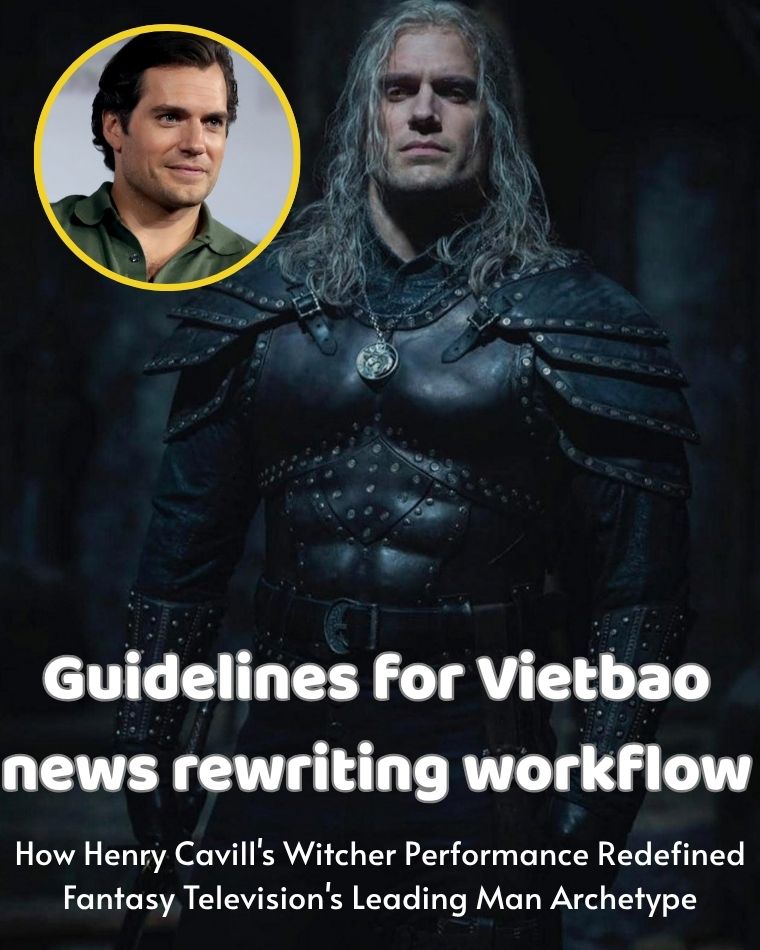
Cre: Wikimedia Commons
Physical Authenticity and Mastery of the Silver Sword
Convincing audiences of Geralt’s lethal prowess required far more than convincing vocal choices.
Henry Cavill committed to an unforgiving physical transformation to embody the genetic enhancements of a witcher.
He built a dense, functional musculature capable of withstanding grueling production schedules and demanding stunt choreography.
Rather than relying entirely on camera tricks or body doubles, Cavill insisted on executing his own combat sequences.
He spent countless hours training under world-class swordmasters to develop genuine fluency with historical and fantasy blade mechanics.
Every slash, parry, reverse grip, and pivot had to reflect a lifetime of ruthless mutant conditioning.
The physical commitment was immediately evident in the character’s kinetic movement and predatory posture.
Cavill moved with a deliberate, grounded weight that made every footstep appear calculated and dangerous.
When drawing either steel or silver, his handling of the weapon appeared second nature rather than rehearsed.
The sheer athleticism required for extended single-take battles set a benchmark for fantasy action.
Audiences witnessed a leading man who could sustain intricate, high-speed sword routines without cutting away to a stunt double.
That continuity between close-up acting and athletic combat anchored the viewer firmly within the fiction.
Interacting with digital creatures also demanded exceptional spatial awareness and raw physicality.
Cavill had to convey the monstrous weight, impact, and recoil of beasts that were added during post-production.
His physical reactions gave weight to invisible claws, sweeping tails, and devastating magical forces.
Even outside of combat, Geralt carried himself like an individual accustomed to sleeping on frozen ground and riding for weeks.
His weathered walk and steady stance projected the harsh realities of survival on the Continent.
Physicality became an extension of character psychology rather than mere spectacle.
This intense personal dedication elevated the standard for leading actors working in prestige fantasy series.
It showed that martial credibility is essential for conveying the authentic peril of a dark fantasy landscape.
Balancing Visceral Action with Deep Philosophical Nuance
The character of Geralt of Rivia is defined by a central contradiction between ruthless lethality and moral sensitivity.
On the surface, Geralt functions as a precision instrument engineered for monster eradication.
Beneath that deadly exterior lies a thinker constantly grappling with destiny, neutrality, and moral consequence.
Henry Cavill captured this dual nature with remarkable nuance and emotional subtlety.
In violent skirmishes, his Geralt was merciless, efficient, and horrifyingly swift.
Yet the moment combat ended, Cavill infused Geralt with a tired, introspective sadness.
Geralt does not revel in bloodshed; he treats it as a grim, unavoidable reality of his vocation.
This philosophical depth allowed the narrative to explore profound ethical dilemmas without losing action momentum.
Cavill portrayed Geralt’s celebrated neutrality not as cold indifference, but as a deliberate defense mechanism.
By claiming witchers lack human emotion, Geralt shields himself from a world that fears and exploits him.
Cavill permitted subtle cracks to show through that hardened facade whenever innocent lives were endangered.
His expressions betrayed quiet heartbreak when forced to choose between the lesser of two evils.
The dynamic between Geralt and his traveling companions highlighted this intellectual complexity.
In his interactions with the bard Jaskier, Cavill played the ultimate straight man, balancing wit with exasperation.
These lighter moments revealed Geralt’s dry sense of humor and begrudging capacity for enduring friendship.
When interacting with powerful mages and royalty, Cavill demonstrated Geralt’s keen political awareness.
Though Geralt claims to avoid politics, he often sees through court intrigues faster than the nobles themselves.
Cavill balanced these cerebral conversations with sudden bursts of terrifying combat capability.
This equilibrium made Geralt feel like a multidimensional, breathing inhabitant of a broken world.
He proved that an action hero can be both brutally capable and emotionally profound.
Passion for Andrzej Sapkowski’s Literary Universe
Long before securing the role on Netflix, Henry Cavill was an outspoken admirer of Andrzej Sapkowski’s literature and video game adaptations.
His deep familiarity with the original texts gave him an uncommon perspective among Hollywood leading men.
Cavill did not treat the role as just another high-profile acting contract.
He saw himself as an active steward responsible for protecting the core themes and character traits established by Sapkowski.
Throughout production, Cavill actively lobbied creative teams for book-accurate character traits and nuanced dialogue.
He understood that Geralt’s literary voice was rich with dark humor, cynical philosophy, and complex existential dread.
Cavill frequently referred directly to the original novels on set to inform his reactions and choices.
He advocated for storylines that retained the moral ambiguity that made the Continent famous.
Longtime readers recognized iconic mannerisms, specific sword grips, and philosophical attitudes drawn straight from the pages.
This authentic passion bridged the delicate divide between devoted book lovers and casual television viewers.
Fans could sense immediately that the leading man understood the nuances of the lore as intimately as they did.
Cavill understood the tragedy of Cintra, the geopolitical friction of Nilfgaard, and the complex rules of witcher mutations.
His encyclopedic knowledge allowed him to ground the sprawling, multi-timeline narrative in emotional truth.
He never treated the fantasy concepts as absurd or disposable genre tropes.
By taking the lore entirely seriously, Cavill elevated the dignity of the entire fantasy production.
Longtime enthusiasts trusted his artistic instincts because his advocacy for literary fidelity was genuine.
His commitment reassured audiences that the adaptations would respect the foundational source material.
This artistic stewardship demonstrated how much an actor’s personal passion can enrich a cinematic adaptation.
Authentic reverence for original literature turns commercial entertainment into enduring popular culture.
Navigating Complex Timelines and Emotional Restraint
The Witcher’s initial season presented a non-linear narrative structure that jumped across decades of Continent history.
Grounding this sprawling temporal structure required an anchor of immense stability and narrative clarity.
Henry Cavill served as the connective tissue holding these fragmented timelines together.
Because witchers age at a vastly reduced rate, Geralt’s physical appearance remains nearly unchanged across decades.
Cavill had to signal the passage of time through shifting demeanor, growing cynicism, and weary body language.
In earlier timelines, his Geralt moved with relative lightness, before decades of isolation hardened his perspective.
As the narrative converged toward destiny, Cavill displayed the growing weight of fate pressing upon the witcher.
Maintaining emotional restraint across these temporal shifts was an immense technical achievement.
Mutants are culturally perceived as emotionless killers, a reputation Geralt frequently uses to his advantage.
Yet Cavill never allowed Geralt to feel robotic, wooden, or emotionally detached from the human experience.
He layered his performance with subtle micro-expressions, lingering gazes, and slight vocal inflections.
Audiences could always perceive the roiling humanity beneath Geralt’s icy white hair and scarred face.
This restraint made moments of genuine emotional connection extraordinarily impactful for viewers.
When Geralt finally accepted his paternal bond with the young princess Cirilla, the emotional payoff was profound.
The protective instinct was earned through hours of accumulated stoicism and quiet vulnerability.
Cavill avoided sentimental indulgence, choosing instead to portray familial loyalty as an unspoken duty.
His ability to communicate affection without shedding his hardened warrior persona defined the dynamic.
Balancing monster hunts with sweeping, epic relationships required tremendous tonal agility.
Cavill shifted effortlessly between fighting grotesque swamp beasts and conveying tragic romantic longing.
His grounded performance preserved the human heart at the center of a chaotic, magic-filled world.
He proved that stoic heroes can convey immense emotional range through disciplined subtlety.
The Enduring Impact on Fantasy Casting and Industry Standards
The global resonance of Henry Cavill’s Geralt permanently altered how major streaming platforms conceptualize fantasy television.
For years, studios often cast leading roles based strictly on star power without considering source material affinity.
Cavill demonstrated that genuine fan fluency and emotional investment are indispensable assets for franchise adaptations.
His total immersion established a new operational paradigm for top-tier television casting.
Streaming networks now recognize that modern genre audiences demand authenticity over superficial Hollywood polish.
Viewers possess instantaneous access to source materials and will quickly reject portrayals that lack artistic reverence.
Cavill raised the bar for physical readiness, demanding that future action leads take ownership of their fight scenes.
His refusal to rely heavily on stunt doubles set an ambitious physical standard across the television industry.
Furthermore, his success disproved the assumption that audiences only respond to loquacious, quipping protagonists.
He proved that adult viewers hunger for brooding, contemplative figures who reflect difficult moral realities.
The Witcher’s explosive worldwide viewership validated the appetite for complex, uncompromising fantasy narratives.
Cavill’s Geralt proved that adult fantasy can be popular without diluting its philosophical core for mass appeal.
Writers and producers now see the commercial value in trusting actors who know the lore inside and out.
Collaborative storytelling between passionate performers and showrunners has become an industry priority.
The character of Geralt of Rivia will forever remain intrinsically tied to Cavill’s artistic choices and physical presence.
His gravelly voice, iconic postures, and silver-haired presence defined the modern image of the White Wolf.
Future interpretations of fantasy heroes will inevitably be measured against the standard of craftsmanship he established.
Cavill demonstrated that fantasy television is at its best when treating its source material with total artistic respect.
His portrayal remains a masterclass in modern heroic acting, leaving an indelible mark on television history.
Để lại một phản hồi