Emilia Clarke is globally celebrated for her commanding performance as Daenerys Targaryen, yet her trajectory toward international recognition was neither sudden nor free from professional disappointment.
Before stepping onto prestigious television sets, the British actress spent years navigating an industry that offered no assurance of steady employment, confronting initial drama-school rejections while supporting herself through multiple conventional day jobs.
Examining her background reveals an inspiring chronicle of disciplined dedication, practical resilience, and artistic perseverance that laid the groundwork for one of the most defining breakthrough moments in modern television history.
Cre: Gage Skidmore / Wikimedia Commons — Creative Commons Attribution-ShareAlike 3.0 Unported
The Formative Years and an Early Awakening to the World of Acting
Emilia Clarke developed an intense passion for dramatic performance long before she ever set foot in professional recording studios or high-profile television soundstages.
Her introduction to theatre began during early childhood, fostered by a household environment that offered direct insight into the collaborative mechanics of behind-the-scenes production work.
Growing up with a father who worked as a sound designer in regional and commercial theatre, Clarke frequently observed rehearsals and technical preparations from behind the curtains.
These early visits to stage venues introduced her to the atmosphere of live performance and ignited a lifelong fascination with acting as a rigorous, serious craft.
Rather than viewing the entertainment industry solely as glamorous spectacle, she witnessed firsthand the long hours, technical precision, and intense focus required to bring dramatic productions to life.
By the time she reached school age, her ambition to pursue acting had crystallized into a definite career goal rather than a casual childhood hobby.
She took every opportunity to participate in student drama productions and community workshops, building a solid foundation in voice, character study, and movement.
Those who worked with her during her school years noted her vocal energy, expressiveness, and genuine enthusiasm for theatrical literature.
She recognized very early that natural curiosity alone would not be sufficient to build a lasting career in the highly competitive performing arts industry.
As a result, she resolved to seek formal, conservatory-level instruction to master classical techniques and expand her range as an interpreter of complex dramatic scripts.
Yet the path from student ambition to institutional acceptance proved immediately challenging, presenting Clarke with her first major reality check in the performing arts.
Confronting the Initial Drama-School Rejection
Applying to elite British drama institutions is widely known as one of the most rigorous audition experiences a young artist can face.
Every year, thousands of hopeful applicants compete for a tiny handful of coveted positions inside prestigious academies, where acceptance rates frequently mirror the lowest percentages in higher education.
When Clarke submitted her initial applications and attended auditions across top-tier UK drama programs, she encountered an outcome shared by many aspiring performers: an outright rejection.
The setback arrived as a difficult emotional test, casting sudden doubt over her immediate future and forcing her to question how best to pursue her artistic ambitions.
In many creative professions, early rejections can easily convince young practitioners to surrender their ambitions and redirect their energy toward safer educational trajectories.
Clarke, however, chose to treat the adverse decision not as a permanent personal disqualification, but as a clear mandate to mature, gain life experience, and refine her perspective.
She understood that conservatory audition panels look for emotional grounding, technical adaptability, and authentic worldly depth that classroom settings alone rarely provide.
Rather than rushing immediately into another set of unassisted auditions, she deliberately altered her plans and took time away from formal schooling.
This intentional pause allowed her to step outside academic insulation and confront the daily realities that shape working adults outside the creative sector.
Accepting rejection with quiet determination helped her build a strong psychological boundary between professional evaluation and personal self-worth.
The Gap Year Experience: Real-World Independence, Waiting Tables, and Travel
Stepping away from academic auditions, Clarke dedicated her gap year to building genuine personal self-reliance and practical autonomy.
To finance her independence and save funds for future pursuits, she took on a traditional service role as a waitress in local hospitality venues.
Waiting tables taught her the rigorous physical demands of customer service, requiring swift adaptation, multi-tasking, emotional composure, and patience under pressure.
Interacting with hundreds of patrons daily allowed her to observe diverse personality types, speech patterns, behavioral mannerisms, and interpersonal conflicts.
Actors often credit service positions with providing valuable observational research, helping them understand authentic human behavior in ordinary environments.
Alongside her service shifts, Clarke carefully saved money to finance travel opportunities, eager to broaden her perspective beyond her familiar domestic borders.
Venturing into unfamiliar regions gave her a renewed sense of independence and taught her how to navigate unexpected challenges with resourcefulness and calm.
Traveling enriched her emotional palette, giving her a more mature understanding of human resilience, cultural variation, and personal vulnerability.
These experiences transformed her from an eager school graduate into a grounded young woman who possessed real-world stories and practical life skills.
When the following application cycle arrived, she approached her audition panels with an entirely different energy, marked by grounded maturity and deliberate focus.
Her second round of conservatory applications yielded the breakthrough she had worked for, securing her admission into one of the country’s most respected acting institutions.
Rigorous Training at Drama Centre London
Entering Drama Centre London placed Clarke inside an intensely demanding educational program known throughout the industry for producing disciplined and uncompromising talent.
Nicknamed “Trauma Centre” by generations of students due to its rigorous curriculum, the school adhered to rigorous Stanislavski-derived techniques and movement methodologies.
The conservatory curriculum demanded complete commitment, pushing students through exhaustive vocal exercises, physical theatre routines, and text analysis from morning until evening.
Students were expected to dismantle their performance mannerisms, confront subconscious defensive habits, and rebuild characters using profound psychological honesty.
During her time at Drama Centre London, Clarke threw herself into classical texts, exploring the works of William Shakespeare, Anton Chekhov, and modern European dramatists.
Her training required her to transition smoothly between heightened poetic language and subtle, naturalistic scene studies.
The school’s atmosphere left little room for vanity or entitlement, constantly emphasizing that acting is an unsparing craft requiring relentless daily discipline.
Faculty members evaluated students on their ability to stay truthful under intense scene pressure rather than relying on surface charm or effortless charisma.
Clarke absorbed these stringent standards, refining the vocal clarity, stillness, and emotional availability that would later define her best-known screen work.
She also learned to embrace constructive critique, treating detailed notes and tough feedback as indispensable components of artistic progress.
By the time she graduated in 2009, she possessed the comprehensive technical toolkit necessary to step into professional rehearsal rooms and casting sessions.
The Post-Graduation Reality: Balancing Aspiration with Unforgiving Survival Jobs
Graduating from a top conservatory confers artistic credentials, but it guarantees neither financial security nor steady casting opportunities in the commercial marketplace.
Upon entering London’s working theatre and television circuit, Clarke discovered that auditions were scarce, sporadic, and heavily contested by hundreds of qualified actors.
To cover basic living expenses, maintain independent housing, and travel to audition appointments on short notice, she took on a patchwork of ordinary jobs.
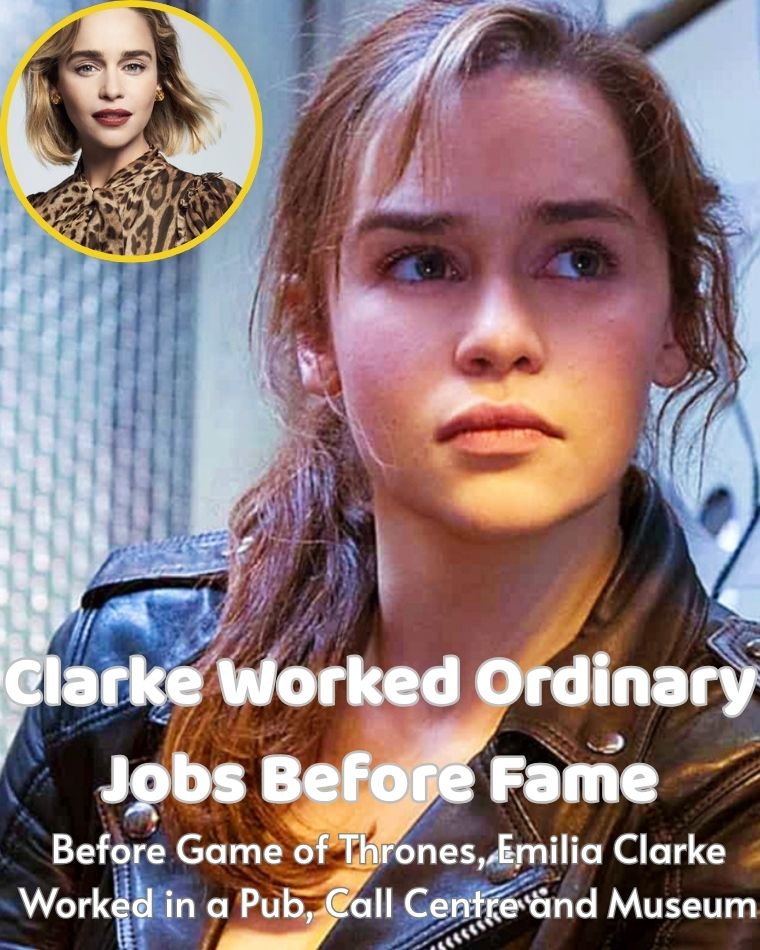
She took shifts behind the bar in a pub, working late hours, pulling pints, managing rowdy patrons, and cleaning venues long after closing time.
Working in a bustling pub required high physical endurance and quick wit, testing her stamina after exhausting daytime auditions and agency meetings.
In addition to her pub shifts, Clarke secured employment at a commercial call centre, spending full days fielding telephone calls and addressing customer requests.
Call-centre work is notoriously repetitive and mentally draining, requiring workers to follow strict conversational scripts while maintaining polite patience across demanding calls.
She also worked in a museum, serving in roles that demanded quiet attentiveness, visitor support, and careful adherence to institutional protocols.
Juggling three entirely different daytime positions while keeping an agent informed and preparing for prospective casting calls was an exercise in intense time management.
She carried audition scripts in her work bags, memorizing lines on public transport or reviewing sides during brief tea breaks in staff rooms.
There were many weeks when commercial auditions failed to materialize, leaving her wondering whether her years of conservatory training would translate into sustained screen roles.
Yet she avoided becoming bitter about the mundane nature of her day jobs, treating them as pragmatic steps necessary to keep her primary creative dream alive.
She never fabricated dramatic claims of extraordinary hardship, speaking instead in later interviews about the quiet, familiar reality shared by thousands of aspiring London creatives.
Early Television Footsteps: Small Appearances in Doctors and Triassic Attack
Despite the overwhelming dominance of her survival jobs, Clarke remained active in seeking on-camera experience, eager to learn how professional film crews operated.
Her first notable television credit came when she landed a guest role in an episode of the long-running BBC One daytime drama series Doctors.
Appearing on the BBC production served as an invaluable professional milestone, introducing her to the rapid pace of daily television manufacturing.
Daytime television operates on exceptionally tight production schedules, where actors must deliver complete emotional scenes in one or two takes with minimal rehearsal.
Clarke stepped onto the Doctors set with focused professionalism, demonstrating that she could take direction instantly and integrate seamlessly with regular cast members.
The brief role confirmed to casting directors that she possessed good set etiquette, photographic composure, and an ability to work calmly under time constraints.
Following her appearance on the BBC serial, she secured a featured role in the Syfy television movie Triassic Attack.
Directed by Colin Teague, the fantasy-action feature was an unpretentious genre film about resurrected dinosaur skeletons terrorizing a small community.
Playing the daughter of the central characters required Clarke to react convincingly to visual effects, interact with physical stand-ins, and deliver dramatic stakes inside an over-the-top scenario.
Although Triassic Attack was far from an intellectual prestige drama, it gave her sustained exposure to major production equipment, stunt coordination, and multi-camera blocking.
Working on the film also provided her with substantial showreel footage that demonstrated her ability to anchor large-scale genre narratives with natural sincerity.
Importantly, completing the television project showed prospective agents and casting agencies that she was fully prepared for substantial filming schedules.
Nevertheless, once production wrapped on Triassic Attack, steady offers did not immediately follow, and Clarke returned to London to face the uncertain cycle of auditions and part-time shifts once again.
She set personal deadlines for herself, deciding how long she could reasonably continue balancing multiple low-wage positions before needing to reassess her career options.
It was during this period of professional plateau that a sudden casting notice arrived from the United States, creating an opening that would irrevocably alter her future.
The Pivotal Turning Point: Auditioning for Game of Thrones
In 2010, the premium American cable network HBO was preparing to launch Game of Thrones, a high-budget fantasy series adapted from George R. R. Martin’s bestselling novels.
The production team had already filmed an initial pilot episode, but key creative revisions led to the decision to recast the pivotal role of Daenerys Targaryen.
The character was extraordinarily complex: an exiled young noblewoman who begins the story in severe subjugation before transforming into a formidable leader of armies.
Casting directors Nina Gold and Robert Sterne were tasked with finding an actress who could portray intense inner innocence alongside emerging, unyielding ferocity.
When Clarke’s agent secured her an audition for the recast role, the young actress knew that opportunities of this magnitude were extraordinarily rare.
She had very little time to prepare, quickly reading character descriptions and absorbing the mythical background of the narrative before entering the audition room.
During the initial reading, the directors were immediately impressed by Clarke’s expressive emotional control, vocal presence, and balanced vulnerability.
She was summoned to Los Angeles to perform a final screen test inside HBO’s corporate offices before executive producers David Benioff and D. B. Weiss.
The audition room in California was quiet, high-stakes, and filled with network executives evaluating whether an untested young actress could carry a multi-million-dollar production.
Clarke delivered the dramatic dialogue with emotional depth, showing the exact steeliness and regal sorrow required for the dragon queen’s journey.
When asked by the producers if there was anything else she could do, she famously broke the tension by offering an impromptu rendition of the robot dance.
Her spontaneous charm, coupled with her dramatic command, confirmed to the executives that she possessed the versatility, warmth, and resilience needed for a grueling multi-year shoot.
Shortly after returning to London, she received the life-altering phone call confirming that she had officially been cast as Daenerys Targaryen.
Overnight Global Stardom and the Weight of Cultural Impact
When Game of Thrones premiered in April 2011, it captured global critical attention and swiftly grew into an unprecedented worldwide cultural phenomenon.
Clarke’s portrayal of Daenerys Targaryen became an immediate visual and narrative anchor of the series, earning her praise from international critics and audiences alike.
Viewers who followed her journey on screen saw a character evolve across eight seasons, moving from quiet vulnerability to sweeping geopolitical dominance.
Behind the scenes, the role demanded monumental emotional discipline, international filming across extreme climates, and lengthy scenes delivered in fictional languages like Dothraki and High Valyrian.
Her work on the HBO fantasy epic earned her multiple Primetime Emmy Award nominations and elevated her into one of the most recognizable screen actresses of her generation.
For the general public, her transition from obscure British newcomer to global pop-culture icon appeared almost instantaneous.
Yet Clarke frequently used retrospective interviews to correct that misperception, reminding journalists that her visible success rested entirely on years of unglamorous preparation.
Without the discipline acquired during her drama-school rejections, the practical resilience learned while waiting tables, and the technical rigor taught at Drama Centre London, she could not have sustained the pressure of leading a massive global production.
The grounded perspective she cultivated during her years working in pubs and call centres helped protect her from the disorienting effects of rapid commercial celebrity.
Colleagues on the Game of Thrones set repeatedly praised her egalitarian attitude, noting that she treated crew members and supporting artists with the exact same respect she showed executive producers.
Having worked ordinary day jobs in customer service, she understood the exhausting physical effort required by the technical crew behind the cameras.
Her background kept her focused on the craft of storytelling rather than the superficial trappings of Hollywood celebrity culture.
Enduring Lessons from a Conventional and Resilient Journey
Looking back at Emilia Clarke’s early career provides a sobering and inspiring corrective to the widespread myth of effortless Hollywood discovery.
The entertainment industry often celebrates fairy-tale narratives, making it seem as though prominent actors simply stepped into iconic roles through pure fortune.
Clarke’s actual trajectory underscores that artistic achievement is almost always preceded by unheralded work, quiet persistence, and mundane daily responsibilities.
Her willingness to take gap-year service jobs, accept early rejections, and work in museums and call centres while awaiting auditions demonstrates emotional maturity.
She never viewed ordinary work as beneath her dignity, recognizing that professional performers must sustain their physical independence while honoring their creative calling.
Her training at Drama Centre London provided the unyielding technical core that allowed her to deliver complex dramatic performances under intense international scrutiny.
Furthermore, her initial appearances in minor productions like Doctors and Triassic Attack highlight the value of treating every single assignment as a crucial learning experience.
She did not wait for a masterpiece before giving full commitment to the camera, using every modest credit to sharpen her instincts and build operational confidence.
When the monumental audition for Game of Thrones finally presented itself, she was not an inexperienced novice hoping for a break, but a fully prepared artist ready to seize the moment.
Her professional journey reminds aspiring creators that setbacks and routine day jobs are not embarrassing detours, but foundational experiences that build character and artistic endurance.
By preserving her humility, cultivating disciplined technical habits, and persisting through years of silence, Clarke earned her position as one of the most compelling dramatic talents of our era.
Để lại một phản hồi