Daniel Radcliffe surprised television audiences when he stepped into the animated realm of The Simpsons to lend his voice to a charming young vampire.
The special 2010 Halloween broadcast featured the British star as Edmund in an affectionate parody of the worldwide Twilight phenomenon.
By joining the veteran animated comedy, Radcliffe bridged two iconic pop-culture universes with self-aware comedic flair.
The appearance marked a memorable career pivot for an actor who was universally recognized for portraying the boy wizard Harry Potter.
The episode arrived at a historic high point for modern fantasy fiction on the silver screen and in literature.
Audiences had watched Radcliffe grow up in front of cameras across eight monumental feature films.
At the very same time, cinemas around the globe were dominated by the brooding romantic saga of vampires and werewolves.
Stepping into Springfield gave Radcliffe an ideal creative venue to lampoon the very tropes that defined blockbuster fantasy without undermining his signature work.
The role of Edmund was far from a simple generic cameo.
Instead, the character was meticulously designed to mirror the intense brooding tropes of romantic teen vampire fiction.
The Halloween special offered viewers a rare fusion of classic American animation and British dramatic performance.
Radcliffe’s willingness to embrace animated voice acting proved that his artistic ambitions extended well beyond live-action drama.
The broadcast remains one of the most celebrated contemporary entries in the long-running anthology series.
The 2010 Broadcast of Treehouse of Horror XXI
Every autumn, television fans eagerly anticipate the seasonal tradition of The Simpsons presenting its Halloween-themed anthology.
The annual special provides the writers with complete creative freedom outside the boundaries of normal series continuity.
Characters can die gruesome deaths, transform into bizarre creatures, or navigate otherworldly dimensions without affecting subsequent storylines.
In 2010, the production team unveiled the twenty-first installment of this enduring franchise, officially titled Treehouse of Horror XXI.
The episode was broadcast across the United States on the Fox network in early November 2010.
The special followed the long-established three-segment format that had defined the anthology since its debut in 1990.
Each distinct vignette tackled a different theme or cinematic parody.
Among the three stories produced for the episode, the final segment captured the largest wave of mainstream pop-culture buzz.
Titled “Tweenlight”, the segment aimed its satirical lens directly at the adolescent vampire romance craze.
The television landscape was flooded with paranormal teen melodramas at the time.
Series showrunners recognized that viewers were eager for an intelligent, comedic subversion of the genre.
Guest stars had always served as a major pillar of prestige for The Simpsons.
The producers needed an actor whose participation would create instant thematic resonance.
Radcliffe agreed to take on the voice role of the mysterious newcomer.
His casting guaranteed that audiences would tune in to witness how the wizarding icon would handle a fanged romance.
The broadcast quickly established itself as a standout event of the television season.
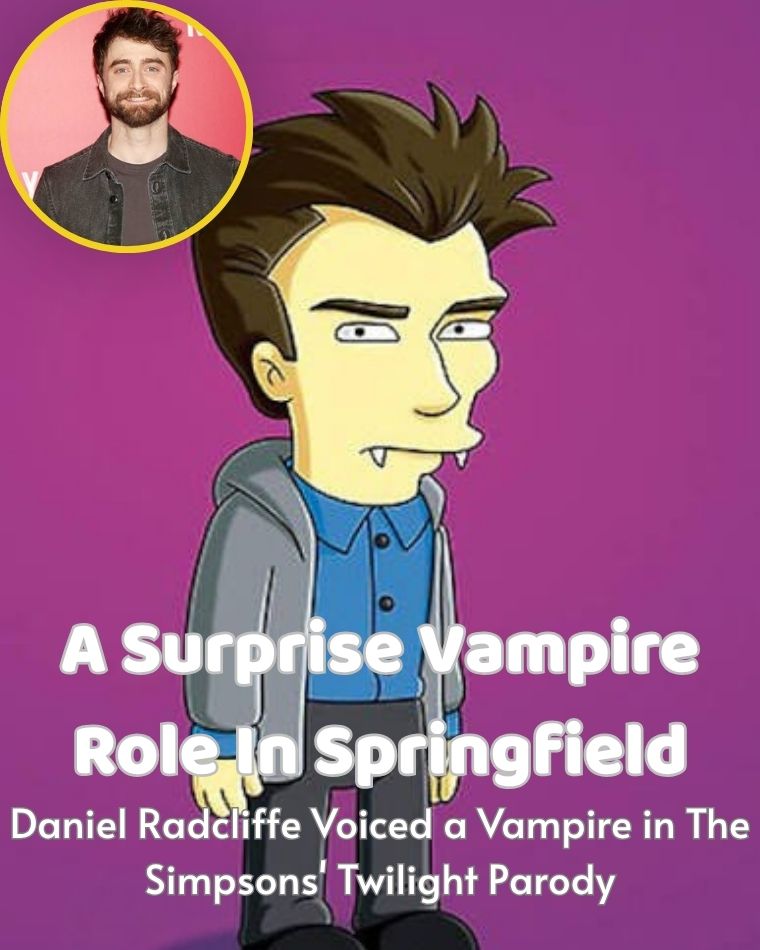
Cre: Wikimedia Commons — Bản quyền Matt Groening / Fox (Public domain / Trademark)
Introducing Edmund: The Brooding Vampire Boy
The narrative of “Tweenlight” kicks off with the arrival of a striking new pupil at Springfield Elementary School.
His name is Edmund, and he immediately disrupts the mundane routines of the local children.
Sporting dark hair, an aristocratic demeanor, and pale skin, Edmund possesses an undeniable aura of mystery.
While most of the student body is intimidated or perplexed by him, Lisa Simpson is instantly enchanted.
Edmund does not act like the rowdy elementary school boys Lisa typically encounters.
He speaks with a dignified, articulate voice that signals centuries of concealed experience.
A sudden accident in the school bus loading zone reveals Edmund’s superhuman reflexes and power.
He steps in front of danger and halts a runaway vehicle with a single hand to protect Lisa.
The dramatic rescue initiates an intense emotional bond between the two characters.
Lisa begins to suspect that her chivalrous protector is hiding a major personal secret.
Edmund eventually leads Lisa away into the Springfield forest canopy to disclose the truth about his heritage.
He confesses that while he appears to be an eight-year-old schoolboy, he is actually a four-hundred-year-old vampire.
Rather than reacting in sheer terror, Lisa is completely swept away by the gothic romance of the situation.
Edmund struggles internally with his predatory nature and his affection for the intelligent young girl.
The character of Edmund encapsulates every classic trope of paranormal adolescent fiction.
He is ancient yet youthful, dangerous yet deeply protective.
Radcliffe’s vocal performance breathed genuine emotional gravity into the comedic dialogue.
His measured pacing made the young vampire seem earnestly poetic even while reciting absurd lines.
The contrast between the grave romantic seriousness and typical Springfield absurdity provided the episode’s greatest laughs.
Deconstructing the Twilight Phenomenon Through Satire
The core appeal of “Tweenlight” lies in its pointed deconstruction of the Twilight books and films.
During the late 2000s and early 2010s, Stephenie Meyer’s bestselling series had captured millions of dedicated followers.
The franchise centered on the brooding high-school romance between Edward Cullen and Bella Swan.
Cinematic adaptations generated massive box-office receipts and dominated mainstream media headlines worldwide.
With immense cultural ubiquity came widespread opportunities for parody.
The Simpsons approached the material by exaggerating the melodramatic gravity that defined the vampire saga.
The character Edmund was an unsubtle, brilliantly crafted surrogate for Edward Cullen.
His sudden rescue of Lisa in the school driveway mirrored the famous parking lot van sequence from the original Twilight film.
In true Springfield fashion, the show took the gag to ridiculous extremes by having Edmund stop a continuous parade of oncoming vehicles.
Even the shadowy forest landscapes directly aped the Pacific Northwest aesthetic popularized by the film adaptations.
The script examined the awkward logistical realities of a romance between a mortal child and an ancient bloodsucker.
When Edmund brings Lisa home to meet his family, the story introduces classic gothic horror royalty.
Edmund’s father is depicted as Count Dracula himself, representing the traditional, dignified era of vampire folklore.
The contrast between Dracula’s theatrical old-school villainy and Edmund’s modern teen angst fueled relentless humor.
Generational clashes erupt over family values, modern dietary choices, and teenage rebellion.
The segment even poked fun at the passionate fandom divisions that characterized the era, including cheeky nods to romantic rivals like Milhouse.
The satirical writing exposed how inherently bizarre teen vampire tropes become when placed under common-sense scrutiny.
Yet the parody remained good-natured throughout its entire running time.
The creative staff did not display contempt for the vampire genre; instead, they reveled in its atmospheric flourishes.
Daniel Radcliffe’s Transformative Voice Performance
Stepping into the recording booth for an iconic animated program requires a distinct skill set from live-action cinema.
Actors must convey emotional nuance, comedic timing, and physical presence purely through their vocal cords.
Radcliffe had spent his adolescence working on massive movie sets where physical presence and visual expression carried immense weight.
Voicing Edmund offered him an opportunity to demonstrate the technical versatility of his voice.
Rather than attempting to mask his distinctive British inflection, Radcliffe leaned into an articulate, aristocratic cadence.
His vocal texture gave Edmund an air of melancholy that felt authentic to classic gothic literature.
The performance stood out because Radcliffe played the role with total sincerity.
Comedic voice acting frequently falters when a performer attempts to sound deliberately humorous or detached.
Radcliffe understood that the comedy functioned best if Edmund took his tragic immortality entirely seriously.
Every declaration of eternal devotion to Lisa was delivered with genuine theatrical conviction.
When family friction arises with his vampire father, Radcliffe brought dramatic intensity to the absurd family argument.
His delivery turned standard cartoon dialogue into memorable comedic highlights.
Working on The Simpsons also represented a major badge of honor for the young British star.
The animated institution had hosted world leaders, legendary musicians, and cinema luminaries across its two decades on television.
Radcliffe had expressed admiration for classic television comedy throughout his burgeoning career.
Taking on Edmund allowed him to collaborate with legendary voice performers like Dan Castellaneta and Yeardley Smith.
The guest appearance was celebrated by critics as one of the standout vocal turns of season twenty-two.
Reviewers highlighted how comfortably Radcliffe slipped into the rhythmic pacing of the series.
The success of the episode opened the door for Radcliffe to return to Springfield in subsequent seasons for completely different animated parts.
It proved that his comedic timing was just as formidable as his dramatic capability.
Contrasting Two Titans of Fantasy: Harry Potter and Twilight
The cultural context of 2010 made Radcliffe’s guest appearance especially irresistible to entertainment analysts.
At that moment, the global box office was virtually shared between two colossal fantasy juggernauts.
On one side stood the Harry Potter film series, an expansive coming-of-age journey rooted in magic, schooling, and epic mythology.
On the other side stood the Twilight saga, an emotionally charged romance centered on supernatural creatures living hidden among regular humans.
Both properties were based on bestselling book series that turned reading into an international phenomenon.
Both franchises transformed their young casts into immediate global superstars.
Media outlets of the era frequently framed the two franchises as cultural competitors fighting for adolescent devotion.
However, the reality between the creative talents was far more collaborative and friendly than competitive.
The British film industry provided an intimate artistic circle where actors continually crossed paths.
Robert Pattinson, who portrayed Edward Cullen in Twilight, had previously co-starred alongside Radcliffe in Harry Potter and the Goblet of Fire.
Pattinson had portrayed the noble Hogwarts champion Cedric Diggory before rocketing to worldwide fame as the cinematic vampire.
Because of this shared cinematic history, Radcliffe voicing a vampire character carried rich contextual subtext.
Audiences understood that Radcliffe was playfully stepping into the thematic territory that had made his former co-star a heartthrob.
The segment did not exist to demean or attack Twilight as an inferior artistic endeavor.
Instead, it celebrated how thoroughly both franchises had embedded themselves into the social fabric of an entire generation.
Harry Potter had defined fantasy heroism for the 2000s, while Twilight had reshaped gothic romance.
By inviting Radcliffe to voice Edmund, The Simpsons brought these two artistic movements together under one roof.
The episode offered a warm cultural salute to an extraordinary era of fantasy storytelling.
The Narrative Resolution of “Tweenlight”
The storyline of “Tweenlight” progresses toward an inevitable dramatic confrontation between mortal desires and vampire reality.
Edmund and Lisa find themselves fleeing from Springfield to protect their blossoming connection.
They travel to a mysterious gothic location named Dracula-la Land, seeking a sanctuary where they can be together undisturbed.
Lisa expresses a reckless desire to undergo the transformation and become a vampire so she can spend eternity alongside Edmund.
Edmund prepares to bite Lisa’s neck to grant her immortality, but moral hesitation causes him to pause.
He recognizes the heavy spiritual burden of living forever as a creature of the night.
Before the transformation can occur, Homer Simpson arrives on the scene to rescue his daughter.
Homer is accompanied by Edmund’s father, who is determined to keep his son in line.
A chaotic brawl breaks out between the human father and the ancient vampires.
Homer relies on makeshift weapons, brandishing a cross and confronting the vampires directly.
In the ensuing struggle, both Edmund and Count Dracula attempt to bite Homer instead of Lisa.
The act proves to be disastrous for the undead creatures.
Homer’s bloodstream is so thoroughly laden with saturated fats and cholesterol that it proves instantly lethal to the vampires.
The ancient predators perish on the spot due to the horrifying nutritional profile of the average American diet.
The sudden comedic twist resolves the supernatural danger in quintessential Simpsons fashion.
Lisa returns safely home to her suburban reality, having experienced a taste of dangerous dark romance.
Homer does not escape the encounter completely unchanged.
Having received a vampire bite during the brawl, he finds himself transformed into a creature of darkness.
The segment concludes with Homer transforming into a bat, only to discover that his excess weight prevents him from flying effectively.
The visual gag brought the high-stakes melodrama crashing back down into everyday physical slapstick.
It was an ending that honored the classic horror conventions while delivering irreverent laughs.
The Evolution of Radcliffe’s Post-Potter Career
When Treehouse of Horror XXI premiered in late 2010, Radcliffe was preparing to conclude his decade-long tenure as Harry Potter.
The final cinematic installments of the wizarding series were rolling out to global audiences.
Many child actors face severe difficulties transitioning into adult artistic sustainability after wrapping iconic franchises.
Industry observers watched Radcliffe carefully to see whether he would be permanently typecast by his breakout role.
His participation in The Simpsons signaled a conscious strategy to diversify his creative portfolio.
Radcliffe demonstrated that he did not take his superstar status too seriously.
He was eager to engage in self-parody and try unexpected creative experiments.
In the years immediately preceding and following the animated episode, he explored live theater extensively.
He earned critical praise on Broadway and in London’s West End for dramatic stage roles such as Equus.
He subsequently took on independent films, experimental cinema, and eccentric comedy projects.
His guest performance as Edmund showed casting directors that he possessed sharp comedic reflexes.
Voice acting became an ongoing thread in his artistic repertoire.
Rather than running away from his connection to popular fantasy, Radcliffe learned to engage with genre culture on his own terms.
He understood that audiences appreciated his willingness to laugh alongside them.
The transition from young teenage star to respected, fearless character actor was achieved through deliberate, unconventional choices.
The Springfield cameo remains an early, shining example of that artistic philosophy in practice.
Cultural Legacy of “Tweenlight”
Looking back from more than a decade after its original transmission, “Tweenlight” serves as an enchanting time capsule of early-2010s entertainment.
The episode preserves a moment when supernatural romance held an unprecedented grip on global culture.
The Simpsons has always served as a mirror for contemporary society, capturing trends before they fade into history.
By capturing the height of the vampire craze, the show created an enduring comedic document of that cultural chapter.
Fans of the animated series frequently cite the segment as one of the best parodies of the modern era.
The writing managed to blend affectionate homage with razor-sharp satire.
For enthusiasts of Harry Potter, the episode provides a treasured piece of franchise crossover trivia.
Watching Daniel Radcliffe play a fictional character modeled on Robert Pattinson’s signature performance remains an entertaining delight.
It highlights the shared pop-culture landscape of two cinematic phenomena that defined childhood for millions of viewers.
The episode also demonstrated the enduring appeal of the annual Treehouse of Horror tradition.
Even after two decades on the air, the creative team proved capable of tapping into fresh cultural moments.
The guest appearance confirmed that animated comedy could attract top-tier global talent eager to test their comedic range.
Edmund took his place alongside a prestigious roster of memorable guest characters in Springfield lore.
The episode continues to air in seasonal Halloween syndication marathons around the world.
New viewers discover the segment each year, enjoying its rapid jokes and whimsical musical cues.
Ultimately, Radcliffe’s role as Edmund remains a testament to the fun that occurs when great artists step outside their comfort zones.
It showed that an actor known for heroic magical destiny could make audiences laugh as a lovestruck creature of the night.
The performance stands as a charming chapter in the remarkable artistic journey of Daniel Radcliffe.
Để lại một phản hồi