In Drew Goddard’s stylish 2018 mystery thriller Bad Times at the El Royale, Chris Hemsworth stepped away from traditional heroism to deliver an unsettling performance as the manipulative cult figure Billy Lee. The production marked a high-profile reunion between the Australian actor and writer-director Drew Goddard, following their celebrated collaboration on the 2012 horror puzzle The Cabin in the Woods. Through its richly detailed ensemble storytelling and examination of unchecked charm, the film stands as a defining chapter in Hemsworth’s broader artistic evolution.
A Daring Departure From Conventional Screen Heroism
When audiences think of Chris Hemsworth, towering figures of righteous conviction and mythological power usually spring to mind.
Throughout the peak era of modern comic-book blockbusters, Hemsworth cemented global stardom through physical presence, broad humor, and unwavering moral clarity.
Yet the actor has repeatedly sought creative detours that deliberately challenge audience expectations and complicate his clean-cut persona.
His appearance in the 2018 mystery thriller Bad Times at the El Royale represents one of the sharpest pivots in his career.
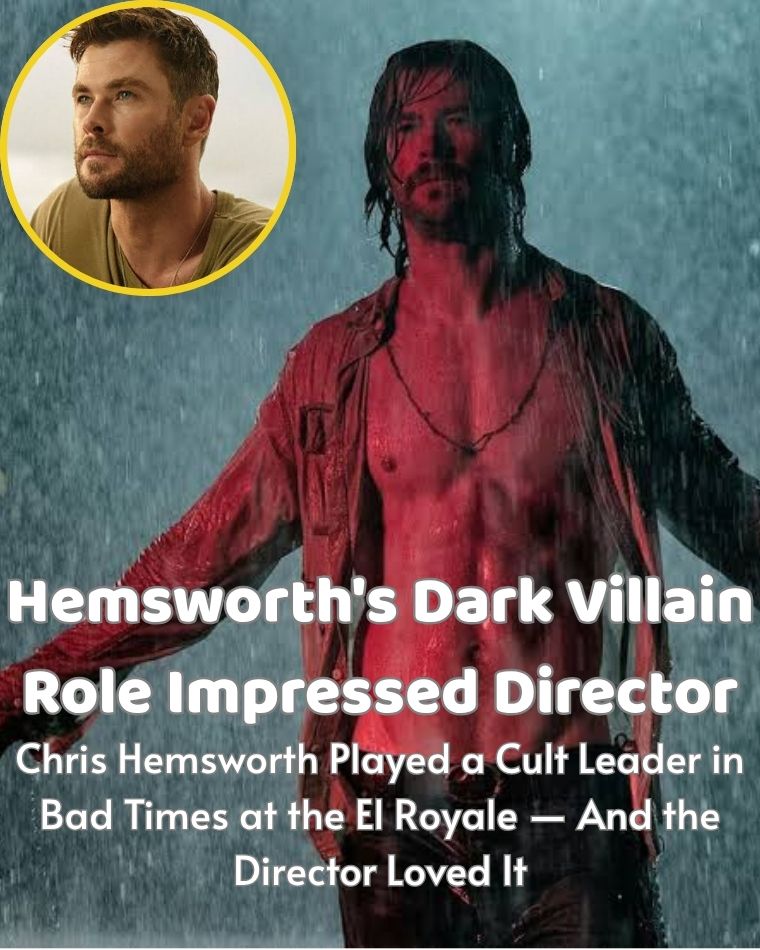
In the film, Hemsworth portrays Billy Lee, a charismatic yet deeply menacing cult leader whose influence ripples across the narrative.
Instead of wielding cosmic weaponry to rescue civilization, Billy Lee uses psychological dominance, seductive rhetoric, and cruelty to bend vulnerable followers to his will.
The project arrived in American cinemas on October 12, 2018, produced by Twentieth Century Fox.
The release introduced mainstream moviegoers to a chilling side of Hemsworth that few had witnessed before.
His performance was not a minor cameo but rather the catalyst that drives the third-act collision of the entire story.
For viewers who only knew him as an infallible champion, Billy Lee served as a startling demonstration of predatory charisma.
The character stands unbuttoned and barefoot, exuding an effortless confidence that immediately commands attention.
Behind that warm smile and hypnotic cadence, however, lies an absolute disregard for human autonomy.
The actor leanly balances physical grace with underlying sadism, making every quiet conversation feel volatile.
Audiences quickly realize that Billy Lee’s easygoing posture is an intentional tactic designed to disarm potential prey.
By stripping away the moral grounding of his superhero iconography, Hemsworth revealed a nuanced capability for psychological menace.
It was an ambitious artistic risk that rewarded fans seeking depth, friction, and genre complexity from the global star.
The role underscored that Hemsworth was eager to test his capabilities within dark, experimental cinematic spaces.
Rather than coasting on formulaic franchise success, he intentionally sought out complex material guided by trusted creative visionaries.
Cre: Gage Skidmore / Wikimedia Commons — Creative Commons Attribution-ShareAlike 3.0 Unported
Reuniting With Director Drew Goddard
The creative bridge that made this transformation possible was filmmaker Drew Goddard.
Goddard wrote and directed Bad Times at the El Royale, assembling an intricate neo-noir vision steeped in period tension.
His working relationship with Hemsworth originated years earlier on another genre-bending cinematic triumph.
In 2012, Goddard made his feature directorial debut with the meta-horror hit The Cabin in the Woods.
Goddard directed that earlier film and co-wrote its inventive screenplay alongside Joss Whedon.
Hemsworth was cast in The Cabin in the Woods as Curt Vaughan, an athletic student caught in an elaborate ritual nightmare.
The filming of that cabin thriller actually took place before Hemsworth became an overnight international icon in Marvel’s cinematic universe.
Working together under tight production constraints forged mutual trust between the director and the rising actor.
Goddard recognized that Hemsworth possessed a rare combination of physical gravitas, comic timing, and intellectual curiosity.
When Goddard finally prepared to step back into the director’s chair for another feature project, Hemsworth was near the very top of his mind.
Bad Times at the El Royale became Goddard’s first directorial follow-up to The Cabin in the Woods.
The gap between the two releases spanned six years, during which both artists had achieved considerable creative maturity.
Goddard had penned acclaimed screenplays such as The Martian, earning an Academy Award nomination for his adapted writing.
Hemsworth, meanwhile, had headlined massive global blockbusters while honing his comedic versatility in titles like Thor: Ragnarok.
Their reunion allowed both collaborators to bypass customary introductory barriers and jump directly into complex character work.
Goddard knew precisely how to position Hemsworth to subvert expectations without undermining the overall tone of the piece.
For Hemsworth, committing to Goddard meant placing himself in the hands of a filmmaker who respected actor ensemble dynamics above star vanity.
The project allowed them to pick up right where they left off, expanding an artistic dialogue that had begun nearly a decade prior.
The Mysterious Setting of the El Royale Hotel
The narrative engine of Bad Times at the El Royale relies heavily on its unique, atmospheric physical setting.
Set in 1969, the story centers around the El Royale hotel, a once-luxurious haven situated directly on the border dividing California and Nevada.
The geography of the establishment plays an active symbolic role throughout the entire film.
A bold dividing line splits the property right down the middle, separating the Golden State from the Silver State.
Guests are greeted by different licensing rules, decor aesthetics, and even pricing depending on which side of the hallway they occupy.
Once frequented by wealthy elites, glamorous celebrities, and high-stakes gamblers, the El Royale has fallen into noticeable decay by 1969.
Its vast lobby feels eerily deserted, manned by a single, overwhelmed young concierge who conceals secrets of his own.
The hotel contains a covert labyrinth of two-way mirrors and hidden corridors designed for surveillance and illicit blackmail.
Over the course of a single fateful night, seven distinct strangers converge upon this decaying retreat.
Each guest arrives carrying profound burdens, hidden motives, and personal pasts they desperately wish to bury.
Outside the hotel walls, a torrential storm cuts off communication, trapping everyone within a claustrophobic pressure cooker.
The period setting of 1969 adds profound thematic weight to the unfolding paranoia.
It was an era characterized by political assassinations, shifting cultural boundaries, the shadow of the Vietnam War, and the grim emergence of charismatic fringe movements.
Drew Goddard built the El Royale not merely as a decorative set, but as a liminal purgatory where morality is tested under extreme circumstances.
The hotel offers these wanderers one final, desperate chance at redemption before inevitable chaos engulfs them all.
Into this volatile environment walks Billy Lee, whose sudden arrival shatters what little uneasy peace the guests have established.
His presence transforms the hotel from an uncomfortable hiding spot into an active hostage arena.
The contrast between the mid-century architecture and Lee’s bohemian cruelty creates vivid cinematic tension.
Every room, neon fixture, and rain-soaked windowpane serves to heighten the dread of that single evening.
Unpacking Billy Lee and Drew Goddard’s Creative Vision
In October 2018, director Drew Goddard offered candid reflections regarding the character of Billy Lee and Hemsworth’s execution during an extensive interview with TheWrap.
The filmmaker revealed that casting the antagonist required an actor who could project intoxicating warmth alongside chilling danger.
“Chris sunk his teeth into that very quickly,” Goddard explained in the interview.
He noted that Hemsworth instinctively grasped the psychological mechanisms that make predatory leaders so successful.
“He understood the darkness that came from the charisma of a character like Billy Lee and how seducing people, and the audience, makes them complicit in the darkness and so with Chris, he very much embodied that,” Goddard told TheWrap.
The director stressed that Billy Lee was conceived to probe deep societal anxieties concerning power dynamics.
“So much of this film is about toxic masculinity and how men use that toxic masculinity to achieve power,” Goddard stated.
He pointed to modern real-world parallels to emphasize why exploring such dynamics remains urgently relevant.
“We see it with cults even today, these cults are still thriving and you see the same characteristics in these cults; they’re all, almost exclusively led by men and a singular man who is very charismatic and very dangerous in his charisma,” the filmmaker elaborated.
Goddard felt that confronting this predatory energy was essential to understanding the plight of other characters in the story.
He specifically emphasized the experiences of the female characters who find themselves cornered and forced to resist systematic manipulation.
“I felt like exploring that darkness was sort of key to the understanding of this film and understanding what the women of this film were going through and what they had to deal with and so it started there,” Goddard recalled.
Hemsworth’s performance fully inhabited this creative brief without tilting into superficial caricature.
He spoke his lines with deliberate softness, avoiding cartoonish villainous growls or frantic histrionics.
Instead, the terror of Billy Lee stems from his casual intimacy and the realization that he genuinely believes his own warped doctrine.
He approaches acts of violence not with enraged fury, but with the cool playfulness of a child playing a parlor game.
That specific interpretation made the character deeply unpredictable and unsettling to watch unfold.
Goddard’s praise underscored the level of technical discipline and insight Hemsworth brought to each scene on set.
The Power of the Ensemble Cast
While Billy Lee acts as a disruptive lightning rod, Bad Times at the El Royale thrives primarily because of its exceptional ensemble cast.
Goddard assembled a diverse group of celebrated performers who bring distinct textures and emotional stakes to the hotel.
Academy Award winner Jeff Bridges stars as Father Daniel Flynn, an aging priest who is far more complex than his collar suggests.
Goddard candidly told TheWrap that securing Bridges for the production fulfilled a long-standing personal dream as a writer and director.
Bridges grounds the movie with weary humanity, providing an empathetic counterweight to the mounting chaos.
Cynthia Erivo portrays Darlene Sweet, a struggling soul singer whose moral spine and soaring voice anchor the movie’s emotional core.
Erivo’s performance drew widespread critical acclaim for its resilience, dignity, and raw vulnerability.
Dakota Johnson takes on the fierce role of Emily Summerspring, an enigmatic woman on a determined rescue mission to extract her younger sister.
Her sister, Ruth Summerspring, is played by Cailee Spaeny, depicting a youth deeply ensnared by Billy Lee’s psychological grip.
Jon Hamm appears as Dwight Broadbeck, an overly talkative traveling vacuum salesman who quickly reveals hidden allegiances.
Lewis Pullman delivers a poignant turn as Miles Miller, the hotel’s traumatized concierge harboring personal guilt and devastating secrets.
Nick Offerman also appears, setting the narrative gears in motion during the film’s gripping prologue.
Managing such an expansive and talented group requires enormous structural discipline from the director and total humility from the performers.
Goddard noted that Hemsworth’s egoless approach served as a vital anchor for the entire production unit.
“[Chris Hemsworth] is such an extraordinary talent and an extraordinary person,” Goddard told TheWrap.
“He really is someone I could mix all the other actors around him he’s so conscious of everyone else, both cast and crew,” the director praised warmly.
Goddard emphasized that Hemsworth elevated those sharing the frame, creating space for co-stars to shine rather than demanding sole attention.
“He’s just — he’s one of the radiant talents of our time… I hope he’s in everything I do for the rest of my life,” Goddard shared.
That mutual generosity fostered an electric atmosphere where every actor delivered career-highlight work across intense dialogue sequences.
Expanding Creative Horizons Beyond the Blockbuster Safe Zone
Hemsworth’s work in Bad Times at the El Royale illustrates a deliberate, long-term approach to his career trajectory.
Achieving global fame through iconic franchise roles can easily lock a performer into a narrow creative corridor.
Studios frequently encourage bankable stars to repeat proven formulas, minimizing financial risk while guaranteeing steady commercial returns.
Hemsworth, however, has consistently demonstrated an appetite for diverse challenges that test his emotional and physical range.
Taking a supporting antagonist role in an original, R-rated, dialogue-heavy thriller signaled genuine commitment to artistic reinvention.
He did not treat Billy Lee as a minor novelty, but threw himself wholeheartedly into the unsettling psychology demanded by Goddard’s writing.
The project allowed him to explore how screen presence can be used to manipulate rather than reassure.
This willingness to step outside comfort zones has paid significant dividends across his broader filmography.
Throughout his career, Hemsworth has swung seamlessly between high-concept action, deadpan comedy, psychological dread, and grounded character studies.
His dynamic partnership with Drew Goddard proves the immense value of director-actor trust in Hollywood.
When filmmakers possess a clear vision and give actors freedom to experiment, familiar screen archetypes can be dismantled in captivating ways.
Bad Times at the El Royale remains a compelling testament to what happens when major talent embraces dark, daring storytelling.
The film holds a special place in contemporary cult cinema, admired for its craft, structural audacity, and bold performances.
As time passes, Hemsworth’s portrayal of Billy Lee continues to stand as persuasive proof of his versatility and range as a serious dramatic actor.
Để lại một phản hồi