Emilia Clarke stepped into the world of Terry Pratchett in the 2022 computer-animated fantasy feature The Amazing Maurice, bringing the clever narrator Malicia to life. Directed by Toby Genkel and Florian Westermann, the film adapts Pratchett’s acclaimed 2001 novel with a star-studded British ensemble cast that includes Hugh Laurie and David Tennant. This extensive cinematic production marked a significant animated outing for the Emmy-nominated actress, translating celebrated literary satire into family-friendly screen storytelling.
The animated feature film The Amazing Maurice arrived in theaters and on streaming platforms across international territories in 2022.
Based on Sir Terry Pratchett’s celebrated 2001 novel The Amazing Maurice and His Educated Rodents, the production represents one of the most prominent animated adaptations of the author’s beloved Discworld literary universe.
The project secured global attention early during its announcement when major international screen stars joined the voice cast.
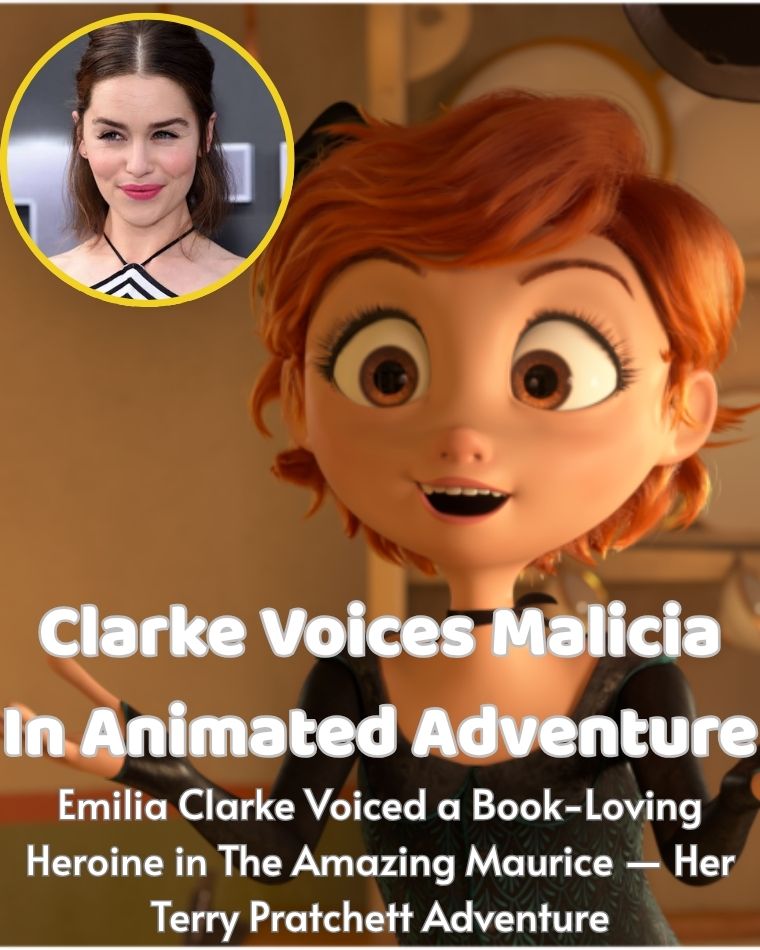
Among the leading ensemble, British actress Emilia Clarke was cast to voice the role of Malicia Grim.
Malicia serves as the central human protagonist, an imaginative mayor’s daughter obsessed with fairy tales and narrative structures.
Her character operates as the spirited heart of the story, frequently breaking narrative boundaries with witty observations.
The movie brings together top-tier European animation talent under the direction of Toby Genkel alongside co-director Florian Westermann.
Renowned American screenwriter Terry Rossio, widely known for his writing credits on Shrek and Aladdin, penned the animated screenplay.
The production transformed Pratchett’s distinct brand of literary deconstruction into a colorful, fast-paced family adventure.
For audiences across the world, Clarke’s vocal performance presented a sharp, engaging heroine capable of driving the film’s multi-layered humor.
Cre: Wikimedia Commons — Gage Skidmore (CC BY-SA 3.0)
The Literary Origins of Terry Pratchett’s Classic Tale
The source material for the film dates back to 2001, when Sir Terry Pratchett published the 28th novel in his expansive Discworld series.
Titled The Amazing Maurice and His Educated Rodents, the book stood out within the franchise as Pratchett’s first novel aimed specifically at a younger readership.
The story was widely recognized for its literary merit, earning Pratchett the prestigious Carnegie Medal in Literature in 2001.
Pratchett cleverly reimagined the traditional German folk tale of the Pied Piper of Hamelin with his signature wit and social commentary.
In Pratchett’s narrative, a streetwise ginger cat named Maurice develops human-level sentience after eating scraps around the magical Unseen University.
Maurice forms a lucrative business partnership with a group of intelligent talking rodents and a gullible human boy named Keith.
Together, the troupe travels from town to town staging elaborate rat infestations.
Keith then plays his pipe to lure the rodents away, allowing the group to collect generous payments from panicked townspeople.
Their lucrative confidence scam proceeds smoothly until they reach the isolated town of Bad Blintz.
Upon arriving, the group discovers that local food supplies are mysteriously vanishing, yet real rats are nowhere to be found.
The mystery forces the deceptive cat and his rodent companions into an unexpected encounter with real malevolence.
Rather than a simple children’s story, Pratchett’s work offered profound reflections on morality, consciousness, and the power of storytelling.
Capturing these complex themes required a faithful yet accessible cinematic approach during the film’s development.
Screenwriter Terry Rossio preserved the self-referential humor that made the original novel a modern classic.
The animated adaptation honors the memory of Pratchett, who passed away in 2015, by maintaining the core philosophical inquiry of the original text.
Emilia Clarke and the Character of Malicia
In the film, Emilia Clarke provides the energetic voice of Malicia, the daughter of Bad Blintz’s town mayor.
Unlike the townsfolk who accept circumstances passively, Malicia is sharp-witted, skeptical, and constantly analytical.
She views life strictly through the conventions of classic fairy tales, carrying books of folklore wherever she goes.
When Keith and the talking rodents arrive in Bad Blintz, Malicia immediately recognizes that they are part of a larger story unfolding.
She appoints herself as the primary detective and narrator of the adventure, guiding Keith through the town’s suspicious underground secrets.
Clarke’s vocal delivery balances youthful theatricality with genuine emotional warmth.
Her performance captures Malicia’s tendency to speak directly to the audience and deconstruct narrative tropes in real time.
For Clarke, the role presented an exciting opportunity to explore full comedic voice acting in a feature-length family film.
The actress achieved worldwide stardom for her dramatic performance as Daenerys Targaryen in HBO’s landmark fantasy series Game of Thrones.
Following her breakthrough television work, Clarke showcased versatility in romantic dramas such as Me Before You and franchise entries including Solo: A Star Wars Story.
Her role as Malicia allowed her to tap into high-energy character acting that resonated strongly with younger viewers.
In recorded promotional materials for the film, the production team noted that Clarke brought vitality and timing to the animated recording booth.
Malicia’s character design features wide, expressive eyes and animated gestures that align seamlessly with Clarke’s enthusiastic line readings.
Rather than playing a stereotypical fairy-tale maiden, Clarke voices a determined heroine who solves problems through intellect and deduction.
Her dynamic with Himesh Patel’s character Keith forms the grounded emotional core of the film’s human storyline.
A Star-Studded Ensemble of Renowned British Actors
Beyond Emilia Clarke, The Amazing Maurice assembled one of the most distinguished vocal casts in recent British animated cinema.
Critically acclaimed actor Hugh Laurie leads the production as the voice of the titular feline, Maurice.
Laurie delivers a performance steeped in dry humor, cynically navigating negotiations while hiding an emerging moral conscience.
His trademark comedic timing, honed over decades in British television and international dramas, suits the self-serving cat perfectly.
Actor Himesh Patel voices Keith, the soft-spoken orphan piper who travels alongside Maurice and the educated rodents.
Patel brings sincerity to the role, balancing Maurice’s scheming nature and Malicia’s overwhelming energy.
The rodents themselves are voiced by a remarkable lineup of prominent performers.
David Tennant lends his distinctive voice to Dangerous Beans, a blind, philosophical albino rat who serves as the moral compass of the rodent clan.
Tennant’s performance highlights the character’s unwavering search for a peaceful utopia where humans and rats can coexist.
Gemma Arterton voices Peaches, a compassionate rodent who acts as the group’s scribe and reads sacred texts to her companions.
Veteran actor David Thewlis voices the sinister character known as the Boss Man, providing an intimidating vocal presence that drives the film’s central conflict.
The cast also features Joe Sugg as Sardines, a tap-dancing rat who provides comic relief throughout their travels.
Rob Brydon portrays the Pied Piper, capturing the theatrical arrogance of the rival exterminator.
Peter Serafinowicz makes a memorable appearance delivering voice work for the iconic figure of Death, a recurring character in Pratchett’s universe.
The collective vocal chemistry elevates the screenplay, giving every talking animal and human eccentric a distinct personality.
Translating Screen Presence into Feature Animation
The transition from live-action performance to the voice-recording booth represents a distinct artistic discipline for actors like Emilia Clarke.
In live-action productions, actors rely extensively on physical movement, facial subtleties, and direct spatial interaction with scene partners.
In contrast, animated voice performance requires an actor to convey complete character depth entirely through vocal modulation.
Pitch, pacing, breath control, and inflection become the sole instruments available to construct a believable character.
For Malicia, Clarke utilized dynamic vocal registers to reflect the character’s rapid-fire thought processes and relentless curiosity.
The voice work had to synchronize smoothly with the complex character animation produced across European studios.
The animation for the film was spearheaded by Ulysses Filmproduktion in Germany and Cantilever Media in the United Kingdom.
Animation director Florian Westermann and character designer Carter Goodrich developed expressive visual styles that complemented the voice tracks.
Goodrich, whose previous design credits include Ratatouille and Despicable Me, crafted visual silhouettes that communicated personality instantly.
The animators listened closely to the recorded vocal tracks of Clarke, Laurie, and Tennant, shaping facial keyframes around their specific cadences.
This collaborative synthesis between vocal artist and digital animator ensured that Malicia’s dialogue felt organic and lively on screen.
Clarke’s performance demonstrated her ability to engage younger audiences without losing the sharp edge of Pratchett’s original satire.
Her portrayal established Malicia as a standout protagonist in modern independent computer animation.
The film successfully navigated the balance between respecting high-profile source literature and providing accessible visual entertainment.
Production Context and International Reception
The Amazing Maurice was developed as an independent co-production spanning multiple European creative hubs.
Financing and production involved Ulysses Filmproduktion, Cantilever Media, Sky Cinema, and Studio Rakete.
The project represented one of the largest independent animated endeavors undertaken in Europe during its production window.
Rather than competing directly with Hollywood studio budgets, the filmmakers prioritized literary fidelity and distinct artistic styling.
Global distribution was secured through major regional partners, with Sky Cinema handling the release across the United Kingdom and Ireland.
The film premiered internationally at various film festivals throughout late 2022 before rolling out widely across theatrical circuits.
Critics commended the adaptation for retaining the intelligence and subversive tone of Terry Pratchett’s writing.
Particular praise was directed at the vocal cast, with reviewers highlighting the witty exchanges between Clarke and Laurie.
The film’s visual design received positive notices for capturing the whimsical yet slightly gothic atmosphere of Bad Blintz.
By maintaining the philosophical questions of the novel, the film avoided the trap of dumbing down classic literature for modern cinema.
The project proved that Pratchett’s expansive bibliography could be successfully translated into feature-length 3D animation.
For the estate of Terry Pratchett, the release served as a shining example of how to introduce new generations to Discworld.
Emilia Clarke’s involvement helped spotlight the animated film in competitive international entertainment markets.
Her vocal turn as Malicia remains a memorable chapter in her post-television career trajectory.
The Amazing Maurice stands as a vibrant tribute to British storytelling, exceptional voice acting, and creative animation collaboration.
Để lại một phản hồi