Anna Kendrick delivered a career-defining performance as Natalie Keener in Jason Reitman’s critically acclaimed drama Up in the Air.
Securing an Academy Award nomination at age twenty-four, she held her ground opposite George Clooney and established a lasting benchmark for supporting turns in contemporary cinema.
Her natural portrayal bridged corporate rigidity and raw vulnerability, demonstrating how independent features can launch major Hollywood careers.
When Jason Reitman released Up in the Air, the film captured a precise cultural and financial moment in modern history.
The narrative examined corporate downsizing, professional detachment, and the human cost of economic displacement.
Central to this examination was Natalie Keener, an ambitious and idealistic corporate efficiency expert played by Anna Kendrick.
At the time of the film’s production and release, Kendrick was only twenty-four years old.
Despite her young age, she stepped onto the set alongside established Hollywood heavyweight George Clooney.
The dynamic between their characters required a delicate balance of intellectual sparring and evolving personal empathy.
Clooney played Ryan Bingham, a veteran corporate downsizer who spends hundreds of days a year traveling between airports.
Kendrick played the newcomer who proposed taking the entire termination process online to cut overhead costs.
From her very first scene, Kendrick demonstrated a commanding screen presence that matched the film’s veteran performers.
She inhabited the role with a blend of sharp corporate discipline and youthful earnestness.
That balance prevented Natalie Keener from becoming a cold caricature of modern management consultancy.
Instead, the performance anchored the film’s ethical and emotional questions.
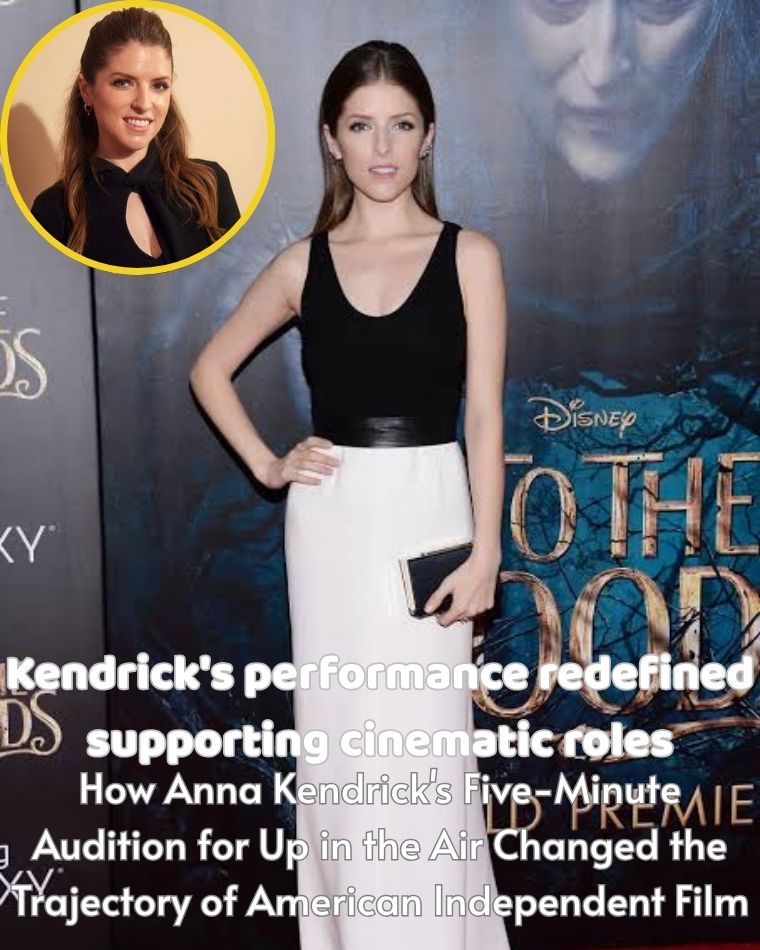
Cre: Wikimedia Commons — CC BY-SA 2.0
The success of Kendrick’s portrayal contributed heavily to the widespread critical acclaim garnered by the feature.
Up in the Air went on to achieve six Academy Award nominations, including a nod for Best Picture.
Among those six nominations was Kendrick’s own citation for Best Supporting Actress.
Receiving an Oscar nomination at twenty-four places an actor in rare company across cinematic history.
What made the achievement particularly noteworthy was Kendrick’s relatively limited screen time compared to traditional leading roles.
She maximized every minute she was granted on screen.
Her performance proved that total screen minutes matter far less than dramatic resonance.
Each sequence featuring Natalie offered essential insight into the film’s broader themes of connection and isolation.
The writing provided a strong foundation, but Kendrick brought nuance that went beyond the script’s lines.
She understood that Natalie was not merely an antagonist pushing an unfeeling technology onto vulnerable employees.
Natalie genuinely believed that digital termination represented an efficient and progressive evolution in corporate operation.
Her idealism was sincere, which made her eventual disillusionment deeply poignant.
Kendrick played that initial certainty with absolute conviction and precise comic timing.
Her banter with Clooney felt effortless, quick, and grounded in professional tension.
She refused to shrink back in scenes where Clooney’s character attempted to dismiss her inexperience.
Instead, Natalie pushed back with modern corporate metrics and confident determination.
This friction created the primary intellectual engine driving the film’s first half.
Audiences observed two distinct philosophies of work and life clashing across nondescript airport terminals and conference rooms.
The brilliance of Kendrick’s approach lay in her ability to reveal the cracks beneath that polished corporate exterior.
Underneath the power suit and the rigid posture was a young woman trying desperately to navigate early adulthood.
She carried the universal anxieties of recent graduates entering demanding professional environments.
That layer of internal vulnerability transformed what could have been a bureaucratic archetype into a deeply human protagonist.
Kendrick avoided melodrama, relying instead on subtle shifts in vocal tone and facial expression.
Her posture gradually softened as her character traveled across the country witnessing genuine human heartbreak.
Each firing session exposed Natalie to the harsh reality of her proposed efficiency model.
Watching real people lose their livelihoods shattered her abstract theories about workflow optimization.
Kendrick conveyed that mounting guilt with quiet restraint rather than theatrical outbursts.
Her eyes registered the weight of every broken worker who sat across their consultation desk.
This gradual shift set the stage for one of the most memorable emotional sequences in recent independent cinema.
While on the road, Natalie receives a sudden text message from her long-term boyfriend ending their relationship.
The sudden shock of personal rejection collides violently with her professional obligations.
What follows is an emotional breakdown that instantly became a masterclass in accessible and honest screen acting.
Kendrick did not play the breakup scene as a conventional Hollywood romantic tragedy.
She played it with messy, unvarnished humiliation and desperate sorrow.
Sitting in a public hotel setting, Natalie allows the protective corporate armor to crumble completely.
She articulates her shattered expectations regarding romance, career milestones, and adulthood.
Her dialogue tumbles out with the breathless rhythm of someone genuinely overwhelmed by grief.
Yet even in the depths of that breakdown, Kendrick maintained the specific personality quirks that defined Natalie.
The scene managed to be simultaneously heartbreaking and gently comedic.
Audiences recognized their own moments of youthful devastation in her tearful admissions.
That balance illustrated a dramatic maturity that far exceeded her chronological age.
Clooney’s character, traditionally detached from emotional entanglement, was forced to step into an unexpected mentoring role.
The scene deepened the bond between the two characters and shifted the entire emotional trajectory of the narrative.
Without Kendrick’s absolute authenticity in that moment, the film’s central relationships would not have resonated as powerfully.
The emotional arc from unyielding professional to heartbroken individual became an industry template for rising actors.
It illustrated how young performers could tackle layered, adult material without sacrificing genuine vulnerability.
Too often, young characters in corporate or adult dramas are written as either precocious geniuses or naive victims.
Kendrick avoided both traps by committing fully to the contradictions of real human behavior.
Natalie was brilliant yet inexperienced, ambitious yet fragile, confident yet lost.
Holding those disparate qualities together requires exceptional craft and emotional intelligence.
Reitman’s direction provided space for Kendrick to explore these dimensions naturally.
The camera stayed close, capturing the subtle micro-expressions that telegraphed her internal conflict.
Even when listening to other characters speak, Kendrick remained fully engaged in character.
Her active listening added immense texture to scenes dominated by Clooney’s monologues or Vera Farmiga’s worldly dialogue.
Supporting acting is fundamentally about enriching the narrative world without derailing the primary plot.
Kendrick understood her role within the larger ensemble and served the story at every turn.
Her performance elevated the scenes around her while giving the central character a crucial sounding board.
The critical community responded enthusiastically to this nuanced achievement.
Reviews highlighted her ability to match Clooney’s legendary charisma beat for beat.
Industry publications quickly singled out her performance as one of the standout supporting turns of the decade.
The film’s performance at the global box office validated that critical enthusiasm.
Up in the Air proved to be both a major commercial victory and an awards powerhouse.
It demonstrated that mid-budget adult dramas could achieve widespread commercial viability when driven by compelling character work.
For Kendrick, the production served as a major professional launchpad that transformed her industry standing.
Prior to the film, she was recognized primarily by theatergoers and fans of youth-oriented franchise cinema.
She had earned a Tony Award nomination at age twelve for her performance in the Broadway musical High Society.
Later, she appeared in supporting roles in popular film franchises that targeted younger demographics.
However, Up in the Air announced her arrival as a formidable dramatic presence capable of handling complex cinema.
The Oscar nomination confirmed that Hollywood’s highest creative institutions recognized her dramatic capability.
It altered the trajectory of her career almost overnight.
Casting directors began viewing her as a performer who could carry major studio projects across diverse genres.
Crucially, the success of her casting affirmed the vitality of independent cinema as an incubator for major talent.
Studio tentpoles and superhero franchises often dominate conversations regarding career breakthroughs.
Yet Kendrick’s ascent proved that intelligent, character-driven independent projects could launch an A-list career just as effectively.
A breakthrough in a film like Up in the Air demands pure acting ability rather than spectacle or digital effects.
An actor cannot rely on computer-generated imagery to create emotional resonance in a quiet drama.
The impact depends entirely on emotional truth, vocal control, and screen presence.
Kendrick delivered on all three fronts, earning the long-term trust of filmmakers and audiences alike.
Following her Oscar nomination, she leveraged that goodwill across an exceptionally wide range of creative material.
She navigated effortlessly between independent art-house titles and massive commercial comedies.
Her musical background combined with her sharp comedic instincts in subsequent blockbuster productions.
Yet even in broad commercial comedies, she retained the authentic vulnerability first showcased under Reitman’s direction.
Her characters remained relatable, grounded, and emotionally accessible to mass audiences.
Looking back at Up in the Air, Natalie Keener represents an indelible snapshot of generational ambition.
The character entered the workforce right as technological innovation began replacing traditional human interaction.
Her proposition to conduct corporate layoffs through computer monitors foreshadowed the remote-work reality of later decades.
In hindsight, the film’s premise feels strikingly prophetic.
Natalie’s early enthusiasm for remote communication reflected the broader tech-optimism of the late 2000s.
Her subsequent horror upon witnessing the real-world fallout anticipated the modern longing for genuine human connection.
Because Kendrick played the role with such grounded authenticity, the film’s social commentary remains potent today.
The character does not feel like an obsolete artifact of 2009 cinema.
Instead, Natalie feels like someone we might encounter in any modern corporate boardroom or startup accelerator.
Her arc continues to instruct viewers on the ethical responsibilities of professional ambition.
When Natalie eventually resigns after realizing the devastating human toll of her program, her choice carries weight.
The departure feels earned because Kendrick carefully charted the psychological toll leading up to that decision.
The final scenes give her character an honorable resolution rooted in self-awareness and renewed purpose.
She moves on, humbled by her journey but wiser in her understanding of human empathy.
Kendrick’s performance ensured that audiences felt that personal growth intimately.
Her depiction established an enduring standard for how supporting roles can anchor the moral core of a story.
In independent filmmaking, supporting characters must often carry thematic weight without consuming excessive screen time.
They must establish distinct identities quickly and advance the narrative efficiently.
Kendrick executed that assignment with masterclass precision.
Every line reading was crisp, purposeful, and brimming with personality.
There were no wasted movements or generic delivery styles in her performance.
She showed that young actors do not need decades of life experience to deliver profound dramatic insight.
What matters is an intuitive understanding of human nature and honest emotional access.
Kendrick possessed both qualities in abundance throughout the production.
Her chemistry with both Clooney and Vera Farmiga enriched the entire ecosystem of the film.
Together, the three actors created a sophisticated triangle of contrasting viewpoints on life, career, and commitment.
Farmiga’s worldly elegance contrasted sharply with Kendrick’s eager naivety.
Meanwhile, Clooney stood between them, forced to reexamine his own solitary existence through their eyes.
Kendrick was the catalyst that disrupted Clooney’s comfortable isolation and demanded accountability.
Without a strong performer in that catalyst role, the entire thematic structure of the film would have collapsed.
Her presence provided the vital spark that forced Ryan Bingham to confront his own loneliness.
The legacy of Kendrick’s Oscar nomination continues to influence discussions around casting in independent cinema.
It demonstrated to producers that casting young, talented theater actors could yield immense artistic dividends.
The performance served as concrete evidence that emotional authenticity resonates far more than conventional celebrity status.
Audiences recognized that Kendrick was delivering genuine emotional truth rather than an engineered movie-star turn.
That authenticity built a lasting reservoir of public goodwill that sustained her career across subsequent decades.
Viewers trusted her choices because she had proven her artistic capability at the highest level of cinema.
Whether performing in an intimate indie drama or a large-scale musical, that foundation of trust remained intact.
Her career trajectory stands as an inspiring case study for emerging performers entering the entertainment industry.
It highlights the enduring value of seeking out intelligent scripts and director-driven character studies.
Rather than chasing superficial fame, Kendrick prioritized material with thematic depth and artistic substance.
That strategic artistic choice paid off with critical respect and commercial longevity.
The famous firing scene in particular continues to be analyzed in film classes and acting workshops worldwide.
Educators use the sequence to demonstrate how to balance comedic vulnerability with tragic personal realization.
It shows how an actor can convey profound grief without losing the comic essence of a scene.
The sequence proves that human beings rarely experience emotions in simple, isolated categories.
In real life, heartbreak and absurdity often occur at the exact same moment.
Kendrick captured that complex human truth with effortless naturalism.
Her delivery felt spontaneous, as if the character were processing her thoughts for the very first time in that moment.
That spontaneity is the ultimate hallmark of great screen acting.
It draws the spectator into the immediate reality of the character’s lived experience.
Even after countless viewings, the scene retains its emotional bite and comedic sparkle.
It stands as a testament to Kendrick’s instinctual grasp of comedic rhythm and dramatic stakes.
Her work in Up in the Air remains a defining milestone in contemporary American independent film.
It helped reshape what audiences and critics expect from young supporting actresses in serious drama.
No longer relegated to simple love interests or decorative foils, young female characters could serve as intellectual equals.
They could drive the moral arguments of the film and challenge legendary male leads directly.
Kendrick proved that such roles could be simultaneously formidable, vulnerable, and deeply engaging.
Her success expanded the possibilities for similar characters in subsequent cinematic releases.
Filmmakers recognized that audiences were hungry for authentic portrayals of young professional women.
Natalie Keener provided a blueprint for how to write and perform those characters with honesty and depth.
The impact of that achievement reverberates through independent cinema to this day.
Ultimately, Anna Kendrick’s turn in Up in the Air transcended typical awards-season recognition.
It cemented her status as a rare talent capable of bridging complex drama and accessible mainstream appeal.
Her performance remains a masterclass in how to extract maximum emotional resonance from limited screen time.
She stood side by side with an international cinema icon and held the screen with total poise and absolute integrity.
In doing so, she crafted a timeless character who captured the anxieties and hopes of an entire generation.
Natalie Keener remains one of the most memorable and influential supporting figures in modern cinematic storytelling.
And for Anna Kendrick, it was the definitive moment that announced a remarkable creative force to the entire world.
Để lại một phản hồi